Advent Calendar of Castles: December 12th: Beaumaris

beuamaris1beuamaris2beaumaris3

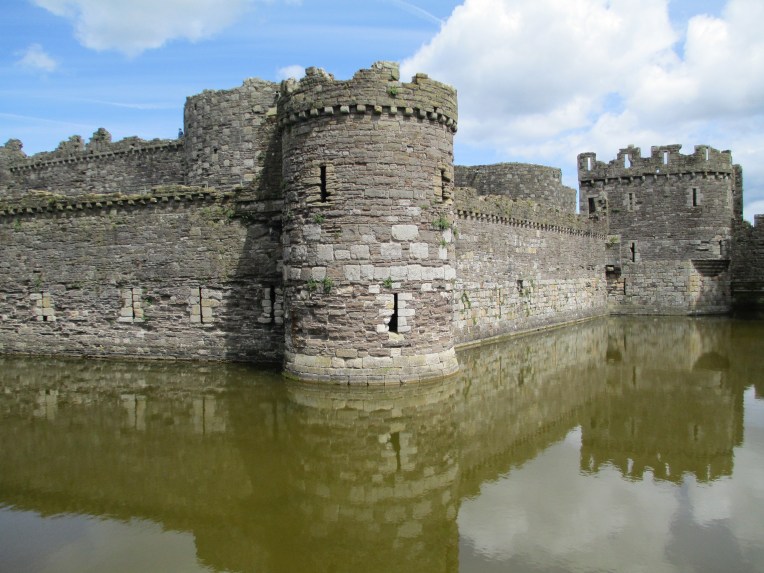
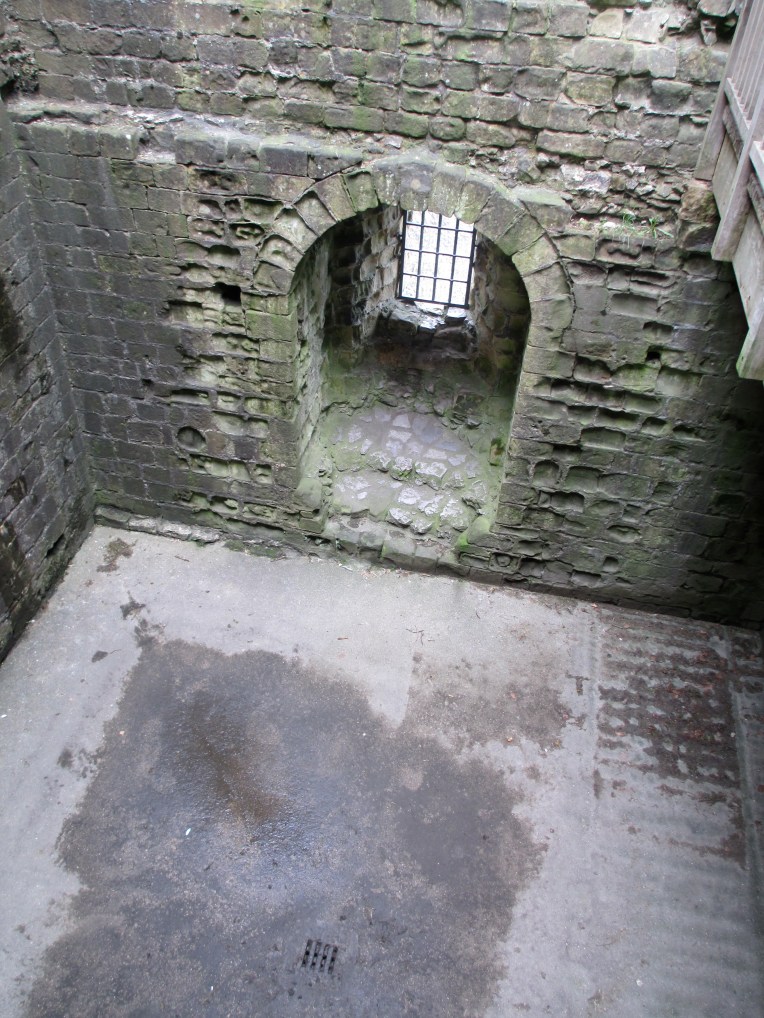
Beaumaris stands on the Island of Anglesea looking across the Menai Straits and it was to control these straits that Edward I had Beaumaris built in c. 1295. It was the last of his ring of castles and was built largely in response to the rebellion of Madog ap Llywelyn. It is the largest and the most sophisticated of Edward I’s castles, probably because there was no existing structure on the site to try and build around or on top of. The native population of the area of Llanfaes was forced to move prior to the construction of the castle. It is a concentric castle with walls within walls and, something that is actually quite unusual in medieval castles, a moat that holds water.  The moat was 18 feet wide and actually had a tidal port at one side that would allow for ships to come right up to the castle for trade. The curtain wall around the moat boasts 16 towers and the massive 3 quarters of an acre of the inner ward is guarded by an interior wall boasting a further 6 towers and 2 gatehouses. This castle was virtually impenetrable before the age of cannon.  Ironically the castle is not complete. The towers were intended to be three stories not two.

Beaumaris has actually seen very little battle. Owain Gwndyr’s supporters held the castle for two years, 1403-1405, while the locals in the unwalled town that had developed around the castle suffered immensely in attempts to take the castle. It also did play a small role in the Civil War in the 17th century being held by royalists, then surrendered, then taken, then surrendered again. After that the castle largely stayed out of any historical events.

It is still an almost unbelievable castle to visit, not the least because it does genuinely have a moat. The town of Beaumaris in also home to the tomb of Joan Princess of Wales, illegitimate daughter of King John and wife of Llywelyn the Great. Her tomb was used as horse trough for a time, but thankfully the sarcophagus survived and can be seen in the Beaumaris parish church. For more on Joan click here.

References:

Site visit 2012

Wales Castles and Historic places: 9781850130307

Castles in wales: 9781847710314

http://www.castlewales.com/beaumar.html

The photos are all mine.

Advent Calendar of Castles: December 11th: Conwy Castle

conwy1conwy3conwy2

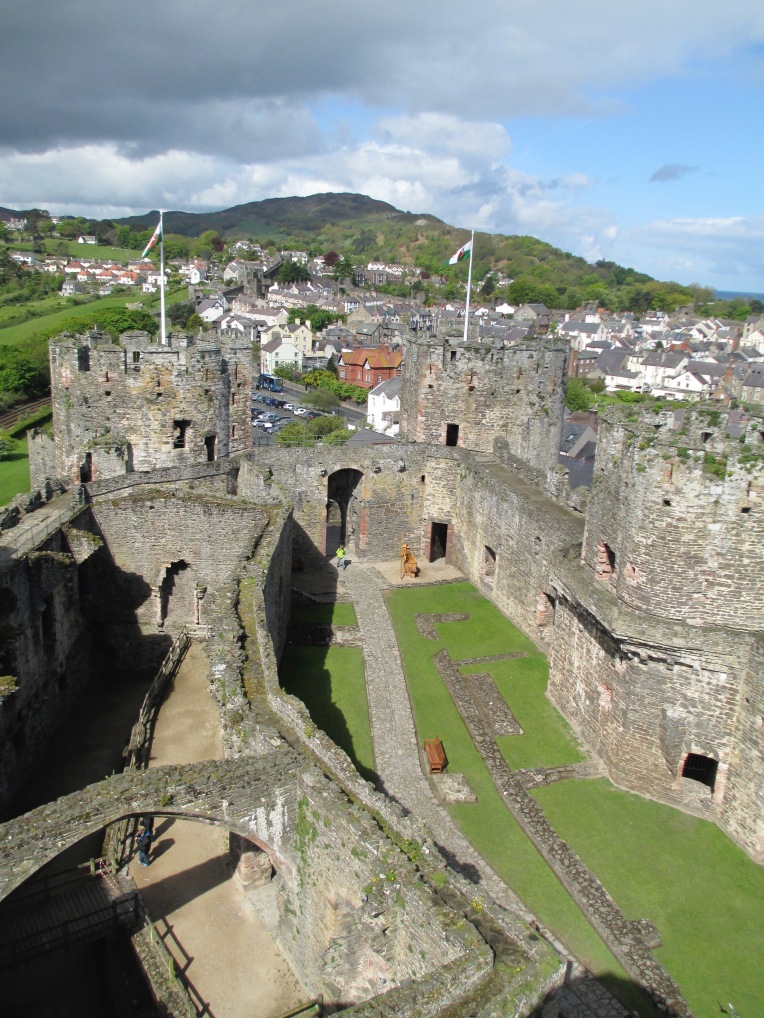
Conwy is the first I’ll be discussing of a series of castles built by Edward I in his domination of Wales. Conwy was built in 1283 and remains one of the most impressive surviving medieval fortifications in Britain.

The ring of castles Edward built around Wales, especially in the north, were constructed both to impose his authority on the area and to ensure that any expensive future rebellions was squashed. Edward used the towns and castles he built to import Englishness. He brought in English settlers and English laws and made the towns havens of the English. It wasn’t until the 1700s that the Welsh really had towns they could call their own, the Welsh at the time didn’t really live in towns because they tended to be a disparate agricultural community.

Edward I  took the Conwy valley in 1283 and very quickly began to erect a garrison town and the castle. By 1287 the castle was largely finished. This castle sits on a rock base which provided enough security that it was not necessary for Edward I to have the walls with in walls that are a feature of many of his other Welsh castles.

Edward lavished more money on Conwy than any of this other welsh castles, spending 15 000 pounds, an extraordinary sum for the time. He built the castle and the wall on the site of Aberconwy Abbey, one of the most important Welsh abbeys and the burial place of probably the most important Welsh Prince, Llywelyn the Great. Llywelyn’s body was moved by the monks and his sarcophagus can now be found at Llanwrst parish church.

Edward I was actually held at Conwy under siege by Madog ap Llywelyn in 1295, but the castle didn’t fall. Conwy was also taken by the forces of Owain Glyndwr in the 1400s.  Glyndwr came very close to taking Wales out of the hands of Henry IV, but in this particular case it was two of his kinsmen who took the castle. Rhys and Gwilym Tudor, yes those Tudors, took the castle through trickery. They waited till the garrison was at prayer and then, some stories say by pretending to be carpenters, snuck in and took the castle in 1401. They held it for months before it was traded back for funds for the rebellion.

References:

Site visit 2012

Wales Castles and Historic places: 9781850130307

Castles in wales: 9781847710314

http://www.walesdirectory.co.uk/his/cas/conwy.htm

http://www.castlewales.com/edwrdcas.html

http://cadw.gov.wales/daysout/conwycastle/?lang=en

http://www.castlewales.com/glyndwr.html

http://www.castlewales.com/conwy.html

The photos are all mine.

Advent Calendar of Castles: December 8th: Middleham Castle

middleham1middleham-2

middleborough2middleham-3

Middleham castle is best known as the home of Richard III. However it is also a fascinating castle in its own right. As so much has been written about Richard III and his tenure there, I’m going to focus on the earlier years of the castle.

The first castle on this site wasn’t actually exactly where the present day castle stands. It would have been a typical motte and bailey Norman castle, built of earth and timber, and would have stood on the high ground just to the south west of where Middleham stands to today. The castle was constructed in c. 1086 and was in the hands of Ribald who was the brother of Aland Lord of Richmond who was probably responsible for the nearby Richmond castle.  The motte is believed to have stood at about 12 meters high and to be been surrounded by a ditch 6 m wide. You can still see the remains of the motte and ditch today (the final photo above).

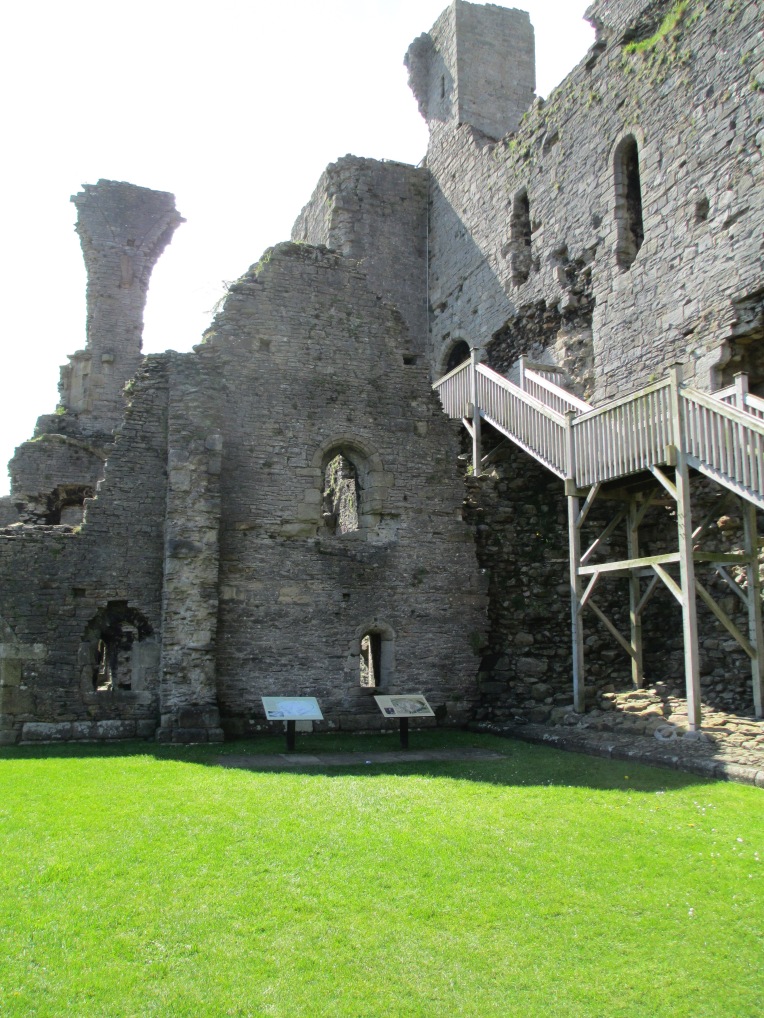
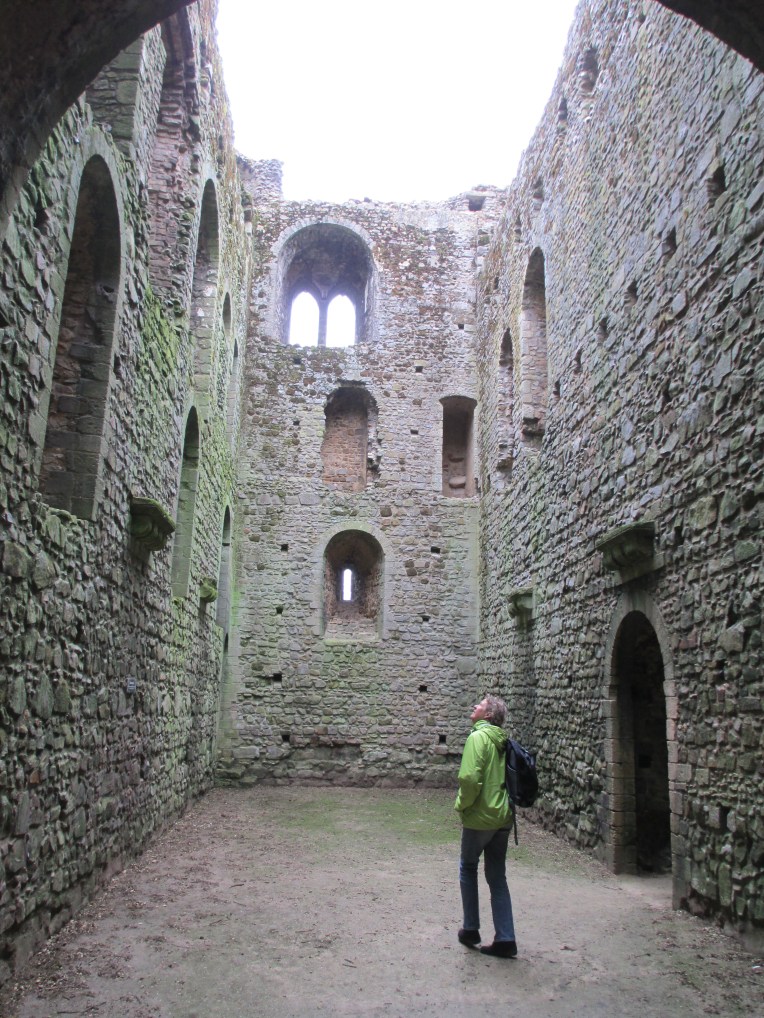
At some point early in the 12th century the original castle was abandoned and the castle you can see today was begun in stone. It is unknown which descendant of Ribald built the stone keep, which is the middle of today’s Middleham, but it probably dates to sometime between 1170 and 1180. This would mean that it was most likely built by his grandson Robert FitzRanulph. The great keep was very modern for its time with a great hall, great chamber, privy chamber, chapel, two small chambers up the top and a large basement, which would have included a kitchen. Middleham’s keep is different to other contemporary keeps as it houses several functions that would have usually been housed in outer buildings in the bailey of the castle.

Middleham passed out of the FitzRanulph family in 1270 when the heiress married Robert Neville. Through Robert Neville Middleham passed ultimately to Richard Neville Earl of Warwick, known as the King maker and a key player in the War of the Roses. The War of the Roses were an intense and complex conlfiict, but this is not the place to explain in detail. After Richard Neville’s death in at the Battle of Barnet in 1471 the castle came to Richard Duke of Gloucester, who became Richard III.

References:

Site visit 2012

English Heritage Middleham Castle Guidebook: 9781850744092

For Richard III and Middleham http://richardiii-ipup.org.uk/riii/44

The photos are all mine

Advent Calendar of Castles: December 5th: Pickering Castle

pickering-1pickering-2pickering-3

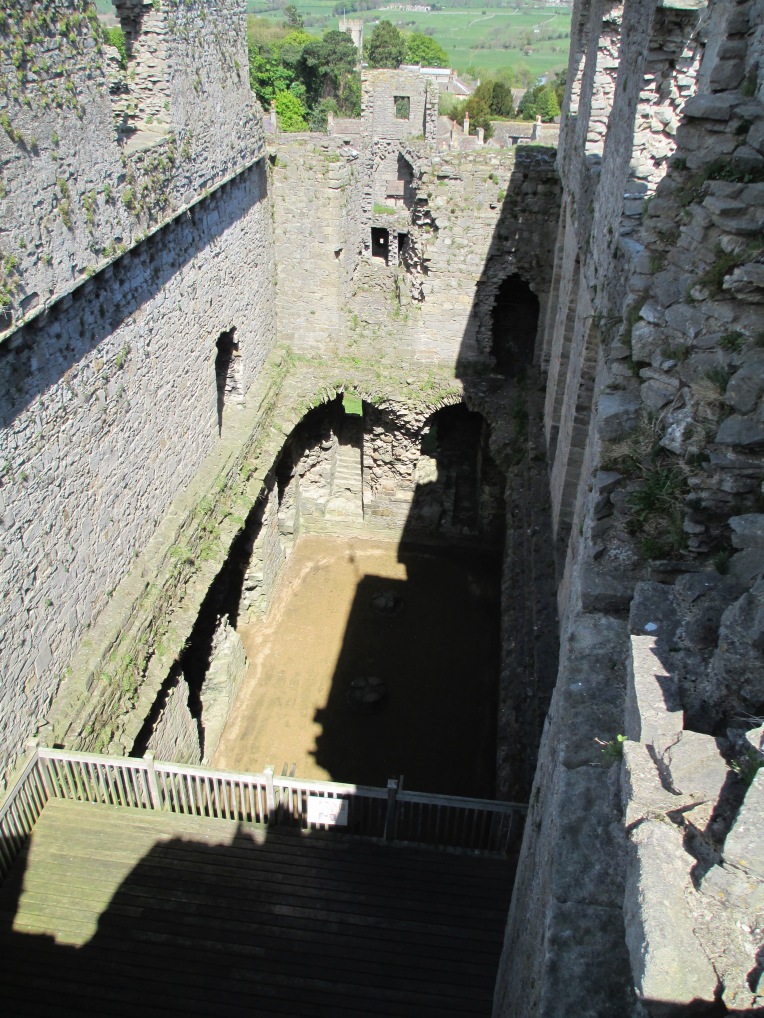
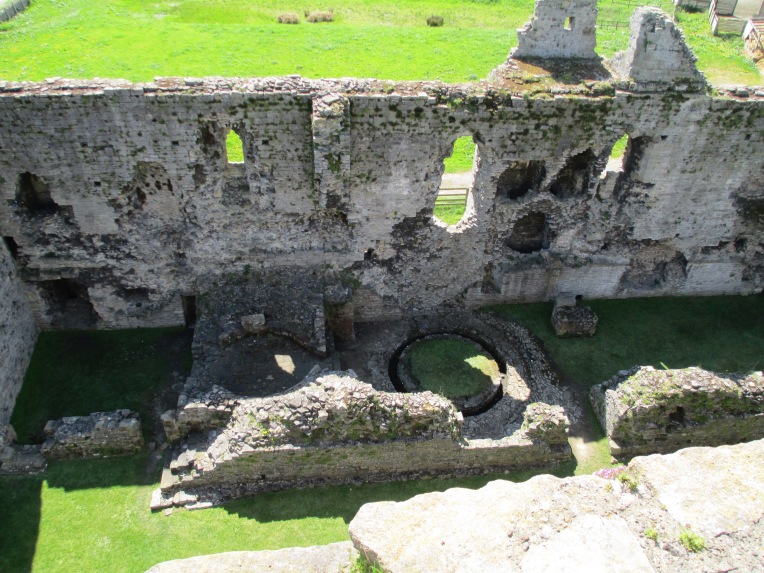
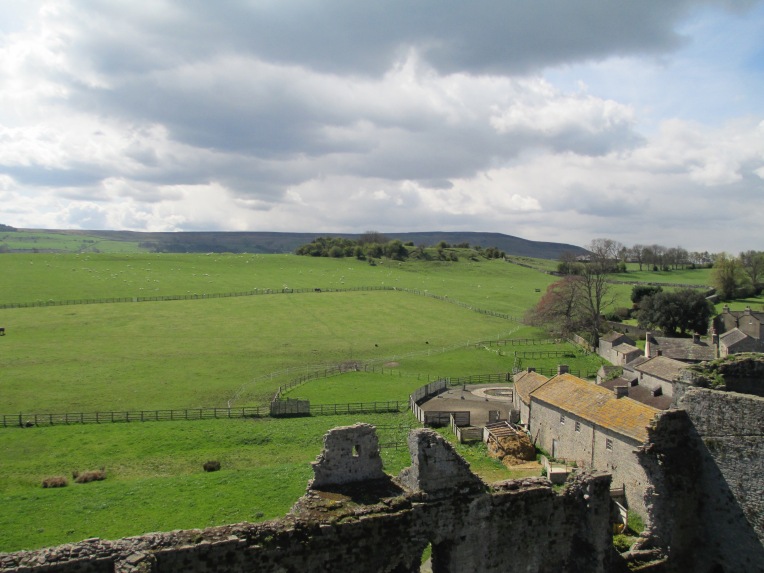
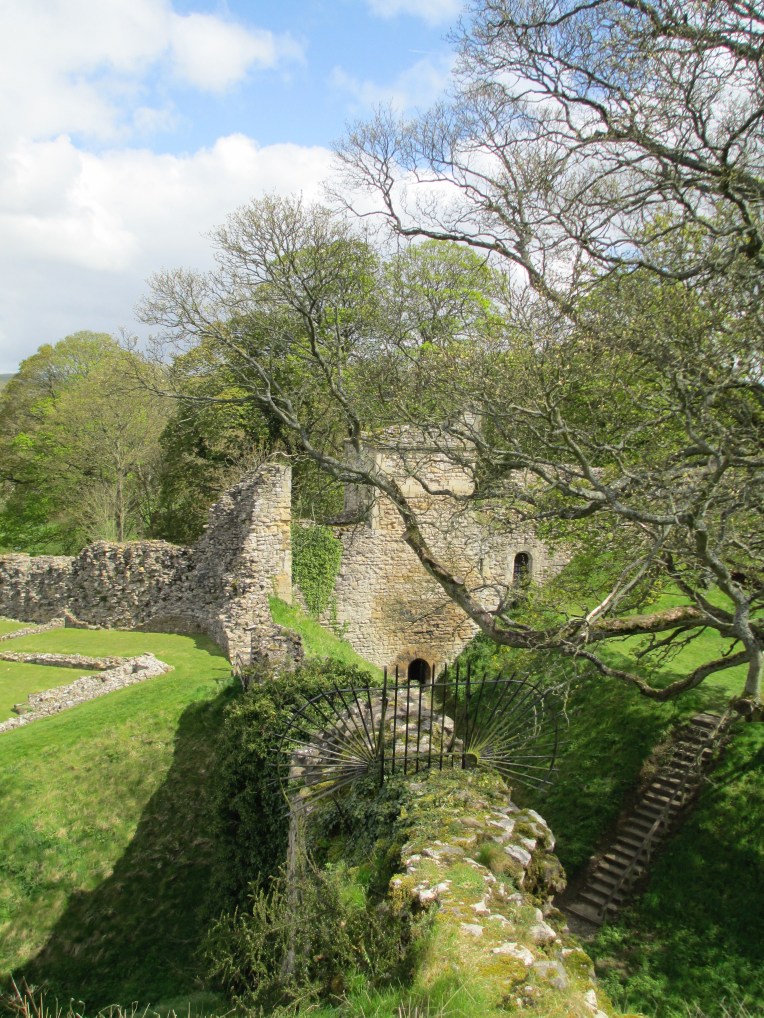
Pickering Castle was established by William the Conqueror in c. 1070. It was built in response to the northern revolts against his rule. William’s stamping of authority on the north is known was the Harrying of the North. Such an innocuous name sounds like it was a minor irritation, however this couldn’t be further from the truth. William the Conqueror led a brutal pillaging of the north, killing people and destroying crops and food. Tens of thousands of people starved to death in the aftermath.

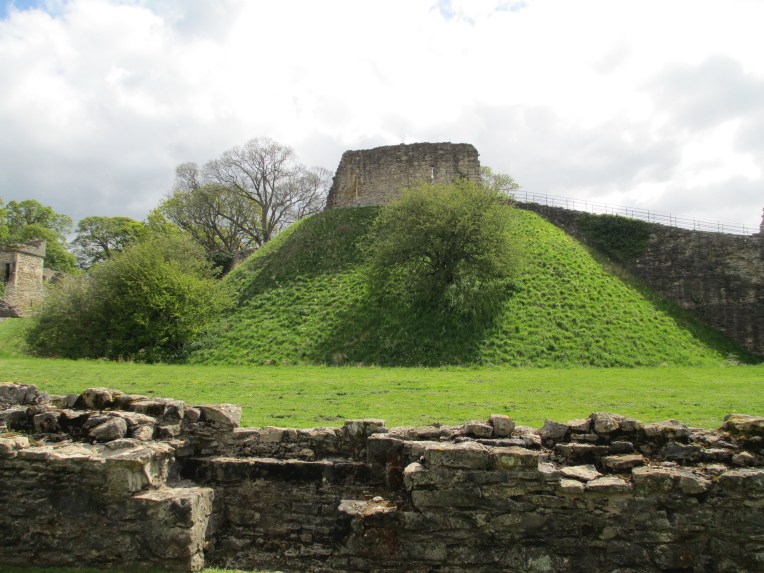
The original castle would have been earth and timber and the motte on which it was built still stands today. The rebuilding of the castle in stone began around 1180 and continued into the 13th century under successive kings. Within the walls there is also a chapel dedicated to St Nicholas which dates to roughly 1227. Until the mid 16th century the castle would have had a resident chaplain.

By the early 14th century the castle has passed into the hands of Thomas Earl of Lancaster, the grandson of Henry III. He married heiress Alice de Lacey and using her money introduced more stone buildings, including building a new hall for the family to live in, within the walls of the castle. In the mid 14th century Edward II ordered the outer walls to be built in stone, including stone towers as part of the walls. He used the castle for raising horses. He established a stud at the castle and often used it as a hunting lodge.

By the time of the civil war the castle had fallen too much into disrepair to be used for defence and in the 17th century parts of the castle were used as a court house. The castle came into the hands of English Heritage in 1926.

References:

Site visit 2012.

http://www.britainexpress.com/counties/yorkshire/castles/pickering.htm

The Harrying of the North: http://www.historyextra.com/article/bbc-history-magazine/battle-of-hastings-aftermath-consequences-harrying-of-the-north


The photos are all mine.


Advent Calendar of Castles: December 4th: York Castle

york-1york-2york-3


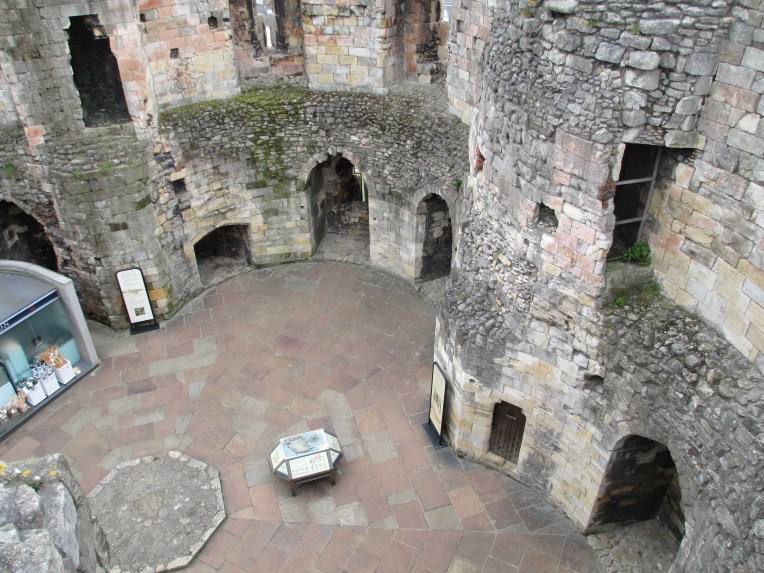
The castle you see in the photos is all that remains of York’s once much larger castle. The current structure, known as Clifford’s Tower, was built in the 13th century and served as the heart of government in York and was also used to house the royal treasury. That is not to say that there was not a castle on the site prior to the construction of Clifford’s Tower. A wood and earth Norman tower was built on this site in the 11th century and suffered much damage and rebuilding during these tumultuous times, but it probably survived largely intact until the 12th century. The castle was then the setting for one of the most infamous incidents in York’s history. In 1190 tensions between the York Jewish community and the largely Christian population came to a head and roughly 150 Jews were given protective custody in the wooden castle that stood on the current site of Clifford’s Tower. Something went terribly wrong though and the royal officials found themselves shut out of the castle. They summoned reinforcements to retake the castle and these reinforcements joined with a local mob. The mob and the reinforcements were soon out of control and the Jews in the castle were besieged. On the 16th of March the Jews inside realized there was no way out and they committed suicide and set the tower alight rather than face the wrath of the mob. According to some accounts some Jews did survive and came out under an amnesty to then be massacred by the mob.

The tower burnt down but it was rebuilt, in wood and stone, but it wasn’t until the mid 13th century that the tower you see today was constructed. Henry III ordered a new stone tower to be built in roughly 1245 to help deal with the threat of the Scots. The tower was finished by the end of the 13th century and would have likely stood surrounded by a moat of some description and an outer bailey and walls were added in the 14th century. Over the years the tower and castle acted largely as an administrative centre rather than a royal residence. The first recorded use of the name “Clifford’s Tower’ dates to the mid 16th century but it is possible that the name comes from the rebel Roger de Clifford who was executed in 1322 and whose body was displayed on a gibbet at the castle.


References:

Site visit 2012

http://www.english-heritage.org.uk/visit/places/cliffords-tower-york/history/


The photos are all mine.


Advent Calendar of Castles: December 2nd Lincoln Castle.

lincoln-1

lincoln-3

lincoln-2

Lincoln Castle was begun by William the Conqueror in c.1068 making it one of the first Norman castles built. It was part of the Conqueror’s plan of the domination of England through a network of castles. It was through castles like Lincoln that he administered and controlled his new territory. Lincoln Castle stands on the site of an old roman fort and when it was built 166 Saxon houses were demolished to make way for it.

In the early medieval period Lincoln castle was the site of two decisive battles. The first was in 1141 during the time period known as the Period of Anarchy (1136-1154). King Stephen and the Empress Matilda were fighting for control of the country. It was a time which the Anglo-Saxon Chronicle described as “people openly said that Christ slept, and his saints.” In 1141 the Earl of Chester and his brother William of Roumare had rebelled against King Stephen and taken Lincoln Castle by deceit. Oderic Vitalis’ version says that they sent their wives in on the pretext of a friendly visit and the Earl arrived to collect the women with only three knights and then, “Once inside the castle they suddenly snatched crowbars and weapons which lay to hand and violently expelled the king’s guards. Then William burst in with a force of armed knights, according to a pre‑arranged plan, and in this way the two brothers took control of the castle and the whole city.”

Regardless of how they took the castle they held it and King Stephen arrived to besiege the castle. The Earl of Chester escaped and alerted Robert of Gloucester, Empress Matilda’s brother and the head of her campaign for the crown. Gloucester arrived in Lincoln with an army and there was a pitched and bloody battle, unusual in a war that was mainly looting and skirmishes, Gloucester’s forces were victorious and King Stephen was captured.

The other key battle at Lincoln was in 1217. It was so bloodless that it was soon known as the Fair of Lincoln. William Marshal headed forces fighting for the newly crowned Henry III. Marshal was the young Henry’s regent. They were fighting the remains of the barons who had forced King John to sign the Magna Carta in 1215. The majority of barons had returned to the royal fold after King John’s death, but there were a few hold outs who were still supporting Prince Louis of France as their candidate for king. Prince Louis’ forces were besieging Lincoln which was held by the remarkable Nicola de la Haye (who I hope to write more about later), Marshal’s forces came to relieve the siege. They had help from the inside the castle and the battle was a route. Prince Louis’ forces were demolished and the battle was pretty much the end of the baronial revolt, though it was the Battle of Sandwich and paying off Louis that got rid of him completely.

Outside of these two key battles Lincoln continued to be both a prison and court for centuries to come. It is also the location of one of the only four surviving original copies of the Magna Carta as well as a copy of the 1217 Charter of the Forest.

References

Site visit 2012

Lincoln castle information leaflets.

https://www.lincolncastle.com/content/history

Anglo Saxon Chronicle: http://www.britannia.com/history/docs/1137.html

Battle of Lincoln 1141: http://deremilitari.org/2014/03/the-battle-of-lincoln-1141-from-five-sources/

The Fair of Lincoln 1217: Tout, T.F, ‘The Fair of Lincoln in the ‘Histoire de Guillaume le Maréchal’, The English Historical Review, 18, 1903, pp. 240-265.

The photos are all mine.


Advent Calendar of Castles December 1st: Castle Rising

This year for christmas I’m running an advent calendar of medieval castles. Each day I’ll post three photos of a castle and some information. Today I’m starting with Castle Rising in Norfolk just out of Kings Lynn.

castle-rising-1castle-rising-2castle-rising-3

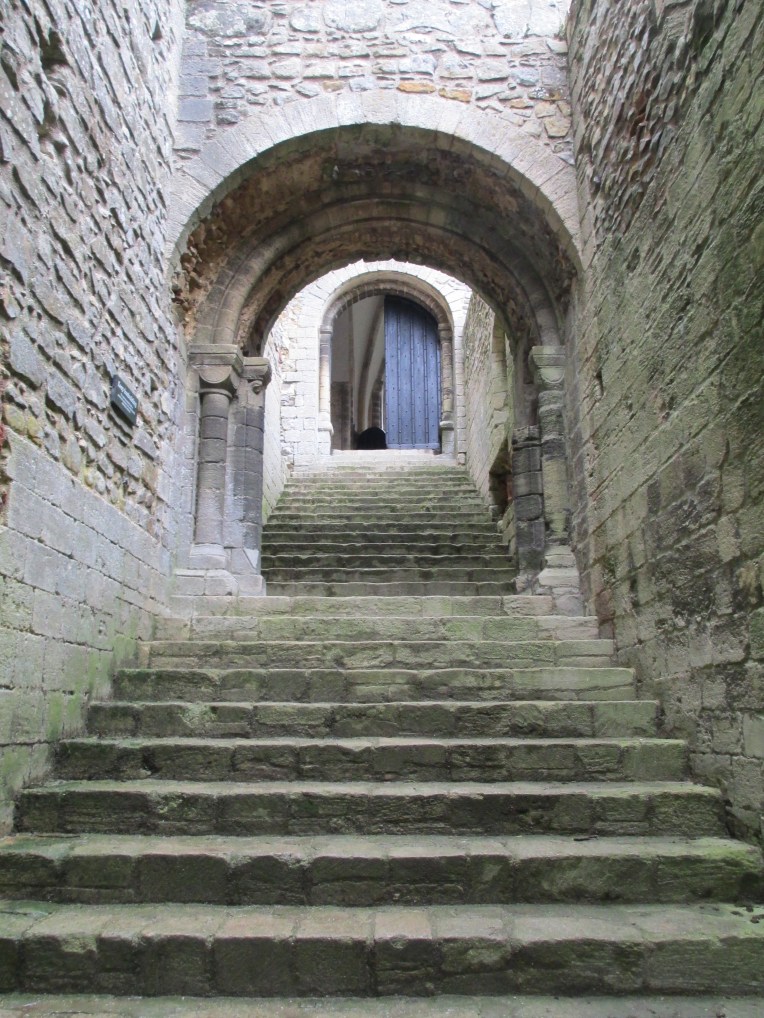
William d’Albini the Earl of Arundel began having the castle built in c. 1138. It was most likely built for his new wife, who was the widow of Henry I, Adeliza of Louvain. The keep itself was probably envisioned as self-contained accommodation for the lord and his family.  It is curiously domestic in scale, but the massive earthworks make it clear that defence was at least considered. The uppermost levels of the keep were likely added at a later date and this included re-roofing and adding an extra room at the top of the keep. As well as the keep, in the grounds behind the earth works, there are the remains of a Norman church. It most likely predates the castle and would have been replaced by the current parish church in the town of Rising around the time the castle was built.

The d’ Albini family died out in the 13th century and Castle Rising passed into the Montalt family. The Montalt family died out in the 14th century and Castle Rising came into royal hands. It was after this that the castle entered what is probably its best known phase when it became the residence of Queen Isabella, known as the she wolf of England. She was the Queen of Edward II and many argue she had a role in his murder. It has been argued that Castle Rising was her prison, but it is also just as possible that it was the residence she chose in exile. There were certainly buildings erected for her in the grounds of the castle

Castle Rising ultimately came into the hands of the Howard family who still own and manage it today.


References:

Site visit 2012

http://www.castle-rising-history.co.uk/castlecameo.html

http://www.castlerising.co.uk/thecastle.html

http://www.english-heritage.org.uk/visit/places/castle-rising-castle/

The photos are all mine

Peveril Castle

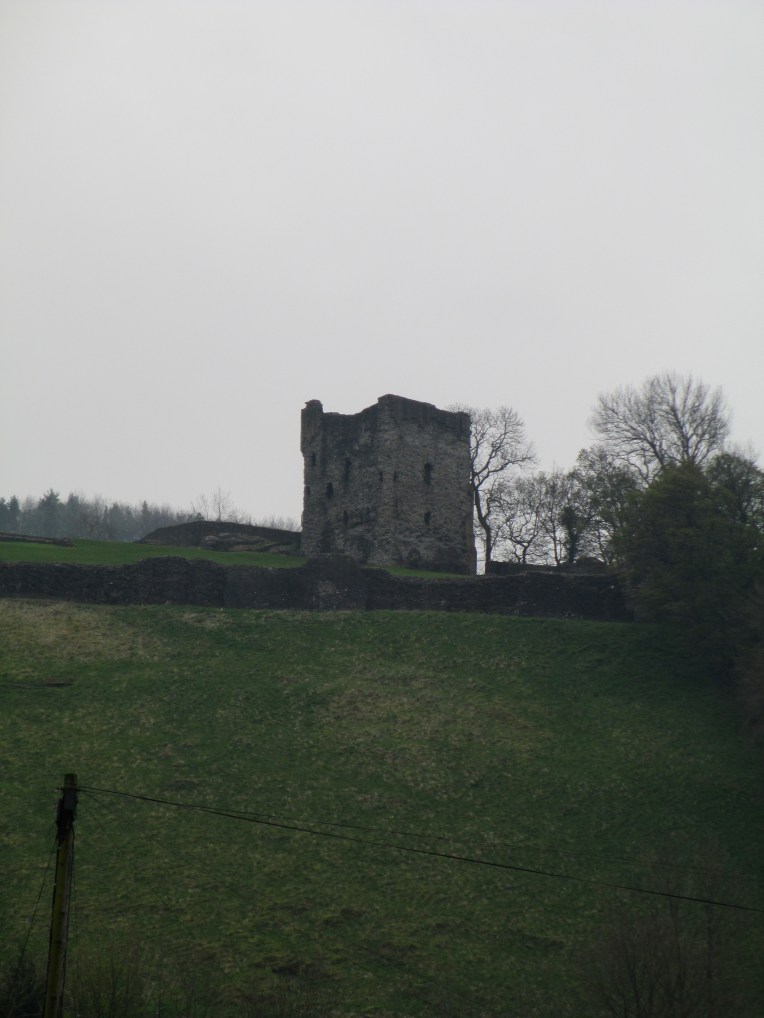
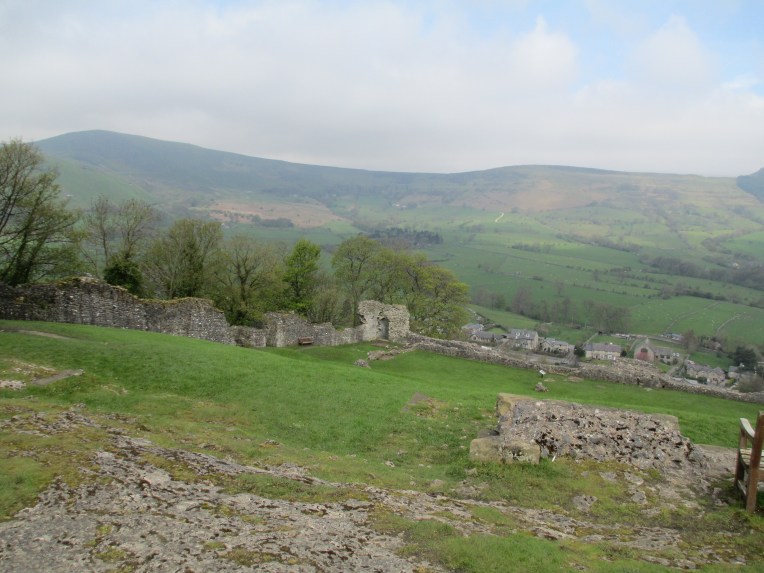
Peveril Castle perches dramatically on the edge of a craggy hill  looking over the town of Castleton and Hope Valley in the Peak District.img_0519

Peveril Castle

Castleton grew up around Peveril castle and and was first documented in royal accounts in 1196, but was probably there from around 1155 at least. By 1215 it had its own trade fair and it continued on through the centuries to survive as a local hub, even after the demise of the castle.

img_0541

The view over Castleton and Hope Valley.

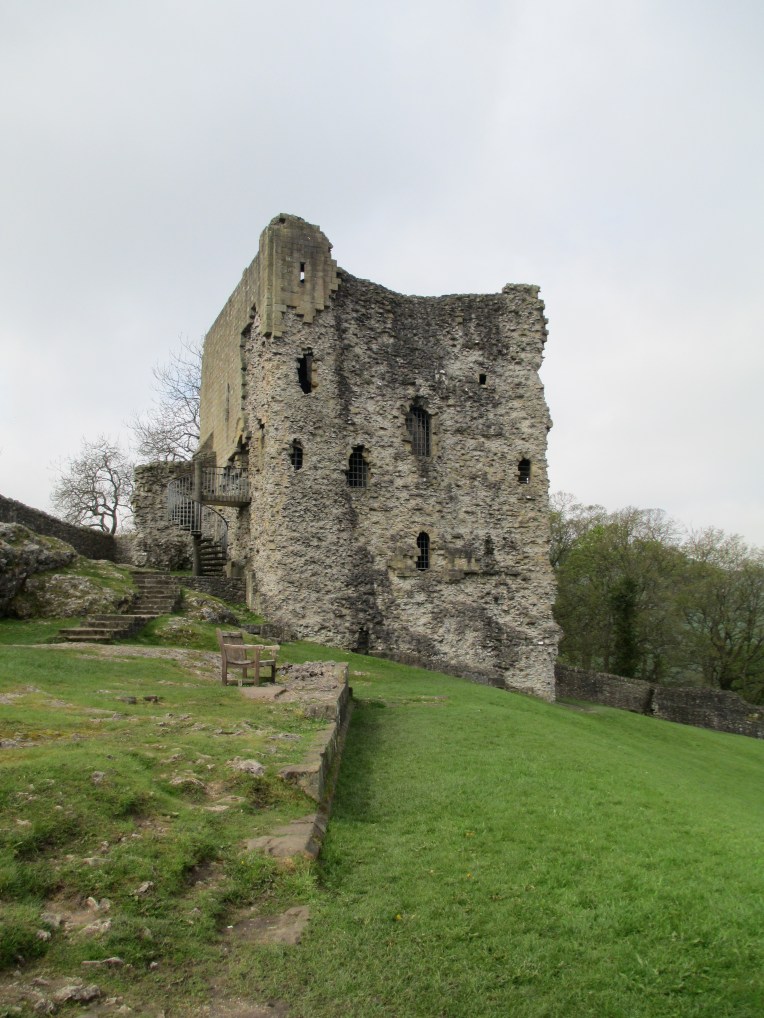
Peveril castle itself was originally built, most likely of stone, by William Peveril shortly after 1066. However its most striking feature, the keep, was the work of Henry II. The castle came into Henry II’s hands in 1155 and is an excellent example of the common square keeps that he had built up and down the country.  Peveril came into royal hands after William Peveril’s son, also called William, firstly made an enemy of the powerful Earl of Chester and then of Henry FitzEmpress, who shortly became Henry II. In 1153 Henry had already promised to dispossess the younger William of his estates for treachery and plundering and give them to Chester. By 1155, when he carried out the threat, Chester was dead so Henry kept the castle for himself. The name however survived. Henry II used Peveril as a base to oversee the local area and keep the local barons, who had been used to more autonomy during the period of anarchy, in check. Even when he wasn’t there, and there were only a few guards left to man it, Peveril was a potent symbol of royal authority. It also served as an administration point for the Forest of the Peak.

Peveril was part of the Lordship of the Peak and it was given by Richard I to his brother John when Richard came to the throne in 1189. John however was forced to surrender it due to his rebellion. When John came to the throne himself in 1199 William Ferrers, the Earl of Derby, paid the huge sum of 2000 marks to claim much of the lordship for himself. John however refused to hand over the castles of Peveril and Bolsover, which he saw as the symbols of the authority in the area. He only conceded Ferrers’ right to them in 1216 when his authority was crumbling. However his castellan refused to hand them over and John told Ferrers he could take them by force, if he could. John died in 1216 and Ferrers managed to take Bolsover by force during the first year of the reign of Henry III, however he never attacked Peveril and the castellan moved out by negotiation. Ferrers, however had only been given lordship of Peveril until Henry III came of age. Initially, though, he refused to hand it over. He finally gave up and surrendered it to royal hands in 1223.

img_0551

Peveril Keep

Peveril stayed in royal hands until the 1372 when it was given to John of Gaunt, who was the Duke of Lancaster and the third son of Edward III. He was one of the most powerful lords of his time and he possessed many castles. As such he never saw Peveril as being a residential centre and began to strip lead from it to use in other castles. Slowly  the administrative functions of the castle began to drift elsewhere too and by the 16th century the castle was derelict.

The castle was never besieged, so the ruinous state you see it in now is due to decay through time and the stone being repurposed for Castleton below.

img_0561

looking down on Castleton from the keep.

Peveril stands on a steep natural hill with the precipice-like Cave Dale to the back and one side and Cavern Gorge to the right. It commands the main high ground over Hope valley and was a symbol of authority for all the lords who held it. img_0530

a model of what Peveril would have looked like in around 1300.

img_0554img_0568

The landscape around the outcrop on which Peveril stands.

The path that you take up to the castle now leads you through the remains of what would have been the east gate. It was most likely built under Henry II in the late 1100s. It would originally have been a simply decorated arch.

img_0539This path is most likely the route through which Peveril would have been accessed for the majority of its existence. It is very steep but it would have just about been accessible to horses.  Upon entrance to the castle precinct it is the keep which immediately dominates the view.

img_0553

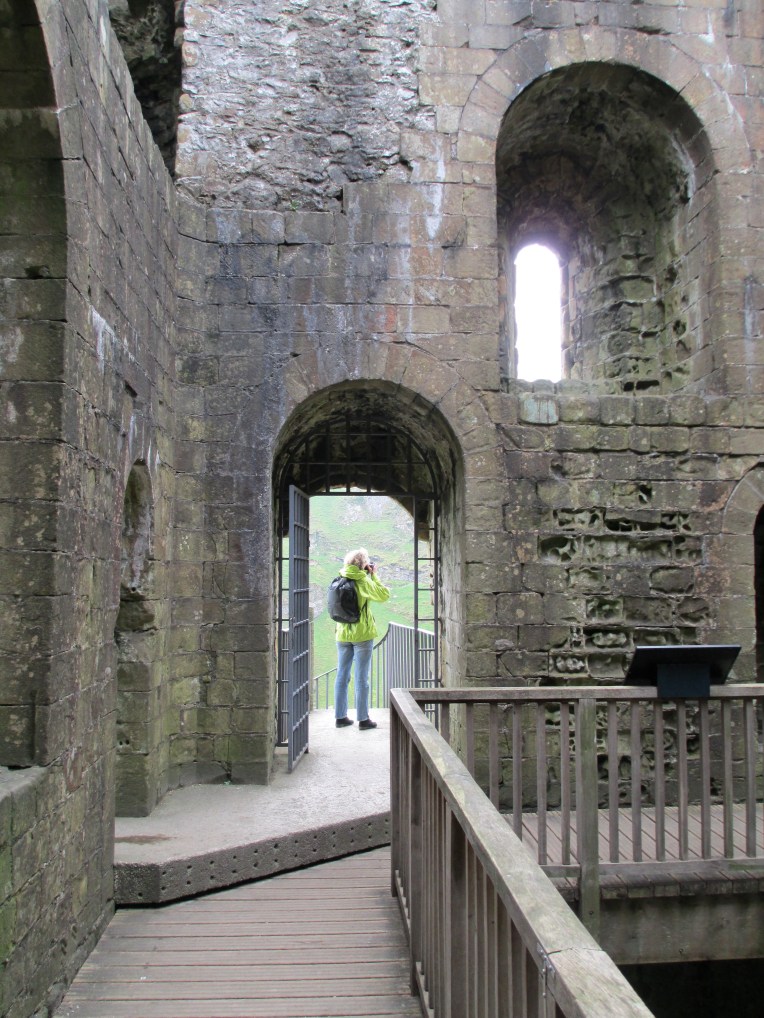
It stands at approximately 15m high. It would originally have had a parapet. It is less than 12m square and as such is much smaller than other similar keeps that Henry II had built all over the country. It is said to have cost around 184 pounds and to have been built of stone quarried locally. The spiral stair you can see in the photo above is roughly in the same spot that the original medieval stair, built of either stone or wood, would have stood. The keep would have housed a main public space on the first floor entry, and a basement storage area below. You can see the entrance door in the photo below, it is taken roughly where the floor of the main hall would have been. img_0566

You can see the line of the original pitched roof of the main hall still visible in the outline of the stone in the photo below.img_0558

You can see the basement in the photo below. The stair down still survives.

img_0564

The keep at Peveril was not the only hall. In the photos below you can see the view down from the keep to the area where the new hall and the west gate would have stood.img_0556img_0563

It is not known exactly when the new hall was built, but it was probably in the mid 13th century. It would have had a fire place and a kitchen and been where important people dined. Henry III stayed at Peveril in 1235 and if this hall was complete in time it would have been here that he held court. This area is also the site of the west gate. It would have led to a bridge over the gorge outside, but there are sadly no remains to be seen today. This would have been the other main access point to the castle, apart from the east gate.

Below you can see the area where the old hall and the chapel probably stood.

img_0550

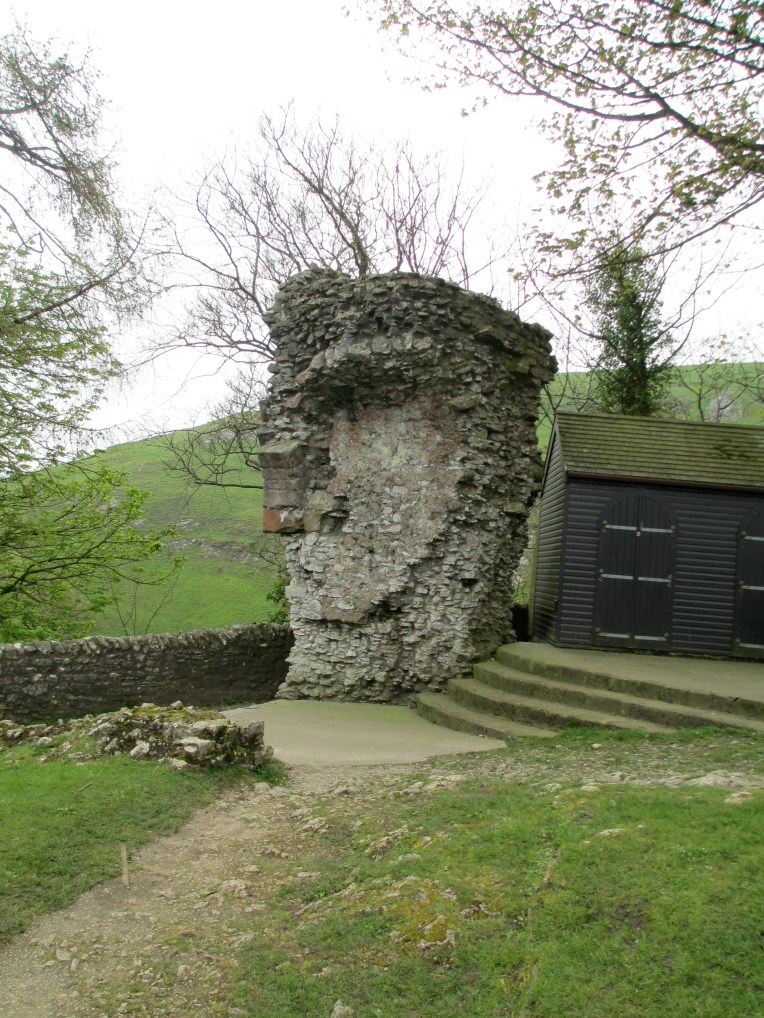
There was also a small circular tower in this section which was built partly of roman stone, repurposed from a nearby Roman site. This was probably a 13th century addition and may not have had much functional defensive use.  The hall itself was most likely in this area in one form or another since the beginning of the castle, the remains today date to roughly the same time as the keep because it was built using the same stone. While it is not certain where the chapel was, we know there was one because of a document from 1264 which mentions it. There is a structure next to the hall that has Norman masonry and is facing roughly east west and has no other known purpose, so it has been interpreted as being the chapel.

This does not cover all of Peveril castle and it is a site well worth a visit. Although it is not one of the largest castles in the country it is certainly one of the more atmospheric and the position it commands is extremely dominating.

References: English Heritage Peveril Castle book and a site visit in 2012.

The photos are all mine.

The King’s Champion Part 2

I have written a previous post about my quest to discover the medieval origins of the position of King’s Champion. Rather than rehashing it, you can find it here.

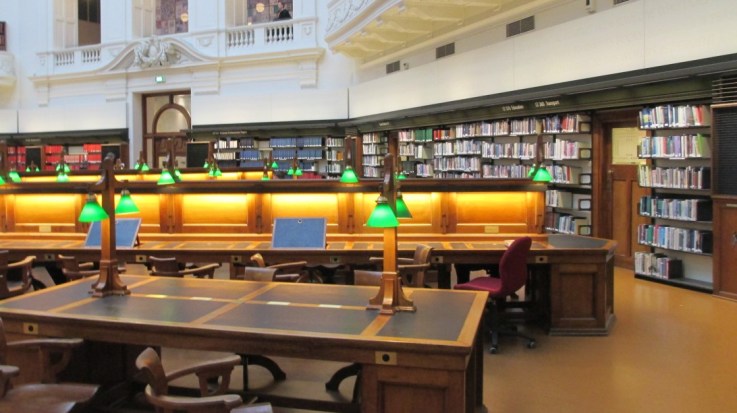
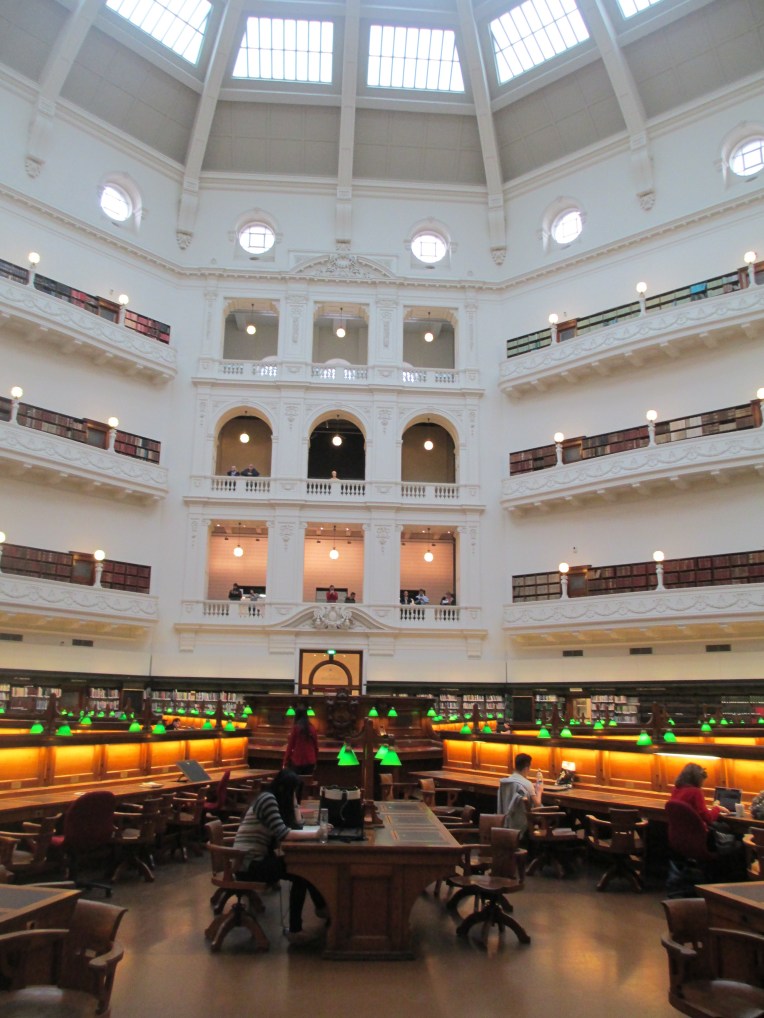
So following the work I did for the previous post, I decided I needed more information than my collection of books and what I’d so far managed to find online could provide. So I headed for the State Library of Victoria. It’s one of my favourite places to do research and if you’re not familiar with it you can see the famous domed reading room in the photos below. I always work in here whenever I can because it has an extensive collection and the most amazing atmosphere. IMG_0695
cropped-lob.jpg

In the reading I’d been doing for my previous post many of the 1800s sources on the King’s Champion I’d found had been based on the work of William Dugdale. I decided he would be a good person to begin the next stage of my search with. Primarily to see if he had any references in his work that would let me track back further. I discovered he was a writer in the 1600s who wrote extensively about both baronial families and peerage. I also found that the State Library had a copy of his two volume work The Baronage of England or The Historical Account of the Lives and Most Memorable Actions Of Our English Nobility.  The first volume covers from the Saxons, to the Norman Conquest, to those who had their rise before the reign of Henry III. The second volume covers from the end of Henry III’s reign to the reign of Richard II. It was the first volume I was most interested in as it was this that later writers were referencing when discussing the Marmion family’s heritage.

I ordered both the books from the State Library. They are classified as rare books so I had to view them in the heritage reading room. Rare books is a wide ranging definition. A book can be rare due to age, or fragility, or a lack of copies in existence as well as other reasons. I was expecting an 1800s copy of the work as this is what usually happens. So I was delighted to find that what I’d ordered was actually a printing from 1675. This is one of the things I love about libraries like the State Library of Victoria. They have an amazing range of rare, fragile and obscure items but you don’t have to have any special qualification to access them. They are there for the use of all Victorians. All I needed to access these books was my library card. I was very excited as this is now my record for the earliest book I have ever held. It beat one from the mid 1700s I used for researching William Marshal during my honours year. The title page of Dugdale’s book can be seen below.

IMG_8530

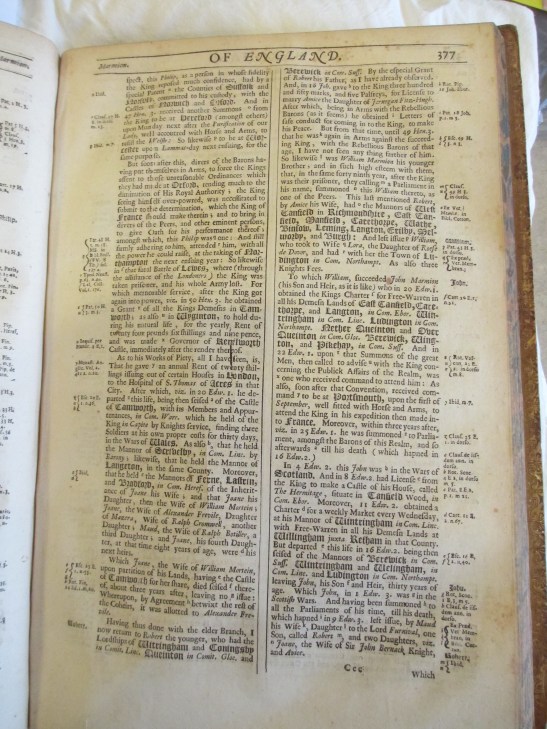
The first volume indeed had the peerage of the Marmion family. It begins by saying that William I gave Robert Marmion the castle of Tamworth. The Domesday Book lists Tamworth castle as being in the hands of the king in 1086. William I died in 1087 so it is just about possible that he gave the castle to Robert Marmion. What is most interesting is the entry regarding the Marmion family and Scrivelsby, the manor which is now tied to the role of King’s Champion. It is only mentioned once and this is not until the narrative reaches Phillip Marmion who died in the 20th year of the reign of Edward I. In this case it is just a passing mention. Scrivelsby is listed as of one of the properties Phillip held by right of Barony on his death. You can see the passage on the page below.
IMG_8544

Dugdale does provide references as to where he is getting his sources. Unfortunately he does it in an abbreviated form, but doesn’t explain what the abbreviations mean. I am yet to work out exactly what the reference for Scrivelsby is referring to, but when I work it out I’ll track it down. The other telling thing about this book is the lack of any kind of reference to the Marmions as hereditary Kings Champions. This doesn’t prove that they weren’t of course, but it might mean that it wasn’t well known or considered especially important.

I also examined the second volume of Dugdale’s work, but there were no further mentions of the Marmions or of the Dymoke family, the family who inherited the title of King’s Champion. What Dugdale does give the reader is what seems to a be a reasonably accurate account of the individual Marmions in England in the Norman and early Plantagenet times. So it seems likely that whether or not they were official King’s Champions, or hereditary Champions of Normandy, that the Marmions were in England roughly from the time of William I. There is also a second Dugdale work that apparently does discuss the role of King’s Champion that I am hoping to track down soon.

Having determined that most likely the Marmions were in England in some form from the time of William I, I decided to try a slightly different track. I’d been looking into the household of the king because the King’s Champion is often mentioned in coronations alongside positions such as the Marshal. From work I’d done on William Marshal I knew that the Marshal is definitely an hereditary position and that it was certainly considered a part of the king’s household. So I decided it was worth having a look through one of the best records of a king’s household from the early Plantagenet period. The Constitutio Domus Regis is a contemporary account probably of the household of Henry I. The exact date is still under debate. It has thankfully been translated by S.D Church. The State Library has a copy which also contains the translation, by Emile Amt, of the Dialogus De Scaccario (the Dialogue of the Exchequer) which dates to the 12th century. I have gone carefully through the Constitutio and am unable to find any mention of the King’s Champion. I also can’t find any kind of regular payment to the King’s Champion listed in the Dialogus. Again this doesn’t mean that it didn’t exist in this time, it may just not have been included in these particular documents. It could also mean that if it did exist then it was much less formal an appointment than say the Marshal, and may have not had a day to day role.

Continuing on a slightly different track I decided that exploring the question from the point of view of the coronation itself was a good idea. Other sources I’d been reading referenced two books

1. The Coronation Book of the Hallowing of the Sovereigns of England.  By Jocelyn T. Perkins published 1902

2.  English Coronation Records  Edited by Leopold  G. Wickham Legg published 1901.

The State Library had copies of both. I began with The Coronation Book. While this text doesn’t provide  any revelatory new information it does cover the position of King’s Champion in later years in detail and provide some lovely little vignettes of the Champion’s role in the coronation.  For example John Dymoke entrance as the champion to Richard II. When he appeared at the coronation on his ‘mighty steed’ he was summarily told that he had come in at the wrong time and told to come back later when it was appropriate.

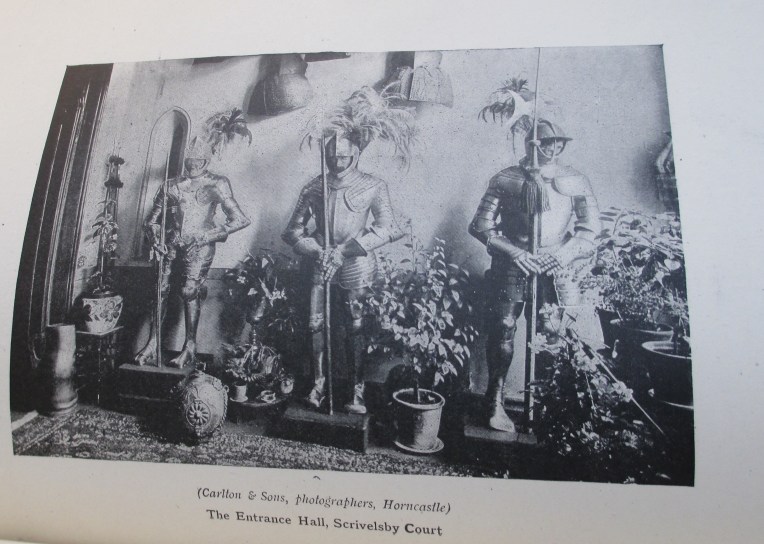
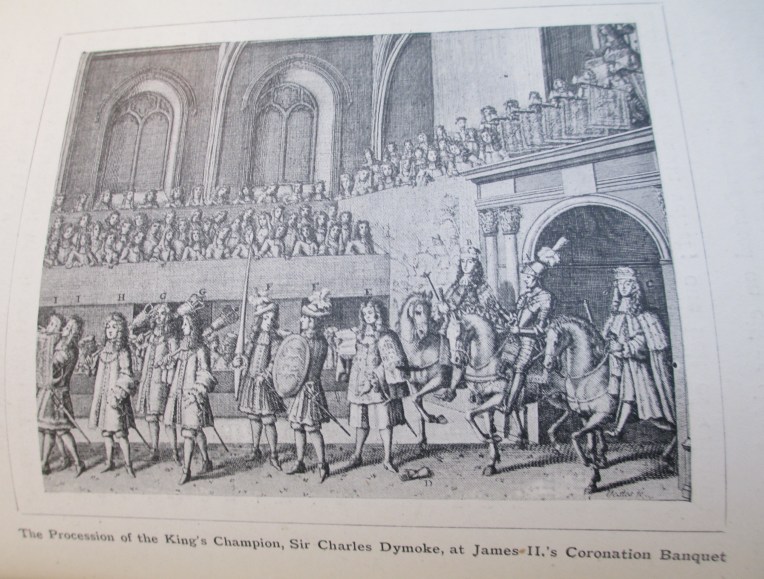
The Coronation Book  provides extensive discussion of many of the ceremonies that various Champions after the reign on Richard II were involved in. It doesn’t however provide any information as to the the role of the Champion before the reign of Richard II. What it does do though is give some lovely illustrations and photos. Some are non contemporary illustrations of the Champions performing their duties and others are of the Champion’s acroutements. They can all be seen below.

IMG_8592

The Manor of Scrivelsby  which is currently tied to the position of Champion.
IMG_8600

Some of the suits of armour worn by the Champions.

IMG_8604

The cups which are the official payment to the Champion for their service at the coronation.
IMG_8608

Sir Charles Dymoke James II’s Champion

IMG_8613

Henry Dymoke the Deputy Champion.

Henry Dymoke participated in George IV’s coronation because the Champion John Dymoke (Henry’s father) was a cleric and therefore apparently unable to undertake the role. The only other time a Deputy Champion was used was at the coronation of Richard II when the hereditary Champion was Margery Dymoke. Her husband John Dymoke undertook the role by right of his wife as she was a woman and as such unable to be to be Champion. [1]

Margery and John Dymoke actually raise a very interesting point which is briefly discussed in The Coronation Book. The coronation of Richard II is the first record we have of the Champion’s role in the coronation. It is also the period in which the Dymoke family took over from the Marmions as the Champions. The Coronation Book mentions that there was a case in the Court of Claims before Richard II’s coronation. John Dymoke argued his right to be Champion through his wife’s descent from Phillip Marmion and his possession of Scrivelsby. [2] When I found this I realised that this court case would be absolutely key because it would have to include an explanation of the rights of the Marmions to the position of King’s Champion. The Coronation Book  doesn’t really provide that much more detail, but thankfully the second book I listed above, English Coronation Records, does.

English Coronation Records in fact has a transcription and translation of the court case. It’s reasonably long and as such I won’t present it in full here. In summary John Dymoke and Baldwin de Freville both presented their cases to be the King’s Champion. Both of them were claiming the position of Kings Champion due to their descent, through marriage, from Phillip Marmion. Phillip was the last of the main line of Marmions and he died in the reign of Edward I. John held Scrivelsby and Baldwin held Tamworth. There were fierce arguments on both sides. In the end it was decided that as John had presented a better case and crucially because “several nobles and magnates appeared in the said Court and gave evidence before the said Lord Steward, that the said Lord King Edward and the said Lord Prince lately dead frequently asserted, while they lived, and said that aforesaid John ought of right to perform the aforesaid service for the said Manor of Scrivelsby.” [3] This last point is absolutely key because this is the point where the role of Champion is tied irrefutably to Scrivelsby itself rather than the specific family.

So through all this I have still failed to find definitive evidence that the Marmions were the hereditary Champions. It does seem, however, that they were certainly believed to be the hereditary Champions in 1367 at the time of Richard II’s coronation. Baldwin and John were both arguing on hereditary descent from the Marmions not specifically on the possession of their respective manors. Additionally no one in the court seemed to find this claim odd and several nobles seemed to feel that Edward III and Edward the Black Prince had discussed it, so it must have been a position that was known and understood.

I am still not quite finished with this. I’m hoping to track down the other Dugdale book in which he apparently discusses the role of the King’s Champion, as well as deciphering his abbreviation style. I am also going to look into the Marmions specifically, as it seems clear that the role was tied to their family not to the property of Scrivelsby until 1367. I am going to see what I can find out about their role in Normandy where they were supposedly hereditary Champions. If I find anything I’ll post an update.

[1]  The Coronation Book of the Hallowing of the Sovereigns of England.  By Jocelyn T. Perkins published 1902 p.151

[2] The Coronation Book of the Hallowing of the Sovereigns of England.  By Jocelyn T. Perkins published 1902 p.134

[3] English Coronation Records  Edited by Leopold  G. Wickham Legg published 1901. pp. 160-161

The photos are all mine.