Vida Goldstein

I recently saw the movie Suffragette and while I did enjoy it and applaud the important story it is telling I couldn’t help but think that I wanted to write about some of the non violent members of the women’s suffrage movement. This idea crystallised when I talked to a few people and realised that even the leaders in Australia’s women’s suffrage movement remain largely unknown. As I began to look I found that Suffragette had prompted many others to write about the people involved with the women’s suffrage movement, which is one of the best outcomes the movie could possibly have had. An example is the Guardian article below about the fascinating Adela Pankhurst. She was one of the daughters of the celebrated Emmeline Pankhurst, who is played by Meryl Streep in the movie.

http://www.theguardian.com/australia-news/2015/dec/24/wayward-suffragette-adela-pankhurst-and-her-remarkable-australian-life

I decided that I wanted to write about someone I knew a little about already and as I’d done some work on Vida Goldstein at high school, and too many people still haven’t heard of her, I thought she’d be a good place to start. I was intending to write a short biography of her role in the women’s suffrage movement but as I began to have a careful look I determined that this has been well and truly done. While I don’t belive that all writing has to be treading new ground I truly didn’t see the point in rehashing the Australian Dictionary of Biography article, which covers all the salient points.

http://adb.anu.edu.au/biography/goldstein-vida-jane-6418

It is absolutely worth reading though.

So I headed into the State Library of Victoria, not that I ever really need an excuse, and did some work using their manuscripts collection. With the information I found here I decided that I am going to focus on Vida’s first attempt at entering parliament in 1903.

First though, a very brief background on Vida and a look at the progression of women’s suffrage in Australia.

vida

Vida Goldstein

http://nla.gov.au/nla.obj-136682563/view

Vida Goldstein was born in 1869 in Portland in Victoria and she was one of the leaders of Australia’s women’s suffrage movement. She died in Melbourne in South Yarra in 1949 and a lot more should be known about her by the general population. In other words read the ADB article.

703017194

A young Vida Goldstein

http://goo.gl/5xcNik

Vida was also very much a part of the international suffrage movement as can be seen by the notes below from Susan B Anthony, who most people will have heard of. Susan B Anthony gave Vida the three volumes of her book called A History of Women’s Suffrage

In each volume she wrote an inscription to Vida and they are all dated to the 4th of July 1902.

To Miss Vida Goldstein

Melbourne Australia

From her disenfranchised friend, the city of Rochester, County of Monroe, State of New York, Country of the United States of America- the land of the free who has worked to the best of her ability, for fifty years and more to the get the right for women to vote- and will continue to battle for it to the end of her life-

affectionately.

Susan B Anthony


To Vida Goldstein

Melbourne Australia

Rejoicing that you have gained the national franchise- and hoping your other states will soon grant the local suffrage- while we of the United States of America struggle on-no one can tell how long to the the right to vote.

Sincerely yours

Susan B Anthony


Miss Vida Goldstein

(to be given to the public library- when she is done with it)

With the congratulations that the new world of Australia has given to her women all the rights of citizenship- equally with her men- and with love and esteem of her friend

Susan B Anthony.[1]

Vida also travelled to speak at suffrage events and meet other members of the suffrage movement, especially those who were still fighting for women’s suffrage. The photo below shows her with other women’s suffrage supporters at the Great Suffragette Demonstration in London in 1911. Vida is on the far right

vida london

Great Suffragette Demonstration

http://nla.gov.au/nla.obj-136683161/view?searchTerm=vida+goldstein#search/vida%20goldstein

Australia was one of the first countries to give the vote to women. It is complicated though by the fact that each state allowed women the vote at a different time and that it occurred federally as well, independent of the individual states. The result of a separate Federal right to vote, which was granted in 1902,  was that there were women from several states who could vote in federal elections but not in their state elections.

Below you can see when the vote was granted state by state

1894 South Australia

1899 Western Australia

1902 Federal

1902 New South Wales

1903 Tasmania

1905 Queensland

1908 Victoria[2]

Vida also described the mood in Australia which made it possible for the vote for women to become a reality far earlier than in countries like the UK.

The Broad Mindedness of Australian Men

One feature of the Suffrage Campaign in Australia makes it radically different from that in any other country- the readiness of our men to admit that our cause was a just one, and entitled to immediate recognition. We never had any difficulty in winning over the men of Australia to our side. Our real battle ground was the Upper House in each colony. The Lower Houses were elected practically on as basis of One Man One Vote and in the Lower Houses it was easy to get a suffrage bill through, but the Upper Houses, which represented only the propertied classes, who in Australia are always against reform, stood solid against us, and it was only when we got a strong Premier in each state that we could get a Suffrage Bill through the Upper Houses.[3]

Vida also described the hard work that went on to not only try to achieve the vote, but also to get male MPs to take notice of specific issues.

Through not having women in Parliament energy and valuable time have to be spent on the often Herculean task of educating members up to the point of seeing the injustice in certain measures affecting women, e.g the Federal Public Services Act. It bristled with discrepancies in pay for men and women doing exactly the same work. To get the principles of equal pay embodied in the bill some of us had to spend days at the House lobbying members, always hateful work- showing them the many injustices in the bill from the women’s point of view, and trying to get them to see them as we saw them. We had to tramp round getting petitions signed and write to the press. Had there been women in the House there would have been no need for such tactics because the injustices were so obvious they only had to be pointed out and most members promised to get them removed. Another example was the Naturalisation Bill which completely merged the individuality of a married woman with that of her husband. [4]

Even before she ran for parliament Vida herself had become vehemently against the two party system because she considered that parties sacrificed  principle to expediency and put their own interests before all else. She came to this conclusion in 1902 when, after women were allowed the vote federally, she started the group Women’s Federal Political Association. Unfortunately male politicians quickly began to use the Association for party purposes and when Vida reacted by moving the Association away from one party and to a non political basis the majority of the male members left.

So this was the background to Vida running for parliament in 1903. The election was in December of 1903 and she launched her campaign in October in her home town of Portland. But she began signalling she would be running earlier. Part of her campaign was a letter published in Reviews of Review in August entitled Should Women Enter Parliament?

She opened by, with what The Advertiser described as “a delightful touch of femininity”, immediately answering her own question

“Of course why not?”

She then went on to defend her supposition laying forth the usual key arguments against women’s suffrage, beginning with the idea that there was a lack of precedent. She refutes this by providing several examples from history and going on to discuss the disparity between men who happily accepted a female sovereign, Queen Victoria had died quite recently, but couldn’t accept women in parliament.[5] As her niece LM Henderson wrote Vida “never indulged in empty rhetoric, she always supported her arguments with facts, and could answer almost any question.”[6] Vida was the first woman to stand for parliament in the Empire and naturally enough there was both comment and opposition. The rural papers tended to be more sympathetic than the Melbourne papers.  For example The Avoca Standard ran this piece in November 1903.

“Miss Goldstein presented a very pleasing appearance on the platform at Avoca. She was graceful, pretilly gowned and wore a most becoming hat. During her address she toyed prettily with a beautiful La France rose- a move that added much to the effect. The lady became a favourite with all present almost at once. Her easy delivery of speech, charming voice, modest manner, and the absence of anything masculine, being the chief factors in her favour.”

This piece might be very condescending, but it isn’t hostile.

The Age and The Argus were generally dismissive, but not always. There was also extensive argument as to the legality of women in parliament. But it quickly became clear that even constitutionally there was no argument barring them running. [7]

The press commentary wasn’t limited to articles, there were also cartoons and poetry. An example of the cartoons can be seen below. In which Vida has to be accompanied to the Senate by a chaperone, and all the men dare not disobey her for fear of being seen as discourteous.

vida cartoon

Vida Goldstein Cartoon

from Punch http://goo.gl/wN04hH

There were headlines like “Sweet Skirted Senators” from the Sunday Times and this really quite interesting poem, also in the Sunday Times, on 9/08/1903

Vidi!-Vida!-Vinci!

What a theme

for the scheme

of a beautiful dream

to be there in the Senate with Vida!

What a foretaste of heaven

the Senate would seem

to the Senator sitting beside her.

They say tis a right which can not be denied her!

Let us give her a vote, for we’d gloat

and we’d dote

on a note 

from the throat

of Miss Vida!

You can see it would be very simple; 

for she wouldn’t want advisors to guide her!

And to all her proposals, of course they’d agree

it would be very rude to deride her!

All the House would have nous

to be meek as a mouse!

They would catch it if any defied her!

And it’s certain soft soap

couldn’t hope

to enrope

or to cope

with the scope

of Miss Vida. 

And I can’t

and I shan’t

see the reason we aren’t

to be ruled by good ladies like Vida.

If you vote for your Uncle

why not vote for you Aunt

if the requisite sense is supplied her.

And she

like a he

should be perfectly free

to engage in a sphere that is wider.

If the matter’s discussed,

then we must,

to be just,

give a thrust

to our trust

in Miss Vida.

Ah! but then

gentlemen

when it comes to the ken

of a Senator’s wife, could he chide her

if she kicked up a row with her tongue and a pen

on the boldness of brainy Miss Vida.

For a lass

is a lass

but alas, should it pass

there are ladies who’d call her a spider!

And although we may cheer

still I fear it is clear

we must bid you “Good Morning”

Miss Vida

W.T Goodge[8]

You can make of that what you will of the poem. I can’t decide if it’s derogatory, celebratory or both.

Media aside, Vida campaigned assiduously, but it is unlikely she ever expected to win. She chose to run for the Senate rather than the House of Representatives probably because it would allow her to campaign throughout Victoria rather than just for one seat. Thus spreading her message further. The election took place in December 1903 and Vida polled 51 497 which was surprisingly good considering voting wasn’t compulsory. It was not, however, enough to win the seat. She took defeat well, commenting on the process in January 1904 in Review of Reviews.

I found political sentiment best developed in the labour ranks, among women earning their own living, and among the country women in the leisure classes. Melbourne women are notoriously ignorant of politics. This difference between city and country was the only new fact my campaign taught me. The chief value of suffrage at present is its educational value, I would sooner see women educated in views diametrically opposed to mine than not educated at all… I had against me the combined power of the Morning and Labour papers, deliberate misrepresentation by two of them, lack of finance, and the prejudice of sex. I stood for the cause of women and children, as a protest against the dictation of the press, and against the creation of the ticket system of voting. From men I had most courteous treatment… The chief lesson to be learnt from this campaign was the need for organisation. The Labour Party had the best organisation and their success shows this. Labour seeks to reach its goal mainly by material means; women place a higher value on the spiritual, but (word missing, LMH) will someday see that is righteous alone that exalteth a nation.

She commented later to her niece Leslie M. Henderson that she was terrified of mice and was always afraid that some of her opponents would discover it and let loose some mice on the platform when she was speaking. Thankfully this never happened. [9]

And that was the end of Vida’s first attempt to join Australia’s parliament. She tried another four times to gain office but was ultimately never successful. This was most likely to do with the fact that she always ran as an Independent Woman Candidate. Despite her lack of electoral success Vida Goldstein was a pioneer for women’s rights around the world and she deserves to be as well know internationally as some of the other larger than life figures in the woman’s suffrage movement.
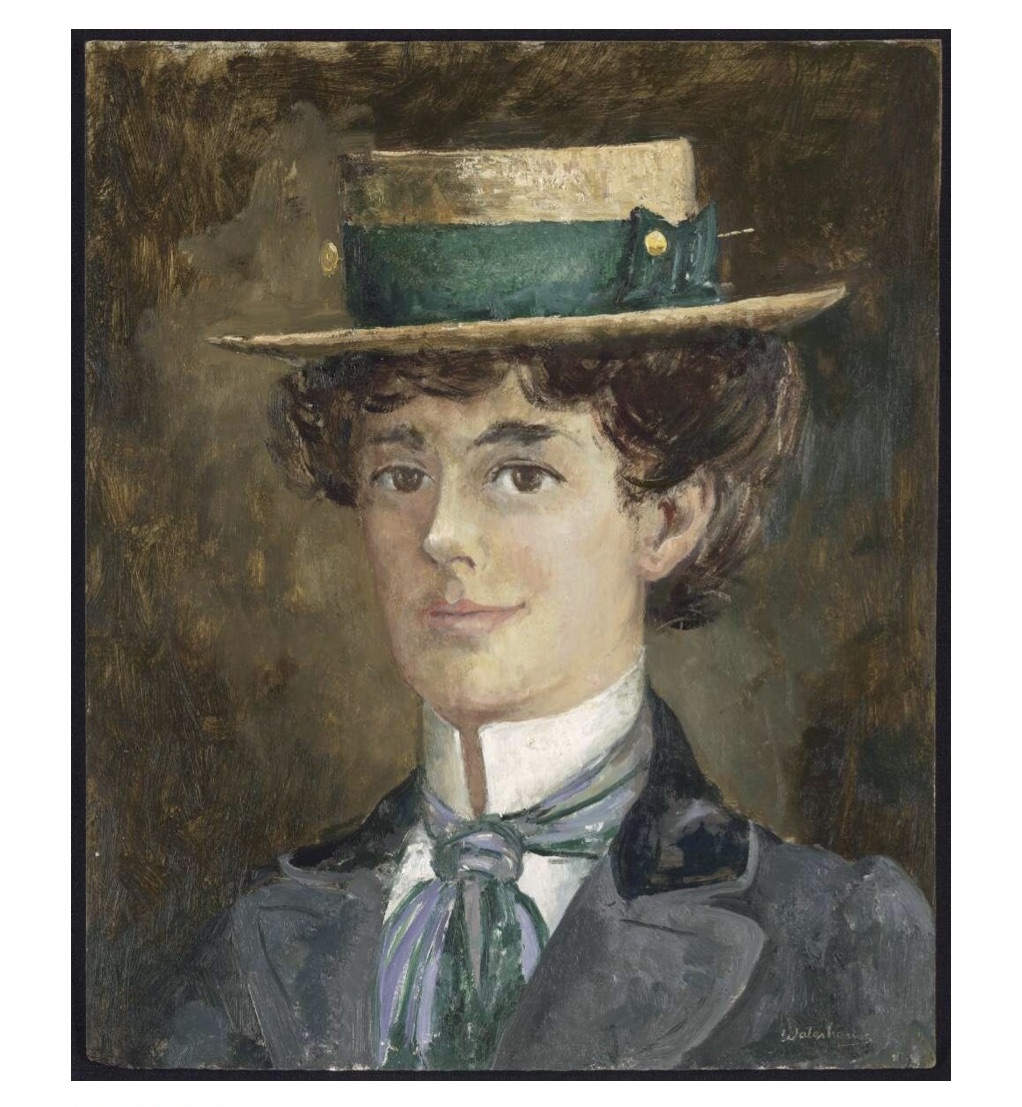
vida older

Vida Goldstein painted by Waterhouse

http://trove.nla.gov.au/work/26335720?q=vida+goldstein&c=picture&versionId=46453732

[1] State Library of VictoriaMS BOX 3097/5(a-c)

[2] From Vida Goldstein’s papers: State Library of Victoria MS MSM 118

[3] From Vida Goldstein’s papers: State Library of Victoria MS MSM 118

[4] From Vida Goldstein 1869-1949: Biographical notes by her niece, Leslie M. Henderson, 1966 January. MS BOX 332/14
[5] From Press cutting book presented to Edith How Morlyn for Women’s Service Library London by Vida Goldstein State Library of Victoria MS BOX 2493/ 5

[6] From Vida Goldstein 1869-1949: Biographical notes by her niece, Leslie M. Henderson, 1966 January. MS BOX 332/14

[7] From Press cutting book presented to Edith How Morlyn for Women’s Service Library London by Vida Goldstein

[8] From Press cutting book presented to Edith How Morlyn for Women’s Service Library London by Vida Goldstein

[9] From Vida Goldstein 1869-1949: Biographical notes by her niece, Leslie M. Henderson, 1966 January. MS BOX 332/14
 

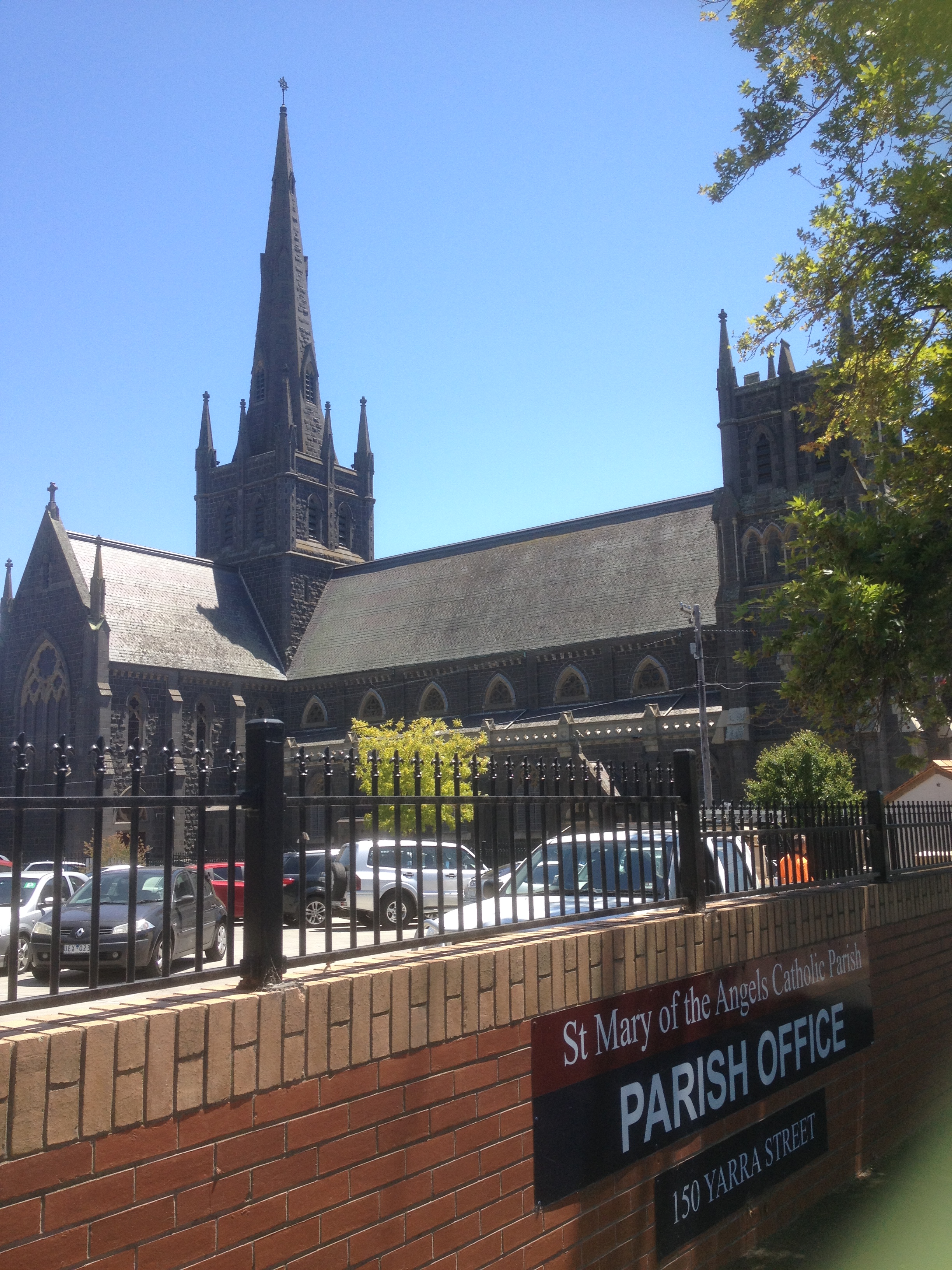
St Mary of the Angels Basilica Geelong

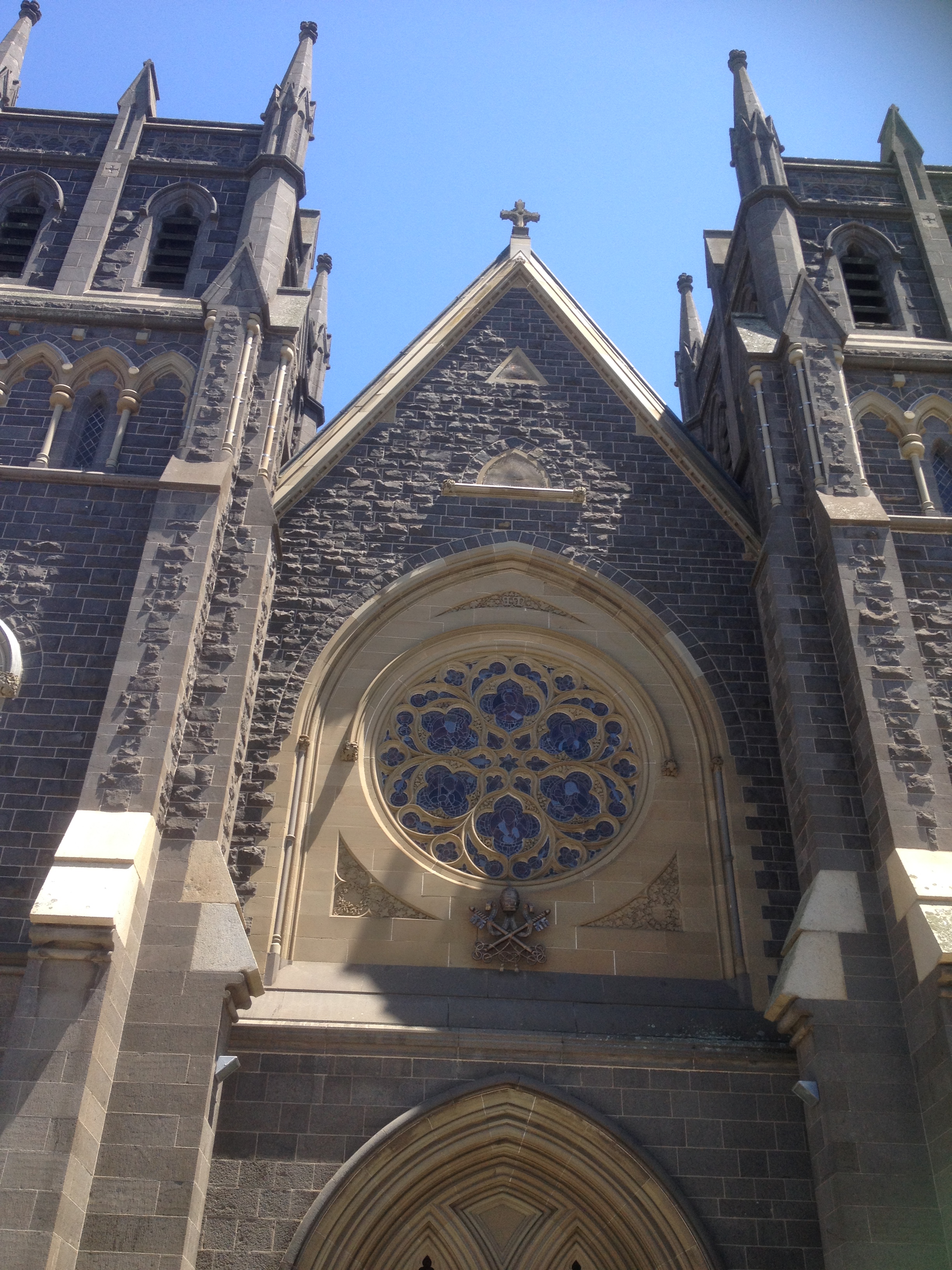
I found this church by accident on a recent trip to Geelong and it’s a really lovely example of Victorian Gothic.

IMG_1291

Geelong is in Victoria Australia about an hour out of Melbourne. It was founded in 1838 when it was laid out and officially proclaimed. Its existence is due to the need for a depot for all the squatters who were pouring into Victoria. The first land sales were held in 1839 with the Wollpack Inn opened in the same year.

The current Basilica stands on what was known as Church Hill and commands the highpoint of Geelong.

The church that can be seen today has humble origins. To begin with Catholics in Geelong, or Corio as it was often known, did not even have a priest. Father Bonaventure Geoghegan became the first priest for the St Benedict’s District, of which Geelong was part, in 1839.

Screen Shot 2016-01-03 at 4.43.18 pm

Father Bonaventure Geoghegan

http://goo.gl/XbtQJJ

Geoghegan was born in Dublin and celebrated his first Mass in an open roofed building in Melbourne on May 19 1839. He baptised the children who had been born in the four years of Melbourne’s existence. He was the only priest to care for Catholics in the whole of the existing area of Victoria. As this was such a significant task Geoghegan was given an assistant, curate Richard Walsh. Then after 12 months, when Walsh was moved to Norfolk Island, Michael Ryan was assigned. He was described by Vicar General Murphy from Sydney as “a very well disposed young man although at times a little hasty & inclined to have too much of his own way.”

It was Ryan who was assigned officially to Geelong in September 1841. Two days after his arrival, on the 8th of September 1841, Ryan celebrated what would have been the first Mass in Geelong. Under Ryan’s watch a foundation stone was laid for the beginnings of a church for the Catholics, but it wasn’t to be for Ryan and Geelong as Ryan was recalled to Sydney in October. Even without Ryan there Geoghegan continued with the plans for a church for Geelong. However progress was slow especially because it wasn’t until 1842 that Geelong again had the benefit of the resident priest. On April 13 Father Michael Stephens celebrated the first catholic marriage in Geelong. Later in 1842 the first catholic chapel was finally completed. It was a modest building made of paling about 30 feet by 20 feet and covered by a shingle roof. A far cry from the current church.

By 1846 the need for a new church had become very apparent. The census of that year showed 1003 catholics in the County of Grant which the small church serviced. The priest at the time, Richard Walsh again, set out on a campaign for the building of a permanent church. After fundraising and other efforts the foundation stone was laid on the 19th of August 1856 by Father Geoghegan.This church was opened on October 6th 1847  it was called St Mary’s and was later described…

“It was a  pretty little church built of very bad Barrabool stone. It soon began to show signs of decay, and the weather side had to get three coats of thick paint in ’53 to preserve it from the effects of frost and rain”

By 1854 the capacity of St Mary’s was very strained,the census of that year showed 3797 catholics in Geelong, and it was resolved that a new church was needed.

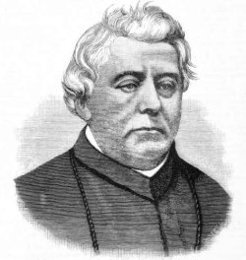
The first stone of the present church was laid by the Most Reverend James Alipius Goold 1st Bishop of Melbourne on the 15th of June 1854.

A040300_246x550

Most Reverend James Alipius Goold

http://adb.anu.edu.au/biography/goold-james-alipius-3633

The nave was completed and  opened for worship, again by Bishop Goold,  on the 4th of February 1872. IMG_1299

The Nave

Daniel Mannix, Archbishop of Melbourne,  consecrated the completed church including spire, on the 16th of June 1937.

IMG_9718

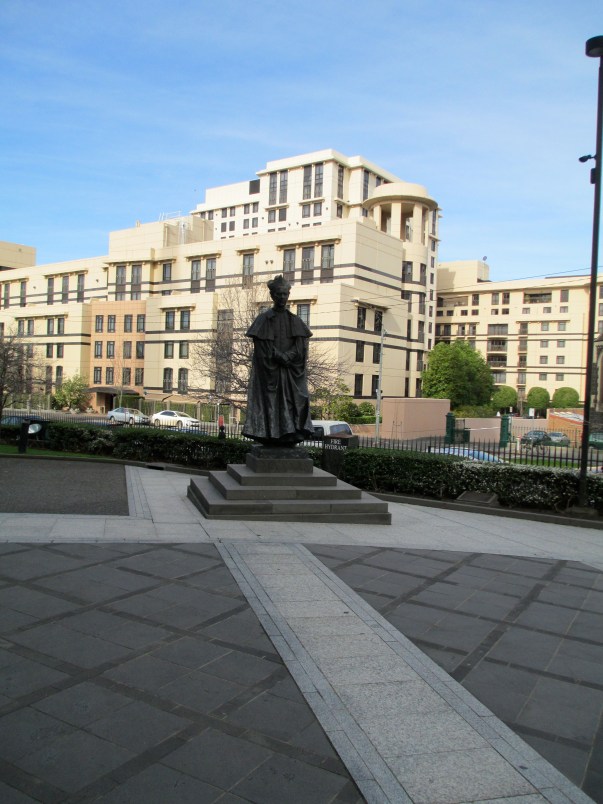
Statue of Daniel Mannix outside St Patrick’s Cathedral in Melbourne.

Even before the spire was completed the church was eliciting extravagant praise.

“It exhibits an edifice of colossal cathedral proportions, such as one might expect to find in the episcopal city of some ancient Catholic continental nation, but which excites astonishment when associated with an antipodean town of yesterday… Even in this incomplete condition, the building is the most conspicuous, commodious and elegant ecclesiastical edifice in the town.”

The church was based on the 13th century gothic style. The central tower rose to a height of 100 feet above the ground and was capped with 8 crocketed pinnacles. These formed the base of the spire which rose another 98 feet into the air before terminating with a 12 foot high cross. The top of the cross was 210 feet above ground. The spire was built from inside without the use of external scaffolding.

IMG_1297

Ceiling below the spire.

IMG_1292

The Spire, you can see the cross up the top.

The total length of the church was 220 feet, the distance between the transepts was 126 feet and the nave with side aisles was 14 feet 6 inches wide. The high altar was made of Verona marble. IMG_1298

The high altar, although this is modified from the original version.

Although it was without doubt a magnificent building the church ran into problems in the 1960s as it was already beginning to age. The foundations on the western end had to be underpinned to stop subsidence and 560 stone crockets had to be removed from the spire because they kept breaking off, damaging the slate roof, causing leaks and threatening anyone walking too close to the church. Major restoration work was also undertaken in the 1980s.

In 2004 the 150th anniversary of the church was celebrated and at the anniversary Mass Archbishop Dennis Hart of Melbourne announced that the Vatican had designated St Mary’s as a Minor Basilica. One of only five in Australia.

These are the conditions for the granting of Minor Basilica status according to The United States Conference of Catholic Bishops.

“1. A church for which the title of basilica is proposed must have been dedicated to God by a liturgical rite and must stand out as a center of active and pastoral liturgy, especially through celebrations of the Most Holy Eucharist, of penance, and of the other sacraments, which celebrations set an example for others on account of their preparation and realization according to liturgical norms and with the active participation of the people of God.

2. To further the possibility of truly carrying out worthy and exemplary celebrations, the aforesaid church should be of an appropriate size and with a sufficiently large sanctuary. The various elements required for the liturgical celebration (altar, ambo [lectern], celebrant’s chair) must be placed according to the requirements of the restored liturgy (cf. General Instruction of the Roman Missal, nos. 288-318).

3. The church may enjoy a certain renown throughout the diocese, for example, because it has been constructed and dedicated to God on the occasion of some particular historical and religious event, or because the body or significant relics of a saint are reserved in it, or because some sacred image is there venerated in a special way.

The historical value or importance of the church and the worthiness of its art are also be considered.

4. So that, as the liturgical year progresses, the celebrations of the various seasons may be carried out in a praiseworthy manner, a fitting number of priests is necessary; they are to be assigned to the liturgical and pastoral care of the church, especially for the celebration of the Eucharist and penance (there should also be an appropriate number of confessors who at stated hours are available to the faithful).

In addition, a sufficient number of ministers is required as well as an adequate schola cantorum, which is to encourage the participation of the faithful with sacred music and singing.”

So the awarding of this title to St Mary’s is very much an acknowledgement of its importance both to the history of Victoria and to the people of Geelong.

It is a really beautiful church. Even if you are completely non religious as I am, the majesty of St Mary’s must be appreciated.

IMG_1294

St Mary’s from the front.

References

Ian Wynd. St Mary of the Angels Basilica. ISBN: 9780975840702

Unless otherwise stated by links the photos are mine.

Medieval Quotes Advent Calendar 24th of December

So this is the last one. It’s been fun. I hope these quotes have been enjoyed. I’ve had fun ransacking my books and lots of other sources.

I thought I’d finish with one more William Marshal quote. This is the description an incident during the siege of the castle of Milli in 1197 under Richard I when the almost fifty-three year old Marshal ran up a scaling ladder in full armour.

“At this point many of those involved in the attack began to retreat, for they were much dismayed and in fear. Left behind on one of the ladders was Sir Guy de la Bruyere, a knight from Flanders who did his all, with intense vigour, to perform great deeds. Those defending the town had caught him with their spiked pikes between his chin and his chest, so overpowering him that he could in no way help himself with either hand. The Marshal, fully armed, was on the moat, and he was filled with pity and anger about the plight of that knight, whom he saw in such torment, so, fully armed as he was, he jumped down into the bottom of the ditch and climbed, I assure you, sword in hand up the other side, and kept his footing until he reached the ladder on which the knight was held by those who sought to kill him. He dealt such blows with his sword as to fully repay each of them individually for the harm they had done to the knight. He dealt so many blows right and left with the sword that he held in his right hand that those inside fell back and left him the sole occupant of the battlements. Those men, who had no taste for the games he played, left him in sole charge of the field as they all went on their way. The Marshal did not care who witnessed it. And when the King saw him leap forward to climb the wall and mount an attack, he was very angry and wanted to do likewise, without delay, but the high ranking men present advised against this course and prevented it. Once the Marshal had entered the castle by force, our men were so filled with glee that they all shouted as one man: ‘The castle is taken, let’s help him!’ Those in the castle took fright as out men leapt onto the battlements. This did not appear to be a laughing matter to Sir William de Monceaux, the constable of the castle. He would not stand still anywhere, but ran straight at the Marshal with the intention of doing all within his power to do him harm and injury, but he was unable to do so, the Marshal proving too much for him now that he had freed himself from the others as a result of the blows he had dealt them, blows which had cost him so much effort that he was somewhat out of breath. The constable came at him with his sword. The Marshal dealt such a blow at him that he cut right through his hauberk and piercing his flesh so that all he could do was come to a halt. He fell down quite unconscious, battered and stunned by the blow he received from the Marshal, and he stayed motionless on the ground. The Marshal, now weary, and who had done more than enough, sat on him to hold him firm.”

From History of William Marshal Volume II. pgs 61-63. ISBN: 0905474457

Medieval Quotes Advent Calendar 23rd of December

Urban II’s address at the Council of Clermont calling for the 1st Crusade in 1095, as recorded by Fulcher of Chartres. There is more than one version of this address, this is just the one recorded by Fulcher.

“Most beloved brethren: Urged by necessity, I, Urban, by the permission of God chief bishop and prelate over the whole world, have come into these parts as an ambassador with a divine admonition to you, the servants of God. I hoped to find you as faithful and as zealous in the service of God as I had supposed you to be. But if there is in you any deformity or crookedness contrary to God’s law, with divine help I will do my best to remove it. For God has put you as stewards over his family to minister to it. Happy indeed will you be if he finds you faithful in your stewardship. You are called shepherds; see that you do not act as hirelings. But be true shepherds, with your crooks always in your hands. Do not go to sleep, but guard on all sides the flock committed to you. For if through your carelessness or negligence a wolf carries away one of your sheep, you will surely lose the reward laid up for you with God. And after you have been bitterly scourged with remorse for your faults-, you will be fiercely overwhelmed in hell, the abode of death. For according to the gospel you are the salt of the earth [Matt. 5:13]. But if you fall short in your duty, how, it may be asked, can it be salted? O how great the need of salting! It is indeed necessary for you to correct with the salt of wisdom this foolish people which is so devoted to the pleasures of this -world, lest the Lord, when He may wish to speak to them, find them putrefied by their sins unsalted and stinking. For if He, shall find worms, that is, sins, In them, because you have been negligent in your duty, He will command them as worthless to be thrown into the abyss of unclean things. And because you cannot restore to Him His great loss, He will surely condemn you and drive you from His loving presence. But the man who applies this salt should be prudent, provident, modest, learned, peaceable, watchful, pious, just, equitable, and pure. For how can the ignorant teach others? How can the licentious make others modest? And how can the impure make others pure? If anyone hates peace, how can he make others peaceable ? Or if anyone has soiled his hands with baseness, how can he cleanse the impurities of another? We read also that if the blind lead the blind, both will fall into the ditch [Matt. 15:14]. But first correct yourselves, in order that, free from blame , you may be able to correct those who are subject to you. If you wish to be the friends of God, gladly do the things which you know will please Him. You must especially let all matters that pertain to the church be controlled by the law of the church. And be careful that simony does not take root among you, lest both those who buy and those who sell [church offices] be beaten with the scourges of the Lord through narrow streets and driven into the place of destruction and confusion. Keep the church and the clergy in all its grades entirely free from the secular power. See that the tithes that belong to God are faithfully paid from all the produce of the land; let them not be sold or withheld. If anyone seizes a bishop let him be treated as an outlaw. If anyone seizes or robs monks, or clergymen, or nuns, or their servants, or pilgrims, or merchants, let him be anathema [that is, cursed]. Let robbers and incendiaries and all their accomplices be expelled from the church and anthematized. If a man who does not give a part of his goods as alms is punished with the damnation of hell, how should he be punished who robs another of his goods? For thus it happened to the rich man in the gospel [Luke 16:19]; he was not punished because he had stolen the goods of another, but because he had not used well the things which were his.

“You have seen for a long time the great disorder in the world caused by these crimes. It is so bad in some of your provinces, I am told, and you are so weak in the administration of justice, that one can hardly go along the road by day or night without being attacked by robbers; and whether at home or abroad one is in danger of being despoiled either by force or fraud. Therefore it is necessary to reenact the truce, as it is commonly called, which was proclaimed a long time ago by our holy fathers. I exhort and demand that you, each, try hard to have the truce kept in your diocese. And if anyone shall be led by his cupidity or arrogance to break this truce, by the authority of God and with the sanction of this council he shall be anathematized.”

After these and various other matters had been attended to, all who were present, clergy and people, gave thanks to God and agreed to the pope’s proposition. They all faithfully promised to keep the decrees. Then the pope said that in another part of the world Christianity was suffering from a state of affairs that was worse than the one just mentioned. He continued:

“Although, O sons of God, you have promised more firmly than ever to keep the peace among yourselves and to preserve the rights of the church, there remains still an important work for you to do. Freshly quickened by the divine correction, you must apply the strength of your righteousness to another matter which concerns you as well as God. For your brethren who live in the east are in urgent need of your help, and you must hasten to give them the aid which has often been promised them. For, as the most of you have heard, the Turks and Arabs have attacked them and have conquered the territory of Romania [the Greek empire] as far west as the shore of the Mediterranean and the Hellespont, which is called the Arm of St. George. They have occupied more and more of the lands of those Christians, and have overcome them in seven battles. They have killed and captured many, and have destroyed the churches and devastated the empire. If you permit them to continue thus for awhile with impurity, the faithful of God will be much more widely attacked by them. On this account I, or rather the Lord, beseech you as Christ’s heralds to publish this everywhere and to persuade all people of whatever rank, foot-soldiers and knights, poor and rich, to carry aid promptly to those Christians and to destroy that vile race from the lands of our friends. I say this to those who are present, it meant also for those who are absent. Moreover, Christ commands it.

“All who die by the way, whether by land or by sea, or in battle against the pagans, shall have immediate remission of sins. This I grant them through the power of God with which I am invested. O what a disgrace if such a despised and base race, which worships demons, should conquer a people which has the faith of omnipotent God and is made glorious with the name of Christ! With what reproaches will the Lord overwhelm us if you do not aid those who, with us, profess the Christian religion! Let those who have been accustomed unjustly to wage private warfare against the faithful now go against the infidels and end with victory this war which should have been begun long ago. Let those who for a long time, have been robbers, now become knights. Let those who have been fighting against their brothers and relatives now fight in a proper way against the barbarians. Let those who have been serving as mercenaries for small pay now obtain the eternal reward. Let those who have been wearing themselves out in both body and soul now work for a double honor. Behold! on this side will be the sorrowful and poor, on that, the rich; on this side, the enemies of the Lord, on that, his friends. Let those who go not put off the journey, but rent their lands and collect money for their expenses; and as soon as winter is over and spring comes, let hem eagerly set out on the way with God as their guide.”


From

http://legacy.fordham.edu/halsall/source/urban2-fulcher.html

Medieval Quotes Advent Calendar 22nd of December

A bit different today. Some medieval poetry. These are from Hywel ap Owain, a fascinating figure in his own right. He was a Welsh prince and an accomplished poet. You can find out more about him here http://michaelfaletra.weebly.com/hywel-ap-owain-gwynedd.html

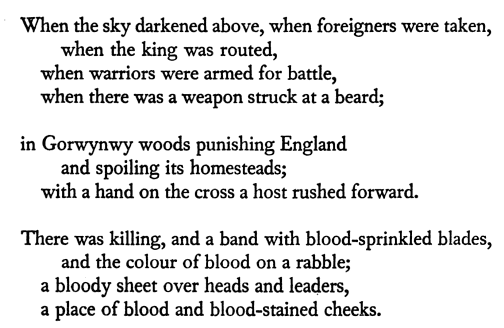
I’ve included two poems. The first is a recounting  of a battle with the English

Ode VII

Screen Shot 2015-12-20 at 12.32.07 pm

The second is a love poem

Ode V

Screen Shot 2015-12-20 at 12.32.31 pm

For interests sake I’m including the original welsh of the first 6 lines of Ode V. Poems really need to be read in their original language to get a true sense of the work. I’m not 100% certain of its veracity as I don’t read welsh and it is from wikiquote, I generally try to find other sources but in this case I can’t find another welsh version anywhere. Nevertheless it is still interesting.

Karafy gaer wennglaer o du gwennylan;
myn yd gar gwyldec gweled gwylan
yd garwny uyned, kenym cared yn rwy.
Ry eitun ouwy y ar veingann
y edrtch uy chwaer chwerthin egwan,
y adrawt caru, can doeth yn rann.

Welsh from https://en.wikiquote.org/wiki/Hywel_ab_Owain_Gwynedd

English translations from

https://books.google.com.au/books?id=GzYawdzshXAC&pg=PP2&lpg=PP2&dq=Welsh+Poems,+6th+Century+to+1600&source=bl&ots=dWaYor3CIg&sig=jIChcVFixaiOpC36vboz3SbOAjs&hl=en&sa=X&ved=0ahUKEwj-qvz3oenJAhVC7GMKHcJnCIEQ6AEIITAB#v=onepage&q&f=false


Medieval Quotes Advent Calendar 21st of December

On the death of Caedwalla king of the West Saxons in 689CE

“In the third year of the Aldfrith’s reign, Caedwalla, king of the West Saxons, after ruling his people most ably for two years gave up his throne for the sake of the Lord and to win an everlasting kingdom, and went to Rome. He was anxious to gain the special privilege of being washed in the fountain of baptism within the the threshold of the apostles; for he had learned that by the way of baptism alone can the human race attain entrance to the heavenly life; at the same time he hoped that, soon after his baptism, he might be loosed from the bonds of flesh and pass, cleansed as he was, to eternal joy; and both of these things came to pass with God’s help just as he intended. He arrived in Rome while Sergius was pope and was baptised on the holy Saturday before Easter Day in the year of Our Lord 689; while still in his white robes, he was attacked by an illness and, on 20 April, he was freed from the bonds of flesh and joined the company of the blessed in Heaven.”

From Bede The Ecclesiastical History of the English People.  pg 244 ISBN:9780192838667

Medieval Quotes Advent Calendar 20th of December

The Battle of Stamford Bridge and the Battle of Hastings from a Welsh perspective from the Welsh chronicle

Brut y Tywysogion

“1066. And then a year after that, Harold, king of Denmark, meditated the subjection of the Saxons ; whom another Harold, the son of earl Godwin, who was then king in England, surprised, unwarned and unarmed, and by sudden attack, aided by national treachery, struck to the ground, and caused his death. That Harold who, at fìrst earl, through cruelty after the death of king Edward unduly acquired the sovereignty of the kingdom of England, was despoiled of his kingdom and life by William the Bastard, duke of Normandy, though previously vauntingly victorious. And that William defended the kingdom of England in a great battle, with an invincible hand, and his most noble army.”

From: Brut y Tywysogion pgs 45-47

https://ia601904.us.archive.org/32/items/brutytywysogiono00cara/brutytywysogiono00cara_bw.pdf

Medieval Quotes Advent Calendar 19th of December

Roger of Wendover 1201

“How the king and queen of the English were crowned at Canterbury.

King John kept Christmas at Guilford, and there he distributed a number of festive garments amongst his knights; and Hubert archbishop of Canterbury, striving to make himself on a level with the king, did the same at Canterbury, by which he roused the indignation of the king in no slight degree. Afterwards the king set out to Northumberland, and exacted a very large sum of money from the inhabitants of that county. He then returned to Canterbury in company with his queen, and on the following Easter-day they were both crowned at that place ; and at the ceremony the archbishop of Canterbury was at great, not to say superfluous, expense, in entertaining them. On the following Ascension-day at Tewkesbury the king issued a proclamation, that the earls and barons, and all who owed military service to him, should be ready with horses and arms at Portsmouth, to set out with him for his transmarine provinces at the ensuing Whitsuntide; but when the appointed day came, many of them obtained permission to remain behind, paying to the king two marks of silver for each scutcheon.”

From Roger of Wendover Flowers of History Volume II. Pg 201

https://ia800503.us.archive.org/35/items/rogerofwendovers02roge/rogerofwendovers02roge_bw.pdf

Medieval Quotes Advent Calendar 18th of December

Extract from a letter from Heloise to Abelard.

“I have your picture in my room; I never pass it without stopping to look at it; and yet when you are present with me I scarce ever cast my eyes on it. If a picture, which is but a mute representation of an object, can give such pleasure, what cannot letters inspire? They have souls; they can speak; they have in them all that force which expresses the transports of the heart; they have all the fire of our passions, they can raise them as much as if the persons themselves were present; they have all the tenderness and the delicacy of speech, and sometimes even a boldness of expression beyond it.

We may write to each other; so innocent a pleasure is not denied us. Let us not lose through negligence the only happiness which is left us, and the only one perhaps which the malice of our enemies can never ravish from us. I shall read that you are my husband and you shall see me sign myself your wife. In spite of all our misfortunes you may be what you please in your letter. Letters were first invented for consoling such solitary wretches as myself. Having lost the substantial pleasures of seeing and possessing you, I shall in some measure compensate this loss by the satisfaction I shall find in your writing. There I shall read your most sacred thoughts; I shall carry them always about with me, I shall kiss them every moment; if you can be capable of any jealousy let it be for the fond caresses I shall bestow upon your letters, and envy only the happiness of those rivals. That writing may be no trouble to you, write always to me carelessly and without study; I had rather read the dictates of the heart than of the brain. I cannot live if you will not tell me that you still love me; but that language ought to be so natural to you, that I believe you cannot speak otherwise to me without violence to yourself.”

From the love letters of Abelard and Heloise.

http://sacred-texts.com/chr/aah/aah04.htm