Marriage Alliances 1180-1250: Part 4 Isabel de Clare.

One of the most interesting heiresses of the period, not in the least because she was married to William Marshal, was Isabel de Clare. Isabel’s marriage to Marshal typified the incredibly important political role that the marriage of these heiresses played. These marriages were not only used as rewards, they were used to elevate men to real positions of power. In some occasions these men could help to change the face of a country, I would argue that Marshal was one of these and his marriage to Isabel was what gave him the status to have a real political affect.

Isabel herself is a little hard to pin down. In essentials she was the perfect medieval wife possessing of great fortune and very fecund, they had ten children, but she makes her own mark in a variety of interesting ways. While the History of William Marshal can not be taken entirely at face value the sentiment that is expressed throughout the work is that Isabel was actively involved in the rule of domains that were essentially hers.

marriage of aoife and storngbow

The marriage of Marshal and Isabel de Clare as depicted in the modern  Ros tapestry in New Ross in Ireland.

Marshal’s marriage to Isabel de Clare was the most significant elevation in his life. The lands that he gained, the children that he had from the marriage and the qualities of Isabel herself were the building blocks on which Marshal’s status was established. Marriage to Isabel gave Marshal substantial and geographically diverse lands as well as titles and wealth. In comparison, materially, Marshal brought little to the marriage because he was a virtually landless knight who only had one small estate in England and probably the rents of some lands in France. He had amassed considerable wealth however from his prowess on tourney field and he was known and respected by King Richard. Isabel gave Marshal lands in England, Ireland, Wales and what is now France and these lands gave Marshal both wealth and authority.[1]  Marshal’s marriage to Isabel mean that he made an indelible mark on her lands, not the least in Ireland. The affect Marshal had on these Irish lands illustrates just how much political change the marriage of an heiress could generate.

medieval irelandjpeg


Ireland under the Normans. You can see Leinster, Marshal’s lands, on the right.

David Carpenter, The Struggle for Mastery: Britain 1066-1284, London: Penguin Books, 2004, p. xx.

 Isabel’s Irish lands came to her from her father Earl Richard de Clare, known as Strongbow, who had gained them by force, and through her mother Aoife, the daughter and heiress of King Dermot MacMurchada of Leinster who was deposed as king in 1166.[1] Strongbow was a leader in a force spearheaded by English lords who won Leinster back for King Dermot. They were given permission to do so by their king Henry II in a letter recorded by Giraldus Cambrensis c. 1166. This was the beginning of the English occupation in Ireland.[2] The rewards Dermot gave Strongbow in return for his services were recorded in the relatively contemporary poem The Song of Dermot and the Earl: his daughter Aoife in marriage and his kingdom after his death. Dermot died in 1171.[3]
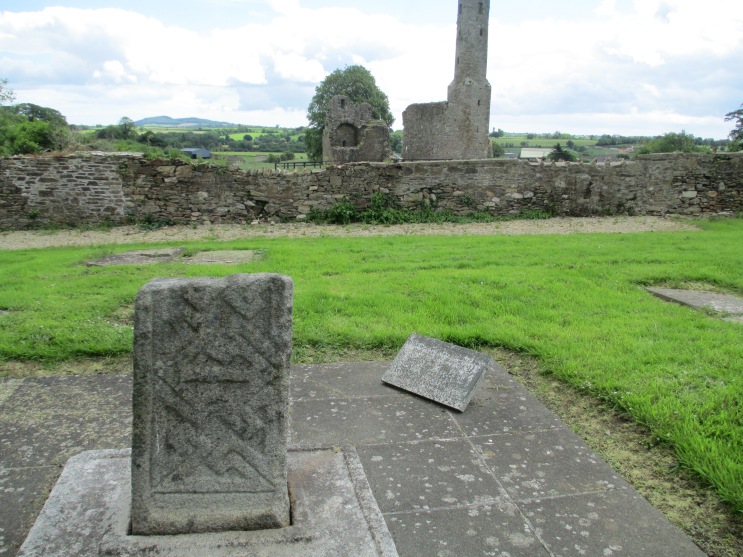
 

Diarmut grave


Dermot’s grave in Ferns, Ireland.

Strongbow died in 1176 leaving a son and daughter too young to inherit and so Leinster was in the hands of the Crown until Strongbow’s son came of age. The son, Gilbert, died as a minor in 1185 and thus Isabel de Clare inherited everything. Marshal on marrying Isabel gained lordship of her entire estate.[4] Trouble could be expected from the local Irish population who were not likely to welcome a new overlord. These peoples included the English lords who had been settled there for more than a decade and the original Irish lords. Marshal faced an uphill challenge in controlling and developing Leinster and it was one at which he certainly succeeded

On taking possession of Leinster Marshal sent deputies but did not go himself until c. 1201, and then only for a brief visit. The Irish Annals found in The Chartularies of St Mary’s Abbey in Dublin recorded that Marshal was in Ireland c. 1201.

st mary's dublin

All that remains of St Mary’s Abbey in Dublin.

They said that he came in a storm and, in thanks to God for his survival on the unforgiving Irish Sea, he founded the abbey of Tintern Parva.[5]

tintern parva

Tintern Parva on the Hook Head Peninsula in Ireland.

ship on the way to ireland

Depiction of the near disaster on the Irish Sea from the Ros Tapestry.

Marshal returned to Ireland in c. 1207 and faced rebellion, mainly from Meyler Fitz Henry. Fitz Henry was one of the original settlers, a bastard grandson of Henry I and had been appointed Justiciar of Ireland, ruler in the king’s absence, by King John. He was tenant in chief of some small fiefs, most of which he held from Marshal. Fitz Henry and Marshal were in repeated conflict and King John involved himself in Fitz Henry’s favour. Fitz Henry led many battles against Marshal’s lands both when Marshal was in Ireland and when he was not.[6] As can be seen in two charters from King John in 1216 Marshal ultimately managed to prevail and found his way back to John’s favour with Fitz Henry disgraced. The first granted Marshal Fitz Henry’s fees, a form of rent or tax, in Marshal’s own lands. The second said that if Fitz Henry should die or take the habit Marshal was to receive Fitz Henry’s fees in the Justicary’s jurisdiction, which effectively disinherited Fitz Henry’s son.[7]

As well as exercising control Marshal was responsible for developments such as the port town of New Ross. Marshal began New Ross, which still exists today, in c. 1207.[8] Once it was established, Marshal set about making it a viable port town. When he was back in favour with King John, c. 1212, Marshal negotiated to ensure that shipping could continue through Waterford and onto New Ross. Waterford was the main port and the Crown had controlled it since 1171.[9] Marshal needed his own port and New Ross suited well because of its deep harbour, river access to the heart of Leinster and links with nearby lordships.[10]
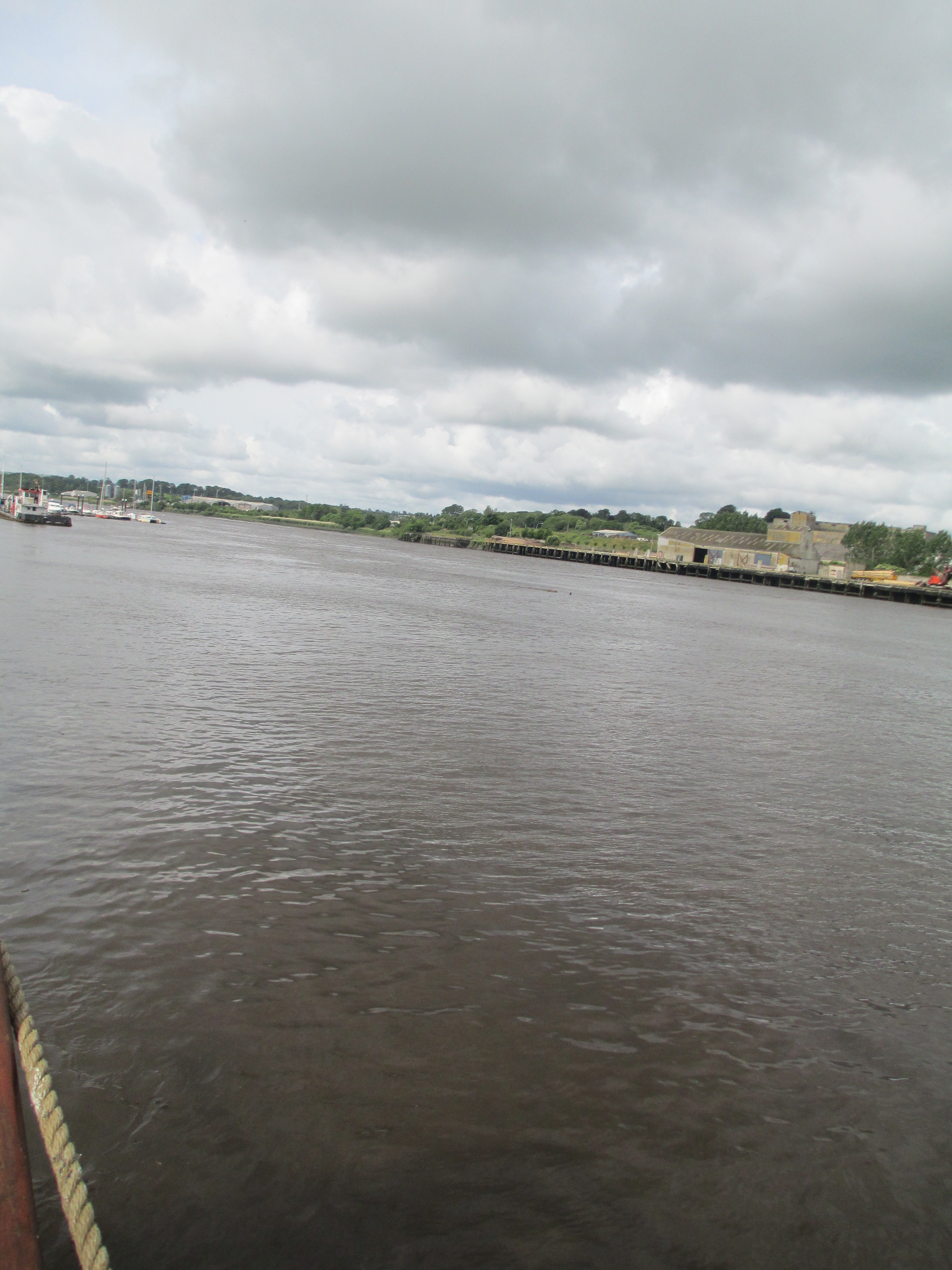
river new ross

 The Barrow river in New Ross.

New Ross is only one of the building and consolidation projects that Marshal undertook in his Irish lands during his lordship. He established other towns and also built a number of castles. He made settlements on the edges of nearby counties, retook land that had been previously lost and established monastic foundations and built a lighthouse which still stands today.
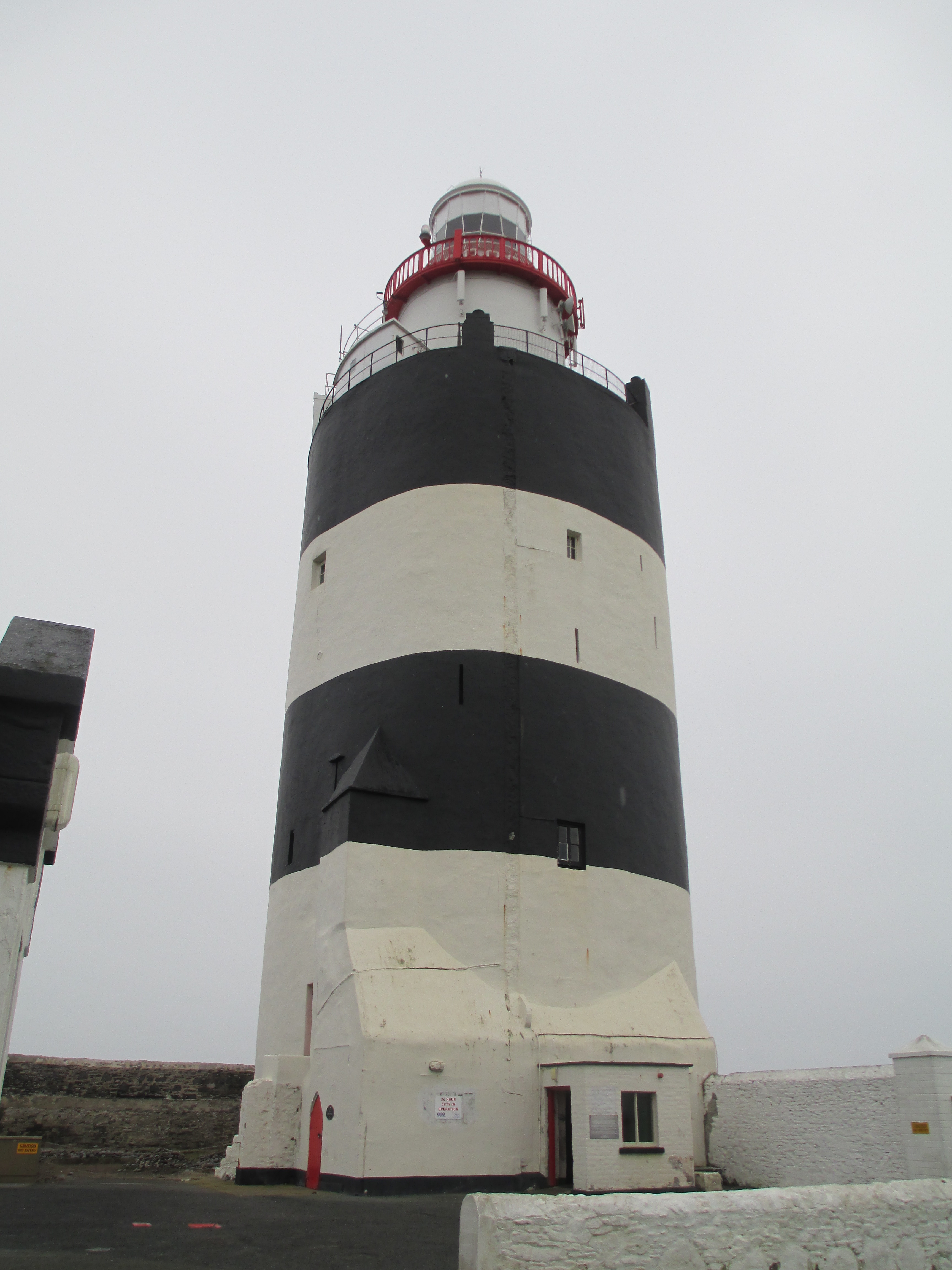
lighthouse

 Marshal’s lighthouse on the Hook Head Peninsula.

ferns castle irland

Ferns Castle which Marshal also built.

Marshal also took over lands that had lacked any kind of central authority because the Crown had run them for many years from a distance.[11] Marshal managed to establish a strong and stable lordship, despite the fact that he was so caught up in English affairs. This administrative skill ensured that he maintained his position as Lord of Leinster, as well as his other lands, and that he was sufficiently influential and experienced to become first the Earl of Pembroke, a title which he came to through right of Isabel, under King John in 1199 and then Regent in 1216.
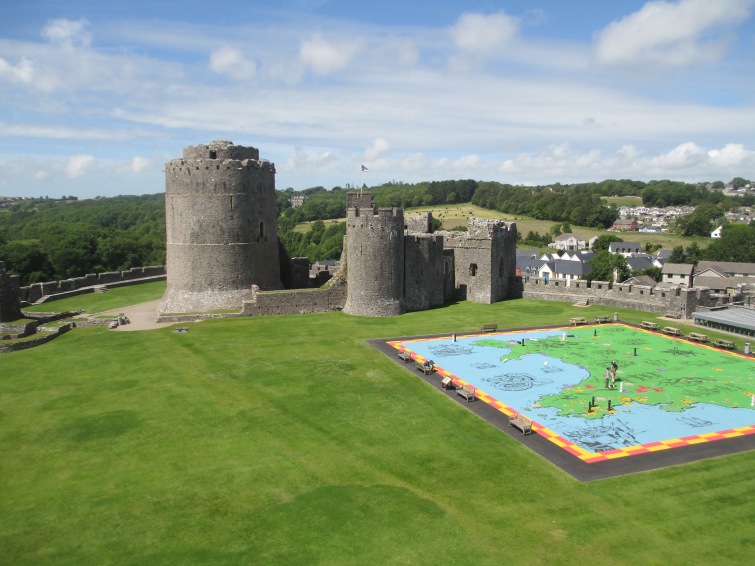
IMG_5435

Pembroke Castle in Wales.

When Marshal married Isabel de Clare he became one of the most influential barons of his time because the marriage laws meant he became ruler of everything that was hers. When it came to marriage, a woman’s lineage, her family and connections, were as important as her lands. In Marshal’s case through Isabel he gained the physical lands themselves but also the eminence of her background as the daughter of an earl and the granddaughter of a King of Ireland.

Lineage and land were not all that Marshal gained from his marriage because the couple also had ten children, five sons and five daughters, all of who survived to adulthood.[12] All five daughters married influential and high ranking noblemen and only the youngest, Joan Marshal, was unmarried when her father died.[13] This gave Marshal alliances in a variety of noble families, another use for heiresses, and helped to give him the support he needed to stay in power even when he was out of favour with King John. It is due to his eldest son William that his memory survives today in such detail because it was he who commissioned the History. Marshal achieved what eluded many prominent landholders of his time because he had five sons thus having multiple heirs. When Marshal died his authority and legacy seemed safe and his position solidified, which must have made reaching the top of his society seem worthwhile because he had been able to protect all his family and to pass on what he created secure in the knowledge of its survival. Success in this time was intended to be dynastic rather than just personal. Unfortunately this was not to come to pass because, although Marshal never knew it, his sons all died childless and his lands were dispersed.[14]


Chepstow Castle Wales

Chepstow Castle which Marshal gained from marriage to Isabel. He also built significant proportions of it.

Children, lineage and land aside, Isabel as a person and the role she played in the marriage and thus in Marshal’s ascent is much harder to define but just as vital and fortuitous. Isabel came to the marriage probably in her late teens while Marshal was in his early forties. Despite the age difference by all accounts she was an active participant in the marriage and in the governing of the lands. If she had not been it is unlikely that Marshal would have succeeded so well in holding together his disparate domains. She was not only his entrée into the high aristocracy, but her support was important to the retention of his authority. There may have been no legal repercussions if Isabel had not supported Marshal, but the people he ruled were her vassals and would have been more likely to rebel against their new untried lord without Isabel’s support.

Marshal trusted Isabel and her abilities enough to leave her in an administrative position in Ireland c.1207 during the fragile military and political situation, when King John forced him back to England. Before returning to England in c. 1207 the History reports that he said to his men.

My Lords, here you see the countess whom I have brought here by the hand into your presence. She is your lady by birth, the daughter of the earl who graciously, in his generosity, enfieffed you all, once he had conquered the land. She stays behind here with you as a pregnant woman. Until such time as God brings me back here, I ask you all to give her unreservedly the protection she deserves by birthright, for she is your lady, as we well know; I have no claim to anything here save through her.[15]

While it is very unlikely that he spoke these exact words the sentiment is clear. Isabel was Marshal’s key to ruling.

Isabel was a potent symbol to Leinster. She was the daughter of the Princess of Leinster and the granddaughter of its last king, which would have pleased the Irish lords. She was the daughter of Richard Strongbow who had been responsible for establishing many of current English lords, or at the least their fathers, in their lands in Leinster and because she was pregnant she represented the future of the lordship. By leaving her behind Marshal had a reasonable chance that many of his lords would cleave to her and thus his cause, which would leave him free to deal with King John.

Isabel proved a very able defender of Marshal and their lands in Ireland. Almost as soon as Marshal left, she found herself embroiled in war and by 1208 she was besieged in Kilkenny castle and “she had a man let down over the battlements to go and tell John of Earley that it was the very truth that she was besieged in Kilkenny.”[16] John of Earley came and Isabel’s men were victorious. It was also Isabel with whom Meyler Fitz Henry first made peace and it was recorded in History that “he [Fitz Henry] had made peace first with the countess and then with the earl’s men, and … he had given his son Henry as a hostage for his inheritance.”[17] Isabel was very much in command of the defence of her lands even if she could not physically lead men. Isabel was a unifying figure because of her lineage and without her presence in Ireland and her willing participation Marshal could have easily lost Ireland while he was trapped at John’s court.

kilkenny

 Kilkenny Castle as it is today.

Defending her lands was not Isabel’s only involvement because she was also engaged in their creation and improvement. Marshal took the fact that his only claim to the lands was through Isabel very seriously because he made many developments in Leinster with charters that had Isabel’s ‘counsel and consent’ recorded on them.[18] According to Cóilín Ó Drisceoil there is a tradition that Isabel had been heavily involved with making the decision to locate the foundation of the town of New Ross on the Wexford bank of the Barrow River. This was not necessarily the most practical bank on which to build a town, as it was steep and required the building of one of the longest bridges in medieval Ireland. It was perfect however from a political point of view because Wexford was the centre of the former Kingdom of Leinster.[19] The earliest written mention of the tradition of Isabel’s involvement in New Ross’s foundation was in the 1607 work Britannia by William Camden.[20] Isabel understood the political imperatives in building a new city and made sure that they were carried out correctly. She also helped to ensure that Marshal remained lord of all their other lands as well because unlike other noble wives she commonly travelled with him throughout their domains and was involved in their governance. She was the symbol by which Marshal governed as well as an active participant.

st mary's New ross

 St Mary’s Abbey which Marshal and Isabel built in New Ross.

Marshal and Isabel’s match seems to have become one of love. This was exemplified by the way Isabel behaved during and after Marshal’s prolonged death. Marshal first began to fall ill around the end of January 1219 and it took him until midday on May 14th 1219 to actually die.[21] A very moving picture of Isabel just after his death was painted in History “whilst mass was being sung it was observed that the countess could not walk without danger of coming to grief, for her heart, body, her head and limbs had suffered from her exertions, her weeping and her vigils.”[22] This was a final testament to a woman who had stood strongly by Marshal throughout much of his life and his protracted death and had continued to love him. Isabel died only a year later and was buried at Tintern Abbey in Wales.

temple churchIMG_3419

The Temple Church in London where Marshal was burried and his effergy.

tinturn abbey

Tintern Abbey in Wales where Isabel was burried, no trace of her burial remains.

Marshal was given Isabel as a reward and as a way of binding a skilled warrior and an admired man to the new King Richard I in 1189. The authority bestowed on him by this land and the wealth he acquired through marriage meant that he had the ability to make an indelible mark on England. When King John died in 1216 he left a country in turmoil with many of the country’s barons in rebellion. The then approximately 70 year old Marshal was made Regent for the nine year old Henry III and under his direction the country was brought back from the brink and Henry III’s kingship saved. The situation was dire enough to prompt Marshal to declare, according to the History, when he assumed the Regency that “if all the world deserted the young boy, except me, do you know what I would do? I would carry him on my shoulders and walk with him thus,” “ and never let him down from island to island, from land to land.” [23] Marshal was the head of the government who defeated the rebellious barons and the French Prince Louis, later Louis VIII, who was the barons’ candidate for the throne of England.[24] Marrying wards to loyal followers as rewards was a long held practice and one that continued. Much of the time it had little overall effect, however on occasion it elevated a man such as Marshal to a prominent position in society which enabled them to have a far-reaching consequences on the political situation, often in multiple countries.

This will for the moment be the end of my series of noble marriages. I may come back to it at a later date.

All the photos, obviously baring the map at the beginning, are mine.


[1] Catherine A. Armstrong, William Marshal Earl of Pembroke, Kenneshaw: Seneschal Press, 2006, pp. 60-61.

[2] Giraldus Cambrensis, The Conquest of Ireland, (trans.) Thomas Forster, Cambridge: Parenthesis Publications, 2001, p. 13.

[3] Anonymous, The Song of Dermot and the Earl, (ed.) & (trans.) Goddard Henry Orpen, Oxford: the Clarendon Press, 1892, pp. 19-27.

[4] Armstrong, Earl of Pembroke, p. 77.

[5] John T. Gilbert, (ed.) Chartularies of St Mary’s Abbey Dublin with The Register of its House at Dunbrody and Annals of Ireland, Volume II, London: Longman and Co, 1884, pp. 307-308.

[6] Sidney Painter, William Marshal: Knight Errant, Baron and Regent of England, Baltimore: John Hopkins Press, 1933 pp. 145-146.

[7] H.S Sweetman, (ed.) Calendar of Documents, Relating to Ireland, 1171-1251, London: Longman and Co, 1875, p. 106.

[8] Cóilín Ó Drisceoil, “Pons Novus, villa Willielmi Marescalli: New Ross, a town of William Marshal” in John Bradley & Cóilín Ó Drisceoil, (eds) William Marshal and Ireland, Dublin: Four Courts Press, pp. 8-9. A note about this particular text. I am unsure what is happening with the publication of this text. I was very kindly sent advanced chapters and given clear permission to use them for reference in my thesis. I feel that as the sections of this post in which I am using this information are almost verbatim from my thesis that this permission should extend to this post. I am endeavouring to discover what has happened to the publication of this book, but it seems as if it may have actually fallen through, I’m not sure. I still think the information is worth including though.

[9] Sweetman, (ed.) Ireland, p. 99.

[10] Ó Drisceoil, “New Ross” in Bradley & Ó Drisceoil, (eds) William Marshal and Ireland, pp. 10-11.

[11] Adrian Empy, “The Evolution of the Demesne in the Lordship of Leinster: the Fortunes of War or Forward Planning?” in Bradley & Ó Drisceoil, (eds) William Marshal and Ireland, pp. 36-38.

[12] T.L Jarman, William Marshal: First Earl of Pembroke, Oxford: Basil Blackwell, 1930, p. 99.

[13] Anonymous, History of William Marshal, (ed.) AJ. Holden, (trans.) S. Gregory & (notes.) David Crouch, Volume II, London: Anglo-Norman Text Society, 2002. pp. 410-411.

[14] Matthew of Westminster, The Flowers of History: Especially as they Relate to the Affairs of Britain from the Beginning of the World to the year 1307, (ed.) & (trans.) C.A. Yonge, Volume II, London: AMS Press, 1968 , pp. 257-258.

[15] History, Volume II, pp. 177-179.

[16] History, Volume II, p. 193.

[17] History, Volume II, p. 195.

[18] Ó Drisceoil, “New Ross” in Bradley & Ó Drisceoil, (eds) William Marshal and Ireland, pp.11-12.

[19] Ó Drisceoil, “New Ross” in Bradley & Ó Drisceoil, (eds) William Marshal and Ireland, pp. 9-11.

[20] William Camden, Britannia, (trans.) Phillemon Holland, at http://www.philological.bham.ac.uk/cambrit/irelandeng1.html#ireland1, accessed 05/12/14.

[21] David Crouch, William Marshal, Knighthood, War and Chivalry, 2nd ed, London: Pearson Education, 2002, pp. 138-140.

[22] History, Volume II, p. 453.

[23] History, Volume II, p. 287.

[24]D.A Carpenter, The Minority of Henry III, Los Angeles: University of California Press, 1990, pp. 17-64.

Marriage alliances 1180-1250: Part 3 Joan of Wales.

joanna close

joanna far

Joan’s tomb. It now lies in Beaumaris parish church with this inscription above it.

This plain sarcophagus, (once dignified as having contained the remains of Joan, daughter of King John, and consort of Llewelyn ap Iowerth, Prince of North Wales, who died in the year 1237), having been conveyed from the Friary of Llanfaes, and alas, used for many years as a horsewatering trough, was rescued from such an indignity and placed here for preservation as well as to excite serious meditation on the transitory nature of all sublunary distinctions.

Joan of Wales was the illegitimate daughter of King John.  She was born in c. 1190 and died in 1237. All we know about her mother was that her name was Clemence.  In 1206 her father King John gave her in marriage to Llywelyn ap Iorweth Prince of North Wales. She was roughly sixteen and he was in his early thirties.

llew coffin 2

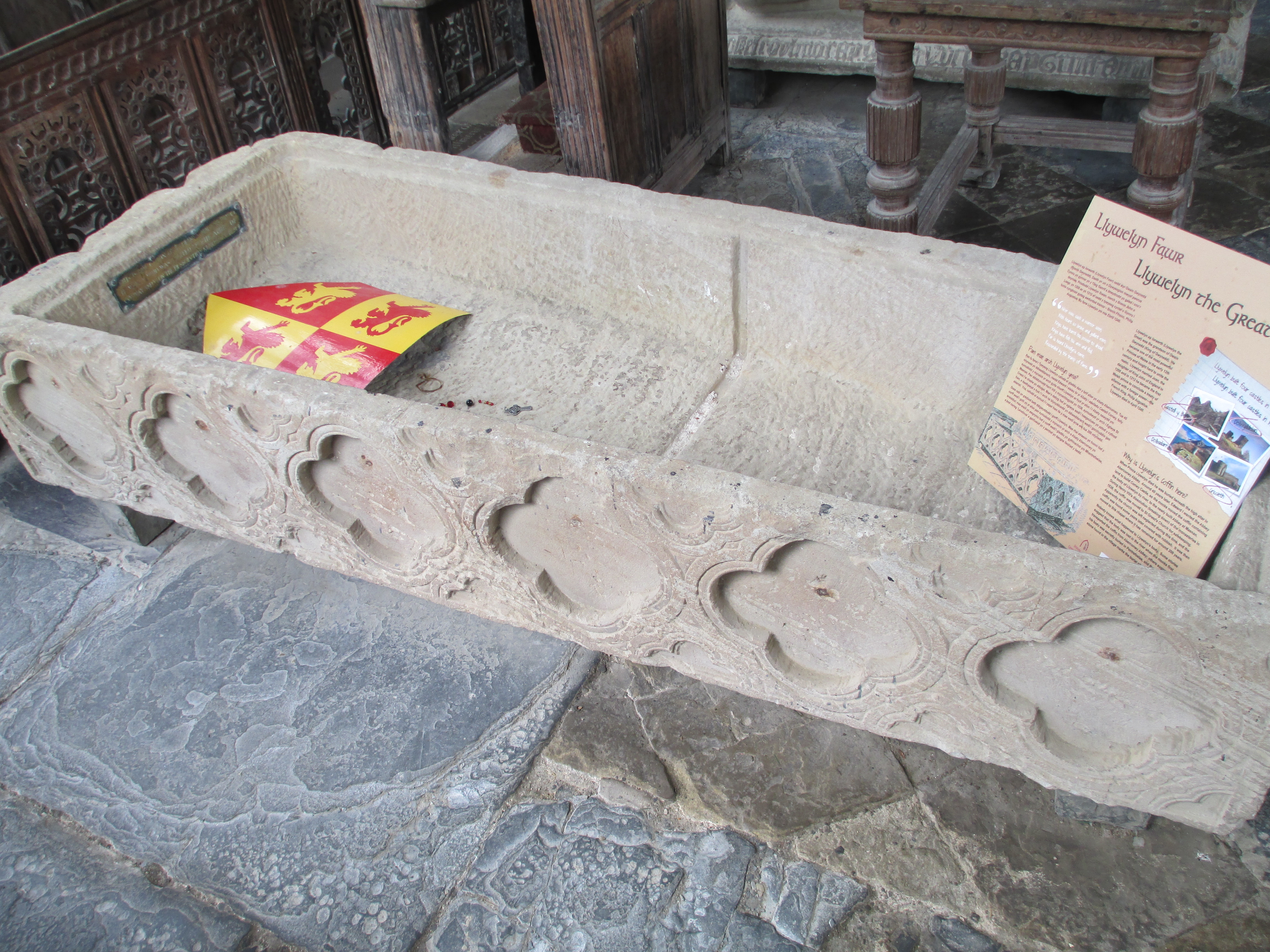
Llywelyn’s sarcophagus.

The sarcophagus is now found in Llanrwst parish church. Llewlyn was buried beneath the high altar of Aberconwy Abbey, but about forty years later Edward I wanted the land the abbey stood on to build Conwy Castle. So the monks moved the coffin containing Llywelyn’s body by river to the newly built abbey at Maenan. During the dissolution of the monasteries the coffin was moved for safe keeping to St Grwst’s church where it was forgotten about and was found covered with rubbish some 200 years later. it was then moved to this chapel in Llanrwst parish church. No one knows what happened to Llywelyn’s body.

llew

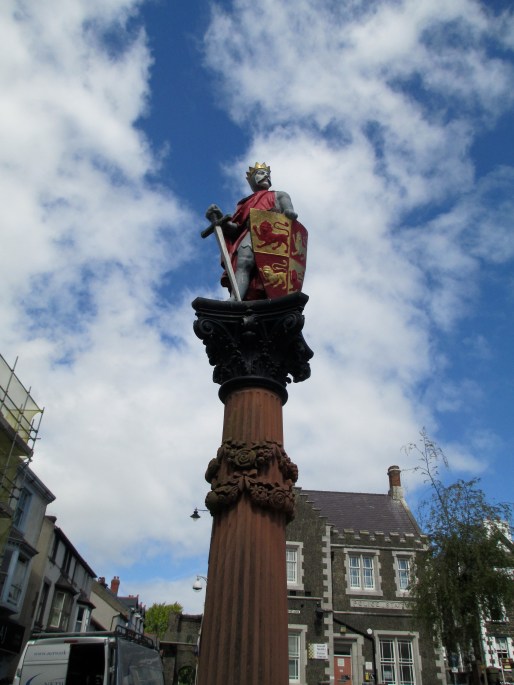
Statue of Llywelyn in Conwy. Obviously not contemporary. Also much smaller than it looks in this photo.

Llywelyn was later known as Llywelyn Fawr (Llywelyn the great). He was the most powerful Welsh Prince of his time and in many ways a serious threat to the English Crown. At this point Wales was still independent of England, although their princes swore featly to the English kings. Joan was sent to a country she didn’t know, whose language she didn’t speak, with a man she had never met before as a bargaining chip from John to try and quell the Welsh. Joan continued to be an important part of English and Welsh negotiations throughout her entire marriage. Joan occasionally acted as a mediator between the two and on one occasion was forced, through circumstance, to beg King John for leniency towards her husband.[1]  Interestingly Joan’s illegitimate birth was not the stigma to the Welsh that it had been to the Norman French. Illegitimate children were even allowed to inherit in Wales as long as their father acknowledged them. However Joan managed to obtain a papal decree in 1226 from Honorius III which declared her legitimate as neither of her parents had been married at the time of her conception, but it clearly gave her no right to the English throne.

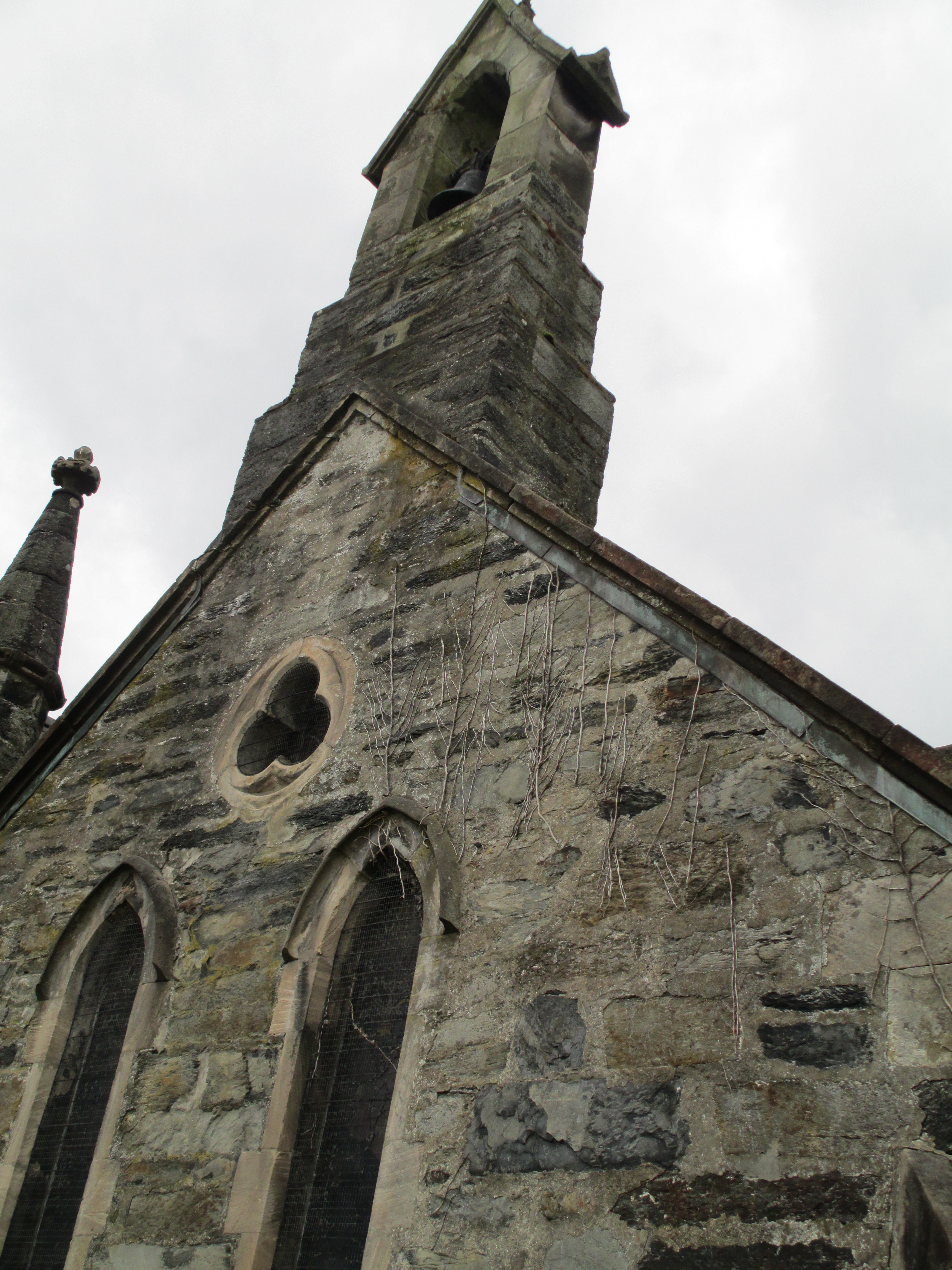
One of the most controversial aspects of Joan’s marriage to Llywelyn was that she committed adultery with William de Barose in 1230. De Barose was found in her bedroom.  De Barose was hanged and Joan was placed under house arrest for twelve months, after which, according to the Chronicle of Chester, Llywelyn took her back and restored her to all her former positions and titles. [2] Their marriage seems to have been one of affection, not many men of the period would have ever forgiven a wife who committed adultery.  Llewlyn was certainly distraught when she died. A Welsh chronicle the Brut y Tywysogion described Llywelyn’s actions at Joan’s death in February 1237. It said “in honour of her [Joan] Llywelyn son of Iorworth had built there [where she was buried] a monastery for barefooted monks which is called Llanvaes in Mona”.[3] So this was one marriage that did seem to have worked emotionally as well as politically. Additionally tradition has it that when they stayed at their hunting lodge at Trefriw Joan found the steep climb to the church at Llanrhychwyn too arduous so in c. 1200 Llywelyn had a church built for her much closer to their hunting lodge. The Church of St Mary’s now stands roughly on the same spot and stain glass windows, not contemporary,  depicting Llywelyn and Joan can be seen in the church in Trefriw. st mary's st mary's stained glass

St Mary’s Church in Trefriw and the stain glass windows. Unfortunately I couldn’t get inside the church as it was locked when I was there.

Joan’s is one of the nicer stories of noble marriages of this time period. Even though she was traded like coin for an alliance and spent much of her marriage trapped between her husband and her father, her marriage itself seems to have been one of at least some affection. Joan also had the advantage of being a little older than some of the other daughters who were used to cement alliances, many were only young girls when they were sent off. Some were even raised in foreign courts. As harrowing as being sent to an alien land where you didn’t speak the language would have been Joan was dealt a better hand than than many of her contemporaries and that says something about the way these women were used during this period.

The next post will look at another noble woman whose marriage turned out for the better. Isabel de Clare was a great heiress and her marriage to William Marshal brought to prominence a man who would have an indelible affect on England.

[1] W.L Warren, King John, London: Eyre and Spottiswode, 1961, pp. 197-198. [2] The Chronicle of the Abbey of St Werberg at Chester. http://www.british-history.ac.uk/report.aspx?compid=67180 [3] Anonymous, Brut y Tywysogion, (ed.) & (trans.) The Rev. John Williams, London: Longman, Green, Longman & Roberts, 1860, pp. 325-327.

Marriage Alliances of Noble Women 1180- 1250: Part 2 Eleanor of Aquitaine

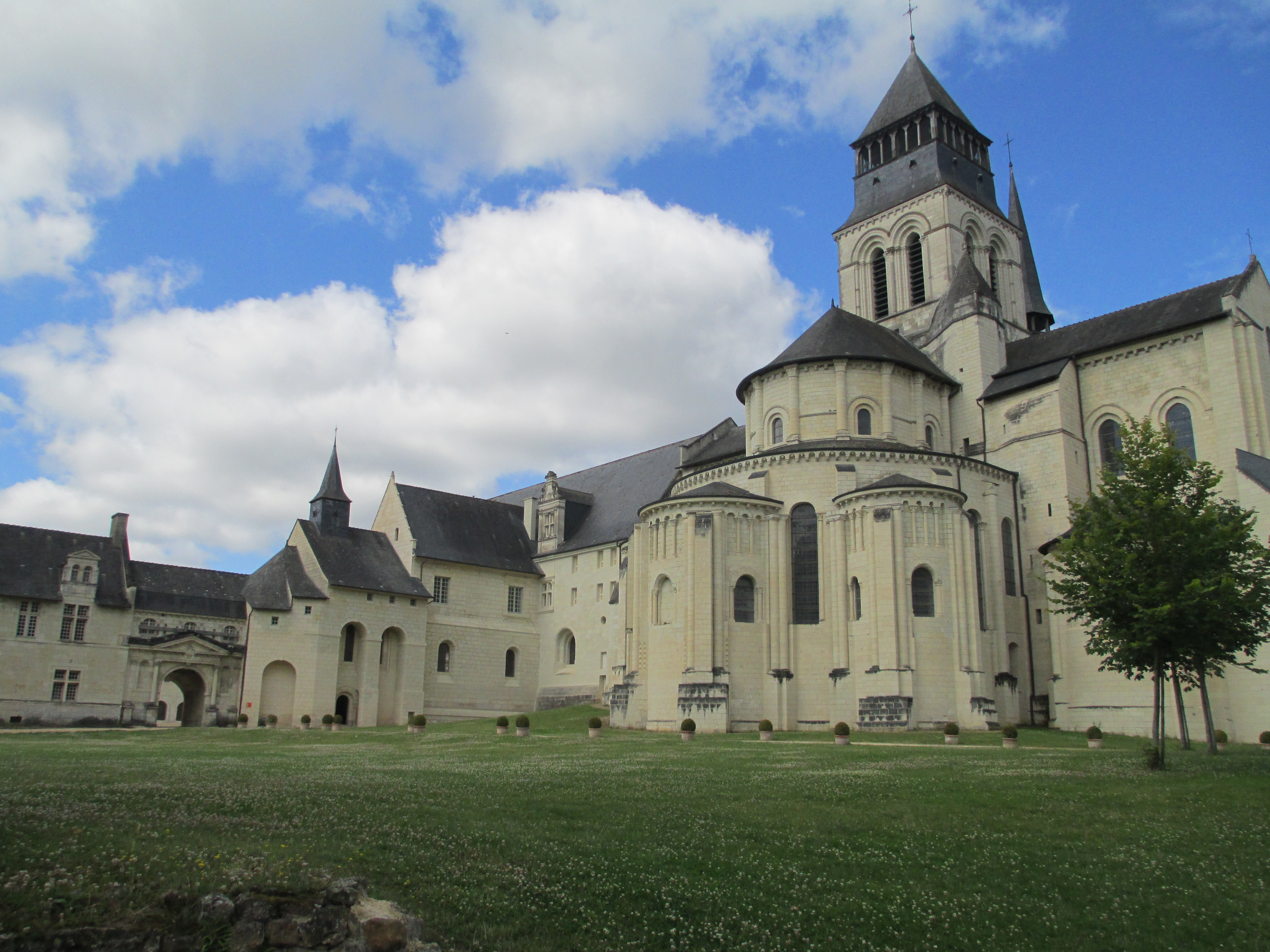
Due to the fact that the majority of interest seems to have been in Eleanor of Aquitaine from part one of this series I am going to begin my investigation of individual women with her. There has been so much written about Eleanor of Aquitaine and I am the first to admit that there isn’t that much new to say, but she is one of my favourites from this time period so I’m always happy to write about her. eofa

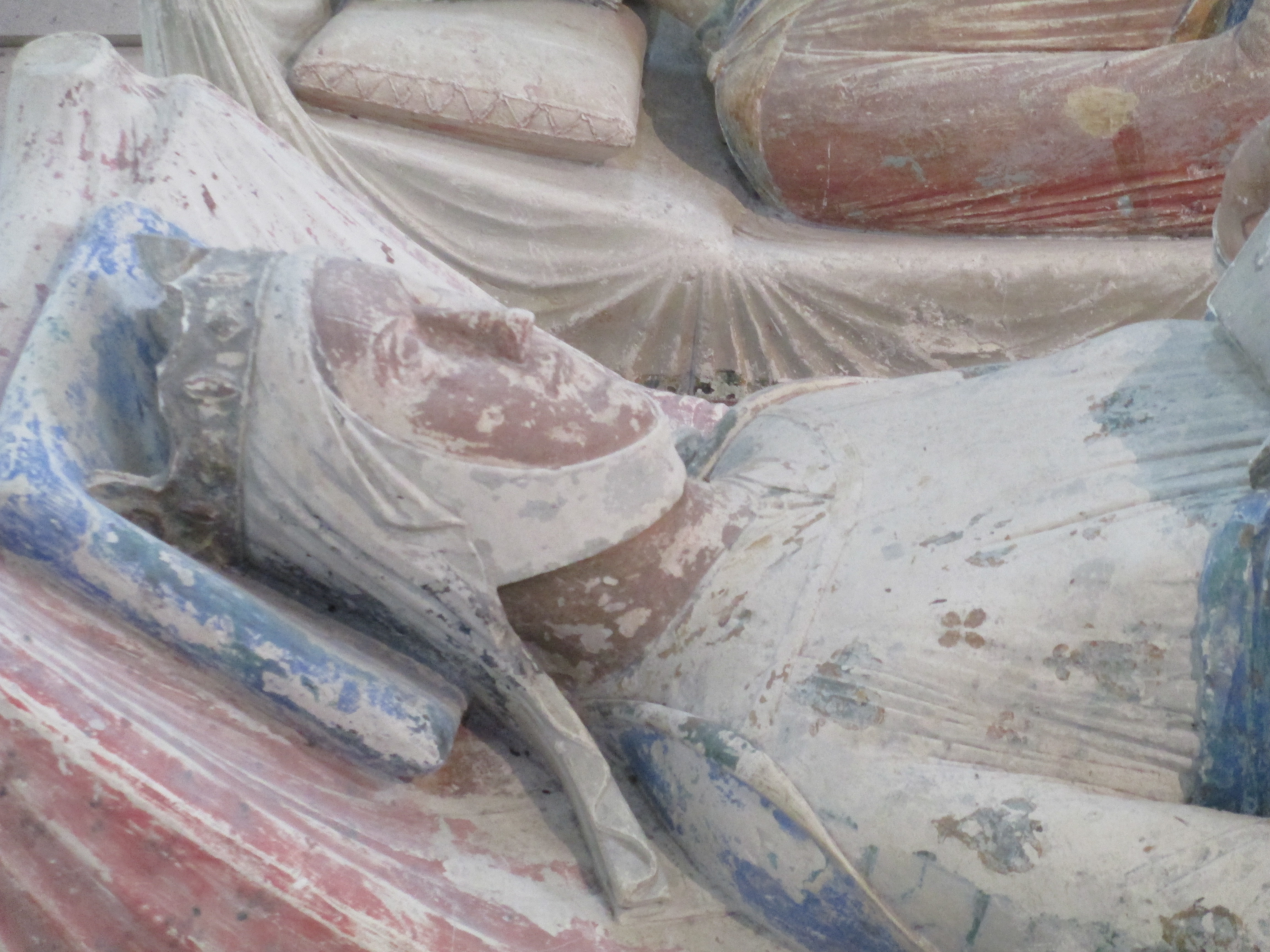
Eleanor of Aquitaine’s effigy at Fontevraud Abbey.

Royal marriages changed the political face of the country and ensured the transmission of states between families. They also formed alliances that helped to stop wars, start wars and disseminate culture between different countries. The royal bride who had the most profound effect on England during this time period was Eleanor of Aquitaine. Eleanor of Aquitaine was married to Henry II from 1152-1189. [1] Her marriage was made for political reasons, on her side as well as Henry’s, but it did later come to involve affection and it appears there was some form of initial attraction on both sides. Her marriage to Henry II also changed English politics. She brought the Duchy of Aquitaine to the English Crown and thus was instrumental in the creation of the Plantagenet Empire on the continent. The Plantagenets ruled substantially more of what we would now consider France than did the French. Eleanor was also the mother of the three kings: Henry the Young King ,who was crowned during his father’s lifetime but died in 1183, Richard I and John I. Richard and John were both kings who made strong marks, good and bad, on the political landscape. Medieval English queens did have authority, but it was largely ceremonial and dependant on their husbands. They had their own unique status, as they were the only ones beside the king who were officially anointed and appointed by God as part of the royal authority.[2] Medieval queens also had their own land in the shape of their dower lands, which were given to them by the king on their marriage. However, how much say the queen had in the running of these lands was dependant on the queen herself and the amount of authority the king allowed her. [3] The queen was also often at the cultural centre of the court.  Even contemporaries who were not otherwise remarkably complimentary of Eleanor of Aquitaine acknowledged the immense cultural downturn the court took in her absence.[4] Patronage was another area in which queens could have great influence.  An example of such patronage is Eleanor of Aquitaine’s 1185 charter to the abbey of Fontevraud. In this charter she gives the abbey and the “nuns serving God there” the “rent of one hundred pounds, in perpetual alms, from the provosture of Poitiers and the vineyard of Benon, particularly what is received from Marcilly.” [5] Fontevraud

Fontevraud Abbey.

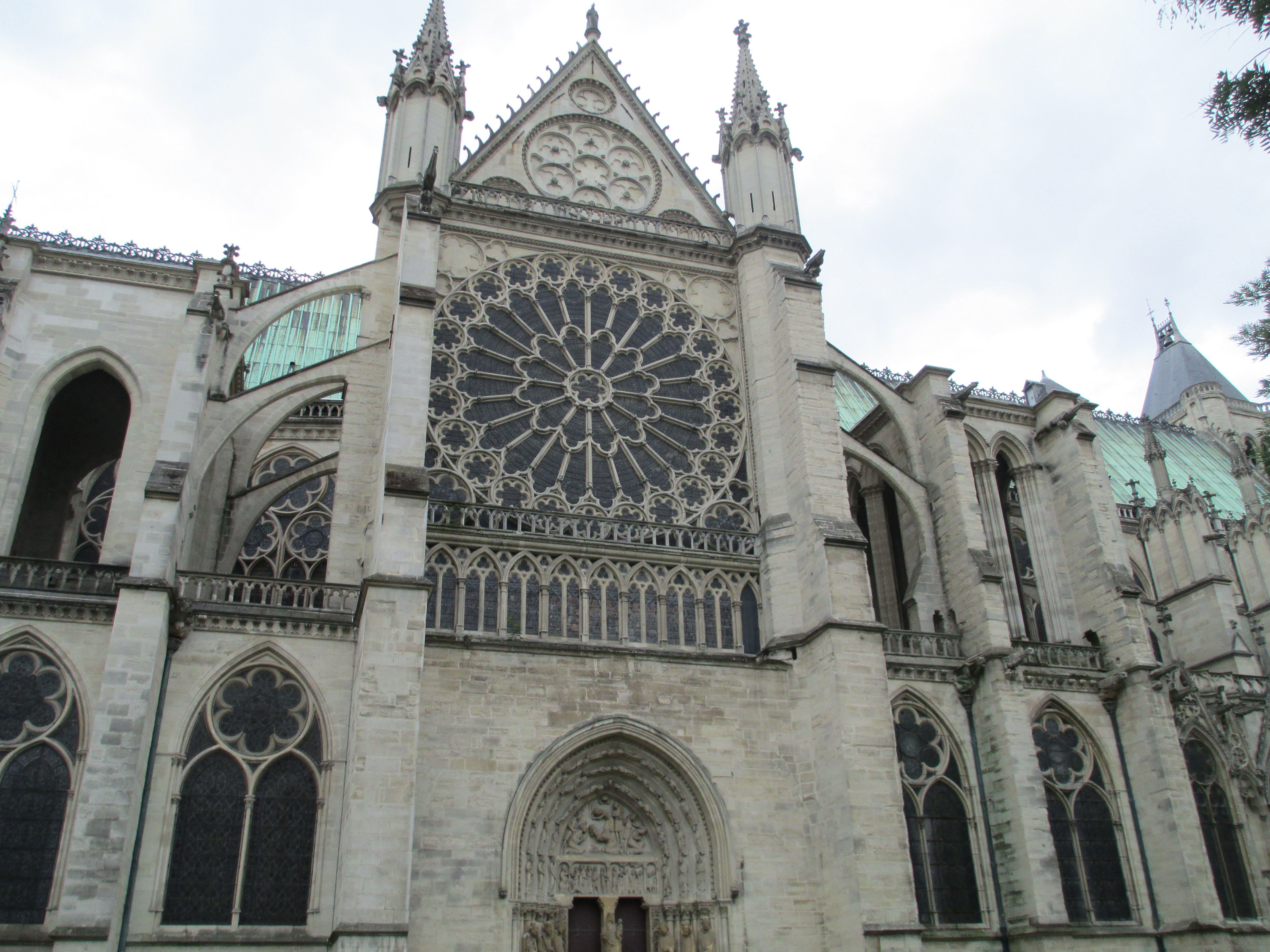
It was primarily because of her background that Eleanor of Aquitaine was able to wield a little more real authority than some other queens of England, though she was still subject to the power of her husband. She was born in c 1124 and was a great heiress in her own right. [6] Her father was Duke William X of Aquitaine and when he died on pilgrimage in c 1137 he left Eleanor as the ruler of one of the biggest and most powerful duchies in Christendom. Contemporary writer William of Newburgh described the duchy as “very extensive” and stretching “from the borders of Anjou and Brittany to the Pyrenees.”[7] In dying William X left Eleanor very vulnerable, because she became a desirable marriage prize.[8]  A little over a month after her father’s death, probably to ensure her own protection, she married Prince Louis the heir to the French throne and the future Louis VII. However for the next fifteen years of her marriage, despite her title as Queen of France, she would have little control over Aquitaine, as Louis took it for himself and installed French administrators.[9] Her marriage was annulled in 1152 and she found herself once again a vulnerable heiress. She married Henry the young Duke of Normandy and the future Henry II of England only eight weeks after the annulment of her previous marriage. This marriage would eventually begin her time as Queen of England, and help to establish her as a woman of authority and power as well as a duchess in her own right.[10] St Denis St denis

 St Denis Cathedral where Louis VII is buried with the majority of the Kings of France. Eleanor would have been very familiar with it.

In the first twenty or so years of her reign as Queen of England Eleanor did have power and involvement, but it was not that dissimilar to the traditional power of a queen. She did originally have some say in the running of Aquitaine, but it was more a position of advising Henry II rather than having a free reign to run the Duchy she had inherited.[11] She also acted as a regent both in England and in various parts of the continental domains. Additionally Eleanor and Henry II seem to have acted in some sort of partnership for the first decade or so of their marriage. This is illustrated with Henry II’s campaign to try to enforce Eleanor’s rights in Toulouse in 1170. This was not a campaign that was particularly advantageous to Henry and it was one that Eleanor had also persuaded her previous husband to undertake.[12] Eleanor also had eight children, including five sons, with Henry II and this helped to increase her standing because she was fulfilling the main role of a queen. Eleanor was not a queen who was just left at home to bear children while the king was out fighting wars. She was present with Henry and without Henry all over their disparate empire and seems to have been very involved in the culture as well as the political side. [13]

henry close

 Effigy of Henry II at Fontevruad Abbey.

However it is also important to note that Eleanor was not necessarily well liked in her new kingdom. Gerald of Wales, a contemporary writer, describes her as having a reputation of “sufficient notoriety,” citing her apparent “carnal knowledge” of Henry’s father Geoffrey of Anjou as evidence.  While it is unlikely this particular accusation was true it does show that Eleanor was very much at the mercy of a masculine world where she was subject to ridicule by male chroniclers. This was a world in which independent authority by a woman, however powerful, was very difficult.[14]

Also her role during the reign of Henry II was curtailed by her fifteen years of imprisonment for her part in her sons’ rebellion. Henry forgave his sons due to their relative youth and the fact that he needed them, but he never forgave Eleanor. The imprisonment was relatively comfortable and it began in the 1174. She was not released until Henry II’s death and Richard I’s ascension to the throne in 1189. In this period she had little influence.  She lost her dower lands and most of her revenues, losing even the traditional trappings of power for a queen. What she did receive she could not dispose of as she wished.[15] Despite the appearance of some autonomy, any power Eleanor did have during the reign of Henry II, like other queens, came courtesy of her husband. She was able to work in partnership as long he allowed her to. So most of her authority came from any influence she might have had over Henry II and his actions. Her acting as regent, while it was a position of significant power, was not independent power.[16] This changed abruptly when Henry II died in 1189.  Eleanor’s certainly shaped the political situation in England with her involvement in the reigns of her sons. It can be seen specifically in her actions in the governance of the kingdom while Richard was on crusade. It was her backing that gave legitimacy to Walter de Coutances, Archbishop of Rouen, when he was appointed as the joint authority with Chancellor Longchamp, Bishop of Ely, who had been left nominally in charge. de Coutances was primarily appointed to check Longchamp’s excesses.[17] Eleanor also mediated in any arguments between the justiciars who were sharing authority in Richard’s absence. Eleanor was also one of the few people who had some influence on Prince John who, as Richard’s most likely heir, caused significant trouble when Richard was out of the country. Eleanor was also not in England all the time that Richard was absent because she traveled across the Plantagenet Empire, helping to hold it together and to bring Richard his new wife Berengaria of Navarre.[18]  In 1191, despite the fact that she was in her late 60’s, she traveled to Navarre, in the modern day Spanish and French borderlands, to bring Berengaria back to marry Richard in Limassol in Cyprus.[19]

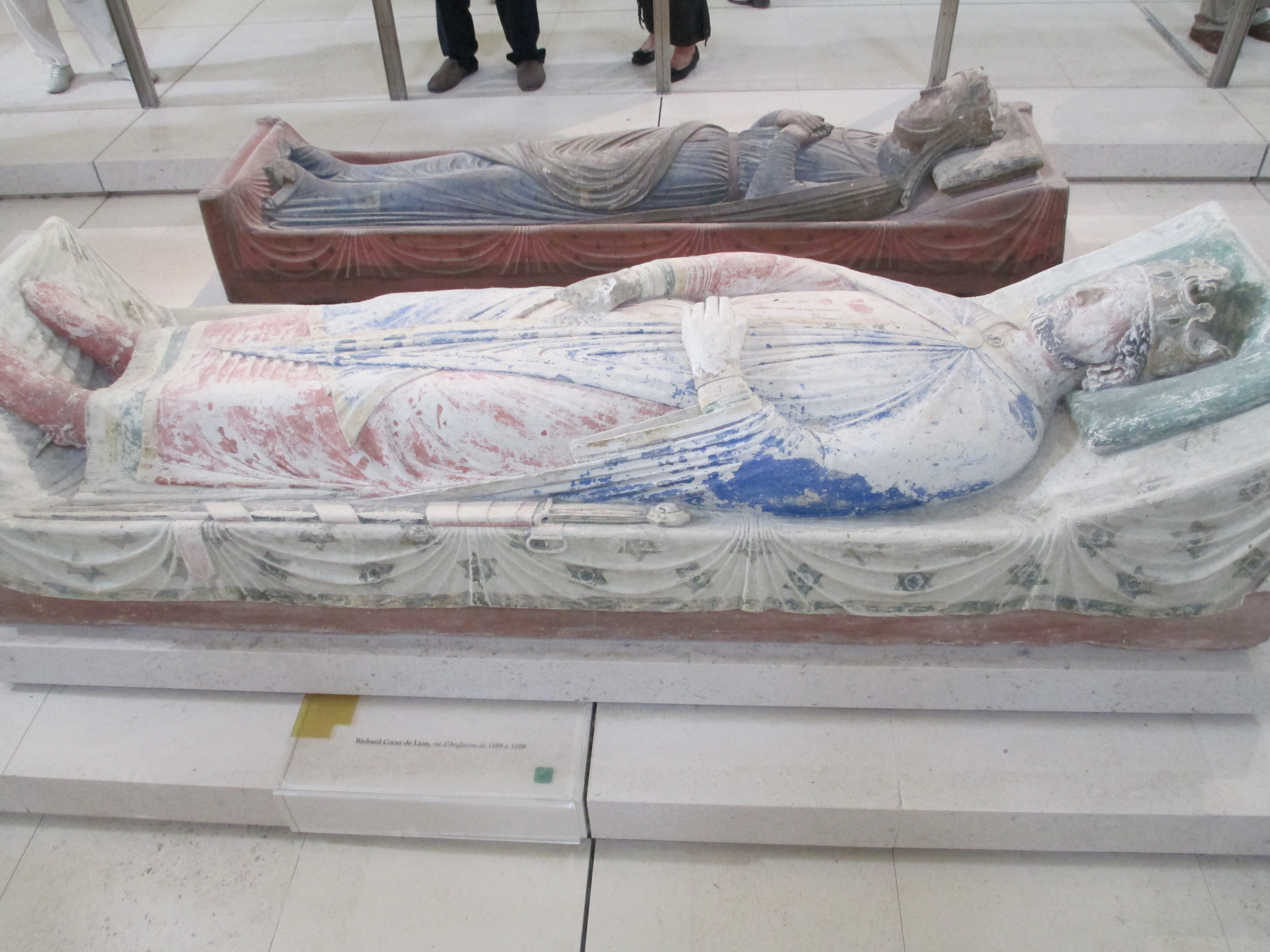
Richard I

Richard’s effigy in Fontevraud Abbey. The effigy beside him is that of Isabel of Angouleme. She was the wife of his brother John and another heiress who will be discussed in a later post.

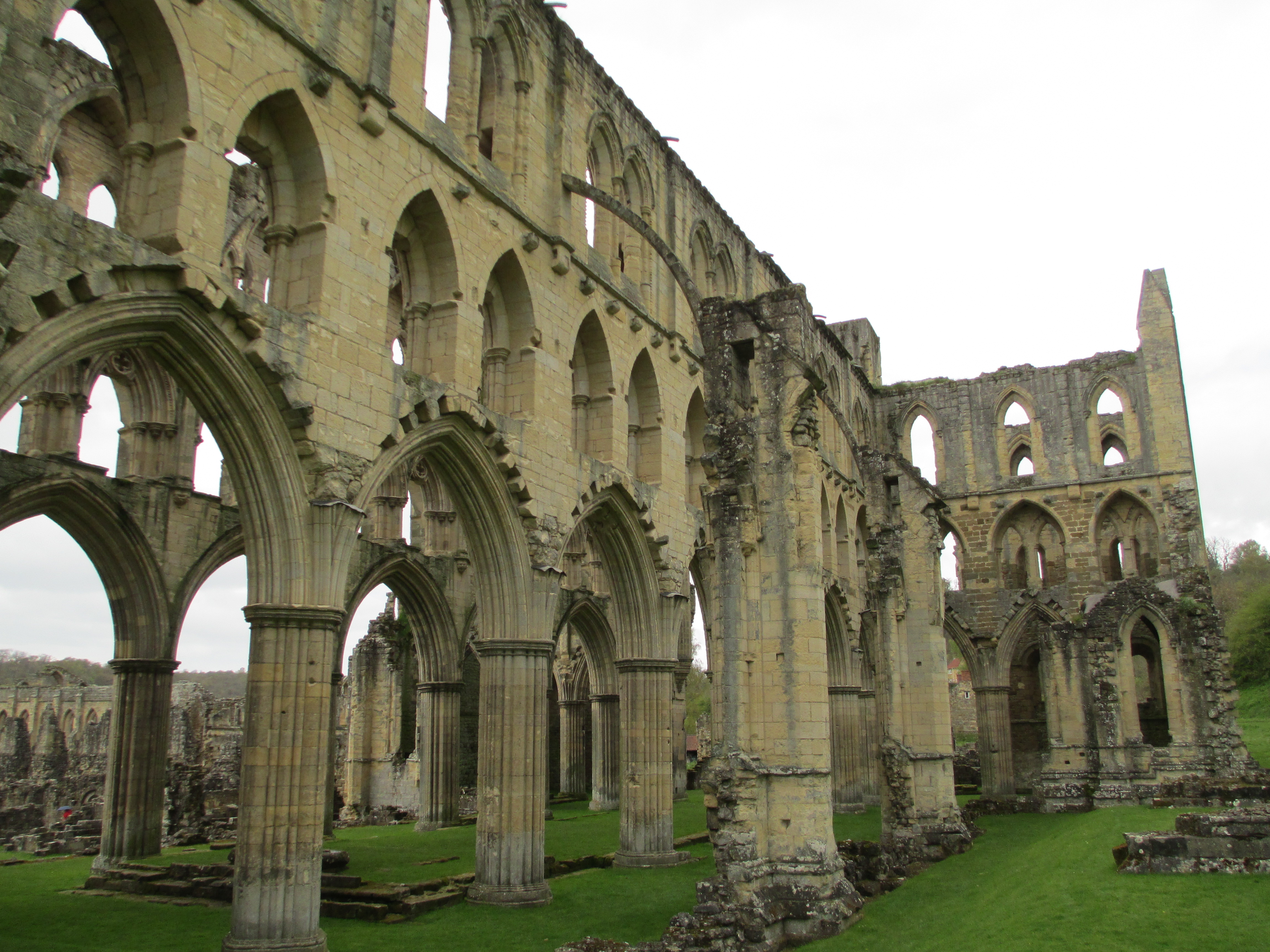
Eleanor’s influence was most apparent when Richard was captured and held for ransom in 1193 on the way back from crusade.[20]   Richard had been taken by Duke Leopold of Austria and the ransom set was the exorbitant 100, 000 silver marks, plus 200 hostages from his vassals’ families.[21] Richard’s lands had already been heavily taxed to help pay for his crusade and now they were squeezed even harder to raise a ransom that was twice England’s annual revenue.[22] One of the ways Eleanor raised the ransom was to approve, with Walter of Coutances,  a levy of one quarter of all moveable goods, a percentage of all knights’ fees and significant contributions of gold and silver from the churches. The only churches that were exempt were the Cistercians and Gilbertines, who were too austere to have gold and silver. From these she demanded a percentage of their wool clip. Her integral involvement in these levies is illustrated by the fact that the treasure was stored with her seal on it as well as Walter of Coutances’.[23] riv2 riveaux

Cistercian abbeys like Riveaux were exempt from providing gold for the ransom.

Richard I also placed great importance on his mother’s role in keeping his kingdom together. This is very well illustrated in the letter that he wrote to her in 1193, requesting her assistance in ensuring that Hubert Bishop of Salisbury would be made Archbishop of Canterbury. Firstly in this letter he describes Eleanor as by the grace of God “Queen of England.” Which clearly shows that he considers her authority paramount. Additionally he thanks her for the “faithful care and diligence [she gave] to [his] lands for peace and defense so devotedly and effectively.” He goes on to say that her “prudence and discretion” is the “greatest cause of [his] land remaining in a peaceful state until [his] arrival.”[24] This independence of action is further illustrated in another letter of Richard’s, regarding the appointment of Hubert.  He appeals to “his dearest mother Eleanor, by that same grace Queen of England, greetings and the inviolable sincerity of filial love”. He appeals to her to ensure that the justiciars the bishops of Canterbury Church, and anyone else she believes needs to be involved, instate Hubert of Salisbury as Archbishop of Canterbury. The fact that Richard I assumes that Eleanor will have the influence and power to achieve his request, indicates the power and independent authority that she wielded during his reign.[25] Henry II married Eleanor as a royal bride mainly for political reasons, they barely knew each other when they were married, but she made an indelible mark on England primarily in holding the country together. The next post in this series will be about Joanna Princess of Wales. She was the wife of Llywelyn ap Iorwerth, know as Llywelyn the Great, and the illegitimate daughter of King John.

[1] Marie Hivergneaux, “Queen Eleanor and Aquitaine 1137-1189”, in Bonnie Wheeler & John Carmi Parsons, Eleanor of Aquitaine Lord and Lady, New York: Palgrave Macmillan, 2003, p 55.

[2] Lisa Hamilton, Queens Consort, London, 2008, pp. 1-3.

[3] Anne Crawford, The Letters of the Queens of England, Stroud, 1997, pp. 8-9.

[4] Lisa Hamilton, Queens Consort, London, 2008, pp. 8-9.

[5] Eleanor of Aquitaine Charter to Fontevrault, 1185 at http://epistolae.ccnmtl.columbia.edu/letter/885.html.

[6] Desmond Seward, Eleanor of Aquitaine, London, 1978, pp. 13-14.

[7] William of Newburgh, The History of English Affairs, trans. PG, Walsh and M.J Kennedy, (eds), William of Newburgh History of English Affairs, Warminster, 1988 pp.129-131.

[8] Melrich V Rosenberg, Eleanor of Aquitaine, Massachusetts, 1937, pp. 4-5.

[9] Desmond Seward, Eleanor of Aquitaine, London, 1978, pp. 21-23.

[10] Ibid., pp. 63-69.

[12] Ralph V Turner, Eleanor of Aquitaine, Padstow, 2009, p. XVIII.

[12] Ibid., pp. 123-125.

[13] Ibid., pp. 139-141.

[14] Gerald of Wales, The Death of Henry II and Comments on the Angevin Family, at http://www.fordham.edu/halsall/source/geraldwales-dip1.html.

[15] Ralph V Turner, Eleanor of Aquitaine, Padstow, 2009, pp. 233-237.

[16] Richard Barber, Henry Plantagenet, Ipswich, 1964, pp.182-183.

[17] Ralph V Turner, “The Role of Eleanor in the Government of Her Sons,” in Wheeler and Carmi Parsons, (eds) Eleanor of Aquitaine, pp. 79-83.

[18] Crawford, Queens of England, pp. 32-34.

[19]. Anne Crawford, “Berengaria of Navarre,” in Anne Crawford, The Letters of the Queens of England, Stroud, 1997, pp. 43-45.

[20] Ibid., pp. 299-301.

[21] Andrea Hopkins, “Eleanor of Aquitaine,” in Andrea Hopkins, Six Medieval Women, London, 1997, pp. 56-57.

[22] Alison Weir, Eleanor of Aquitaine By the Wrath of God, Queen of England, London, 1999, pp. 229-230.

[23] Ralph V Turner, “The Role of Eleanor in the Government of Her Sons,” in Bonnie Wheeler and John Carmi Parsons (eds) Eleanor of Aquitaine, Lord and Lady, New York, 2003, pp. 83-85.

[24] Richard I Letter to Eleanor of Aquitaine, 1193, at http://epistolae.ccnmtl.columbia.edu/letter/148.html.

[25] Richard I Letter to Eleanor of Aquitaine, 1193, at http://epistolae.ccnmtl.columbia.edu/letter/149.html.

Bury St Edmunds

The abbey at Bury St Edmunds is only ruins today, but it was once one of the largest and most powerful abbeys in England. It was home of the Chronicle of Bury St Edmund’s and was one of the places that the Magna Carta was planned. It was a casualty of the dissolution of the monasteries, handed over to the king in 1539.

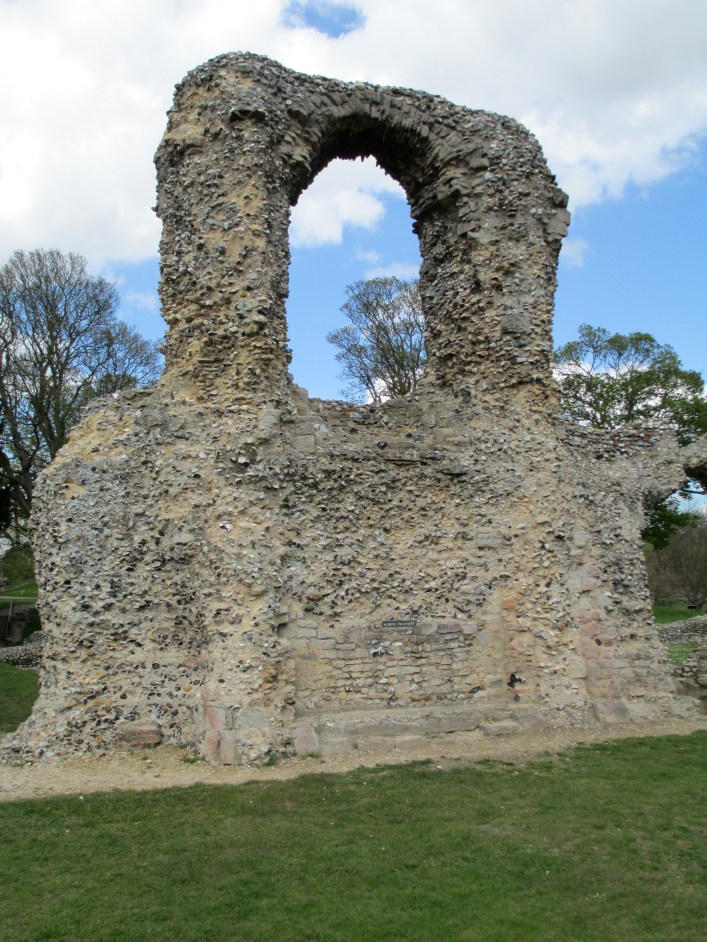
There isn’t a lot left now, but what remains is majestic and  poignant. It allows a glimpse of how spectacular the abbey would have been in all its glory.

bury

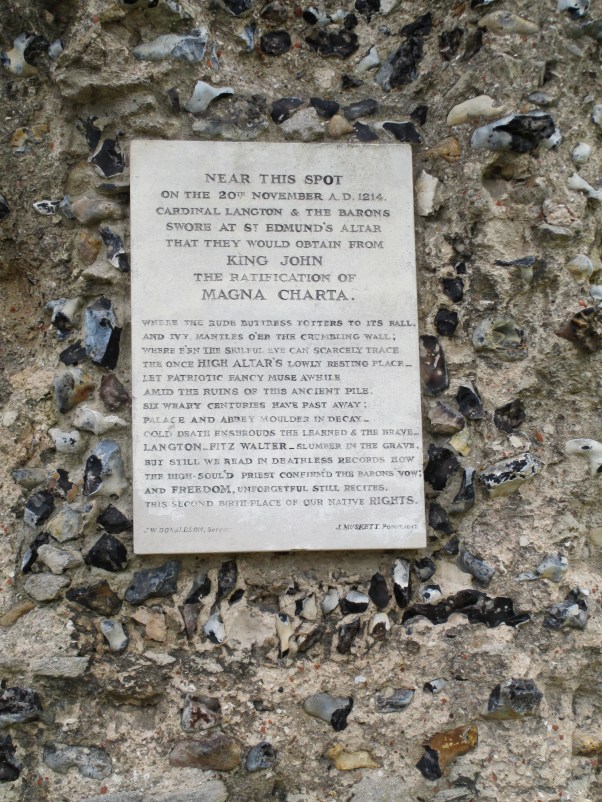
The tallest pillar you can see to the left of the picture is near where the Magna Carta barons met to swear on the altar of St Edmund that they would obtain ratification of the Magna Carta from King John.  The plaque below is affixed to it.

bury st 4

St Edmund’s is also the abbey that Eustace, the wildly unpopular son of King Stephen, plundered right before he died unexpectedly, possibly from choking to death. Many felt that his death was divine wrath, similar to the death of Henry the Young King.

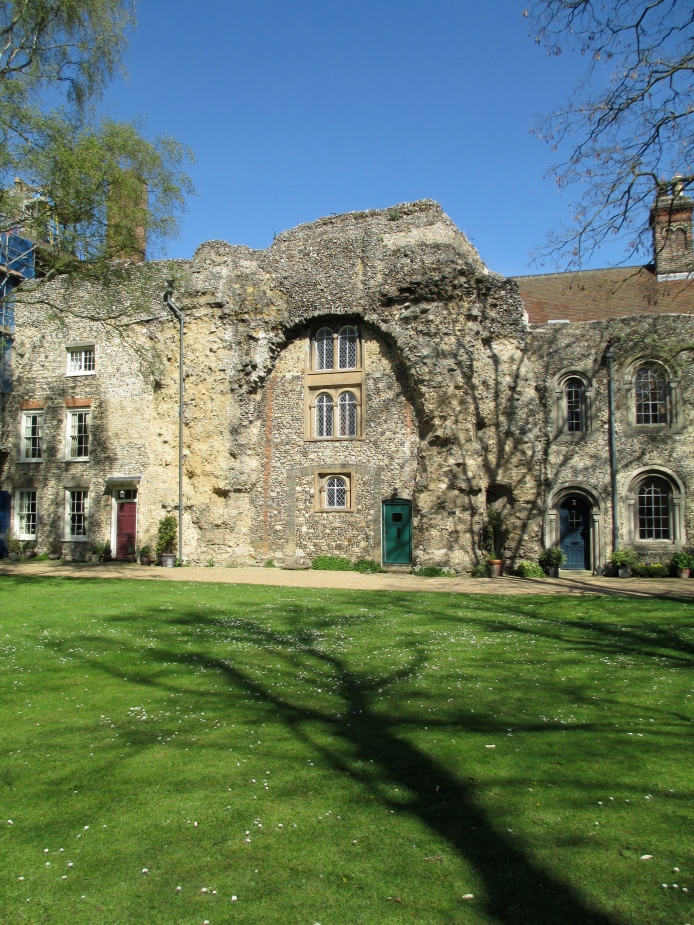
The Chronicle of Bury St Edmunds was also written at the abbey. The Chronicle was written by Jocelin de Brakelond who was the chaplain of Abbot Samson. Samson was  one of the Abbots who had the most structural influence on the abbey. Samson completed the great western front of the abbey.  More of the west front survives today than any other part of the abbey, but it is largely houses. You can still see the remains of Samson’s great arches.bury st8

bury st door

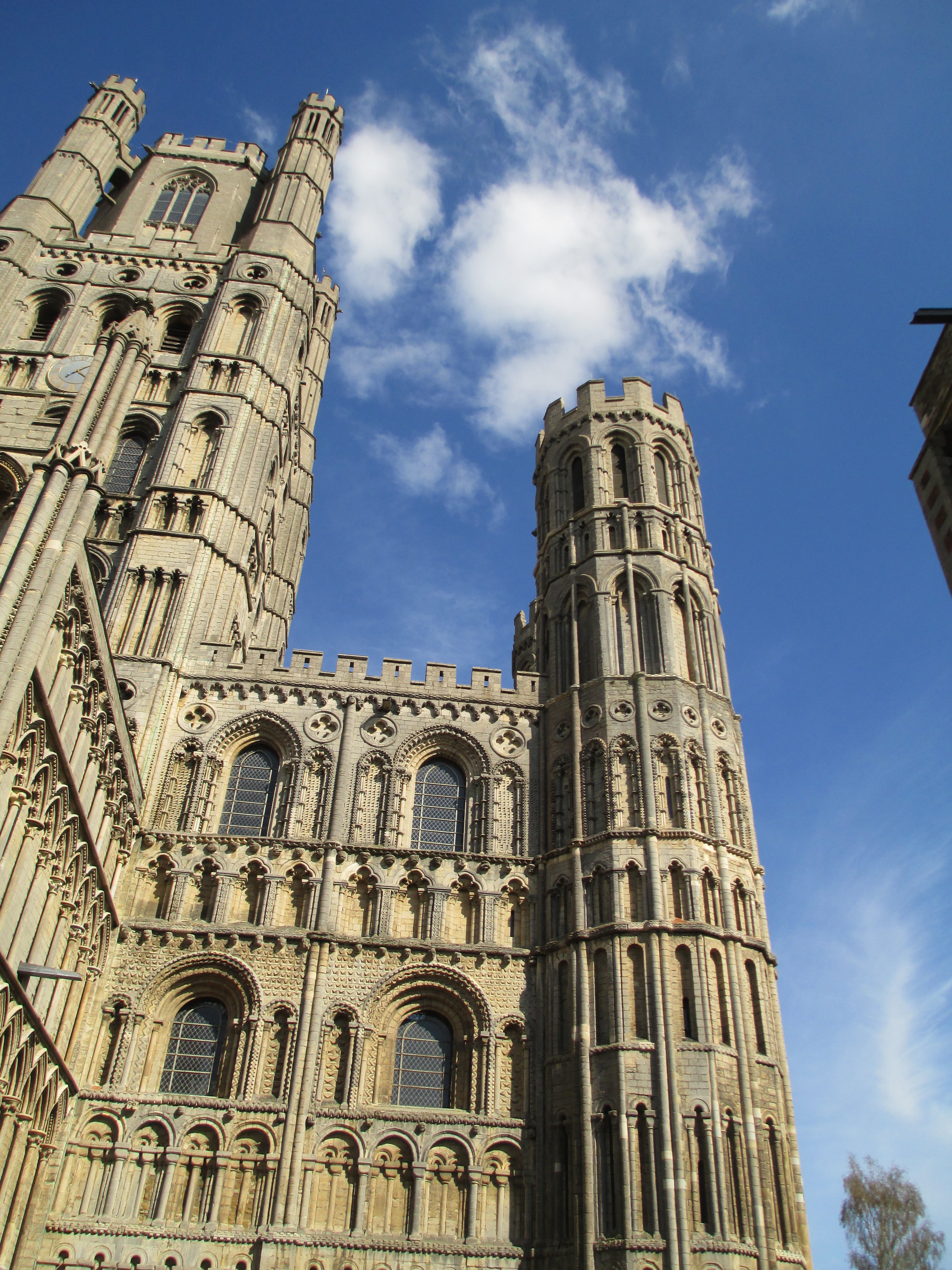
Samson also had an almost competition with Geoffrey Ridel who was Bishop of Ely. Geoffrey requested that Samson let him have oaks from Elmsett for his own building operations at Ely and Geoffrey had secretly gone through and marked the trees he wanted. Samson felt he had to agree, but he immediately felled the best oaks in Elmsett for his own works.  This is an excellent illustration of the competition between the large religious institutions. You can see Ely Cathedral below.

ely

Samson’s works on the abbey and general life at the abbey over this period , 1173-1202, are the main subjects of the Chronicle. It also provides an intriguing picture of Samson himself.

“ABBOT SAMSON was below the average height, almost bald; his face was neither round nor oblong ; his nose was prominent and his lips thick; his eyes were clear and his glance penetrating; his hearing was excellent; his eyebrows arched, and frequently shaved; and a little cold soon made him hoarse. On the day of his election he was forty­ seven, and had been a monk for seventeen years. In his ruddy beard there were a few grey hairs, and still fewer in his black and curling hair. But in the course of the first fourteen years after his election all his hair became white as snow.

He was an exceedingly temperate man ; he possessed great energy and a strong constitution, and was fond both of riding and walking, until old age prevailed upon him and moderated his ardour in these respects. When he heard the news of the capture of the cross and the fall of Jerusalem, he began to wear under garments made of horse hair, and a horse­ hair shirt, and gave up the use of flesh and meat. None the less, he willed that flesh should be placed before him as he sat at table, that the alms might be increased. He ate sweet milk, honey, and similar sweet things, far more readily than any other food.

He hated liars, drunkards, and talkative persons; for virtue ever loves itself and spurns that which is contrary to it. He blamed those who grumbled about their meat and drink, and especially monks who so grumbled, and personally kept to the same manners which he had observed when he was a cloistered monk. Moreover, he had this virtue in himself that he never desired to change the dish which was placed before him. When I was a novice, I wished to prove whether this was really true, and as I happened to serve in the refectory, I thought to place before him food which would have offended any other man, in a very dirty and broken dish. But when he saw this, he was as it were blind to it. Then, as there was some delay, I repented of what I had done, and straightway seized the dish, changed the food and dish for better, and carried it to him. He, however, was angry at the change, and disturbed.

He was an eloquent man, speaking both French and Latin, but rather careful of the good sense of that which he had to say than of the style of his words. He could read books written in English very well, and was wont to preach to the people in English, but in the dialect of Norfolk where he was born and bred. It was for this reason that he ordered a pulpit to be placed in the church, for the sake of those who heard him and for purposes of ornament.”

This excerpt offers an intriguing glimpse into the world of Bury St Edmund’s.

To read more go to http://www.fordham.edu/halsall/basis/jocelin.asp

The remains of St Edmund’s Abbey are like the bones of a giant, you can see the greatness that was once there.  The first photo below shows the remains of what would once have been a beautiful window and the second shows that bases of pillars that held up part of the church.

bury st 5

bury st 3

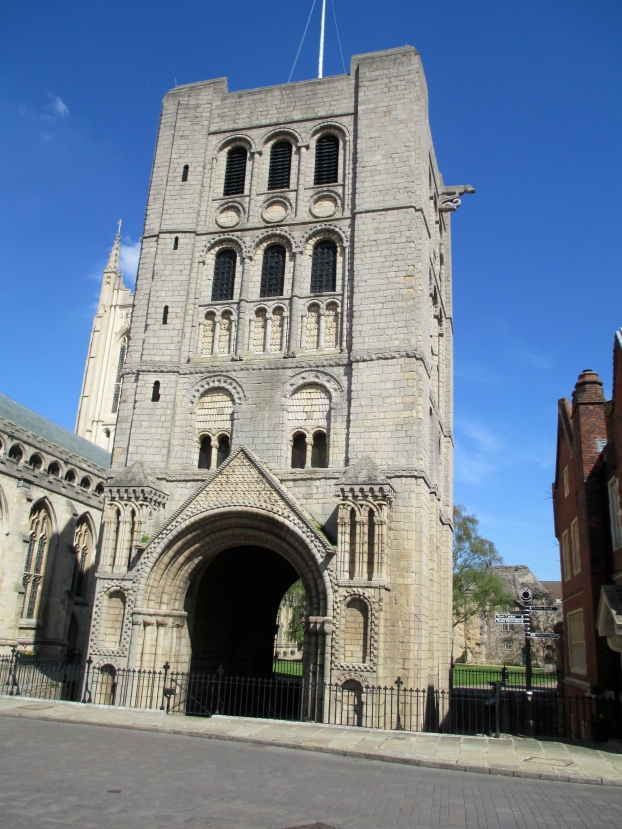
One of the pieces that has survived the destruction of the abbey is the Norman Tower. It was built 1120-1148 and was designed to be both a gateway to the abbey church and a belfry for the church of St James next door, it still serves as a bell tower. It was funded by Abbot Anselm instead of a pilgrimage to St James De Compostella. The carved stone work that survives is truly beautiful.

bury st 7

bury st 6

Bury St Edmond’s was once one of England’s most important and majestic abbeys, you can see from the model below just how large it was, there might not be much left now but there are at least still echoes of the past.

bury st

Strata Florida Tiles

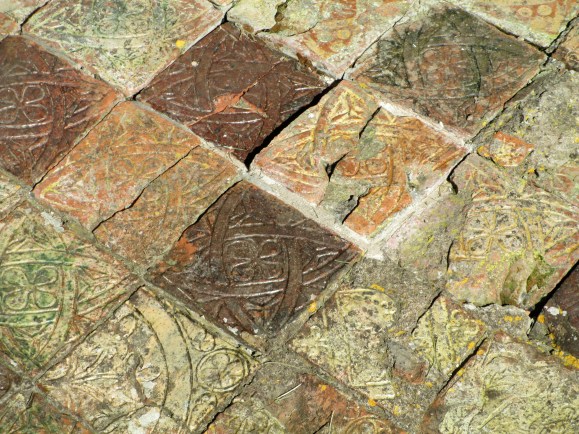
These are medieval tiles from Strata Florida Abbey in Wales.Tiles Strata Florida

The abbey itself is absolutely beautiful, though there isn’t much left. It was not a casualty of the Dissolution of the Monasteries, which is the reason most of the abbeys in the UK are ruins. Strata Florida was a casualty of the repeated English incursions because it always strongly supported the Welsh Princes.

Strata Florida

The abbey is also where the important Welsh Chronicle Brut y tywysogion was written. It was a year by year account of the main events in Wales from AD682 to AD1282. It finished with the death of Llywelyn ap Gruffudd, known as the last true Prince of Wales. The full text of the chronicle can be found at https://archive.org/details/brutytywysogiono00cara.

The abbey is also the burial place for some of the Welsh Princes of Deheubarth and their families.

burial

The tiles themselves are interesting just because they survived. Not many medieval tiles did. These particular ones date to the early 14th century. They were uncovered in excavations in the 1880s and the large section that is now in the south transept are made up of many of these fragments. Their discovery helped Strata Florida become a tourist attraction to wealthy Victorians, though it is rumoured that the occasional tile was taken as a souvenir. The tiles were made in England but laid in Wales and only important guests and choir monks were allowed to stand on them. They also have patterns and designs. See if you can see any of them.tiles strata floridaCommon symbols include the fleur de lis which is a reminder of the origins of the Abbey. It was founded by the Norman lord Robert FitzStephen. The fleur de lis is also a link back to the Abbey’s mother house in Clairvaux in Burgundy. The tiles are also decorated with images of a man gazing into a mirror, which might be trying to say something about the perils of vanity. One of the more intriguing designs is that of the coat of arms of Hugh Despenser, it can be seen in the top right hand corner of the above photo. He was reviled by the Welsh so the presence of his coat of arms is somewhat perplexing, it is possible that it just happened to be placed there when the tiles were made in England. tile ex

As you can see the tiles are now covered by a modern roof to protect them. The tiles are truly beautiful and even the relatively small collection that survives today gives a good idea as to just how spectacular the full expanse must have been when the abbey was whole.