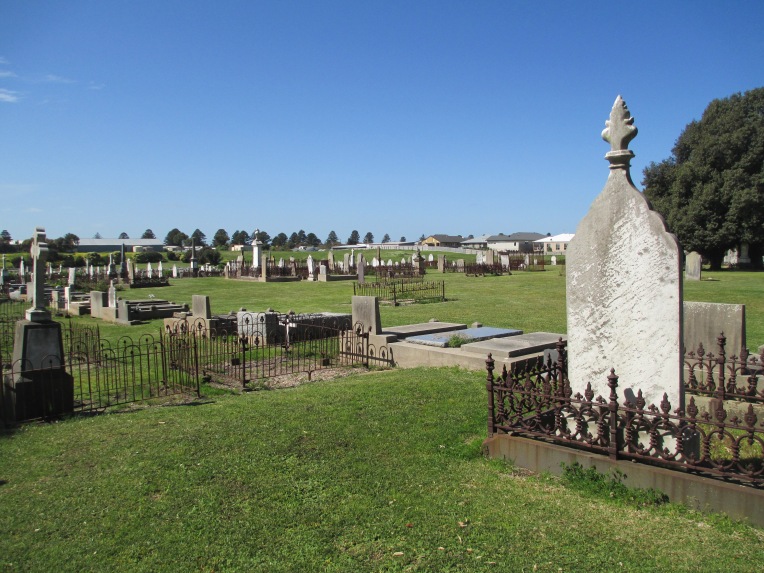
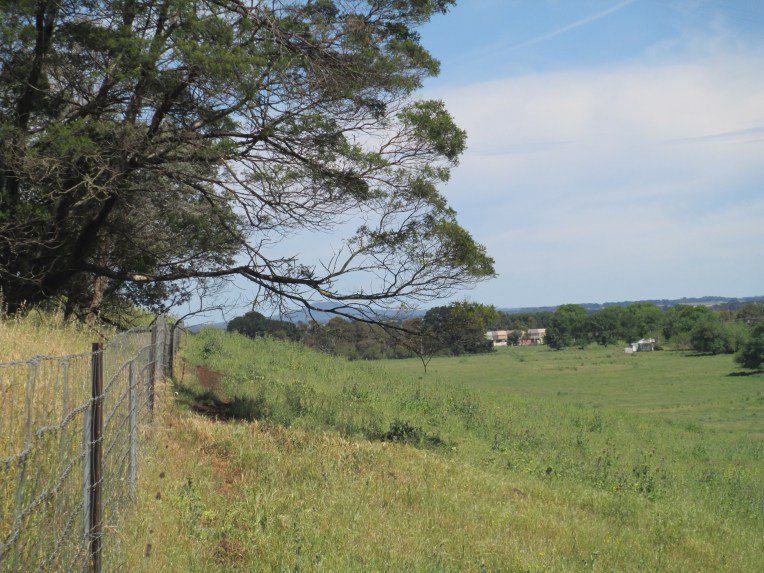
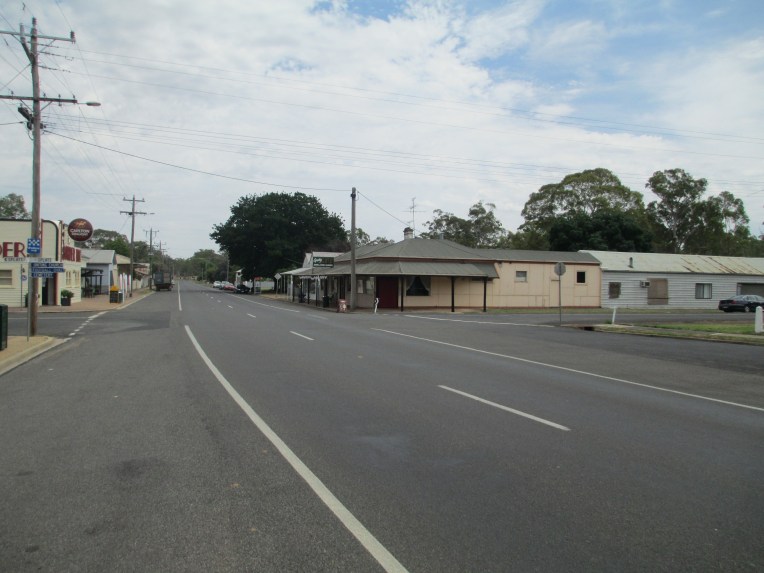
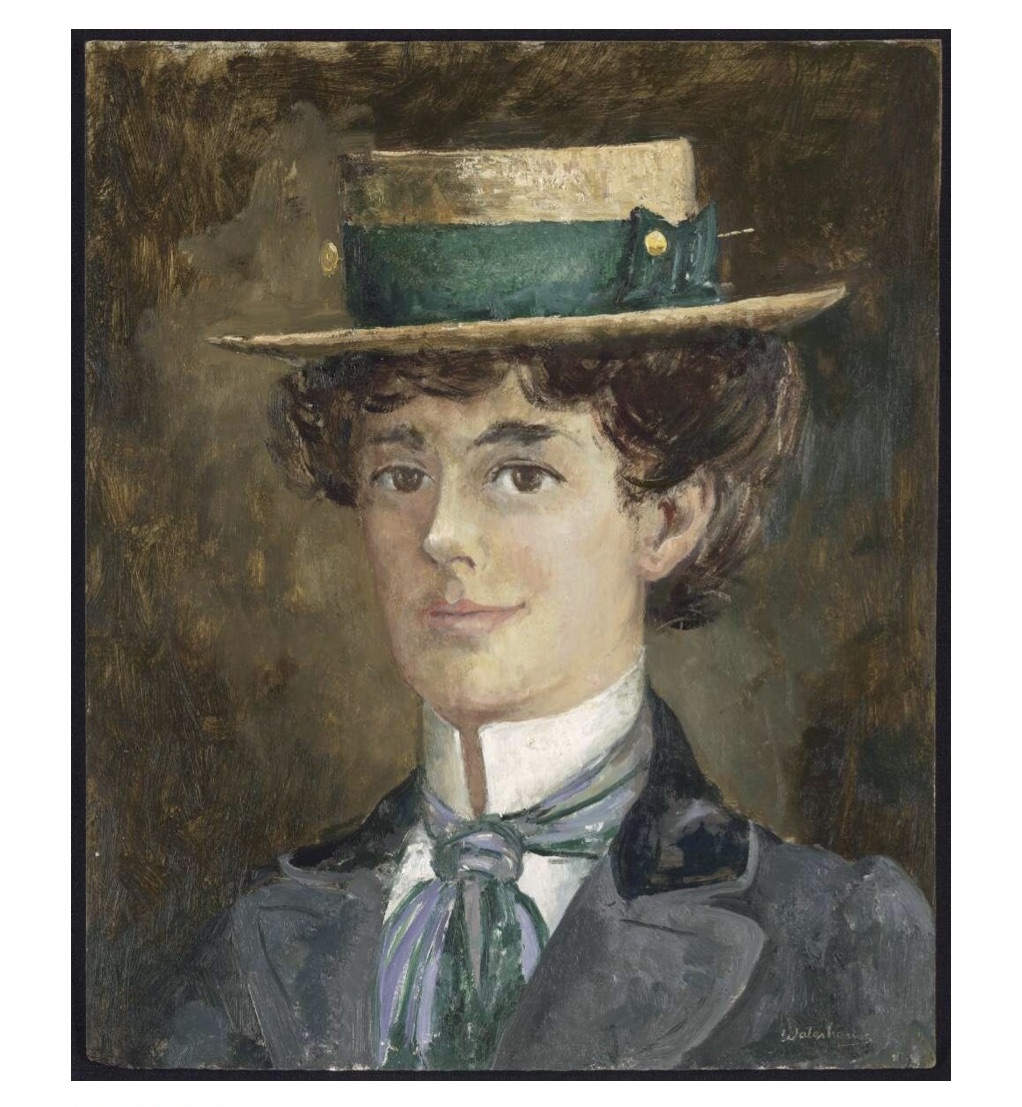
Cemeteries: Port Fairy

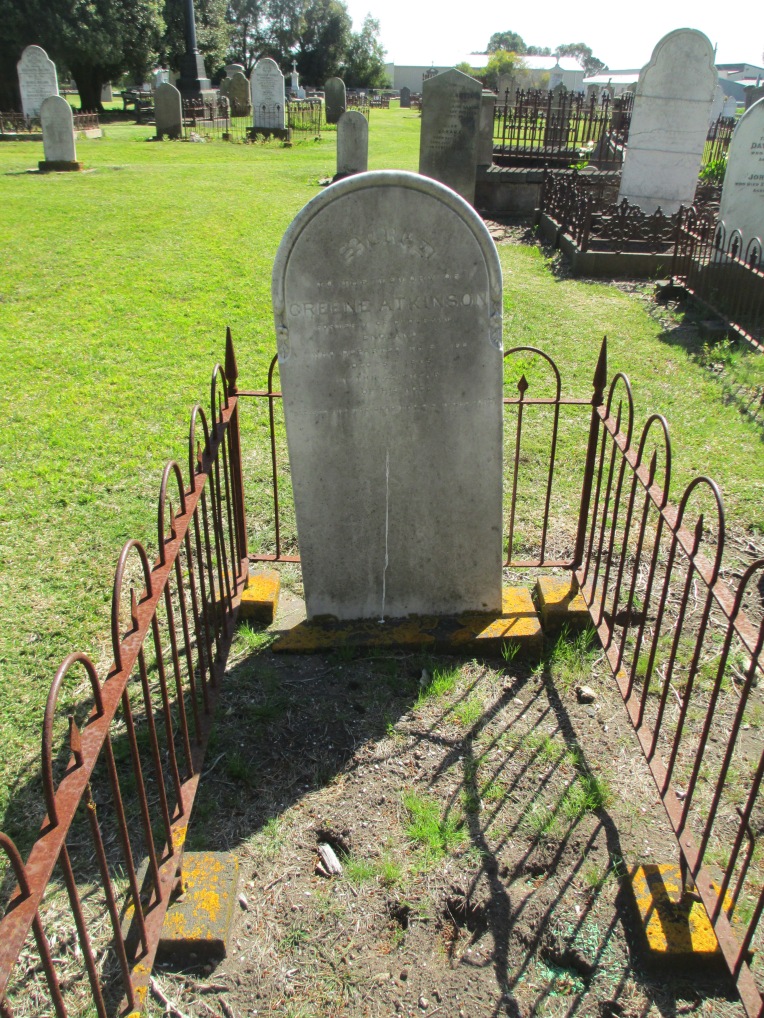
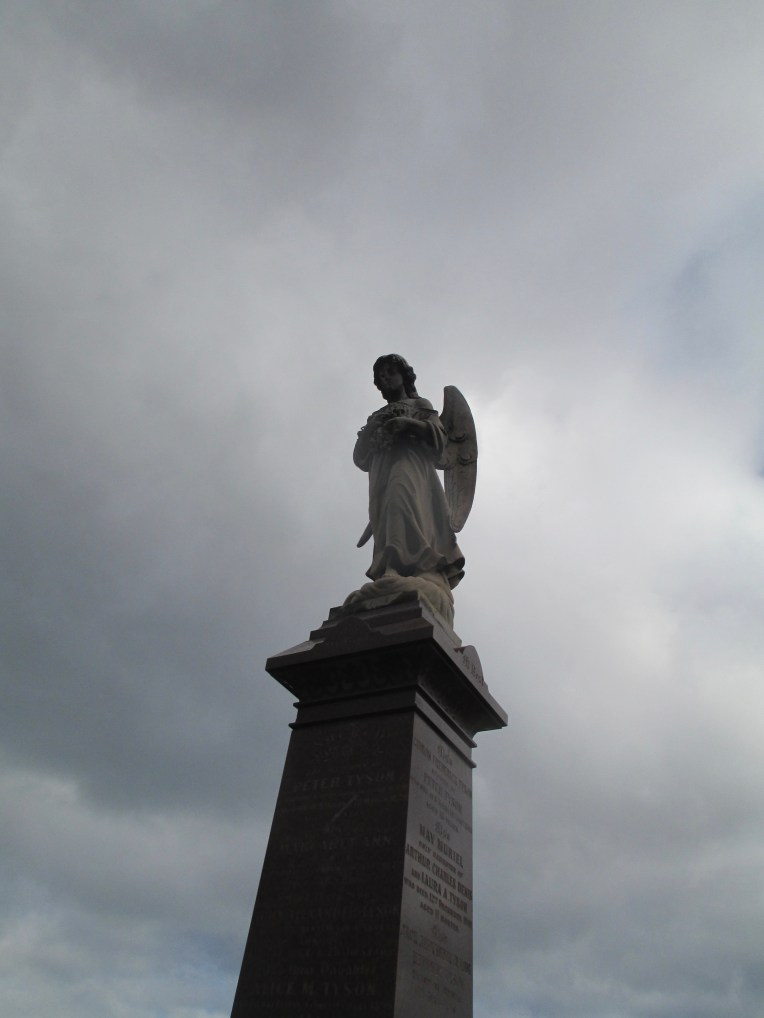
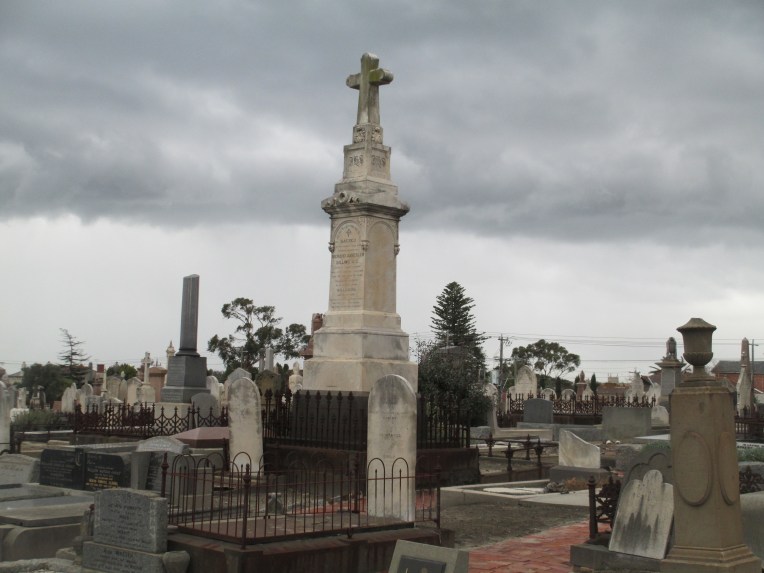
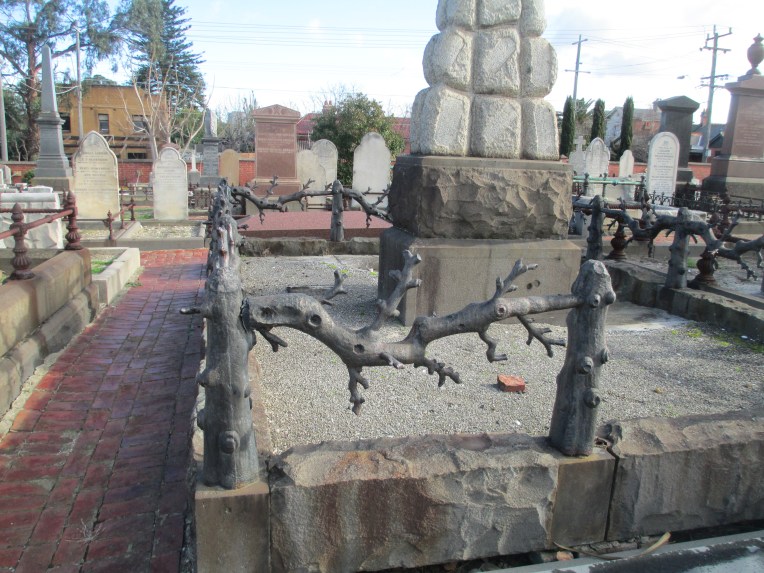
img_9133Port Fairy is a town in Western Victoria that was founded as a town in 1843. There were settlers in the area before this date, and the current name for the town comes from the ship the Fairy which is believed to have arrived in the area in c.1828. The area was also regularly visited by whalers and sealers. The date of 1843 comes from the special survey which was granted to James Atkinson at that time. The special surveys were a system where the government of the Colony of New South Wales was able to control ownership of the land in the Port Phillip District. This was well before federation of Australia as a country in 1901, but also before Victoria became a colony independent from New South Wales which happened in 1851. The basic premise behind the special survey system was to stop squatters just claiming land, because when they did there was little ability to regulate it and there was no fee for the government.
Atkinson arrived in Sydney in 1830 from Ireland and became a prominent and well connected member of Sydney society, at least partly due to his family connections to Colonel Charles Wall of the 3rd Buff regiment who was married to his sister. As he had a high social standing he couldn’t use trade to make money, so he turned to land. He was granted the right to the special survey of the Port Fairy region in 1843. He worked with the existing settlers, but also moved to attract new settlers to the town he named Belfast. He most likely applied for the special survey rights to the land without ever seeing it, as there is no evidence he set foot there before arriving in 1846 with his wife and seven children. He offered very long term leases for land in the town he established, but while he was definitely trying to encourage settlement he was not immediately successful. In 1848 he appointed his nephew (and my great, great, great, grandfather) Robert Henry Woodward, who was farming in the area, as his land agent. Woodward was 25 and oversaw the majority of the establishment of the town proper. It was also Woodward who oversaw, with the blessing of Atkinson, the gifting of parcels of land within the town for churches of different denominations and for community purposes, such as a post office, a hospital, government offices, public wharves, a savings bank, a town hall, public meeting places and a cemetery.

IMGP2243.JPG

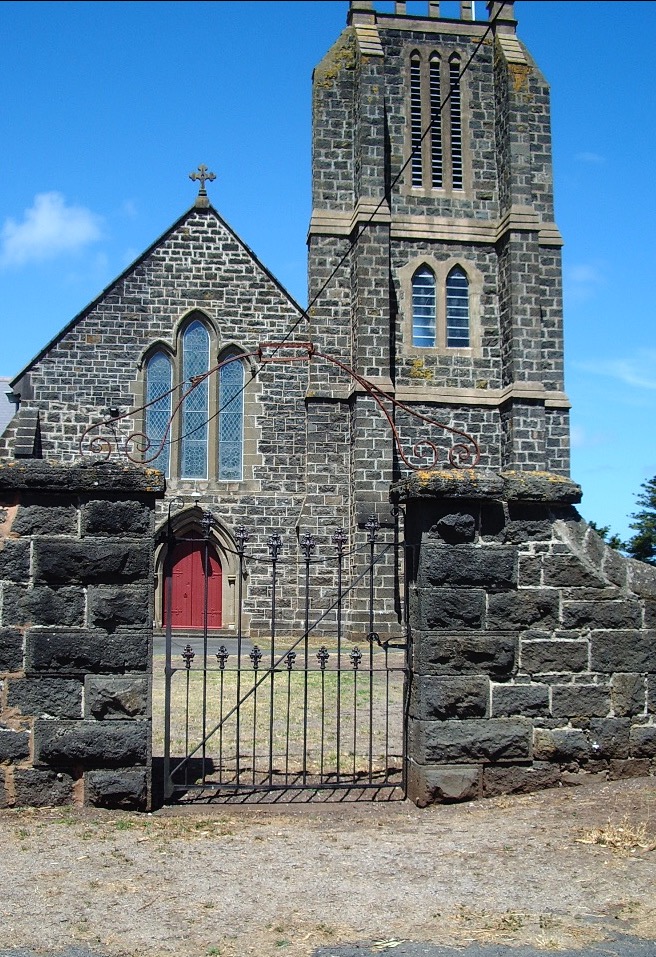
St John’s Anglican Church Port Fairy built between 1854 and 1856. It was the first church in Victoria to have a chancel. The tower was added later in the 1950s.

Atkinson did not remain in Belfast, returning to Sydney and to Ireland, but he did visit to survey the progress of the town in 1859, 1861 and 1864. Atkinson died in Sydney in 1864, though Woodward continued to administer the lands until 1869. The town petitioned, successfully, to change its name to Port Fairy in 1886

Before continuing to discuss the cemetery I would also like to acknowledge the indigenous people of the land which Atkinson bought as the special survey. This area was the land of the Gunditjmara people. If, when Atkinson arrived, there seemed to be a lack of indigenous inhabitants it is not because there wasn’t any ever, but because between the 1830s and the 1840s the indigenous population of the area was destroyed by settlers. A monument to them now stands in Port Fairy on Bank Street. It reads:

In memory of the thousands of aboriginal people who were massacred between 1837 and 1844 in this area of Port Fairy.

Today we pay our respects to them for the unnecessary sacrifices they made.

Your spirit still lives on within our people.  Wuwuurk

This was not isolated to the Port Fairy area. The early history of Western Victoria is mired in bloodshed. A list of the frontier wars in which the indigenous population were by and large overwhelmed and destroyed by superior western weaponry can be seen here.

http://www.australianfrontierconflicts.com.au/index.php/conflicts/chronology/vic

It was also a time of severe retaliations against any interference with livestock and systematic killings, taking of land of the beginning of the removal of children. Not to mention the introduction of alcohol and western disease and their long term affects. This article from the Warrnambool local paper The Standard out lines clearly the actions against the local indigenous population

http://www.standard.net.au/story/792108/the-south-wests-bloody-past/

It is essential that the past of indigenous Australians and the brutal suppression of them is recognised as part of the history of Victoria and Australia. This is especially true when discussing somewhere like a cemetery which provides concrete and tangible records of the deaths of early pioneers, a record that is not available for the deaths of the indigenous population.

img_9148

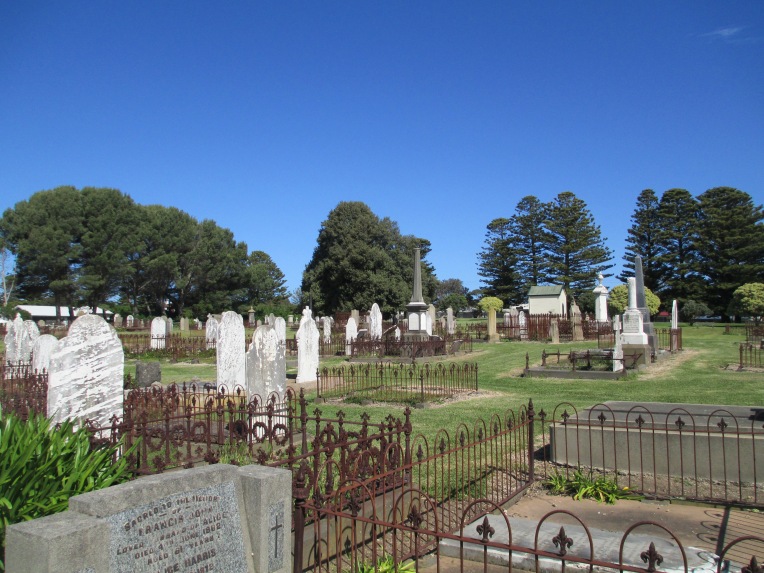
Port Fairy cemetery was founded in the 1850s. There is confusion as to whether it is the ‘old’ or ‘new’ cemetery as many descriptions seem to use the term interchangeably. The other cemetery at Port Fairy was laid out by Robert Hoddle, famous for Melbourne’s CBD grid, at the orders of Governor La Trobe. This other cemetery was in the sand hills out of town, was discontinued and little survives today. The current Port Fairy cemetery has many very early burials and is believed to be one of the first cemeteries in Victoria to have adopted the concept of a lawn cemetery.

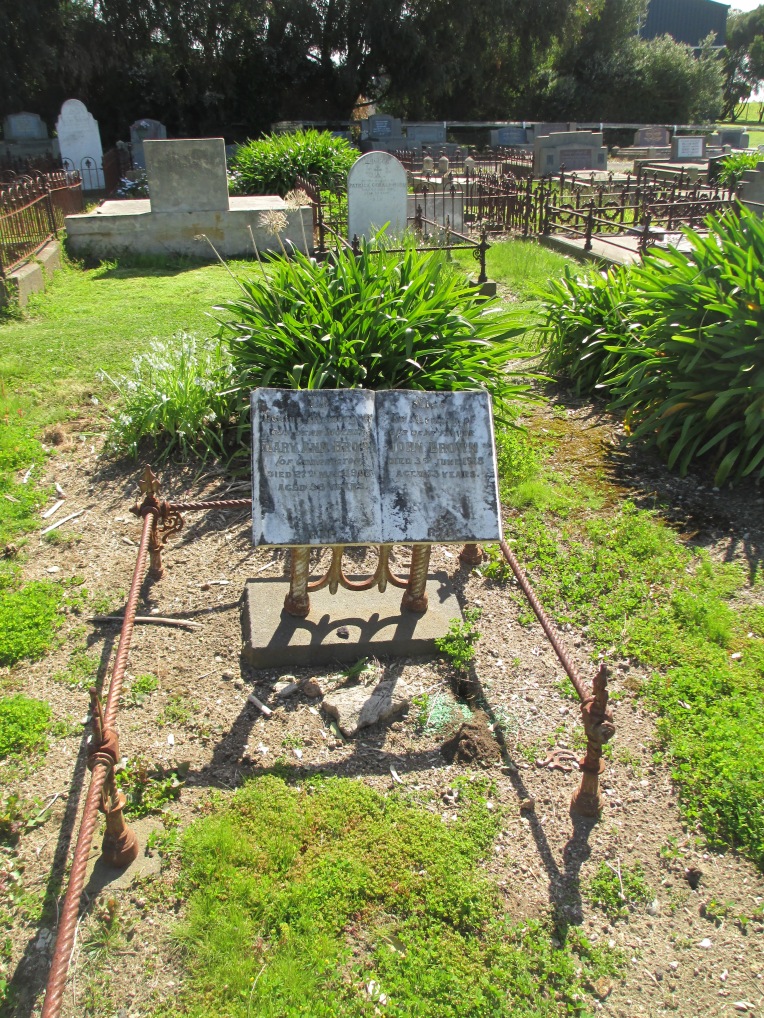
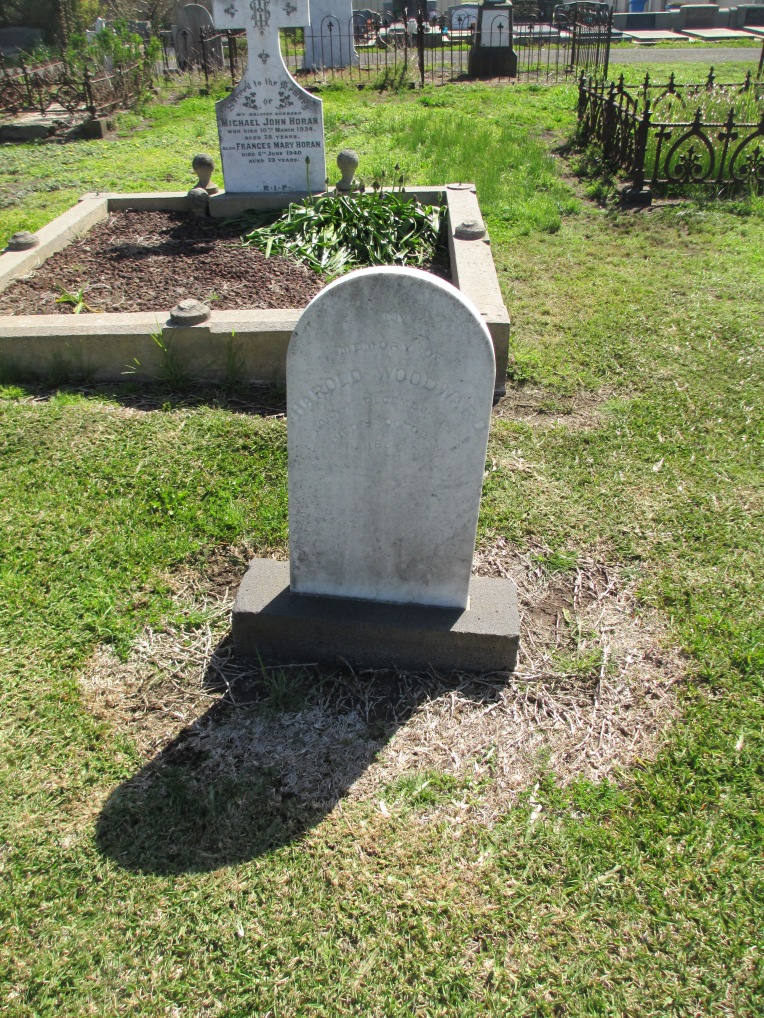
The earliest burials in the cemetery are of the local pioneers and their families. These people are often listed as from a local ‘station’ on their tombstones. The pioneers of the area did not have an easy life and as such there are a high number of young burials, very few survived to old age. One of the earliest and one of the youngest is the grave of Harold Woodward, a son of Robert Henry Woodward and his wife Letitia Wall (daughter of Colonel Wall). Harold died on the 8th of October 1856, but was only born on the 4th of December 1855. img_9147

Of Robert Henry and Letitia Woodward’s 11 children Harold was the only one to meet such an early end. I am descended from his brother Albert William Woodward, the youngest of Robert Henry and Letitia’s  children. Robert Henry and Letitia are buried in St Kilda Cemetery.

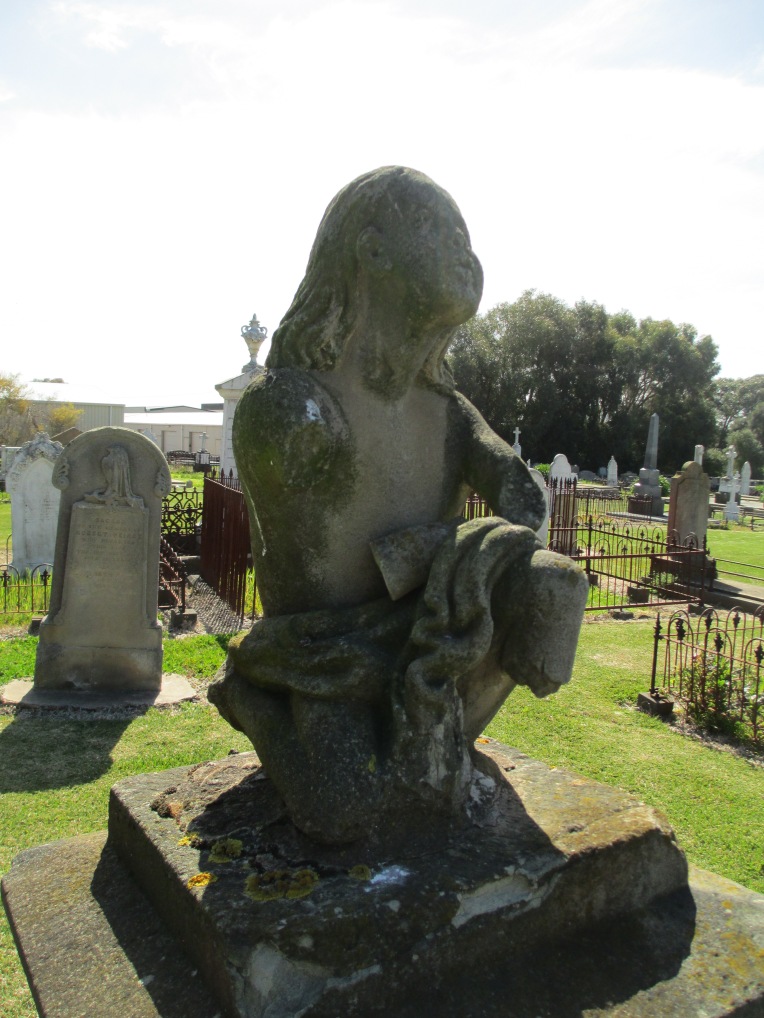
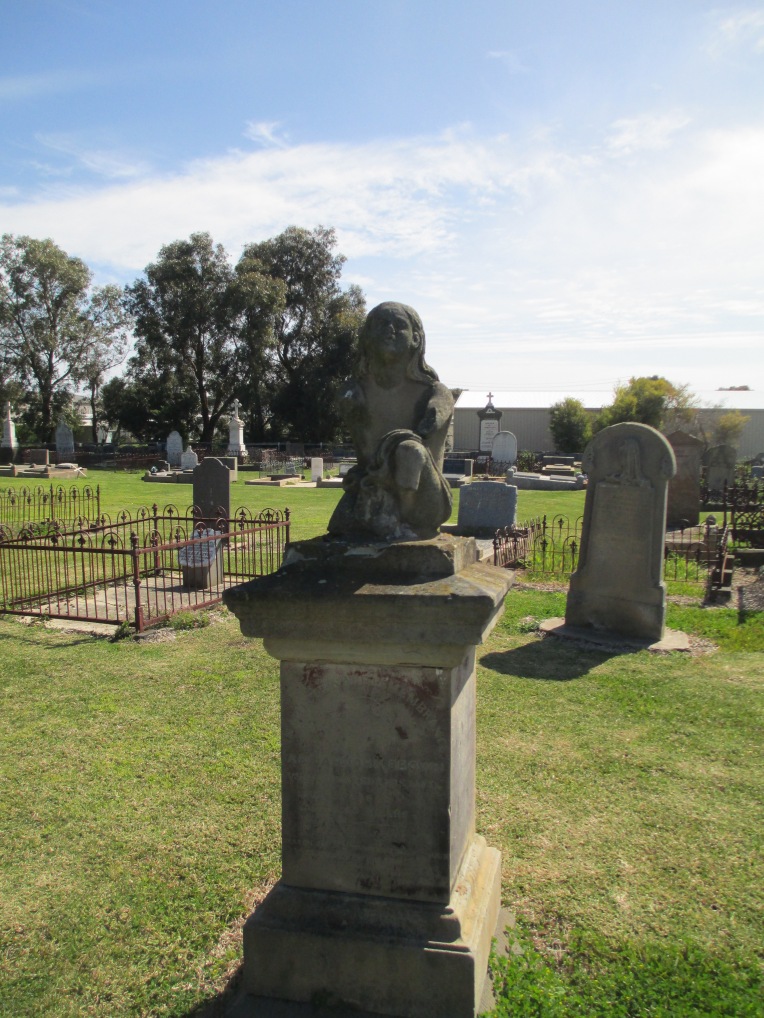
Much of the stone in the cemetery displays intricate examples of early stone masonry. The best example of which is probably the tomb of Abijah Brown.img_9146img_9144He died in 1862 at the age of 40 and the tomb reads:
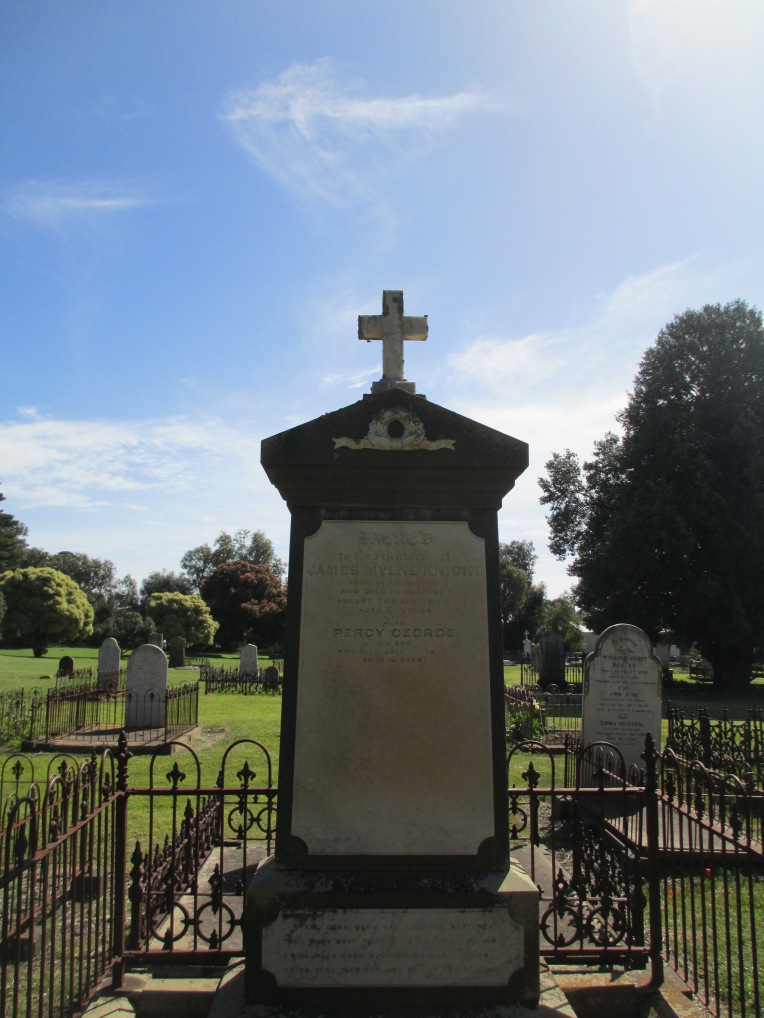
In affectionate memory of Abijah John Brown who departed this life July 19th 1862 aged 40 years. Watch for ye know not what hour your Lord doth come. 

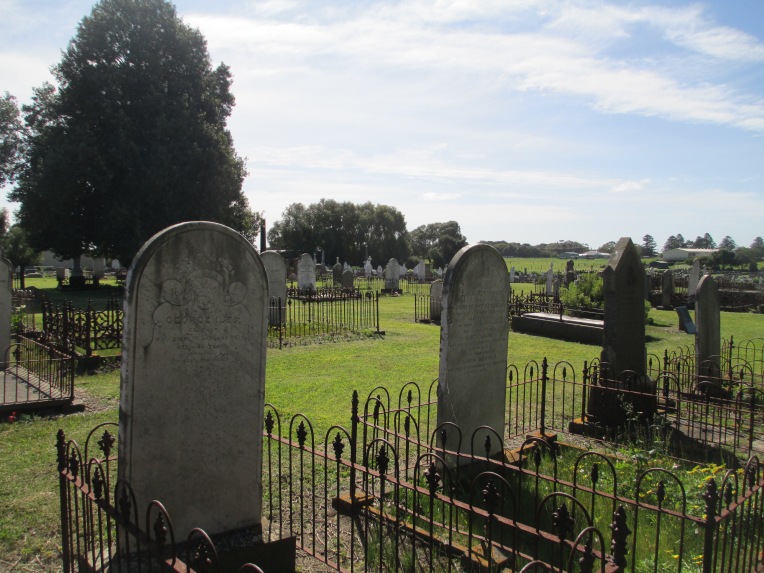
It is an interesting monument because it does not fit any regular pattern seen in Victorian era funeral monuments. It is a, sadly much worn, figure of a young man looking skywards. This man is not an angel or a cherub but a person. It is also a remarkable piece of sculpture in its own right. The Brown tomb is not alone is being striking in the cemetery. The older section of the cemetery is a combination of plain and ornate funeral monuments. Some can be seen in the photos below.

img_9140img_9141img_9150img_9143There are more people buried in the cemetery than are known about. Many of the early burials would have been laid to rest under simple wood crosses and these simply wouldn’t have survived the harshness of Port Fairy’s coastal weather. Despite this, the surviving burials provide a fascinating record of the life and death of the early inhabitants of the district.

References:

http://www.ohta.org.au/organs/organs/StJohnsPortFairy.html

http://www.portfairypubliccemetery.com.au/

An Historic Graveyard: Some early records of Port Fairy Cemetery by P. Frazer Simons.

A Special Survey: Aspects of the development of Port Fairy from 1843. Edited by Rod Collins.

Both books can be borrowed from the Prahran Mechanics Institute Victorian History Library

The photos are all mine.

Cemeteries: Tower Hill

Tower Hill Cemetery lies between Port Fairy and Warrnambool in Western Victoria.

img_9230Tower Hill itself is a former volcano not far from Port Fairy and about 3 hours drive west of Melbourne. You can see the view looking over the remains of the Tower Hill crater and looking out towards the sea from the top of Tower Hill in the photos below.
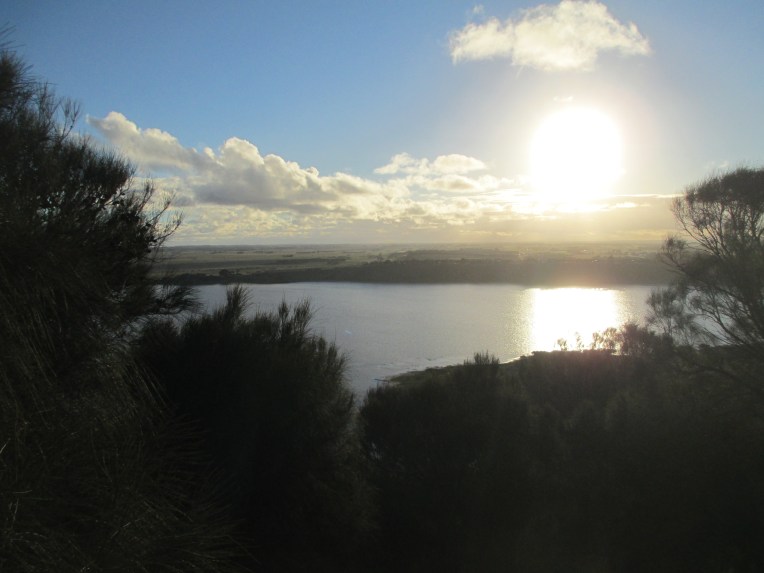
img_1206img_1212

Tower hill itself is not really a town, though there are a few houses around it. Tower Hill was first sighted by Europeans in 1802, the sighting was made by the Frenchmen in the ship the Geographe, but it wasn’t surveyed until 1846. In the surveys conducted between 1846 and 1850 it is described as heavily wooded, with descriptions of ferns and large trees. It was also a favourite site of settler James Dawson of the near by Kangatong station. He had it painted in oils in 1855 so he could show others how beautiful it was. The painting was done by Eugene Von Guerard and you can see the view from the lookout point he painted it from below.

IMG_2581

However between 1857 and 1860 the hill itself and the surrounding area was heavily deforested, mainly for the use of the timber but also for grazing. This use of the land continued until 1961 when Tower Hill was proclaimed Victoria’s seventh state wildlife reserve. There has been significant re planting done since.

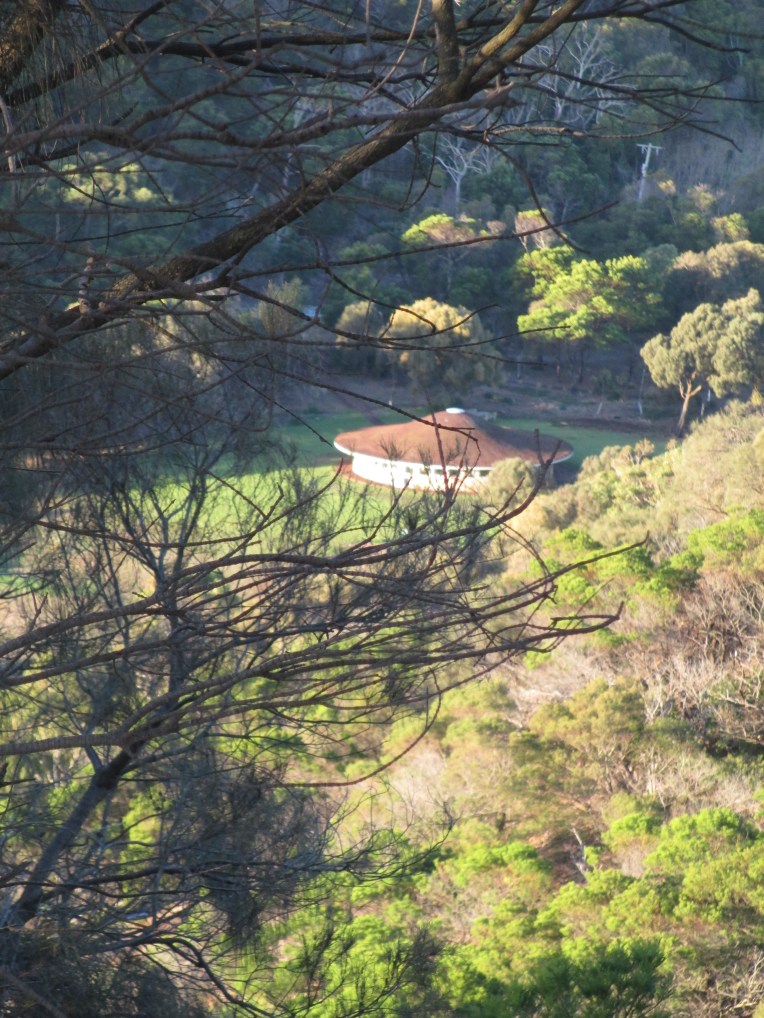
I would like to pause in the ongoing narrative of Tower Hill at this point to discuss its pre-European importance. When Tower Hill was first sighted by Europeans it was certainly not an unknown hill. For the local Koroitgundij people it is a site of great importance and their ancestors undoubtably would have witnessed the eruption that created the funnel shaped crater 30 000 years ago. Today there is the Worn Gundidj  visitor’s centre in the middle of Tower Hill which tells the indigenous history of the site.  You can see the visitor’s centre in the picture below.

img_1208

The cemetery at Tower Hill stands at the base of the hill’s slope. It was established in 1856 and contains some of the most impressive monuments for a cemetery of its size that I’ve ever seen.

img_9226

img_9208-1

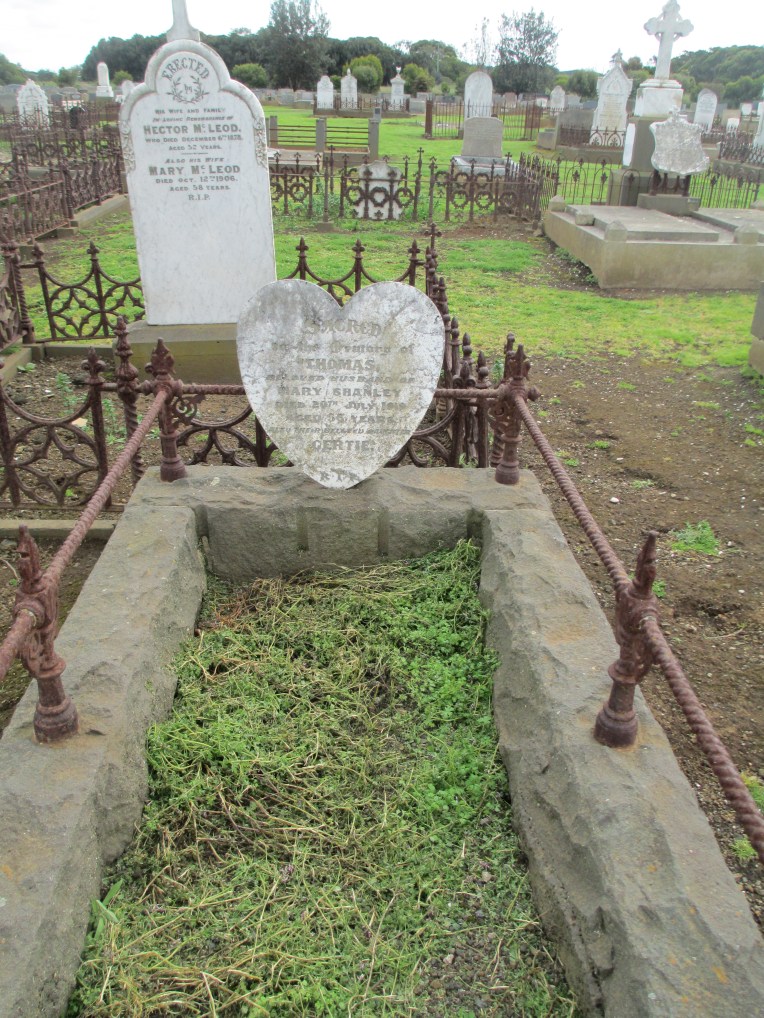
The monuments range from small, such as the heart shaped stone below.

img_9194

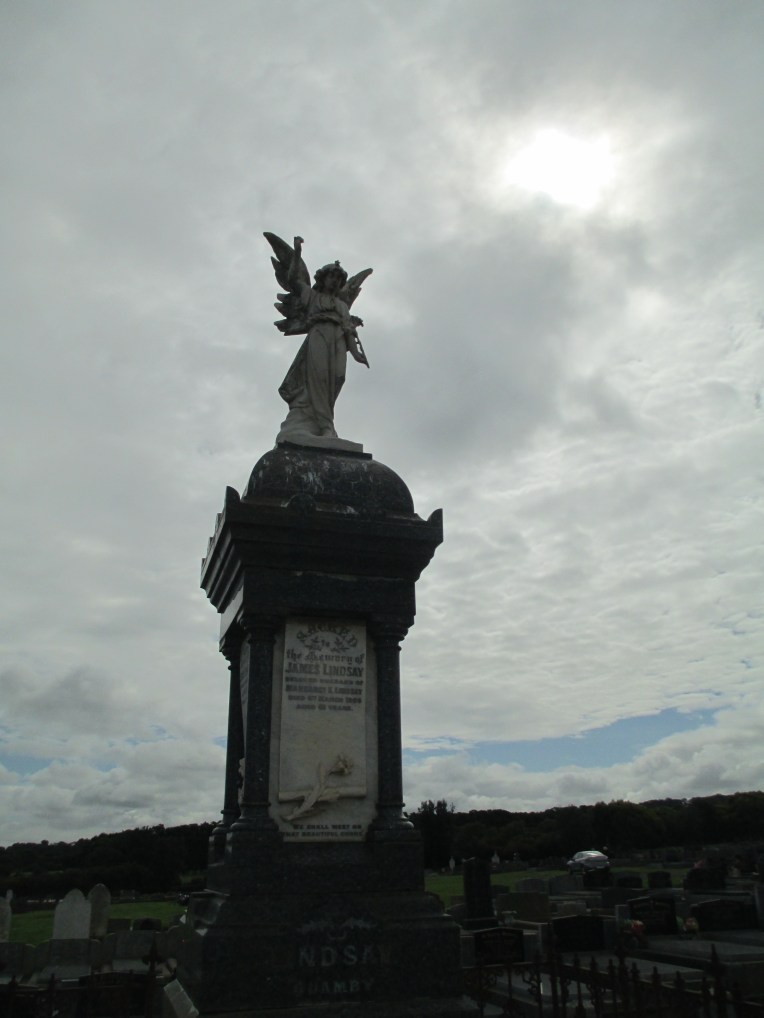
To the significantly more dramatic

img_9206img_9201img_9192

img_9195

There are a number of interesting people buried at Tower Hill, but I thought I’d briefly discuss a man whose death was a key part of Australian labour history. William John Mclean was the first person to die for the union movement in Australia. Known as Billy Mclean he was born in 1869 and lived in Koroit, a small town very near Tower Hill. In the late 1800s the nearby town Port Fairy was one of Australia’s most important international ports, though you certainly wouldn’t know it now.

imgp2398

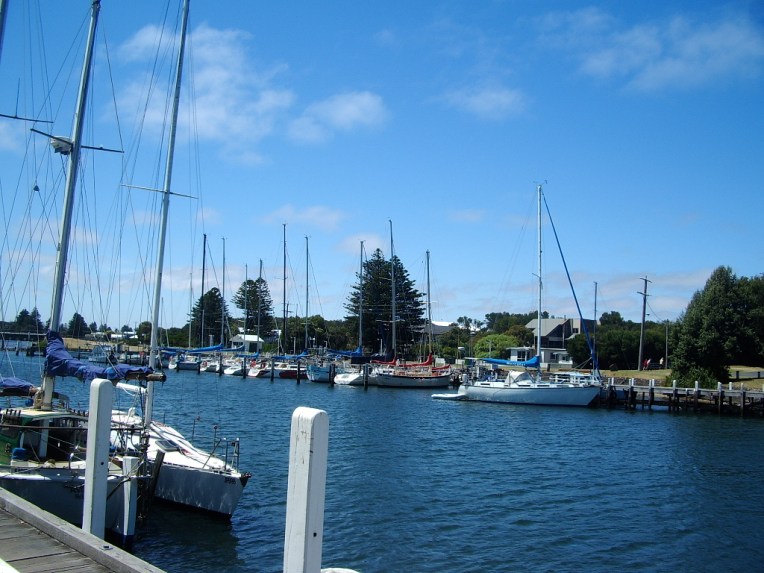
Port Fairy

As an important port much of the wool shorn in areas as far away as southern NSW was taken by the river system and bullock drays to Port Fairy for transportation. Shearers would hitch rides with the bullock drays back in the opposite direction for the shearing season. Billy Mclean was one such shearer. The shearers often endured awful conditions and pretty terrible pay at the same time as being forced to pay exorbitant prices for food from stores that were owned by the stations. As such there were a number of shearer strikes. On the 26th of August 1894 in NSW the paddle steamer Rodney was transporting a non union labor force up the Darling River to work at the near by station of Tolarno. Many of the river captains refused to support the pastoralists by bringing in non union labour to try to break the strikes. Captain Dickson of the Rodney was not one of them. The paddle steamer was set upon by striking shearers and after the non union labour and the crew had been removed from the boat, the shearers doused it in kerosene and burnt to the water line.

The afternoon of the same day, a little further up river, Billy Mclean was one of about fifty shearers who were headed for Grassmere station near Willcannia where it was believed that non union workers from New Zealand had been brought in. Mclean was one of the first to enter the shearing shed and he was shot in the lung, one of his mates Jack Murphy was also shot. Neither died on the scene and they were arrested by the police on the way back to the strike camp. There is definite argument that the shooting was retaliation for the burning of the Rodney earlier that morning.

Mclean was tried and convicted of unlawful assembly, sentenced to 3 years hard labour and sent to Goulburn gaol. In the cold of the prison and never having recovered from his injury Mclean developed tuberculosis of the lung and was sent home to his mother to die, so it couldn’t be said he died in gaol. He died in 1896. He was 26. The man who shot him was never tried and was given a medal by the pastoralists association.

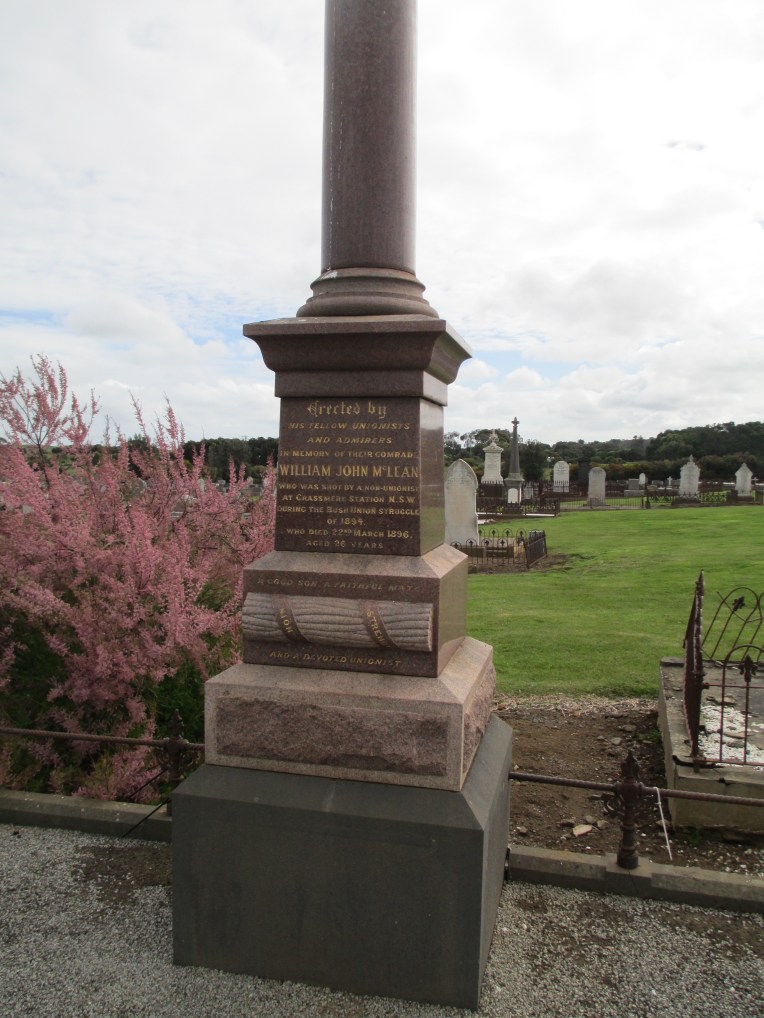
The other shearers rallied round Mclean’s mother and raised 90 pounds for the erection of the monument over his grave. It still stands in Tower Hill Cemetery today and is 14 feet high. You can see it in the photos below.

img_9211

img_9210The epitaph reads

ERECTED BY

HIS FELLOW UNIONISTS

AND ADMIRERS

IN MEMORY OF THEIR COMRADE,

WILLIAM JOHN McLEAN WHO WAS SHOT BY A NON-UNIONIST

AT GRASSMERE STATION, N.S.W.,

DURING THE STRUGGLE OF 1894,

AND WHO DIED 22nd MARCH, 1896,

AGED 26 YEARS,

A GOOD SON, A FAITHFUL MATE, AND A DEVOTED UNIONIST, UNION IS STRENGTH.

Donald MacDonald, the general secretary of the AWU wrote to Henry Lawson asking him to compose the epitaph. It is not known if Lawson did or not.

For more information on Mclean and the shearers’ strikes see…

http://ro.uow.edu.au/cgi/viewcontent.cgi?article=1007&context=unity

Billy Mclean is only one of a number of fascinating people buried at Tower Hill Cemetery. Alongside the outstanding individual monuments Tower Hill Cemetery also houses several groups of matching monuments such as those that you can see below. img_9220

As with many cemeteries of this era, there is a distressingly large number of young deaths and whole families. You see the same surnames repeated over and over, showing the long term connection to the area.

img_9213

My next post will be on the nearby Port Fairy Cemetery.

References

Billy Mclean: http://ro.uow.edu.au/cgi/viewcontent.cgi?article=1007&context=unity

Tower Hill: Victoria’s heritage. http://parkweb.vic.gov.au/__data/assets/pdf_file/0007/315547/Heritage-story-Tower-Hill-Reserve-history-and-heritage.pdf

Books:

Tower Hill: What happened at Tower Hill? Fisheries and Wildlife Dept 1960.

Tower Hill by M.C Downes.

Both books can be found at the Prahran Mechanics’ Institute Victorian History Library.

The photos are all mine.

Victorian History Crossword

NB: If it looks like you’ve seen this crossword before, you have. I put it up yesterday but there was a technical error so I had to take it down. There should be no problems with this version. The questions and answers are all the same as yesterday’s, the lay out is just a little different.

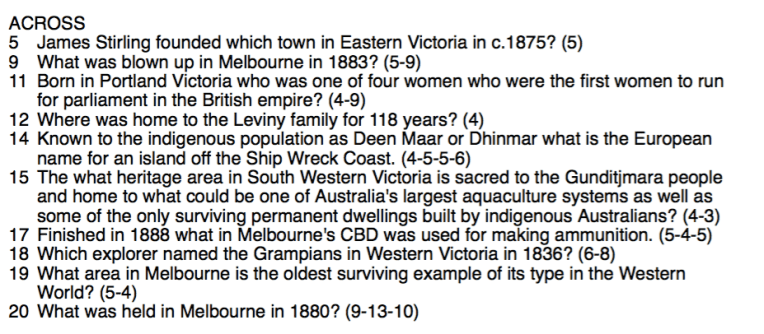
Have a shot, see how you go.  Click this link for a printable version of the crossword grid. Crossword Puzzle

Crossword Puzzle Maker_ Final Puzzle

Screen Shot 2016-08-23 at 6.50.45 PMScreen Shot 2016-08-23 at 6.50.52 PMScreen Shot 2016-08-23 at 6.51.10 PM

Cemeteries: St Kilda Cemetery

IMG_8952

This is the second in my series of posts about cemeteries. The first was about Melbourne General Cemetery and can be found here. This time I’ll be discussing St Kilda Cemetery. St Kilda is a suburb in southern Melbourne and its cemetery is an an excellent example of Melbourne’s inner suburban cemeteries.

I’ve always found cemeteries interesting as a lens through which to view a city, or a town, and I’ve always found the history they so neatly incapsulate fascinating. St Kilda has a personal connection for me as well because there is a plot there in which several of my ancestors are buried. One of them, Robert Henry Woodward, was originally buried in Melbourne General Cemetery. The family believes, however, that he was moved to St Kilda to be with his wife Letitia at a later date. His grave at Melbourne General Cemetery is certainly unmarked.

IMG_8963IMG_8969

The Woodward Graves.

IMG_8955

Robert Henry Woodward and Letitia Woodward

IMG_9755The site of Robert Henry Woodward’s original grave at Melbourne General Cemetery
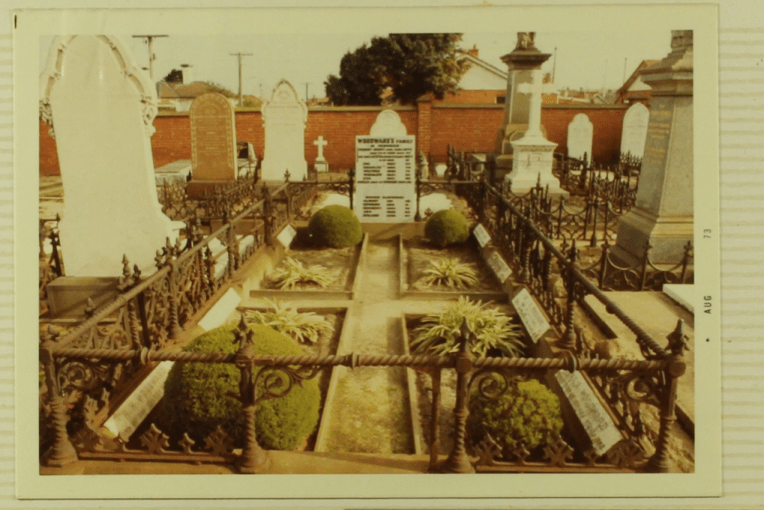
Screen Shot 2016-07-12 at 7.25.39 PM

What the Woodward grave looked like in the 1970s. My extended family and I are in the process of restoring it somewhat.

Robert Henry was one of my first ancestors to come to Australia in the 1850s, and Letitia was born here in 1824 when her father was stationed in Sydney. So I was interested to see where they were buried.

The cemetery itself also has a fascinating history. It was first laid out in 1851 by an assistant of Robert Hoddle, best known for laying out the grid of Melbourne’s CBD. It opened in 1855 and the brick wall enclosing it was added in c. 1883.

IMG_9012

The walls of the Cemetery

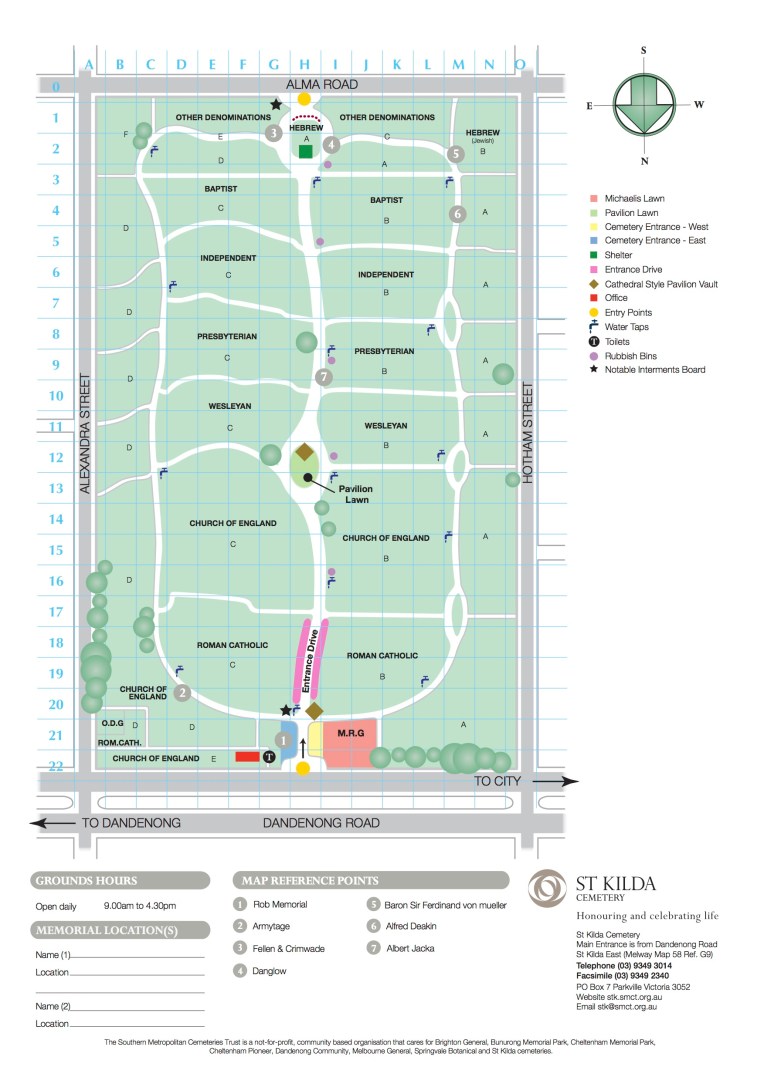
The cemetery covers 18 acres and contains approximately 53 000 burials. St Kilda has been a desirable place to live for over a hundred years and as urban sprawl in Melbourne has increased there have been several attempts to have the cemetery closed. Fortunately none have been successful. The cemetery is laid out in religious denominations as can be seen in the map below.

St Kilda Map-V3_DPMG - FINAL

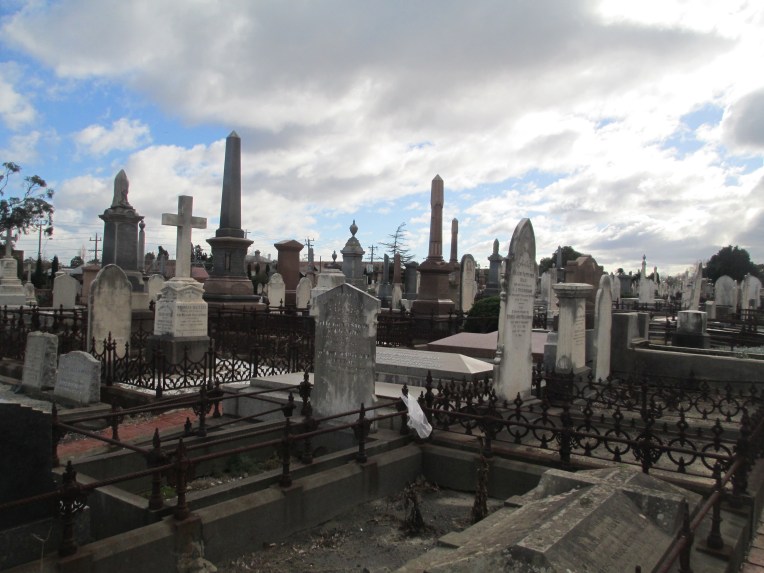
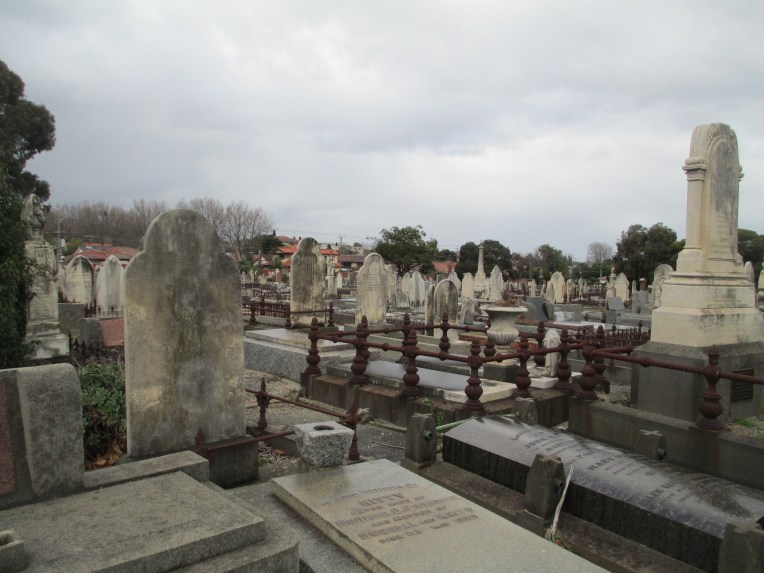
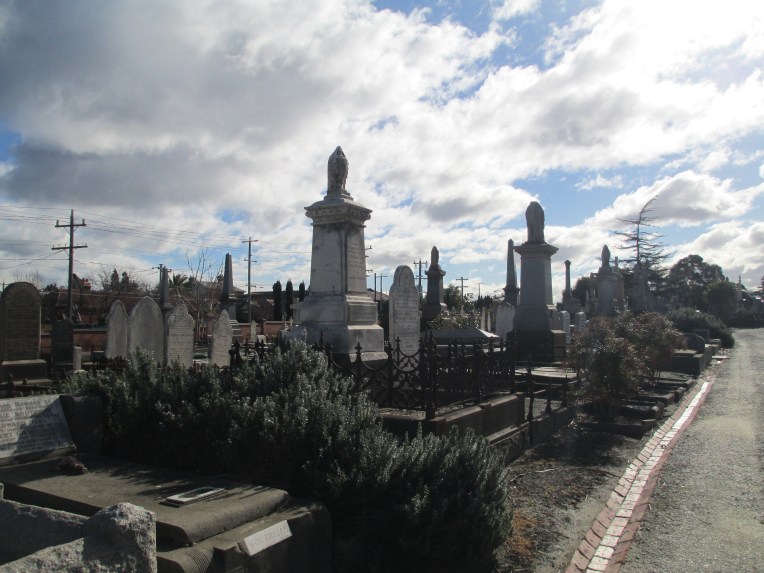
Although in comparison to  Melbourne General Cemetery St Kilda is quite small, it is still large for a suburban cemetery. It certainly feels vast when you step inside, as you can see from the photos below.

IMG_8995IMG_8981

IMG_8948

St Kilda also houses many beautiful funerary monuments. A number of which can be seen below.

IMG_9007

Urns

IMG_8980

IMG_8943

Religious Figures

IMG_8976

Angels

IMG_8946IMG_8950

Crosses

IMG_8945

Scrolls

IMG_9001

Ornate fences.

There are also memorials to a number of well known people in St Kilda Cemetery.

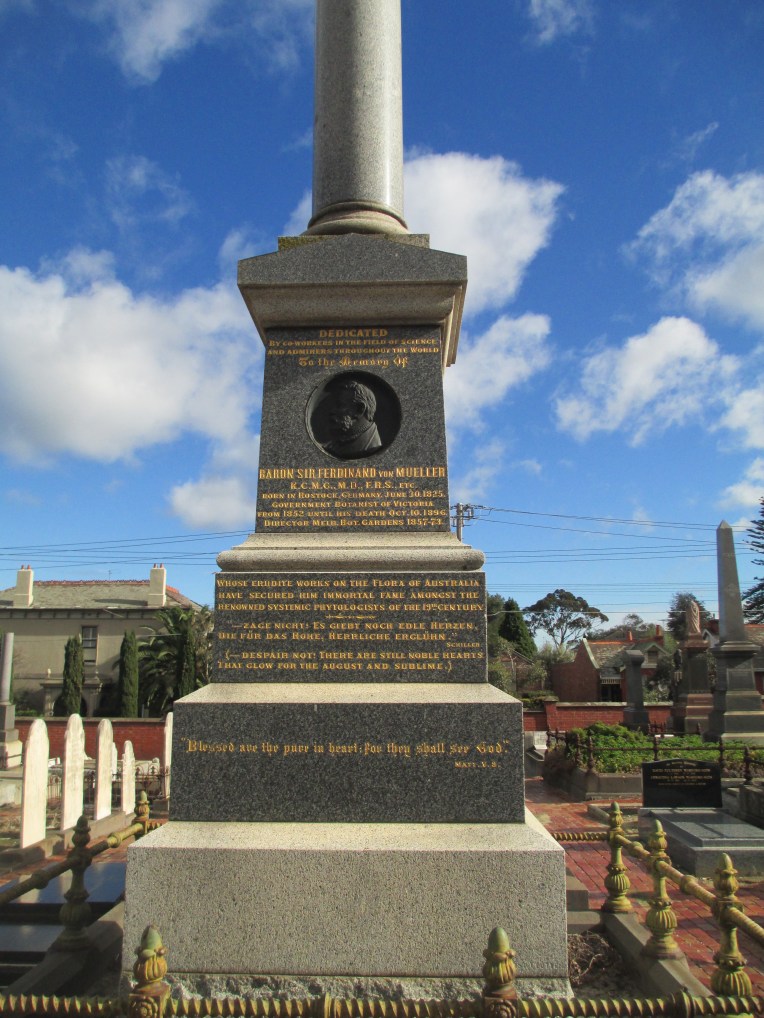
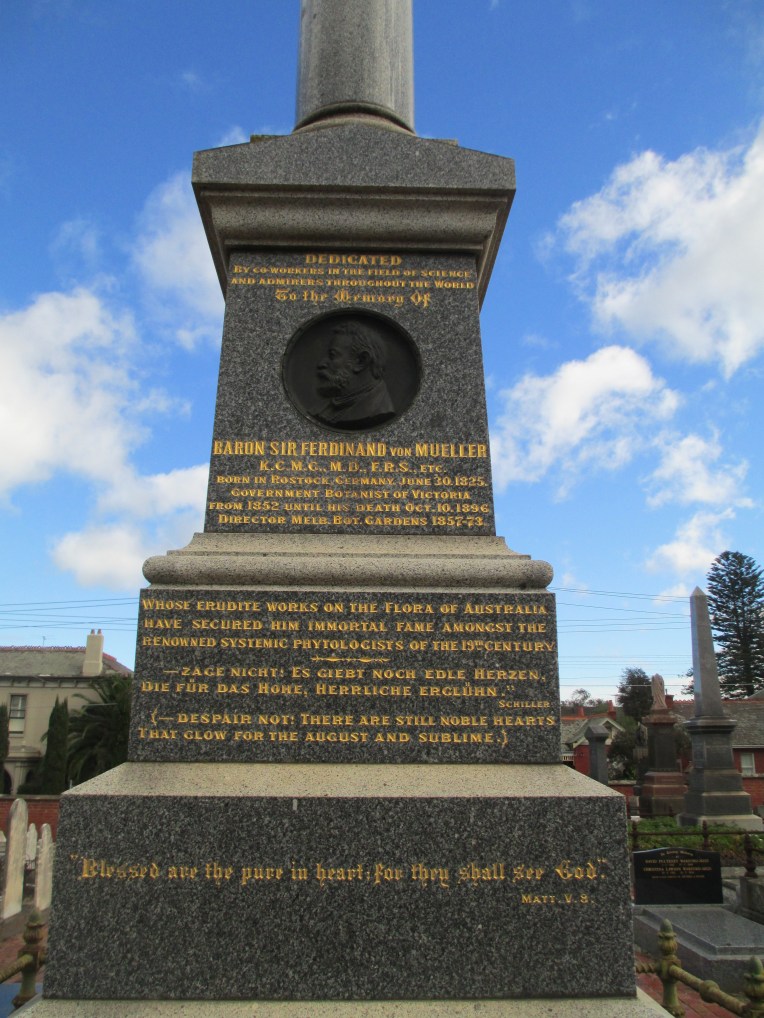
I don’t feel it is necessary to go into the history of each of them, but I would like to discuss one in particular. Ferdinand Von Mueller, best known in Melbourne as the Director of the Royal Melbourne Botanic Gardens from 1857-1873.

A050353_246x550

Von Mueller

http://adb.anu.edu.au/biography/mueller-sir-ferdinand-jakob-heinrich-von-4266

His memorial can be seen below.

IMG_8996IMG_8997IMG_8998IMG_8999

Von Mueller was born in 1825 in Rostock in Mecklenburg-Schwerin in what is now Germany. He trained as a pharmacist, but specialised in botany as part of his degree. He came to Australia in 1847 with his two remaining sisters, seeking a warmer climate for his sister’s health. He began his time in Australia in Adelaide, where he investigated the local flora as well as working as a pharmacist. He came to Melbourne in 1852 when Governor Latrobe appointed him Government Botanist. In Melbourne Von Mueller began collecting specimens of the local indigenous flora. He was instrumental in cataloguing Victorian and in fact Australian flora, adding new genera and greatly expanding exisiting knowledge. He travelled a great deal within Australia and was at the heart of bringing together isolated information from disparate sources on indigenous flora.

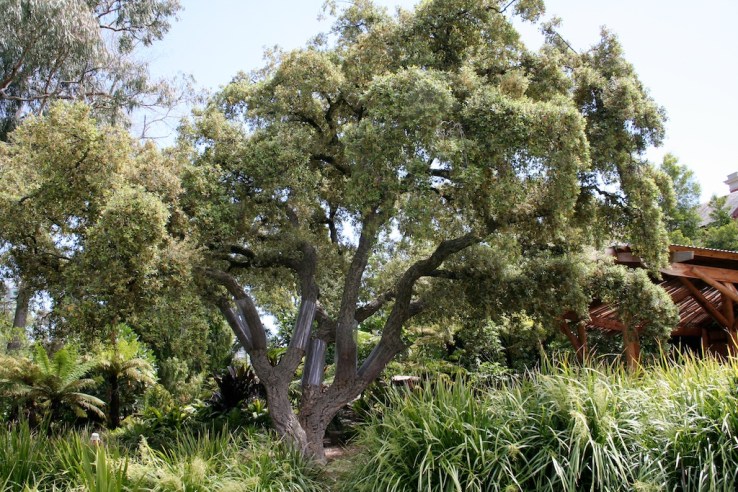
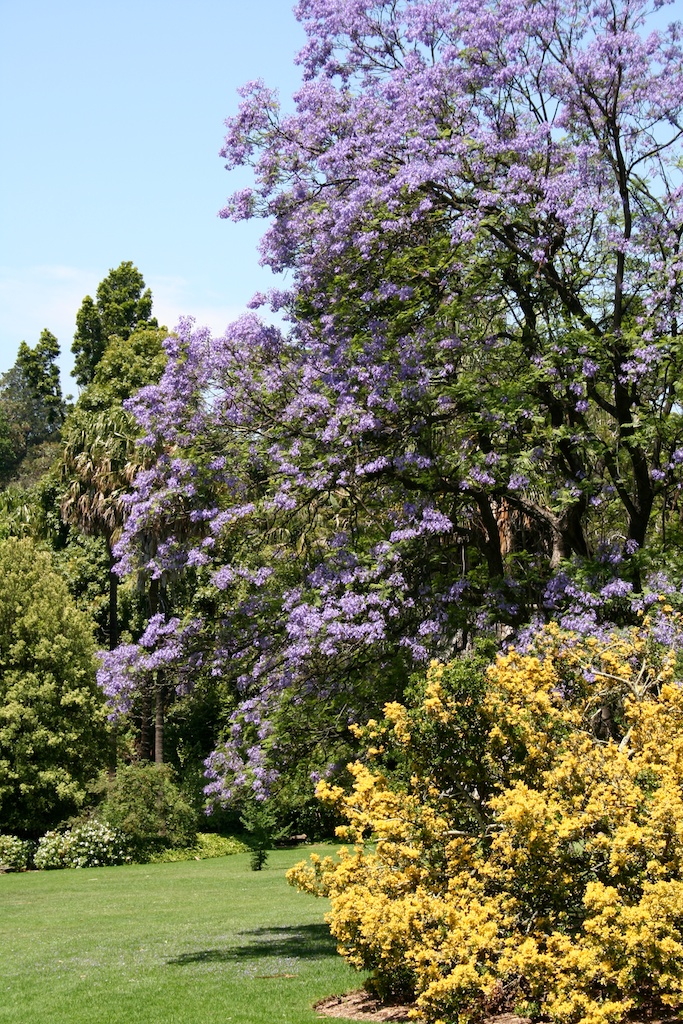
When he was appointed director of the Melbourne Botanic Gardens in 1857 he immediately arranged to have the herbarium built, added his own extensive collection of specimens and began collecting seeds and plants from all over Australia as well as internationally. In the herbarium he built what is now one of Australia’s most important dried plant, algae and fungi collections. Under his stewardship the gardens began to build towards the magnificence which you see today. They can be seen in the photos below.

Botanic Gardens Melbourne
Native mexico

Cork oak, Quercus suber

Botanic Gardens Melbourne

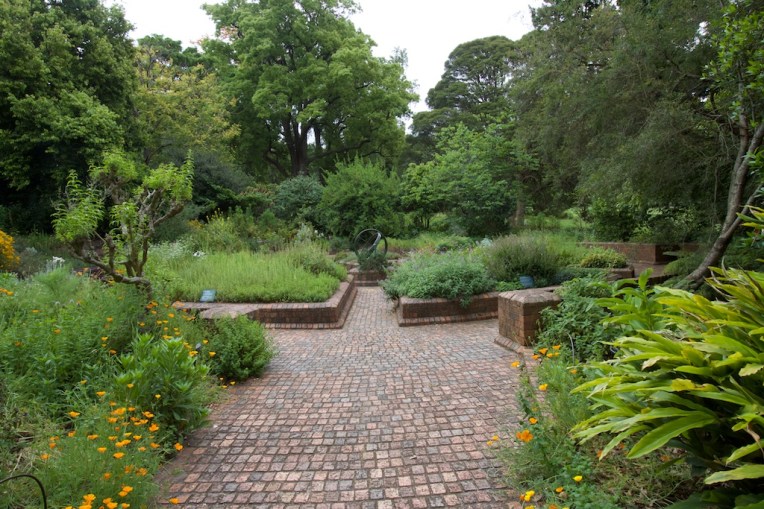
Part of the Children's Garden next to

Children’s garden Melbourne Botanic Gardens

Herb Garden, Botanic Gardens MelbourneHerb Garden Melbourne Botanic Gardens.

Along with the Melbourne Botanic Gardens Von Mueller played a role in the establishment of some of Victoria’s numerous rural botanic gardens. For example when the gardens in Hamilton were established in 1870 Von Mueller supplied 450 shrubs and trees, providing the start of planting for the garden. The tree below is possibly one of the ones he sent.

Corsican pine Botanic Gardens Hamilton

Von Mueller was also one of the first to recognise the importance of the native forests of Victoria and campaigned against indiscriminate clearing. Sadly there began to be complaints about Von Mueller’s management of the gardens in around 1868. There seemed to be the feeling that he was focusing too much on the plants and not enough on the beautification of the gardens. Complaints were along the lines of “‘no foundations exist … neither are statues erected … works of art we can call forth at pleasure, while time lost in forming the plantations cannot be regained”[1] He stoutly defended what he saw as the object of a botanic garden, saying in an 1871 lecture

“that from the early transcendental days of Greece up to the most recent decennia all institutions designated as botanic gardens were mainly or exclusively devoted to the rearing of such plants as were adopted for medicine, for alimentary or industrial purposes; and it would be little short of relapsing into barbarism, were we to alienate any such institutions of ours entirely from their legitimate purpose.”

He continued

“The objects of a botanic garden must necessarily be multifarious, nor need they be, in all instances, precisely the same; they may be essentially modified by particular circumstances and local requirements, yet, in all cases, the objects must be mainly scientific and predominently instructive. As an universal rule, it is primarily the aim of such an institution to bring together with its available means the greatest possible number of select plants from all the different parts of the globe; and this is done to utilise them for easy public inspection, to arrange them in their impressive living forms, for systematic, geographic, medical, technical or economic information, and to render them extensively accessible for original observations and careful records. By these means, not only the knowledge of plants in all its branches is to be advanced through local independent researches, conducted in a real spirit of science, but also phytologic instruction is to be diffused to the widest extent; while simultaneously, by the introduction of novel utilitarian species, local industries are to be extended, or new resources to be originated; and, further, it is an aim to excite thereby a due interest in the general study and ample utilisation of any living forms of vegetation, or of important substances derived there from. All other objects are secondary, or the institution ceases to be a real garden of science.”[2]

Unfortunately he was not successful in his arguments as he was replaced as director in 1873. He remained Government Botanist, but he was so upset by his dismissal from the gardens that it is said that he never set foot in them again. Von Mueller was a dedicated worker, writing over 3000 letters a year, publishing over 800 papers as well as a number of books. By the time he died in 1896 he was largely responsible for the international recognition that was given to Australian scientific endeavour. His work was also of the quality and magnitude that much of it has still not been superseded. He is to me one of the most fascinating people with a memorial in St Kilda cemetery.

St Kilda Cemetery as a repository of history has many more stories to tell apart from Von Mueller’s and the Friends of St Kilda Cemetery do run regular tours. Information can be found here.

St Kilda, like other cemeteries, is a fantastic place not just for its own history but also for the survival of the stories of the people who are buried there. It also creates an area of community space in a tightly urban precinct. It is well worth a visit if you are ever in the area. Cemeteries, like St Kilda, are a vital part of the community.

The photos are all mine apart from the photo of Von Mueller from the Dictionary of Biography and the Botanic Gardens and Hamilton Gardens pictures which were kindly provided by garden writer and photographer Penny Woodward.

For more information on St Kilda Cemetery see:

http://stk.smct.org.au/our-history/

For more on Von Mueller see:

http://adb.anu.edu.au/biography/mueller-sir-ferdinand-jakob-heinrich-von-4266

https://www.rbg.vic.gov.au/about-us/our-story

For the entirety of his speech in 1871 in defence of Botanic Gardens see

http://nzetc.victoria.ac.nz/tm/scholarly/tei-Stout33-t4-body-d9.html


[1] http://adb.anu.edu.au/biography/mueller-sir-ferdinand-jakob-heinrich-von-4266

[2] http://nzetc.victoria.ac.nz/tm/scholarly/tei-Stout33-t4-body-d9.html

Easy to Evil Australian History Quiz.

This is how the quiz works.

There are twelve questions.

There are three sections: easy, hard, evil.

There are four questions in each section.

You get the question then a photo and the the answer is below the photo.

Keep track of how you do because there is a scoring system at the end.

Enjoy 🙂

EASY

  1. What is the name of the market in Melbourne which is built on a graveyard on the corner of Victoria and Elizabeth street?IMG_1142

Answer: Queen Victoria Market. You get the point if you said Queen Vic, Vic or Victoria Market. For more information on the graveyard click here


2.  What is the southern most point of mainland Australia which is named after Thomas who was a friend of Matthew Flinders?

IMGP0304.JPGAnswer: Wilson’s Promontory


3. When was Federation in Australia?

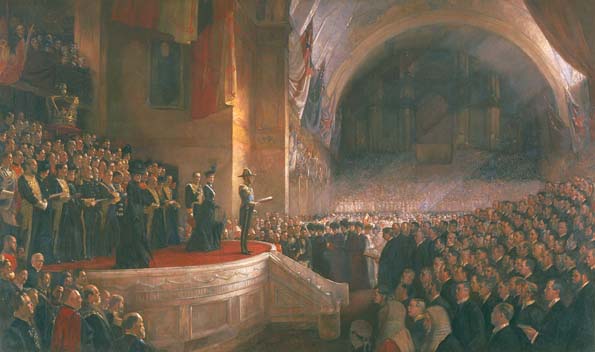
PA0013 Answer: 1901 . The picture is Tom Robert’s painting of the opening of Australia’s first parliament in May 1901. For more information click here
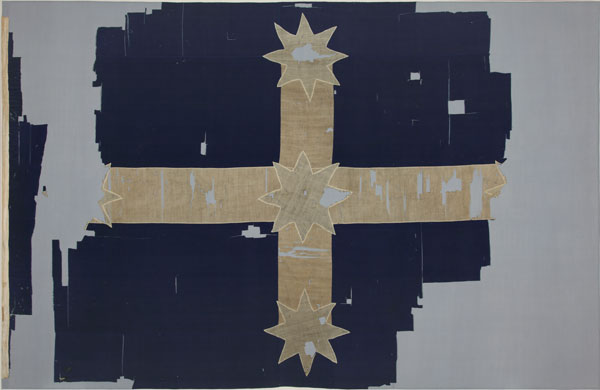


4. What year was the Eureaka Stockade

eureka-flag_conserved

Answer: 1854. The photo is of the flag of the Southern Cross.


HARD

5. Where did Australia’s parliament sit from 1901-1927?

IMG_0654

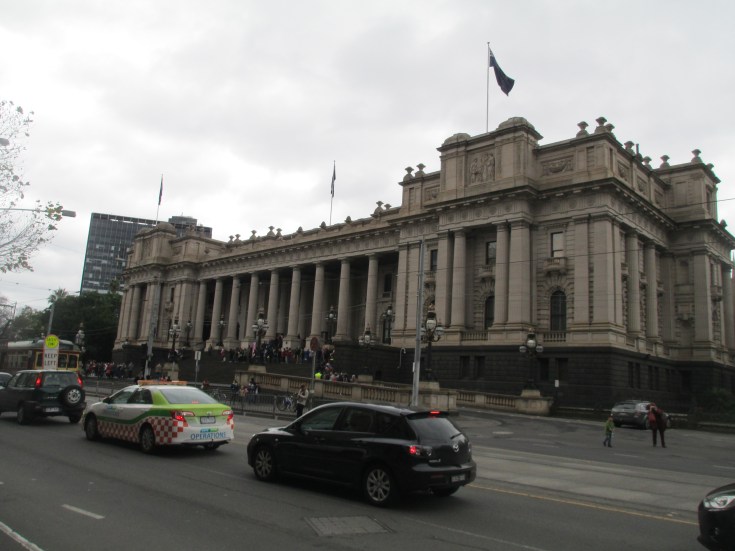
Answer: Parliament House Melbourne. For more information on the fascinating building click here.


6. Where was the first shot fired by the British Empire in World War One ?

pn cheviot 1

Answer: Point Nepean in Victoria. For more information click here


7. What island did Captain James Cook name after he ‘discovered’ it on June 7th 1770?

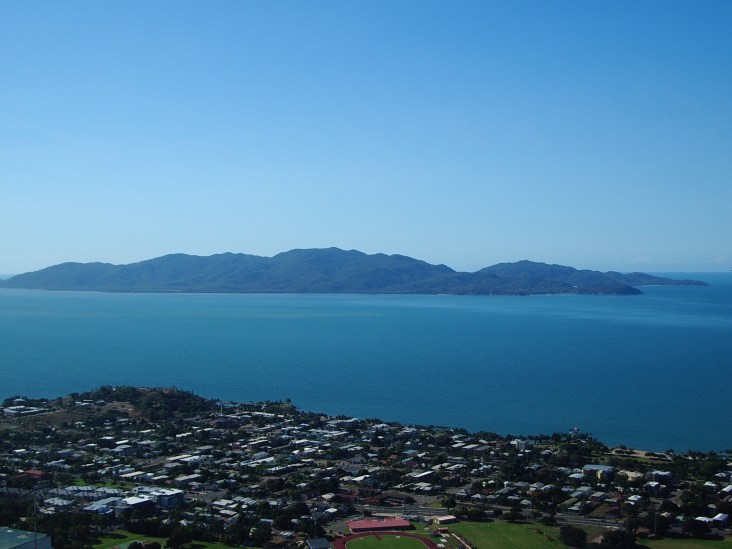
IMGP3548.JPGAnswer: Magnetic Island.


8. What is the name of the beach Harold Holt drowned at and what year did he drown?

PN cheviot 2Answer: Cheviot Beach 1967. For more information click here.


EVIL

9. What is the name of the boat that sank off the shipwreck coast in Victoria on the 1st of June 1878?

loch ard sunshneAnswer: The Loch Ard. The photo is of Loch Ard Gorge. For more information click here.


10.  What is the name of the man who named the Grampian Mountains in Western Victoria and mapped much of the district?

IMG_7551Answer: Major Thomas Mitchell. For more information click here. 


11. What is the name of the small Victorian town named after the man who was Governor of Victoria from 1926-1931?

IMGP2217.JPGAnswer: Somers. The photo is of Somers’ beach.


12. What is the name of the first lighthouse to be erected in South Australia?

IMGP2093.JPG

Answer: Cape Willoughby Light House.


THE END

So that’s it. How did you do?

1-4: Well you’ve got some basics down pat. Good start.

5-8: Impressive. You know you stuff.

9-12: Incredible effort. You may know more than is sensible:)

12: If you got them all… Sure you didn’t write the quiz?


Hope you enjoyed it.


The photos are all mine apart from the Tom Roberts painting which can be found at http://www.aph.gov.au/Visit_Parliament/Parliament_House_Art_Collection/Tom_Roberts_Big_Picture and the Eureka Flag which can be found at http://www.artgalleryofballarat.com.au/exhibitions-and-events/collection/australian-collection/the-flag-of-the-southern-cross-(eureka-flag).aspx


The King’s Champion Part 2

I have written a previous post about my quest to discover the medieval origins of the position of King’s Champion. Rather than rehashing it, you can find it here.

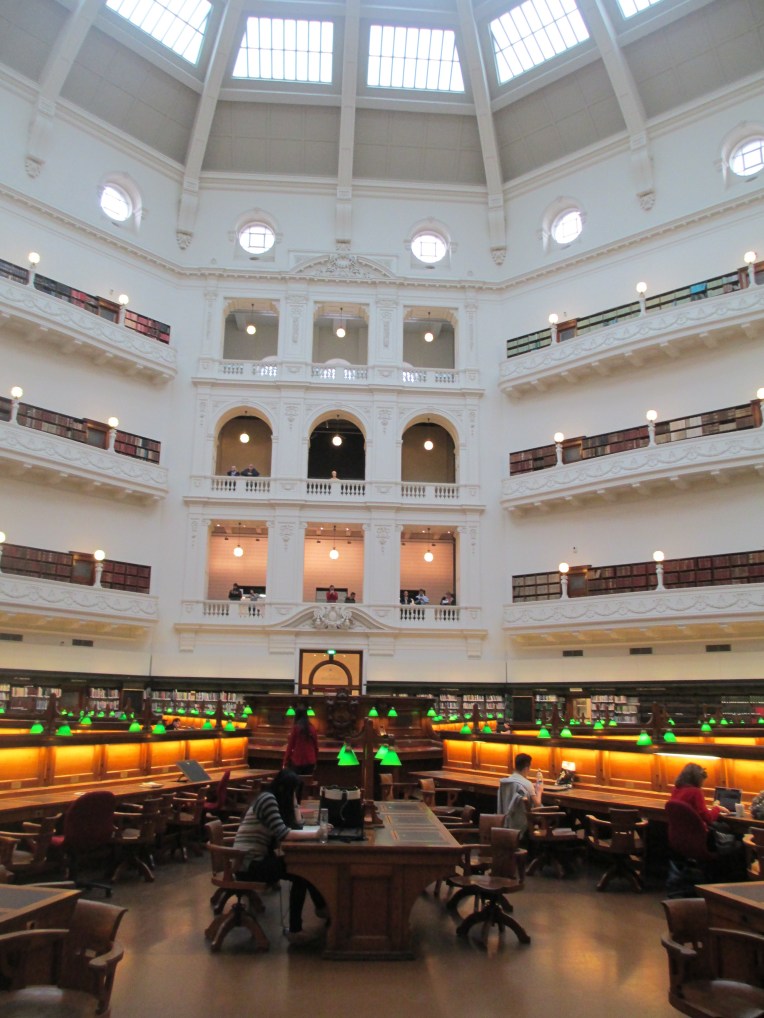
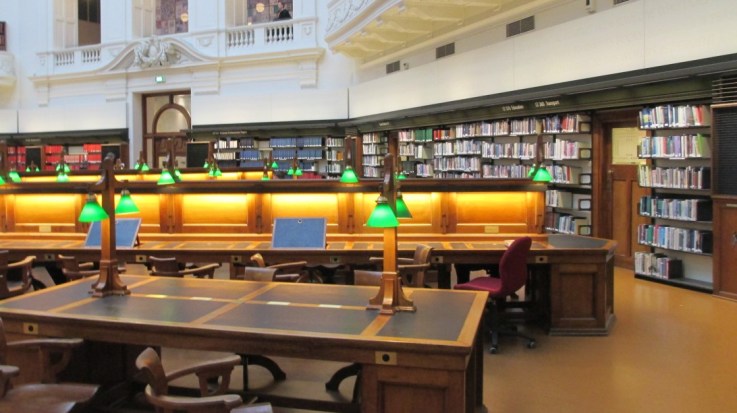
So following the work I did for the previous post, I decided I needed more information than my collection of books and what I’d so far managed to find online could provide. So I headed for the State Library of Victoria. It’s one of my favourite places to do research and if you’re not familiar with it you can see the famous domed reading room in the photos below. I always work in here whenever I can because it has an extensive collection and the most amazing atmosphere. IMG_0695

cropped-lob.jpg

In the reading I’d been doing for my previous post many of the 1800s sources on the King’s Champion I’d found had been based on the work of William Dugdale. I decided he would be a good person to begin the next stage of my search with. Primarily to see if he had any references in his work that would let me track back further. I discovered he was a writer in the 1600s who wrote extensively about both baronial families and peerage. I also found that the State Library had a copy of his two volume work The Baronage of England or The Historical Account of the Lives and Most Memorable Actions Of Our English Nobility.  The first volume covers from the Saxons, to the Norman Conquest, to those who had their rise before the reign of Henry III. The second volume covers from the end of Henry III’s reign to the reign of Richard II. It was the first volume I was most interested in as it was this that later writers were referencing when discussing the Marmion family’s heritage.

I ordered both the books from the State Library. They are classified as rare books so I had to view them in the heritage reading room. Rare books is a wide ranging definition. A book can be rare due to age, or fragility, or a lack of copies in existence as well as other reasons. I was expecting an 1800s copy of the work as this is what usually happens. So I was delighted to find that what I’d ordered was actually a printing from 1675. This is one of the things I love about libraries like the State Library of Victoria. They have an amazing range of rare, fragile and obscure items but you don’t have to have any special qualification to access them. They are there for the use of all Victorians. All I needed to access these books was my library card. I was very excited as this is now my record for the earliest book I have ever held. It beat one from the mid 1700s I used for researching William Marshal during my honours year. The title page of Dugdale’s book can be seen below.

IMG_8530

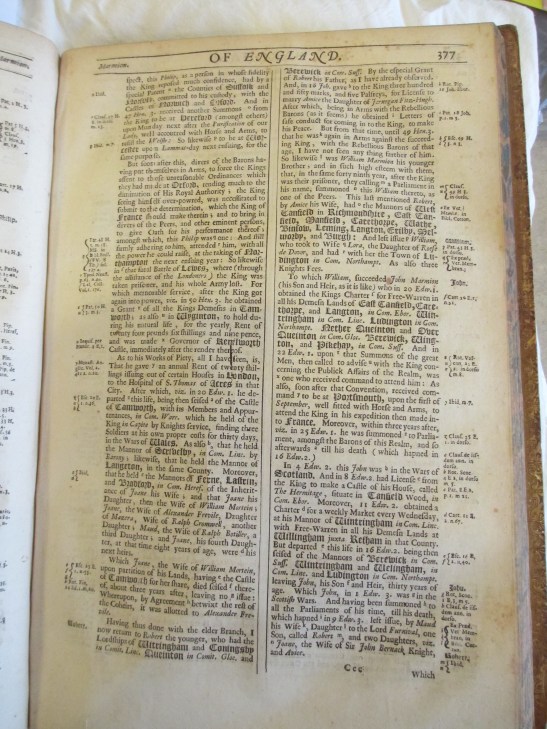
The first volume indeed had the peerage of the Marmion family. It begins by saying that William I gave Robert Marmion the castle of Tamworth. The Domesday Book lists Tamworth castle as being in the hands of the king in 1086. William I died in 1087 so it is just about possible that he gave the castle to Robert Marmion. What is most interesting is the entry regarding the Marmion family and Scrivelsby, the manor which is now tied to the role of King’s Champion. It is only mentioned once and this is not until the narrative reaches Phillip Marmion who died in the 20th year of the reign of Edward I. In this case it is just a passing mention. Scrivelsby is listed as of one of the properties Phillip held by right of Barony on his death. You can see the passage on the page below.

IMG_8544

Dugdale does provide references as to where he is getting his sources. Unfortunately he does it in an abbreviated form, but doesn’t explain what the abbreviations mean. I am yet to work out exactly what the reference for Scrivelsby is referring to, but when I work it out I’ll track it down. The other telling thing about this book is the lack of any kind of reference to the Marmions as hereditary Kings Champions. This doesn’t prove that they weren’t of course, but it might mean that it wasn’t well known or considered especially important.

I also examined the second volume of Dugdale’s work, but there were no further mentions of the Marmions or of the Dymoke family, the family who inherited the title of King’s Champion. What Dugdale does give the reader is what seems to a be a reasonably accurate account of the individual Marmions in England in the Norman and early Plantagenet times. So it seems likely that whether or not they were official King’s Champions, or hereditary Champions of Normandy, that the Marmions were in England roughly from the time of William I. There is also a second Dugdale work that apparently does discuss the role of King’s Champion that I am hoping to track down soon.

Having determined that most likely the Marmions were in England in some form from the time of William I, I decided to try a slightly different track. I’d been looking into the household of the king because the King’s Champion is often mentioned in coronations alongside positions such as the Marshal. From work I’d done on William Marshal I knew that the Marshal is definitely an hereditary position and that it was certainly considered a part of the king’s household. So I decided it was worth having a look through one of the best records of a king’s household from the early Plantagenet period. The Constitutio Domus Regis is a contemporary account probably of the household of Henry I. The exact date is still under debate. It has thankfully been translated by S.D Church. The State Library has a copy which also contains the translation, by Emile Amt, of the Dialogus De Scaccario (the Dialogue of the Exchequer) which dates to the 12th century. I have gone carefully through the Constitutio and am unable to find any mention of the King’s Champion. I also can’t find any kind of regular payment to the King’s Champion listed in the Dialogus. Again this doesn’t mean that it didn’t exist in this time, it may just not have been included in these particular documents. It could also mean that if it did exist then it was much less formal an appointment than say the Marshal, and may have not had a day to day role.

Continuing on a slightly different track I decided that exploring the question from the point of view of the coronation itself was a good idea. Other sources I’d been reading referenced two books

1. The Coronation Book of the Hallowing of the Sovereigns of England.  By Jocelyn T. Perkins published 1902

2.  English Coronation Records  Edited by Leopold  G. Wickham Legg published 1901.

The State Library had copies of both. I began with The Coronation Book. While this text doesn’t provide  any revelatory new information it does cover the position of King’s Champion in later years in detail and provide some lovely little vignettes of the Champion’s role in the coronation.  For example John Dymoke entrance as the champion to Richard II. When he appeared at the coronation on his ‘mighty steed’ he was summarily told that he had come in at the wrong time and told to come back later when it was appropriate.

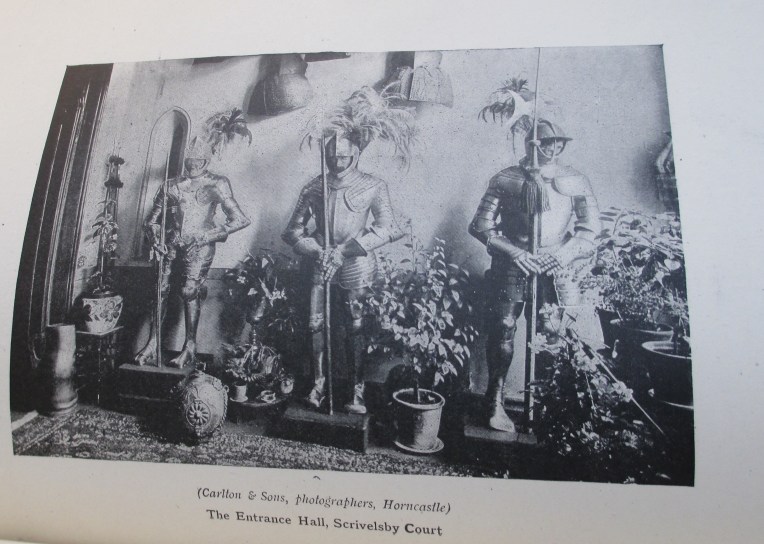
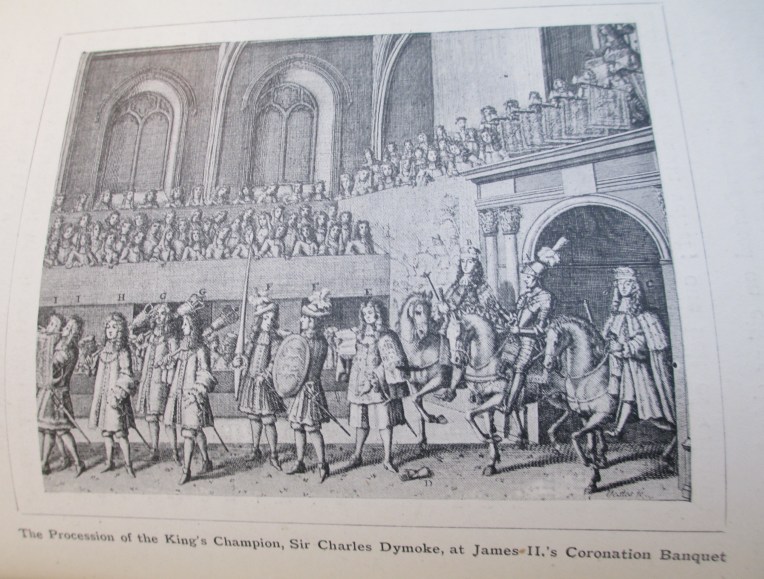
The Coronation Book  provides extensive discussion of many of the ceremonies that various Champions after the reign on Richard II were involved in. It doesn’t however provide any information as to the the role of the Champion before the reign of Richard II. What it does do though is give some lovely illustrations and photos. Some are non contemporary illustrations of the Champions performing their duties and others are of the Champion’s acroutements. They can all be seen below.

IMG_8592

The Manor of Scrivelsby  which is currently tied to the position of Champion.

IMG_8600

Some of the suits of armour worn by the Champions.

IMG_8604

The cups which are the official payment to the Champion for their service at the coronation.

IMG_8608

Sir Charles Dymoke James II’s Champion

IMG_8613

Henry Dymoke the Deputy Champion.

Henry Dymoke participated in George IV’s coronation because the Champion John Dymoke (Henry’s father) was a cleric and therefore apparently unable to undertake the role. The only other time a Deputy Champion was used was at the coronation of Richard II when the hereditary Champion was Margery Dymoke. Her husband John Dymoke undertook the role by right of his wife as she was a woman and as such unable to be to be Champion. [1]

Margery and John Dymoke actually raise a very interesting point which is briefly discussed in The Coronation Book. The coronation of Richard II is the first record we have of the Champion’s role in the coronation. It is also the period in which the Dymoke family took over from the Marmions as the Champions. The Coronation Book mentions that there was a case in the Court of Claims before Richard II’s coronation. John Dymoke argued his right to be Champion through his wife’s descent from Phillip Marmion and his possession of Scrivelsby. [2] When I found this I realised that this court case would be absolutely key because it would have to include an explanation of the rights of the Marmions to the position of King’s Champion. The Coronation Book  doesn’t really provide that much more detail, but thankfully the second book I listed above, English Coronation Records, does.

English Coronation Records in fact has a transcription and translation of the court case. It’s reasonably long and as such I won’t present it in full here. In summary John Dymoke and Baldwin de Freville both presented their cases to be the King’s Champion. Both of them were claiming the position of Kings Champion due to their descent, through marriage, from Phillip Marmion. Phillip was the last of the main line of Marmions and he died in the reign of Edward I. John held Scrivelsby and Baldwin held Tamworth. There were fierce arguments on both sides. In the end it was decided that as John had presented a better case and crucially because “several nobles and magnates appeared in the said Court and gave evidence before the said Lord Steward, that the said Lord King Edward and the said Lord Prince lately dead frequently asserted, while they lived, and said that aforesaid John ought of right to perform the aforesaid service for the said Manor of Scrivelsby.” [3] This last point is absolutely key because this is the point where the role of Champion is tied irrefutably to Scrivelsby itself rather than the specific family.

So through all this I have still failed to find definitive evidence that the Marmions were the hereditary Champions. It does seem, however, that they were certainly believed to be the hereditary Champions in 1367 at the time of Richard II’s coronation. Baldwin and John were both arguing on hereditary descent from the Marmions not specifically on the possession of their respective manors. Additionally no one in the court seemed to find this claim odd and several nobles seemed to feel that Edward III and Edward the Black Prince had discussed it, so it must have been a position that was known and understood.

I am still not quite finished with this. I’m hoping to track down the other Dugdale book in which he apparently discusses the role of the King’s Champion, as well as deciphering his abbreviation style. I am also going to look into the Marmions specifically, as it seems clear that the role was tied to their family not to the property of Scrivelsby until 1367. I am going to see what I can find out about their role in Normandy where they were supposedly hereditary Champions. If I find anything I’ll post an update.

[1]  The Coronation Book of the Hallowing of the Sovereigns of England.  By Jocelyn T. Perkins published 1902 p.151

[2] The Coronation Book of the Hallowing of the Sovereigns of England.  By Jocelyn T. Perkins published 1902 p.134

[3] English Coronation Records  Edited by Leopold  G. Wickham Legg published 1901. pp. 160-161

The photos are all mine.

Major Mitchell and his trail

If you drive into mid-western Victoria in Australia it is impossible to escape the references to Major Thomas Mitchell and his trail

mitchell-front

http://www.majormitchellexpedition.com/

Major Mitchell was born in 1792 in Stirlingshire Scotland. He was a surveyor and in 1827 he took up the position of Surveyor-General of NSW. In 1836 Major Mitchell became the first European to travel across the plains of Western Victoria.

IMG_7565Just out of Dunkeld

The purpose his mission was to follow the Darling River to discover if it flowed into sea or into the Murray. He was then instructed to follow the most promising stream from the Murray and see in which direction it went. This resulted in him crossing Victoria’s western plains. Which is described in his diary thus:

“The scene was different from any I had seen in New South Wales or elsewhere. A land so inviting, and still without inhabitants. As I stood, the first European intruder of the sublime solitude of these verdant plains, as yet untouched by flocks and herds; I felt conscious of being the harbinger of mighty changes; and that our steps would soon be followed by the men and animals for which it seemed to have been prepared.” In fact he thought the land was so good he called it the Australian Felix

I would like to take this moment to point out that the land was far from uninhabited as it was home to several groups of indigenous Australians.  In fact Mitchell certainly encountered some of them because in “December 1836 the Executive Council conducted an inquiry into the killing of Aborigines near Mount Dispersion. It regretted that Mitchell had not made sufficient efforts to conciliate the natives, but in view of their numbers and threatening aspect the council could not severely blame ‘a want of coolness and presence of mind which it is the lot of few men to possess’.”[1] From records it seems that Major Mitchell’s group was followed by a group of Aboriginal people and they felt threatened so they planned an ambush in which 7Aboriginal people were killed. While he was acquitted by an enquiry, as explained above, the incident tarnished his reputation for the rest of his career.

Mitchell’s names for many of the places in the area are still used today and many of them still carry a certain Scottish flavour.

The Grampians

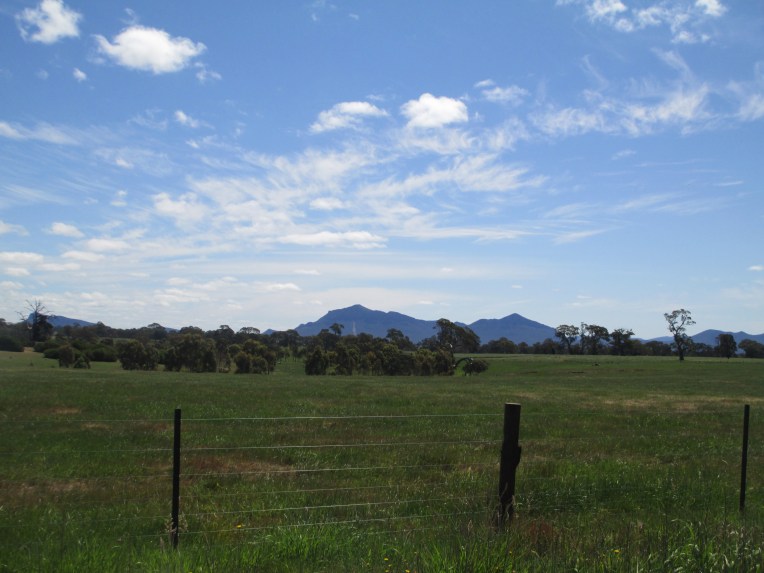
IMG_7542IMG_7596IMG_7588Grampians from a distance

IMG_7853IMG_7851Half way up one of The Grampians

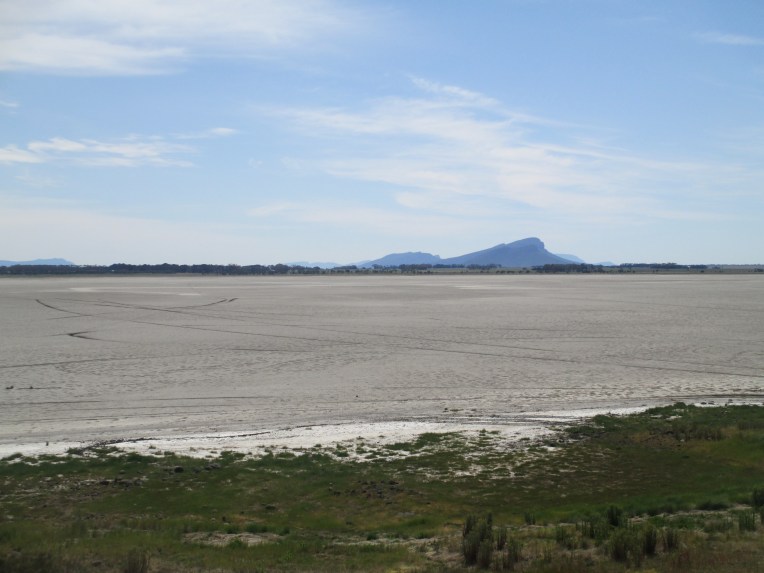
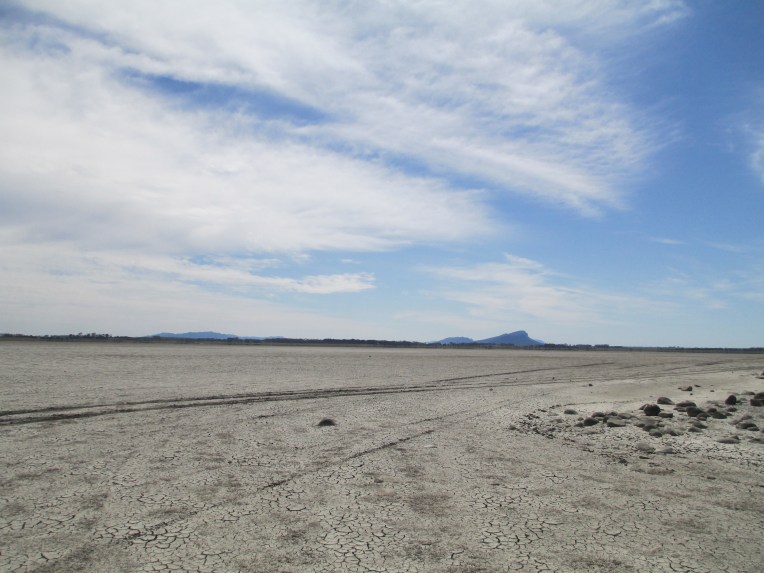
Lake Linlithgow

IMG_7593IMG_7605IMG_7612IMG_7610A very dry Lake Linlithgow

Mount Rouse

IMG_7590The side of Mount Rouse
IMG_7570Mount Rouse from the road

Mount Abrupt

IMG_7552Mount Sturgeon and Mount Abrupt

Mitchell was also the first European to truly explore the Glenelg river.

IMG_7688IMG_7687The Glenelg in mid western Victoria near Harrow.
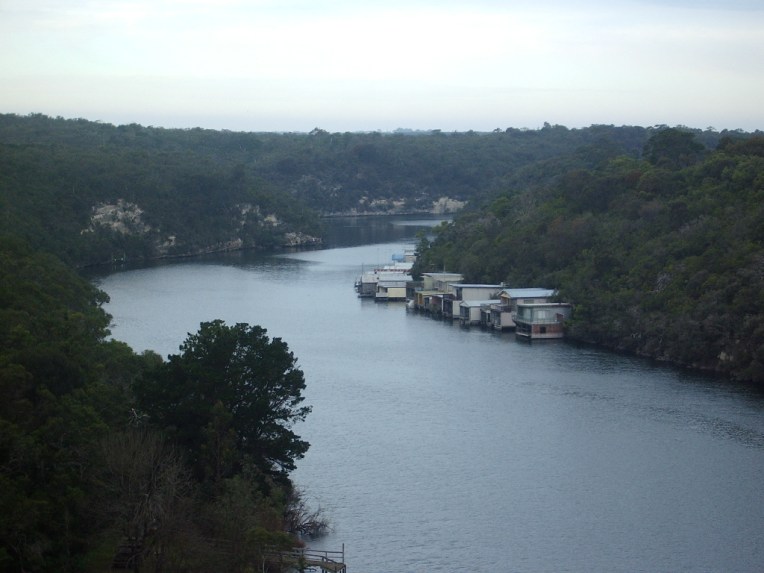
IMGP1460IMGP1461The Glenelg much further down stream near Nelson on the Sth Australian border


Mitchell surveyed the area as he went and this resulted in what was known as Major Mitchell’s trail. You can still follow the trail today, there are marked points and a map.

IMG_7562Monument just out of Dunkeld

IMG_7700Monument just out of Harrow

Other settlers soon followed Mitchell and the European colonisation of western Victoria had begun. Today it is still very much farming country with small towns often bearing very European names, as is true of much of Australia.IMG_7647Balmoral

IMG_7682Harrow

IMG_7793Avoca

IMG_7631Rail bridge over the Wannon in Cavendish

While Major Mitchell’s trek heralded the influx of European settlement to this part of Victoria, he was a skilled surveyor and his diaries give an extraordinary glimpse into what the country would have been like in the mid 1800s.

Resources

Australian Dictionary of Biography

http://adb.anu.edu.au/biography/mitchell-sir-thomas-livingstone-2463

Major Mitchell Expedition

http://www.majormitchellexpedition.com/

Penshurst Portraits. ISBN: 9780646515939

The photos are all mine


[1] Major Mitchell ADB http://adb.anu.edu.au/biography/mitchell-sir-thomas-livingstone-2463


Vida Goldstein

I recently saw the movie Suffragette and while I did enjoy it and applaud the important story it is telling I couldn’t help but think that I wanted to write about some of the non violent members of the women’s suffrage movement. This idea crystallised when I talked to a few people and realised that even the leaders in Australia’s women’s suffrage movement remain largely unknown. As I began to look I found that Suffragette had prompted many others to write about the people involved with the women’s suffrage movement, which is one of the best outcomes the movie could possibly have had. An example is the Guardian article below about the fascinating Adela Pankhurst. She was one of the daughters of the celebrated Emmeline Pankhurst, who is played by Meryl Streep in the movie.

http://www.theguardian.com/australia-news/2015/dec/24/wayward-suffragette-adela-pankhurst-and-her-remarkable-australian-life

I decided that I wanted to write about someone I knew a little about already and as I’d done some work on Vida Goldstein at high school, and too many people still haven’t heard of her, I thought she’d be a good place to start. I was intending to write a short biography of her role in the women’s suffrage movement but as I began to have a careful look I determined that this has been well and truly done. While I don’t belive that all writing has to be treading new ground I truly didn’t see the point in rehashing the Australian Dictionary of Biography article, which covers all the salient points.

http://adb.anu.edu.au/biography/goldstein-vida-jane-6418

It is absolutely worth reading though.

So I headed into the State Library of Victoria, not that I ever really need an excuse, and did some work using their manuscripts collection. With the information I found here I decided that I am going to focus on Vida’s first attempt at entering parliament in 1903.

First though, a very brief background on Vida and a look at the progression of women’s suffrage in Australia.

vida

Vida Goldstein

http://nla.gov.au/nla.obj-136682563/view

Vida Goldstein was born in 1869 in Portland in Victoria and she was one of the leaders of Australia’s women’s suffrage movement. She died in Melbourne in South Yarra in 1949 and a lot more should be known about her by the general population. In other words read the ADB article.

703017194

A young Vida Goldstein

http://goo.gl/5xcNik

Vida was also very much a part of the international suffrage movement as can be seen by the notes below from Susan B Anthony, who most people will have heard of. Susan B Anthony gave Vida the three volumes of her book called A History of Women’s Suffrage

In each volume she wrote an inscription to Vida and they are all dated to the 4th of July 1902.

To Miss Vida Goldstein

Melbourne Australia

From her disenfranchised friend, the city of Rochester, County of Monroe, State of New York, Country of the United States of America- the land of the free who has worked to the best of her ability, for fifty years and more to the get the right for women to vote- and will continue to battle for it to the end of her life-

affectionately.

Susan B Anthony


To Vida Goldstein

Melbourne Australia

Rejoicing that you have gained the national franchise- and hoping your other states will soon grant the local suffrage- while we of the United States of America struggle on-no one can tell how long to the the right to vote.

Sincerely yours

Susan B Anthony


Miss Vida Goldstein

(to be given to the public library- when she is done with it)

With the congratulations that the new world of Australia has given to her women all the rights of citizenship- equally with her men- and with love and esteem of her friend

Susan B Anthony.[1]

Vida also travelled to speak at suffrage events and meet other members of the suffrage movement, especially those who were still fighting for women’s suffrage. The photo below shows her with other women’s suffrage supporters at the Great Suffragette Demonstration in London in 1911. Vida is on the far right

vida london

Great Suffragette Demonstration

http://nla.gov.au/nla.obj-136683161/view?searchTerm=vida+goldstein#search/vida%20goldstein

Australia was one of the first countries to give the vote to women. It is complicated though by the fact that each state allowed women the vote at a different time and that it occurred federally as well, independent of the individual states. The result of a separate Federal right to vote, which was granted in 1902,  was that there were women from several states who could vote in federal elections but not in their state elections.

Below you can see when the vote was granted state by state

1894 South Australia

1899 Western Australia

1902 Federal

1902 New South Wales

1903 Tasmania

1905 Queensland

1908 Victoria[2]

Vida also described the mood in Australia which made it possible for the vote for women to become a reality far earlier than in countries like the UK.

The Broad Mindedness of Australian Men

One feature of the Suffrage Campaign in Australia makes it radically different from that in any other country- the readiness of our men to admit that our cause was a just one, and entitled to immediate recognition. We never had any difficulty in winning over the men of Australia to our side. Our real battle ground was the Upper House in each colony. The Lower Houses were elected practically on as basis of One Man One Vote and in the Lower Houses it was easy to get a suffrage bill through, but the Upper Houses, which represented only the propertied classes, who in Australia are always against reform, stood solid against us, and it was only when we got a strong Premier in each state that we could get a Suffrage Bill through the Upper Houses.[3]

Vida also described the hard work that went on to not only try to achieve the vote, but also to get male MPs to take notice of specific issues.

Through not having women in Parliament energy and valuable time have to be spent on the often Herculean task of educating members up to the point of seeing the injustice in certain measures affecting women, e.g the Federal Public Services Act. It bristled with discrepancies in pay for men and women doing exactly the same work. To get the principles of equal pay embodied in the bill some of us had to spend days at the House lobbying members, always hateful work- showing them the many injustices in the bill from the women’s point of view, and trying to get them to see them as we saw them. We had to tramp round getting petitions signed and write to the press. Had there been women in the House there would have been no need for such tactics because the injustices were so obvious they only had to be pointed out and most members promised to get them removed. Another example was the Naturalisation Bill which completely merged the individuality of a married woman with that of her husband. [4]

Even before she ran for parliament Vida herself had become vehemently against the two party system because she considered that parties sacrificed  principle to expediency and put their own interests before all else. She came to this conclusion in 1902 when, after women were allowed the vote federally, she started the group Women’s Federal Political Association. Unfortunately male politicians quickly began to use the Association for party purposes and when Vida reacted by moving the Association away from one party and to a non political basis the majority of the male members left.

So this was the background to Vida running for parliament in 1903. The election was in December of 1903 and she launched her campaign in October in her home town of Portland. But she began signalling she would be running earlier. Part of her campaign was a letter published in Reviews of Review in August entitled Should Women Enter Parliament?

She opened by, with what The Advertiser described as “a delightful touch of femininity”, immediately answering her own question

“Of course why not?”

She then went on to defend her supposition laying forth the usual key arguments against women’s suffrage, beginning with the idea that there was a lack of precedent. She refutes this by providing several examples from history and going on to discuss the disparity between men who happily accepted a female sovereign, Queen Victoria had died quite recently, but couldn’t accept women in parliament.[5] As her niece LM Henderson wrote Vida “never indulged in empty rhetoric, she always supported her arguments with facts, and could answer almost any question.”[6] Vida was the first woman to stand for parliament in the Empire and naturally enough there was both comment and opposition. The rural papers tended to be more sympathetic than the Melbourne papers.  For example The Avoca Standard ran this piece in November 1903.

“Miss Goldstein presented a very pleasing appearance on the platform at Avoca. She was graceful, pretilly gowned and wore a most becoming hat. During her address she toyed prettily with a beautiful La France rose- a move that added much to the effect. The lady became a favourite with all present almost at once. Her easy delivery of speech, charming voice, modest manner, and the absence of anything masculine, being the chief factors in her favour.”

This piece might be very condescending, but it isn’t hostile.

The Age and The Argus were generally dismissive, but not always. There was also extensive argument as to the legality of women in parliament. But it quickly became clear that even constitutionally there was no argument barring them running. [7]

The press commentary wasn’t limited to articles, there were also cartoons and poetry. An example of the cartoons can be seen below. In which Vida has to be accompanied to the Senate by a chaperone, and all the men dare not disobey her for fear of being seen as discourteous.

vida cartoon

Vida Goldstein Cartoon

from Punch http://goo.gl/wN04hH

There were headlines like “Sweet Skirted Senators” from the Sunday Times and this really quite interesting poem, also in the Sunday Times, on 9/08/1903

Vidi!-Vida!-Vinci!

What a theme

for the scheme

of a beautiful dream

to be there in the Senate with Vida!

What a foretaste of heaven

the Senate would seem

to the Senator sitting beside her.

They say tis a right which can not be denied her!

Let us give her a vote, for we’d gloat

and we’d dote

on a note 

from the throat

of Miss Vida!

You can see it would be very simple; 

for she wouldn’t want advisors to guide her!

And to all her proposals, of course they’d agree

it would be very rude to deride her!

All the House would have nous

to be meek as a mouse!

They would catch it if any defied her!

And it’s certain soft soap

couldn’t hope

to enrope

or to cope

with the scope

of Miss Vida. 

And I can’t

and I shan’t

see the reason we aren’t

to be ruled by good ladies like Vida.

If you vote for your Uncle

why not vote for you Aunt

if the requisite sense is supplied her.

And she

like a he

should be perfectly free

to engage in a sphere that is wider.

If the matter’s discussed,

then we must,

to be just,

give a thrust

to our trust

in Miss Vida.

Ah! but then

gentlemen

when it comes to the ken

of a Senator’s wife, could he chide her

if she kicked up a row with her tongue and a pen

on the boldness of brainy Miss Vida.

For a lass

is a lass

but alas, should it pass

there are ladies who’d call her a spider!

And although we may cheer

still I fear it is clear

we must bid you “Good Morning”

Miss Vida

W.T Goodge[8]

You can make of that what you will of the poem. I can’t decide if it’s derogatory, celebratory or both.

Media aside, Vida campaigned assiduously, but it is unlikely she ever expected to win. She chose to run for the Senate rather than the House of Representatives probably because it would allow her to campaign throughout Victoria rather than just for one seat. Thus spreading her message further. The election took place in December 1903 and Vida polled 51 497 which was surprisingly good considering voting wasn’t compulsory. It was not, however, enough to win the seat. She took defeat well, commenting on the process in January 1904 in Review of Reviews.

I found political sentiment best developed in the labour ranks, among women earning their own living, and among the country women in the leisure classes. Melbourne women are notoriously ignorant of politics. This difference between city and country was the only new fact my campaign taught me. The chief value of suffrage at present is its educational value, I would sooner see women educated in views diametrically opposed to mine than not educated at all… I had against me the combined power of the Morning and Labour papers, deliberate misrepresentation by two of them, lack of finance, and the prejudice of sex. I stood for the cause of women and children, as a protest against the dictation of the press, and against the creation of the ticket system of voting. From men I had most courteous treatment… The chief lesson to be learnt from this campaign was the need for organisation. The Labour Party had the best organisation and their success shows this. Labour seeks to reach its goal mainly by material means; women place a higher value on the spiritual, but (word missing, LMH) will someday see that is righteous alone that exalteth a nation.

She commented later to her niece Leslie M. Henderson that she was terrified of mice and was always afraid that some of her opponents would discover it and let loose some mice on the platform when she was speaking. Thankfully this never happened. [9]

And that was the end of Vida’s first attempt to join Australia’s parliament. She tried another four times to gain office but was ultimately never successful. This was most likely to do with the fact that she always ran as an Independent Woman Candidate. Despite her lack of electoral success Vida Goldstein was a pioneer for women’s rights around the world and she deserves to be as well know internationally as some of the other larger than life figures in the woman’s suffrage movement.

vida older

Vida Goldstein painted by Waterhouse

http://trove.nla.gov.au/work/26335720?q=vida+goldstein&c=picture&versionId=46453732

[1] State Library of VictoriaMS BOX 3097/5(a-c)

[2] From Vida Goldstein’s papers: State Library of Victoria MS MSM 118

[3] From Vida Goldstein’s papers: State Library of Victoria MS MSM 118

[4] From Vida Goldstein 1869-1949: Biographical notes by her niece, Leslie M. Henderson, 1966 January. MS BOX 332/14

[5] From Press cutting book presented to Edith How Morlyn for Women’s Service Library London by Vida Goldstein State Library of Victoria MS BOX 2493/ 5

[6] From Vida Goldstein 1869-1949: Biographical notes by her niece, Leslie M. Henderson, 1966 January. MS BOX 332/14

[7] From Press cutting book presented to Edith How Morlyn for Women’s Service Library London by Vida Goldstein

[8] From Press cutting book presented to Edith How Morlyn for Women’s Service Library London by Vida Goldstein

[9] From Vida Goldstein 1869-1949: Biographical notes by her niece, Leslie M. Henderson, 1966 January. MS BOX 332/14


St Mary of the Angels Basilica Geelong

I found this church by accident on a recent trip to Geelong and it’s a really lovely example of Victorian Gothic.

IMG_1291

Geelong is in Victoria Australia about an hour out of Melbourne. It was founded in 1838 when it was laid out and officially proclaimed. Its existence is due to the need for a depot for all the squatters who were pouring into Victoria. The first land sales were held in 1839 with the Wollpack Inn opened in the same year.

The current Basilica stands on what was known as Church Hill and commands the highpoint of Geelong.

The church that can be seen today has humble origins. To begin with Catholics in Geelong, or Corio as it was often known, did not even have a priest. Father Bonaventure Geoghegan became the first priest for the St Benedict’s District, of which Geelong was part, in 1839.

Screen Shot 2016-01-03 at 4.43.18 pm

Father Bonaventure Geoghegan

http://goo.gl/XbtQJJ

Geoghegan was born in Dublin and celebrated his first Mass in an open roofed building in Melbourne on May 19 1839. He baptised the children who had been born in the four years of Melbourne’s existence. He was the only priest to care for Catholics in the whole of the existing area of Victoria. As this was such a significant task Geoghegan was given an assistant, curate Richard Walsh. Then after 12 months, when Walsh was moved to Norfolk Island, Michael Ryan was assigned. He was described by Vicar General Murphy from Sydney as “a very well disposed young man although at times a little hasty & inclined to have too much of his own way.”

It was Ryan who was assigned officially to Geelong in September 1841. Two days after his arrival, on the 8th of September 1841, Ryan celebrated what would have been the first Mass in Geelong. Under Ryan’s watch a foundation stone was laid for the beginnings of a church for the Catholics, but it wasn’t to be for Ryan and Geelong as Ryan was recalled to Sydney in October. Even without Ryan there Geoghegan continued with the plans for a church for Geelong. However progress was slow especially because it wasn’t until 1842 that Geelong again had the benefit of the resident priest. On April 13 Father Michael Stephens celebrated the first catholic marriage in Geelong. Later in 1842 the first catholic chapel was finally completed. It was a modest building made of paling about 30 feet by 20 feet and covered by a shingle roof. A far cry from the current church.

By 1846 the need for a new church had become very apparent. The census of that year showed 1003 catholics in the County of Grant which the small church serviced. The priest at the time, Richard Walsh again, set out on a campaign for the building of a permanent church. After fundraising and other efforts the foundation stone was laid on the 19th of August 1856 by Father Geoghegan.This church was opened on October 6th 1847  it was called St Mary’s and was later described…

“It was a  pretty little church built of very bad Barrabool stone. It soon began to show signs of decay, and the weather side had to get three coats of thick paint in ’53 to preserve it from the effects of frost and rain”

By 1854 the capacity of St Mary’s was very strained,the census of that year showed 3797 catholics in Geelong, and it was resolved that a new church was needed.

The first stone of the present church was laid by the Most Reverend James Alipius Goold 1st Bishop of Melbourne on the 15th of June 1854.

A040300_246x550

Most Reverend James Alipius Goold

http://adb.anu.edu.au/biography/goold-james-alipius-3633

The nave was completed and  opened for worship, again by Bishop Goold,  on the 4th of February 1872. IMG_1299

The Nave

Daniel Mannix, Archbishop of Melbourne,  consecrated the completed church including spire, on the 16th of June 1937.

IMG_9718

Statue of Daniel Mannix outside St Patrick’s Cathedral in Melbourne.

Even before the spire was completed the church was eliciting extravagant praise.

“It exhibits an edifice of colossal cathedral proportions, such as one might expect to find in the episcopal city of some ancient Catholic continental nation, but which excites astonishment when associated with an antipodean town of yesterday… Even in this incomplete condition, the building is the most conspicuous, commodious and elegant ecclesiastical edifice in the town.”

The church was based on the 13th century gothic style. The central tower rose to a height of 100 feet above the ground and was capped with 8 crocketed pinnacles. These formed the base of the spire which rose another 98 feet into the air before terminating with a 12 foot high cross. The top of the cross was 210 feet above ground. The spire was built from inside without the use of external scaffolding.

IMG_1297

Ceiling below the spire.

IMG_1292

The Spire, you can see the cross up the top.

The total length of the church was 220 feet, the distance between the transepts was 126 feet and the nave with side aisles was 14 feet 6 inches wide. The high altar was made of Verona marble. IMG_1298

The high altar, although this is modified from the original version.

Although it was without doubt a magnificent building the church ran into problems in the 1960s as it was already beginning to age. The foundations on the western end had to be underpinned to stop subsidence and 560 stone crockets had to be removed from the spire because they kept breaking off, damaging the slate roof, causing leaks and threatening anyone walking too close to the church. Major restoration work was also undertaken in the 1980s.

In 2004 the 150th anniversary of the church was celebrated and at the anniversary Mass Archbishop Dennis Hart of Melbourne announced that the Vatican had designated St Mary’s as a Minor Basilica. One of only five in Australia.

These are the conditions for the granting of Minor Basilica status according to The United States Conference of Catholic Bishops.

“1. A church for which the title of basilica is proposed must have been dedicated to God by a liturgical rite and must stand out as a center of active and pastoral liturgy, especially through celebrations of the Most Holy Eucharist, of penance, and of the other sacraments, which celebrations set an example for others on account of their preparation and realization according to liturgical norms and with the active participation of the people of God.

2. To further the possibility of truly carrying out worthy and exemplary celebrations, the aforesaid church should be of an appropriate size and with a sufficiently large sanctuary. The various elements required for the liturgical celebration (altar, ambo [lectern], celebrant’s chair) must be placed according to the requirements of the restored liturgy (cf. General Instruction of the Roman Missal, nos. 288-318).

3. The church may enjoy a certain renown throughout the diocese, for example, because it has been constructed and dedicated to God on the occasion of some particular historical and religious event, or because the body or significant relics of a saint are reserved in it, or because some sacred image is there venerated in a special way.

The historical value or importance of the church and the worthiness of its art are also be considered.

4. So that, as the liturgical year progresses, the celebrations of the various seasons may be carried out in a praiseworthy manner, a fitting number of priests is necessary; they are to be assigned to the liturgical and pastoral care of the church, especially for the celebration of the Eucharist and penance (there should also be an appropriate number of confessors who at stated hours are available to the faithful).

In addition, a sufficient number of ministers is required as well as an adequate schola cantorum, which is to encourage the participation of the faithful with sacred music and singing.”

So the awarding of this title to St Mary’s is very much an acknowledgement of its importance both to the history of Victoria and to the people of Geelong.

It is a really beautiful church. Even if you are completely non religious as I am, the majesty of St Mary’s must be appreciated.

IMG_1294

St Mary’s from the front.

References

Ian Wynd. St Mary of the Angels Basilica. ISBN: 9780975840702

Unless otherwise stated by links the photos are mine.