The Skinny on Bad Parchment

These are beautiful even if they are technically mistakes.

Erik Kwakkel's avatarmedievalbooks

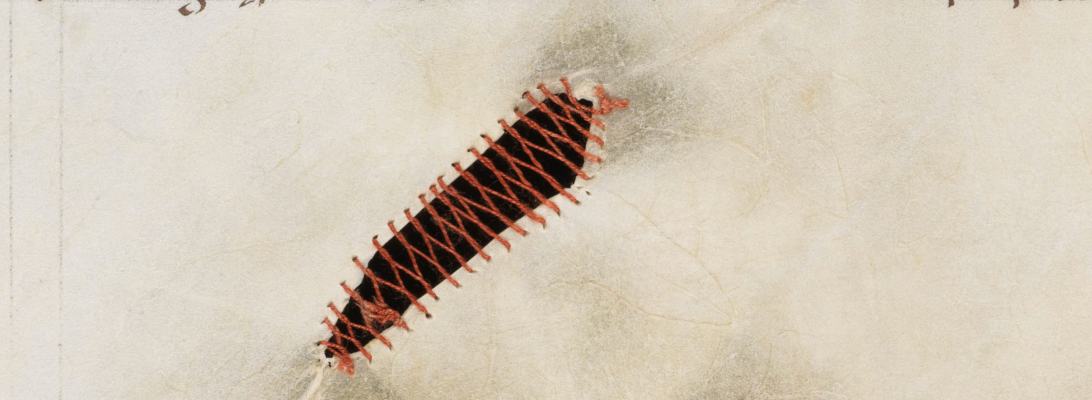
My favourite activity is to touch, smell, and listen to the crackling sound of cows and sheep that have been dead for a thousand years. That’s right, I am talking about medieval parchment, the standard material for books made between the fifth and thirteenth centuries. Animal skin replaced papyrus (standard up to the fifth century) and would ultimately be challenged by paper, which competed for dominance during the later medieval period. Parchment was resilient, however, and it was even used by early printers, including Gutenberg himself – showing the use of animal skin did not die with the medieval manuscript.

There is a lot you can tell from medieval skin. Like a physician today, the book historian can make a diagnosis by observing it carefully. The best quality, for example, feels just like velvet. It usually has an even, off-white colour, and it makes no sound when you turn the page. Bad skin, by contrast, crackles. It is of uneven thickness, and shows staining…

View original post 981 more words

Bury St Edmunds

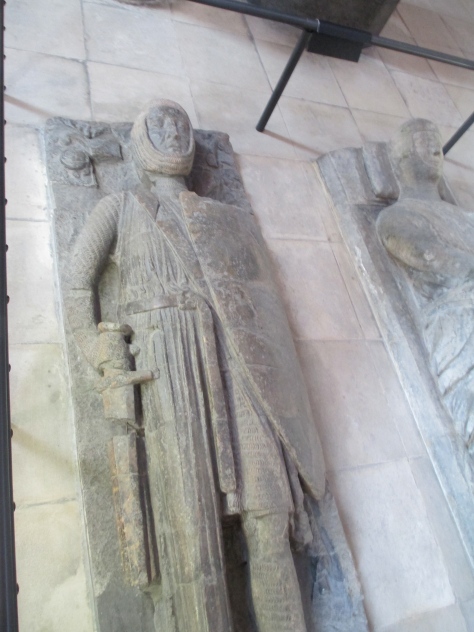
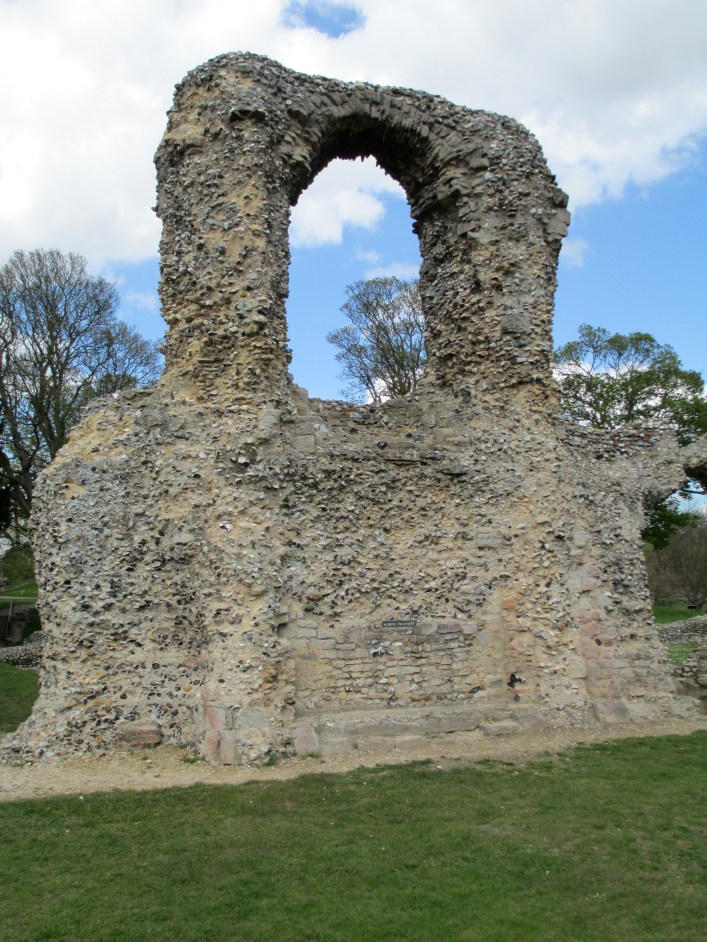
The abbey at Bury St Edmunds is only ruins today, but it was once one of the largest and most powerful abbeys in England. It was home of the Chronicle of Bury St Edmund’s and was one of the places that the Magna Carta was planned. It was a casualty of the dissolution of the monasteries, handed over to the king in 1539.

There isn’t a lot left now, but what remains is majestic and  poignant. It allows a glimpse of how spectacular the abbey would have been in all its glory.

bury

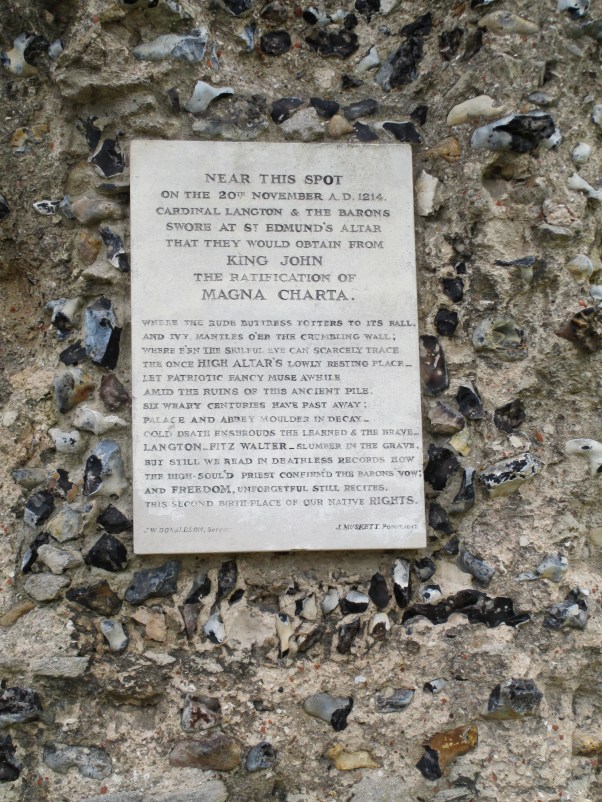
The tallest pillar you can see to the left of the picture is near where the Magna Carta barons met to swear on the altar of St Edmund that they would obtain ratification of the Magna Carta from King John.  The plaque below is affixed to it.

bury st 4

St Edmund’s is also the abbey that Eustace, the wildly unpopular son of King Stephen, plundered right before he died unexpectedly, possibly from choking to death. Many felt that his death was divine wrath, similar to the death of Henry the Young King.

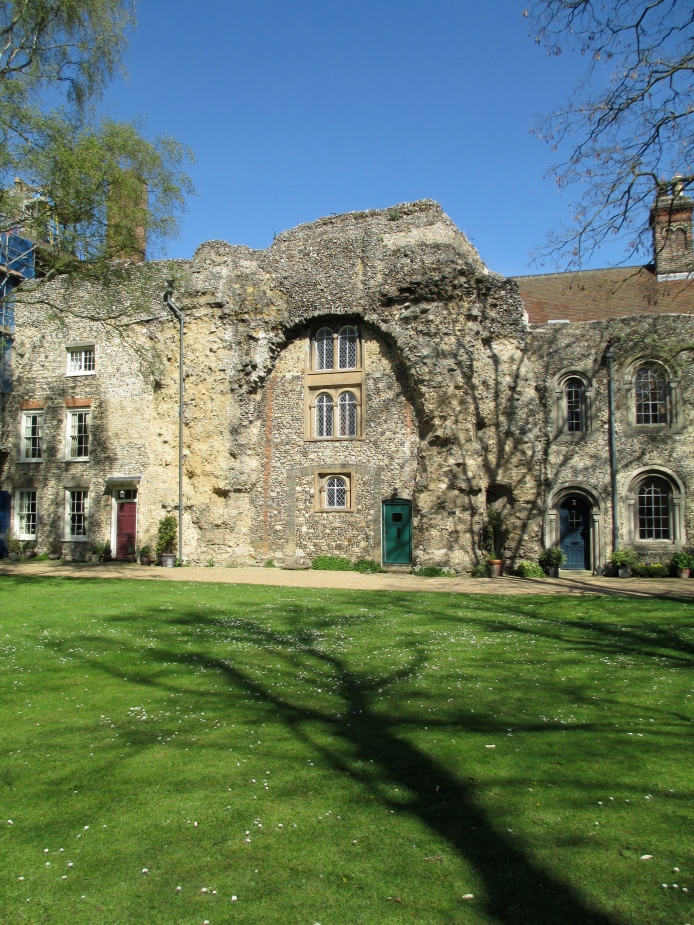
The Chronicle of Bury St Edmunds was also written at the abbey. The Chronicle was written by Jocelin de Brakelond who was the chaplain of Abbot Samson. Samson was  one of the Abbots who had the most structural influence on the abbey. Samson completed the great western front of the abbey.  More of the west front survives today than any other part of the abbey, but it is largely houses. You can still see the remains of Samson’s great arches.bury st8

bury st door

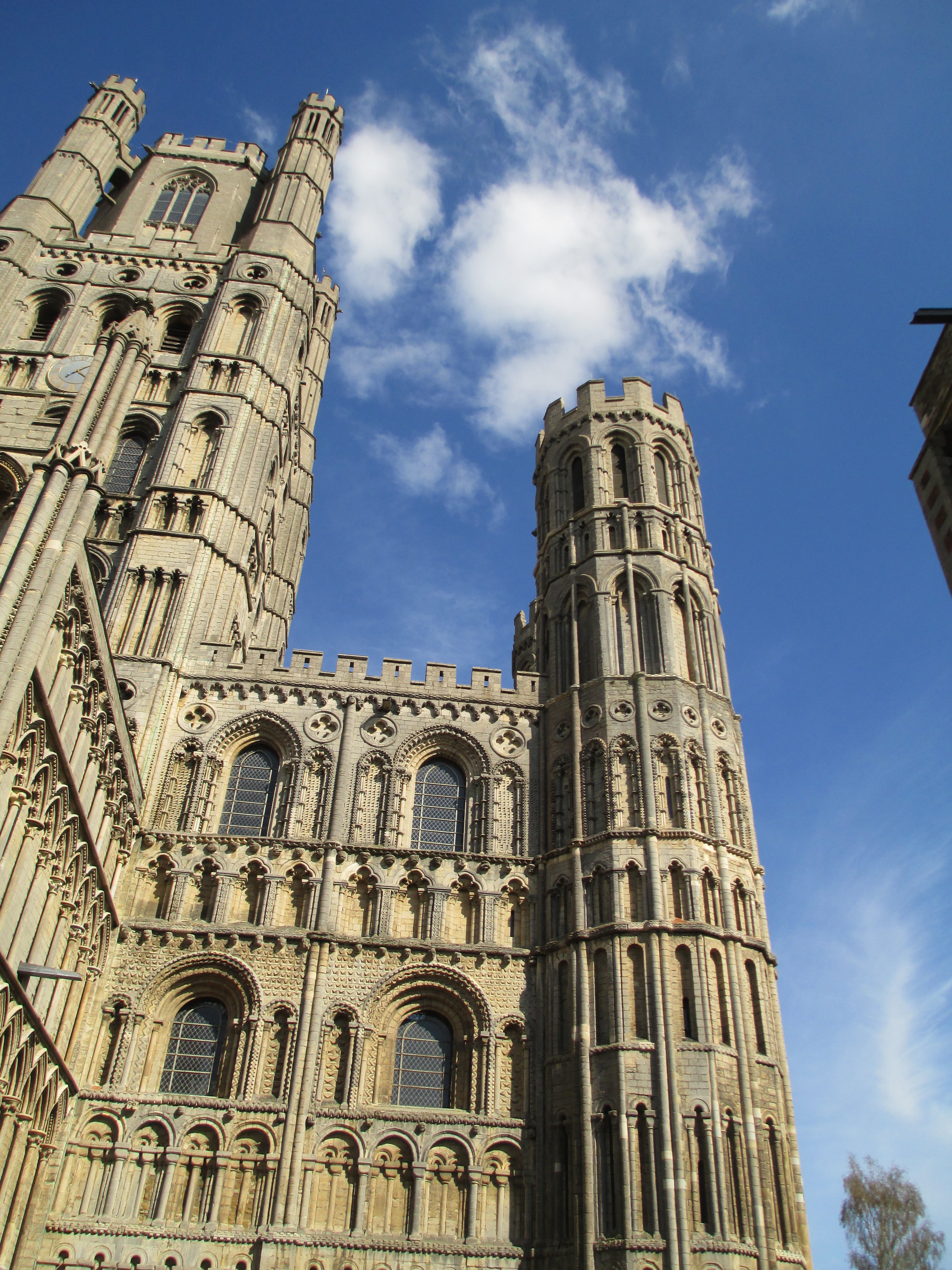
Samson also had an almost competition with Geoffrey Ridel who was Bishop of Ely. Geoffrey requested that Samson let him have oaks from Elmsett for his own building operations at Ely and Geoffrey had secretly gone through and marked the trees he wanted. Samson felt he had to agree, but he immediately felled the best oaks in Elmsett for his own works.  This is an excellent illustration of the competition between the large religious institutions. You can see Ely Cathedral below.

ely

Samson’s works on the abbey and general life at the abbey over this period , 1173-1202, are the main subjects of the Chronicle. It also provides an intriguing picture of Samson himself.

“ABBOT SAMSON was below the average height, almost bald; his face was neither round nor oblong ; his nose was prominent and his lips thick; his eyes were clear and his glance penetrating; his hearing was excellent; his eyebrows arched, and frequently shaved; and a little cold soon made him hoarse. On the day of his election he was forty­ seven, and had been a monk for seventeen years. In his ruddy beard there were a few grey hairs, and still fewer in his black and curling hair. But in the course of the first fourteen years after his election all his hair became white as snow.

He was an exceedingly temperate man ; he possessed great energy and a strong constitution, and was fond both of riding and walking, until old age prevailed upon him and moderated his ardour in these respects. When he heard the news of the capture of the cross and the fall of Jerusalem, he began to wear under garments made of horse hair, and a horse­ hair shirt, and gave up the use of flesh and meat. None the less, he willed that flesh should be placed before him as he sat at table, that the alms might be increased. He ate sweet milk, honey, and similar sweet things, far more readily than any other food.

He hated liars, drunkards, and talkative persons; for virtue ever loves itself and spurns that which is contrary to it. He blamed those who grumbled about their meat and drink, and especially monks who so grumbled, and personally kept to the same manners which he had observed when he was a cloistered monk. Moreover, he had this virtue in himself that he never desired to change the dish which was placed before him. When I was a novice, I wished to prove whether this was really true, and as I happened to serve in the refectory, I thought to place before him food which would have offended any other man, in a very dirty and broken dish. But when he saw this, he was as it were blind to it. Then, as there was some delay, I repented of what I had done, and straightway seized the dish, changed the food and dish for better, and carried it to him. He, however, was angry at the change, and disturbed.

He was an eloquent man, speaking both French and Latin, but rather careful of the good sense of that which he had to say than of the style of his words. He could read books written in English very well, and was wont to preach to the people in English, but in the dialect of Norfolk where he was born and bred. It was for this reason that he ordered a pulpit to be placed in the church, for the sake of those who heard him and for purposes of ornament.”

This excerpt offers an intriguing glimpse into the world of Bury St Edmund’s.

To read more go to http://www.fordham.edu/halsall/basis/jocelin.asp

The remains of St Edmund’s Abbey are like the bones of a giant, you can see the greatness that was once there.  The first photo below shows the remains of what would once have been a beautiful window and the second shows that bases of pillars that held up part of the church.

bury st 5

bury st 3

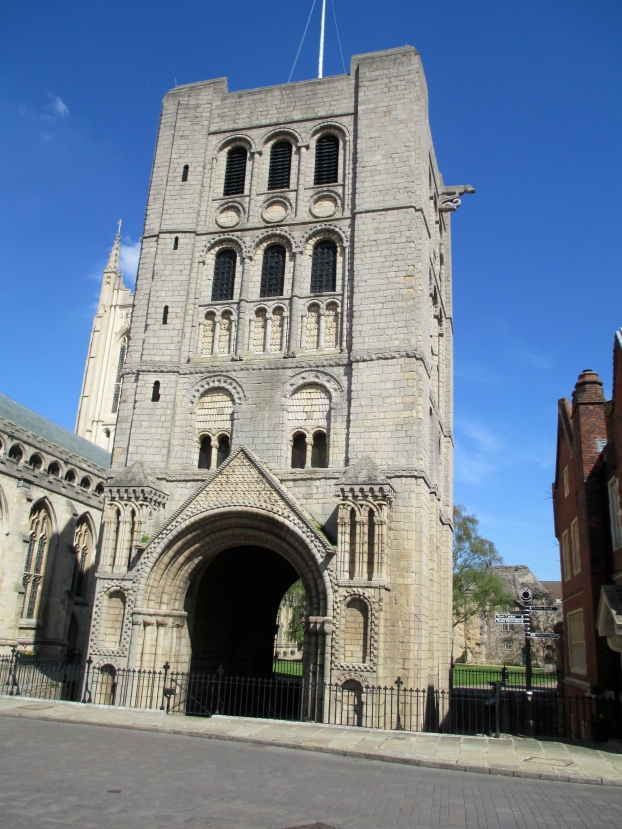
One of the pieces that has survived the destruction of the abbey is the Norman Tower. It was built 1120-1148 and was designed to be both a gateway to the abbey church and a belfry for the church of St James next door, it still serves as a bell tower. It was funded by Abbot Anselm instead of a pilgrimage to St James De Compostella. The carved stone work that survives is truly beautiful.

bury st 7

bury st 6

Bury St Edmond’s was once one of England’s most important and majestic abbeys, you can see from the model below just how large it was, there might not be much left now but there are at least still echoes of the past.

bury st

A Good Death

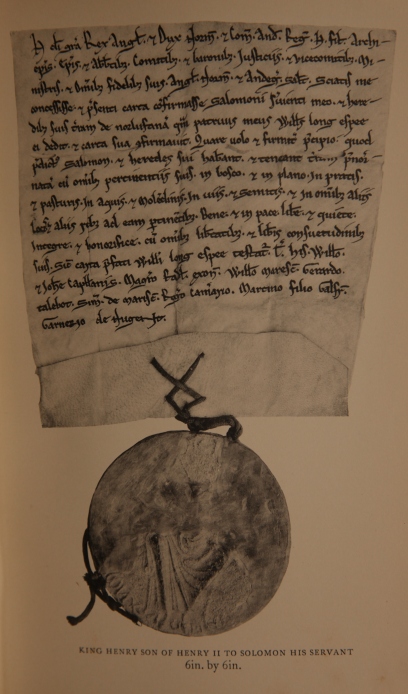
For the male nobility in the 12th and 13th centuries there was a right way to die. I am not talking about death on the battlefield, though that was acceptable too. I am talking about what was done when you knew you were dying. The best way to explain the differences is to examine the deaths of three important medieval figures. Henry the Young King who died in 1183, Henry II who died in 1189 and William Marshal who died in 1219. henry yk charter This is a charter from Henry the Young King from page 29 Stenton, FM. Facsimiles of Early Charters from Northamptonshire Collections. London: J.W Ruddock and sons. 1930. Henry the Young King was the second son of Eleanor of Aquitaine and Henry II. His elder brother William died in infancy though so the Young King was the heir to England, Anjou and Normandy. To read more about the life of the Young King see this excellent blog http://henrytheyoungking.blogspot.com.au. Suffice for now to say that he was crowned in his father’s lifetime, a common practice on the continent but a new practice for England, but was given very little real power. Henry II did not share power easily.
Henry the Young King was seen by his father as a spendthrift and was actually in rebellion against him when he died. The Young King had run out of money for the rebellion and he and his mercenaries had sacked the church of St Mary de Roche Andemar, stripped the tomb of Saint Andemar and carried away all the church’s treasures. When he became sick so soon after it was seen by some as divine retribution. The Young King however wiped all his earthly transgressions clean in his rather spectacular deathbed acts of repentance. Once it became clear that he was dying of a fever and a ‘flux of the bowels’ he repented of his sins and did it in a way that would now be seen as theatrical. Firstly he received absolution of his sins from a bishop and had his knight William Marshal agree to take his cloak, sewn with the crusader cross, to Jerusalem and fulfil his crusader’s vow. Secondly he put aside his fine garments and had himself laid on haircloth and had his men place a noose around his neck. He said “By this cord do I deliver myself, an unworthy, culpable, and guilty sinner, unto you, the ministers of God, beseeching that our Lord Jesus Christ, who remitted his sins to the thief when confessing upon the cross, will, through your prayers and His ineffable mercy, have compassion upon my most wretched soul.” Thirdly he had his men draw him from his bed by the cord and lay him on a bed strewn with ashes. Finally he commanded that two large stones were to be placed under his head and feet. With the mortification of the flesh complete to signify his repentance he died.[1] He was only 28.

The Young King’s death is one of those ‘what if’ moments in history, if he’d survived Richard the Lionheart may never have been king. This was a ‘good death’ because he had completely been freed from his sins, he had correctly repented, he’d died with his faithful men around him and he done it all in a manner befitting a king.
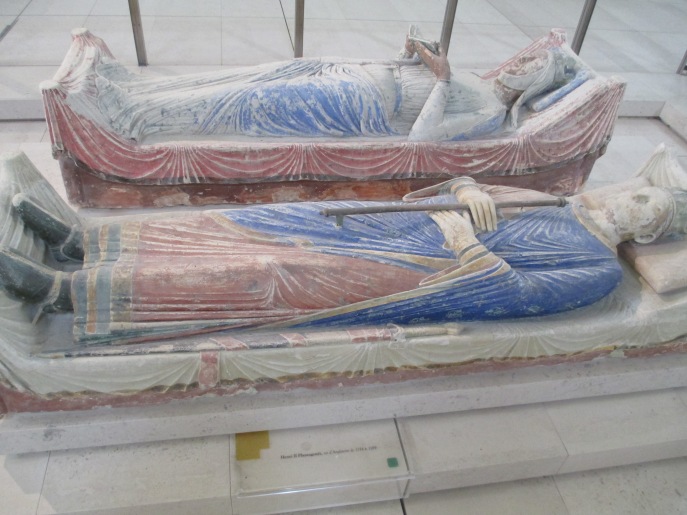
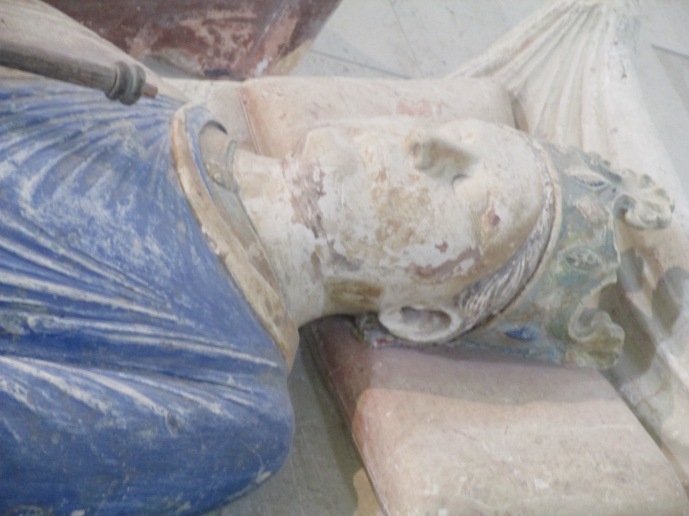
henry and eleanor henry close The photos are of the effigies of Eleanor of Aquitaine and Henry II in Fontevraud Abbey and a close up of the effigy of Henry II. Henry II’s death was very different to his son’s. Henry was one of the most interesting and important kings of this period. He was King of England, Duke of Normandy, Count of Anjou and Lord of Ireland. He also held Aquitaine by right of his wife and he held Brittany, though he had invested his son Geoffrey as its Duke. When he died his two remaining sons, Richard and John, were in rebellion against him and he did not die well.

History of William Marshal goes into detail.  “Death simply burst his heart with her own hands. Death’s discipline was a cruel one. A stream of clotted blood burst forth from his nose and mouth.”[2] It then goes on to say that “nobody had anything to cover his body, so he lay there, so poor and deprived of everything, without a stitch of linen or wool on him.[3] History continues that “all those who were standing around him and who were supposed to watch over his body, when they saw the King was dead, each and everyone appropriated for himself those possessions of the King they were meant to guard.[4] Roger of Hoveden confirms Henry’s sordid death saying “After his death, having plundered him of all his riches, all forsook him; so true it is that just as flies seek honey, wolves the carcass, and ants corn, this crew followed not the man, but his spoils.” [5] His loyal men were forced to clothe him in borrowed robes, as there was nothing else left. He was 56. King Henry died messily, without due ceremony and had his possessions stolen. This complied with none of the ideas of honour, or loyalty or generosity that were meant to be part of any noble death, especially a royal one. The next two photos are of the effigy of William Marshal which can be found in the Temple Church in London.IMG_3421IMG_3419
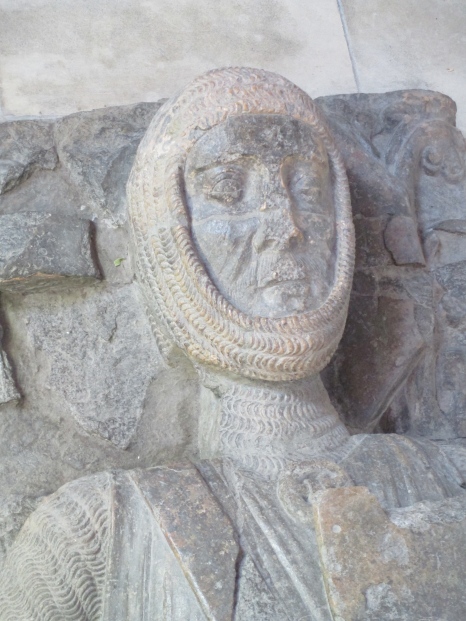
Our final death is that of William Marshal. Marshal was at the deathbeds of both Henry the Young King and Henry II. Marshal succeeded in life where both of them fell. He survived to die of old age. Marshal was approximately seventy-two when he died, which was very old for the medieval period, and he stage managed his final days. We have an extraordinarily detailed account of his deathbed due to the fact that his son had a biographical poem, History of William Marshal, commissioned. History of William Marshal devotes 1285 lines to Marshal’s death, from the first mention that Marshal is dying, until the end of the services after his death.[6] It is one of the most moving and detailed points of the narrative. Both the men responsible for History, the one who commissioned it, William Marshal the younger and the one who contributed his recollections, John of Earley, were at Marshal’s deathbed so there is no reason to doubt its authenticity especially when the level of detail is considered. Marshal’s death was conducted from his mansion in Caversham, where he went to wait out his final illness saying he “preferred to die at home than elsewhere.”[7] Marshal was Regent for the very young Henry III when he realised he was dying. So his first act was to very carefully handover Henry III and the realm into appropriate care.[8]
Marshal died surrounded by his family and his loyal men. The best example of the latter was John of Earley. It was Earley that Marshal sent to collect the cloths he had bought in Jerusalem over thirty years before, that he had “brought back with [him] from the Holy land, to be used for the purpose which they [would] now serve; [his] intention [had] always been that they [would] be draped over [his] body when [he was] laid in the earth.”[9]  We know his wife Isabel was there with his daughters because when he had a desire to sing, but didn’t want to for fear of being called a madman, his knights suggested that his daughters and his wife might sing for him. The daughters came and sang but Isabel was too overcome with grief. [10] He also made sure to die with humility, joining the order of the Templars just before his death. He was made a Templar and Aimery de Saint-Maur, head of the Temple declared, “Marshal, listen to me: it pleases me that you surrender to God and set aside your worldly goods so as not to be separated from Him and his faithful servant. I can tell you that in life as in death you have known higher honour in this world than ever any other knight had, both in respect of your valour, it is true, and your wisdom and loyalty.”[11]

So in becoming a Templar Marshal ended his life in humility and honour in just about the most eye-catching way possible. In dedicating himself to the Templars he was marking himself as pious, dedicated and humble. He was making sure that his image after death was the correct one of humility and piety. His wife Isabel was also present when he took the vows of a Templar. We know this because one of the vows of a Templar is chastity, so moments before he took the vow he said to Isabel  “Fair Lady kiss me now, for you will never be able to do again.’ She stepped forward and kissed him, and both of them wept.” [12]

Marshal was also overtly generous in his final days, firstly in saying to his son “give a portion of my wealth to all the poor you can see [in London] who have come to receive alms; make sure the distribution is such that it may be spoken of before God. And there is another thing I want to remind you of: give food and drink to one hundred of the poor, along with garments to clothe them and shoes.”[13] It is interesting to note though that he was overtly generous, he wanted make sure that his generosity was seen. Possibly because it was an attribute that was expected of a man in his position and it is how he wanted to be remembered. He also gave money in his will to a number of religious foundations. He provided for his knights too. One of his clerks wanted to sell off the robes that had been put aside for the knights’ Whitsuntide gift, but Marshal said “Hold your tongue, you wretch” “It will be Whitsuntide very soon, when my knights should indeed have their new robes for I shan’t be able to give them robes again.”[14] He went on to tell John of Earley to distribute the robes, “and, should any man fail to get his share, send immediately to London and see to it that you get more splendid ones, so nobody can complain.”[15]

When Marshal actually died he had done everything he was supposed to. He had taken leave of his family, he had said how he wished his possessions to be distributed, he had expressed piety and charity and God had absolved him of his sins. The Abbot of Notley performed the “ceremony of absolution”.[16] Also the papal legate had given him remission of all his sins for taking up the Regency in the first place.[17] Marshal’s death was, apart from dying in the holy land on crusade, probably the best way a medieval noble man could go. He died well: humble, pious and just a little bit theatrical. These three deaths represent very different ways of dying. Medieval dying need not be a reflection on a life. In death you could redeem yourself, but while dying badly held some shame it did not negate a good life.


[1] Roger of Hoveden, The Annals of Roger of Hoveden Volume II, pp. 26-27. [2] Holden & Crouch, (eds) History Vol II, pp. 397-461. [3] Holden & Crouch, (eds) History Vol II, pp. 429-431. [4] Holden & Crouch, (eds) History Vol II, p. 399. [5] Holden & Crouch, (eds) History Vol II, pp. 401-409. [6] Holden & Crouch, (eds) History Vol II, p. 413. [7] Holden & Crouch, (eds) History Vol II, p. 433 [8] Holden & Crouch, (eds) History Vol II, pp. 438-439. [9] Holden & Crouch, (eds) History Vol II, p. 439. [10] Holden & Crouch, (eds) History Vol II, p. 423. [11] Holden & Crouch, (eds) History Vol II, p. 451. [12] Holden & Crouch, (eds) History Vol II, pp. 420-421. [13] Holden & Crouch, (eds) History Vol II, p. 279. [14] Holden & Crouch, (eds) History Vol I, p. 463. [15] Holden & Crouch, (eds) History Vol I, p.463 [16] Holden & Crouch, (eds) History Vol I, pp. 463-464. [17] Roger of Hoveden, The Annals of Roger of Hoveden Volume II, p. 111. Roger of Hoveden. The Annals of Roger of Hoveden Comprising the History of England and Other Countries of Europe from A.D 732 to A.D 1201. (trans.) Henry T. Riley, Volumes I & II. London: H.G Bohn. 1853. Anonymous. History of William Marshal. (ed.) AJ. Holden. (trans.) S. Gregory & (notes.) David Crouch, Volumes I, II & III. London: Anglo-Norman Text Society. 2002.

Book Preview: The Map Book

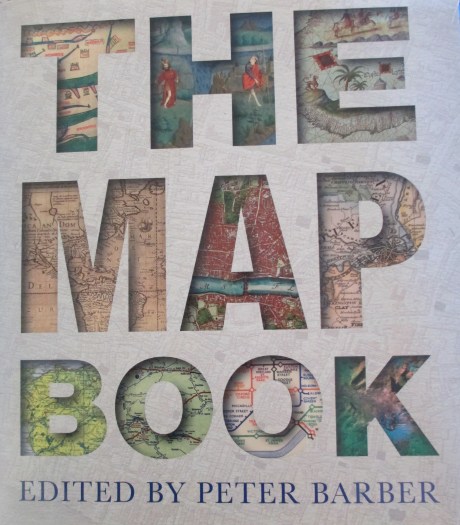
MB front

The Map Book is a fascinating chronological journey throughout the history of maps. It begins in 1500BC with fossilised prayers.

MB BC It concludes with modern satellite images from 2005.

MB 2005

This book has many gems all of which are worth a look, but I’m going to focus on a handful of my favourites.

I will begin in the middle of the chronological line and work backwards.

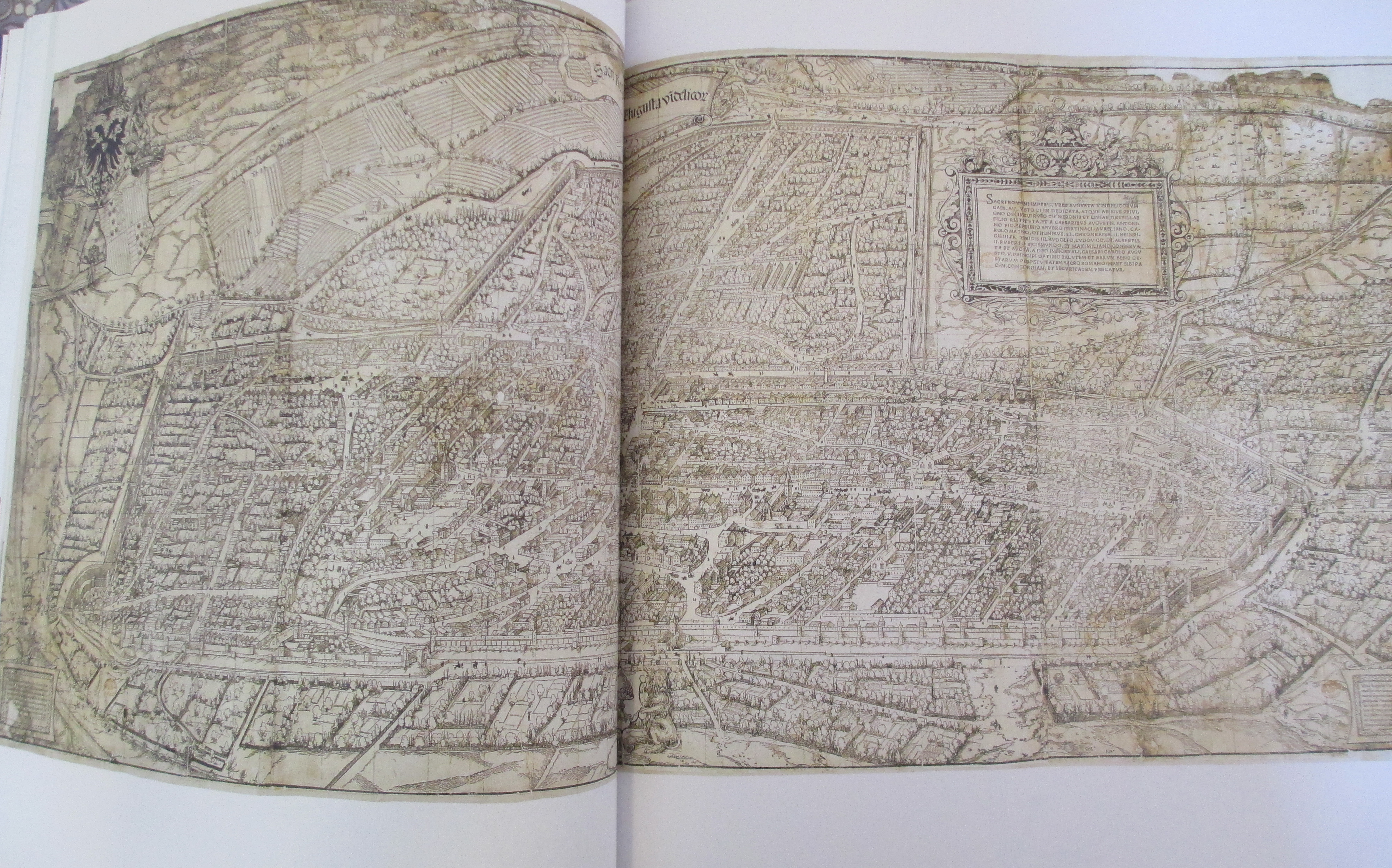
The first map I wanted to talk about is the 1521 map of the City of Augsburg.

MB 1521 MB 1521 fullThis map is the earliest printed north European measured town plan. It appears to be a purely pictorial view as every house is depicted, which is what I like about it. It is surprisingly accurate though because it’s the product of a survey by Jorg Seld. Seld was a goldsmith from Augsburg who was also a military engineer.  The map was cut into wood blocks and then printed, though only two copies survive. If you look closely you can see the citizens of Augsburg out and about in the city. As well as being accurate it’s also a map of praise to the Holy Roman Empire. You can see the arms of Emperor Charles V below the double headed imperial eagle in the top left hand corner.

The next map moves further back in time and illustrates just how important maps can be as a demonstration of power.

MB 1360The map dates from 1360 and is one of the earliest detailed maps of England and Wales. This is a departure from earlier medieval maps because it’s actually recognisable as a map, where as earlier maps tended to be more allegorical than geographically accurate. It depicts castles, towns, abbeys, churches and the roads which linked them all. Above all though, it is emblematic of Edward I’s England and his reign. This is how he imposed royal authority on the country. The castles he built in the newly conquered Wales were essential to bringing it under his control.  This map stood as the template for future maps until the mid 16th century.

The next map I want to consider is probably my favourite. The Hereford Mappa Mundi.

MB HerfordThe picture above is from The Map Book, however I am including the below picture so that you can see some more of the detail.

mappa2This map dates from 1300 and is a wonderful depiction of the medieval world and how it saw itself. It is a map of the world, but as a map for navigation it’s completely useless. It is much more about medieval identity, history and religion than it is about geographical accuracy. Jerusalem sits at the centre with the rest of the world radiating out. It includes people from antiquity such as the Alexander the Great and it has the travel of the apostles and pilgrimage routes. There are also some real world geographic features such as Lincoln Cathedral, Hereford and the River Wye in England and Paris and Rome in Europe, amongst other cities. It roughly maps the world as it was known then, essentially Europe, Asia and North Africa. The Mappa Mundi is many layered in meaning and extremely detailed in reality. It contains over 500 drawings, depicting 420 cities and towns, 15 Biblical events, 33 plants, animals, birds and strange creatures, 32 images of the peoples of the world and eight pictures from classical mythology.

Some years ago Hereford Cathedral, where the map now resides, gave permission for the map to be scanned. The scan has been turned into an in depth exploration of the map online. It is well worth a look because the detail that can be seen is incredible.

For more information on the Mappa Mundi and to have a better look at the second photograph go to http://www.herefordcathedral.org/visit-us/mappa-mundi-1

The Map Book is a wonderful exploration of cartography through the ages and well worth a look.

The Map Book

Author: Peter Barber

ISBN: 9780802714749

Study finds how Richard III died

Just a short post.

You’ve probably seen this, it has certainly been all over my newsfeeds and other blogs, but I still thought it was worth mentioning. Largely because it is really interesting.

Studies done by Leicester University and published in The Lancet have found that Richard received nine blows to the head as well as a blow to the pelvis.  Not all of these wounds were inflicted before he died. Although the pelvic wound would have been fatal the study showed that it was inflicted from underneath, so it’s more likely that he received it after death when  contemporary accounts say his body was slung over a horse and paraded.

This video from The Lancet explains it beautifully.

For more information see The Medievalists.

Or read the study from The Lancet


Book Preview: The Kings and Their Hawks, Falconry in Medieval England.

flacon


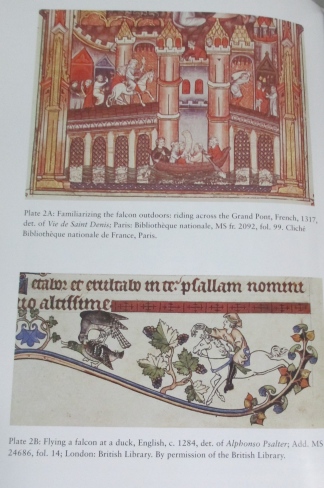
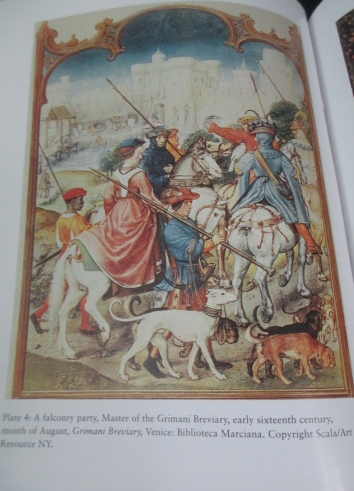
This is a fascinating book about medieval English kings and the noble, but largely forgotten sport of falconry. It is a surprisingly good read and has beautiful depictions of falconry from breviaries, illuminated manuscripts and tapestries.

flacon 2

flacon 3

Falconry was an important part of life for medieval nobles. Admittedly I have mainly read the chapters regarding falconry from the reign of William I to  the reign of Henry II as these were the parts I required for my novel. During Henry II’s reign he was often described as travelling with his hawks and was hawking at key moments in his life. For example when Thomas Becket was summoned to Henry’s court to answer a charge of contempt Becket had to wait because Henry had stopped to hawk along the river banks.

Hawks also played a role in William I’s life. He is depicted in the Bayeaux tapestry as carrying a hawk that had possibly been brought by Harold Godwinson as a gift.

flacon bayeaux. JPG

Eyries of hawks were also listed as assets in the Domesday Book, which was written under the orders of William I.

Hawking and falconry in general was very much part of the life of the nobility. Different birds were seen as having different characteristics, for example goshawks were generally flown at ducks, pheasant and partridge. Goshawks were seen as the lower bird, often used for hunting for food rather than just for sport. Whereas Sparrowhawks were seen as a more noble bird and were often used to hunt prey like teal.

Falcons like the gyrfalcon would come from places like Iceland and could take down cranes and herons. The gyrfalcon was the most highly valued bird by the English Kings and King Haakon IV of Norway sent Henry III three white and ten grey gyrfalcons in 1225 as a gift.

These falcons could also be very productive. In c. 1212 King John’s falcons bagged seven cranes in one day and nine in another.

This book gives a truly interesting insight into medieval falconry, both the birds themselves and the men who flew them.

Title: The Kings and Their Hawks

Author: Robin S Oggins

ISBN: 9780300100587

Strata Florida Tiles

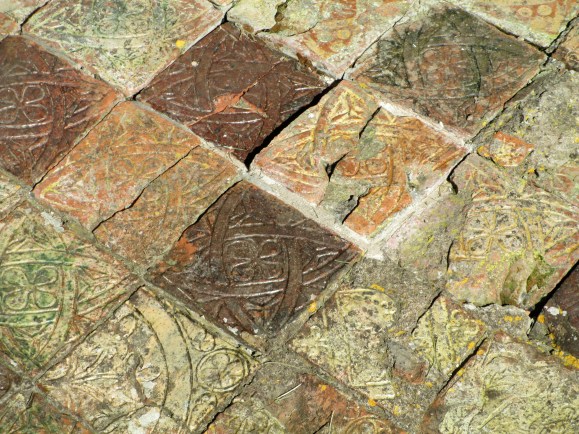
These are medieval tiles from Strata Florida Abbey in Wales.Tiles Strata Florida

The abbey itself is absolutely beautiful, though there isn’t much left. It was not a casualty of the Dissolution of the Monasteries, which is the reason most of the abbeys in the UK are ruins. Strata Florida was a casualty of the repeated English incursions because it always strongly supported the Welsh Princes.

Strata Florida

The abbey is also where the important Welsh Chronicle Brut y tywysogion was written. It was a year by year account of the main events in Wales from AD682 to AD1282. It finished with the death of Llywelyn ap Gruffudd, known as the last true Prince of Wales. The full text of the chronicle can be found at https://archive.org/details/brutytywysogiono00cara.

The abbey is also the burial place for some of the Welsh Princes of Deheubarth and their families.

burial

The tiles themselves are interesting just because they survived. Not many medieval tiles did. These particular ones date to the early 14th century. They were uncovered in excavations in the 1880s and the large section that is now in the south transept are made up of many of these fragments. Their discovery helped Strata Florida become a tourist attraction to wealthy Victorians, though it is rumoured that the occasional tile was taken as a souvenir. The tiles were made in England but laid in Wales and only important guests and choir monks were allowed to stand on them. They also have patterns and designs. See if you can see any of them.tiles strata floridaCommon symbols include the fleur de lis which is a reminder of the origins of the Abbey. It was founded by the Norman lord Robert FitzStephen. The fleur de lis is also a link back to the Abbey’s mother house in Clairvaux in Burgundy. The tiles are also decorated with images of a man gazing into a mirror, which might be trying to say something about the perils of vanity. One of the more intriguing designs is that of the coat of arms of Hugh Despenser, it can be seen in the top right hand corner of the above photo. He was reviled by the Welsh so the presence of his coat of arms is somewhat perplexing, it is possible that it just happened to be placed there when the tiles were made in England. tile ex

As you can see the tiles are now covered by a modern roof to protect them. The tiles are truly beautiful and even the relatively small collection that survives today gives a good idea as to just how spectacular the full expanse must have been when the abbey was whole.


Book Preview: The Grand Medieval Bestiary

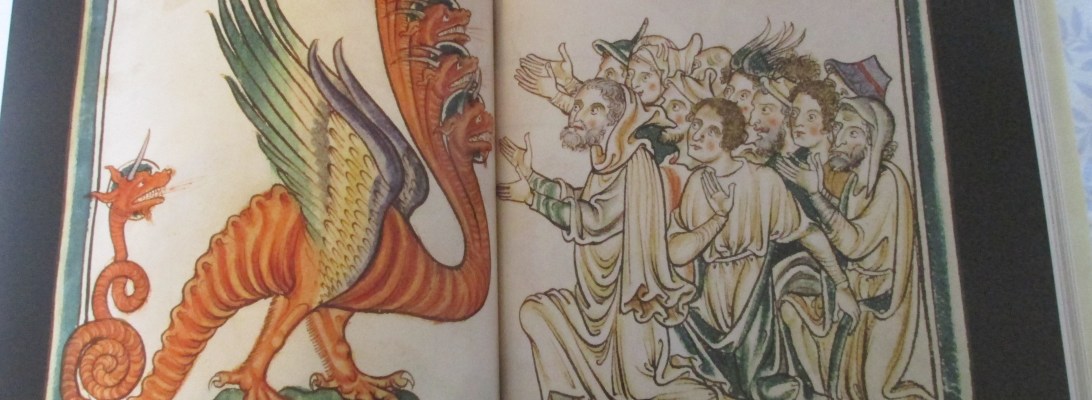
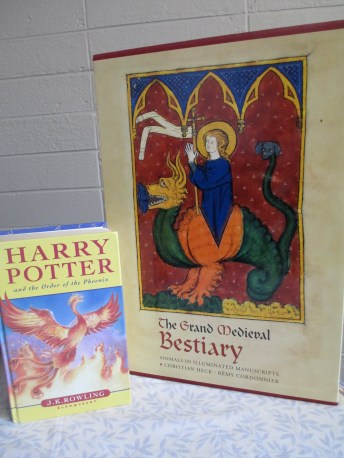
The Grand Medieval Bestiary is one of the most epic and beautiful books I have ever had the pleasure to see. Harry Potter and the Order of the Phoenix is in the photo to illustrate just how large the Grand Medieval Bestiary is. This is a book on a monumental scale. The Grand Medieval Bestiary tells the stories of the animals that featured in illuminated manuscripts. It depicts real world animals, such as the elephant, and how they were seen by people in the medieval period.

beastiary elephantBeastiary

In the case of the elephant it was believed that its primary natural enemy was the dragon. Additionally it was believed that elephants never lay down to sleep. They always leant against a tree and slept standing, but they had to be careful to choose the correct tree. If they didn’t choose correctly and the tree collapsed they couldn’t get up again. If this happened a smaller elephant would climb under a larger elephant and help it up.

The Grand Bestiary also includes mythical animals such as the hydra. The hydra was the mythical beast Hercules fought as one of his twelve labours. The authors of medieval bestiaries came up with logical explanations for the depiction of the hydra regrowing its heads after Hebeasti hydrarcules chops them off. However they did believe that the hydra was a creature who lived in the Nile and fought the crocodiles there by entering their jaws while they slept and tearing them apart from the inside. The hydra also apparently caused an edema of the legs, which was best treated with ox dung.
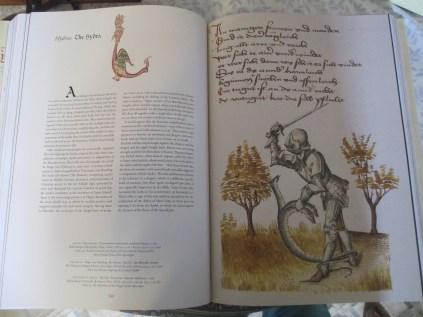
The Grand Medieval Bestiary is a fabulous book, full of life, colour and truly beautiful images. It brings the medieval world of bestiaries and animals wonderfully to life. It is also endlessly entertaining. beast hydra

If you have the shelf space for a book this big, it’s worth it.

Title: The Grand Medieval Bestiary: Animals in Illuminated Manuscripts.

Authors: Christian Heck and Remy Cordonnier

ISBN: 978078921279