Study finds how Richard III died

Just a short post.

You’ve probably seen this, it has certainly been all over my newsfeeds and other blogs, but I still thought it was worth mentioning. Largely because it is really interesting.

Studies done by Leicester University and published in The Lancet have found that Richard received nine blows to the head as well as a blow to the pelvis.  Not all of these wounds were inflicted before he died. Although the pelvic wound would have been fatal the study showed that it was inflicted from underneath, so it’s more likely that he received it after death when  contemporary accounts say his body was slung over a horse and paraded.

This video from The Lancet explains it beautifully.

For more information see The Medievalists.

Or read the study from The Lancet


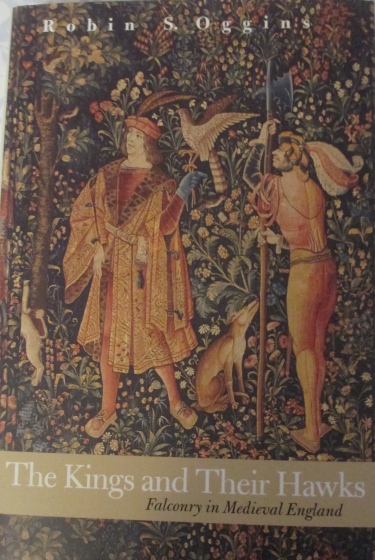
Book Preview: The Kings and Their Hawks, Falconry in Medieval England.

flacon


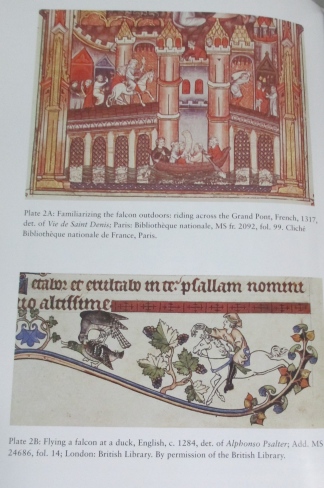
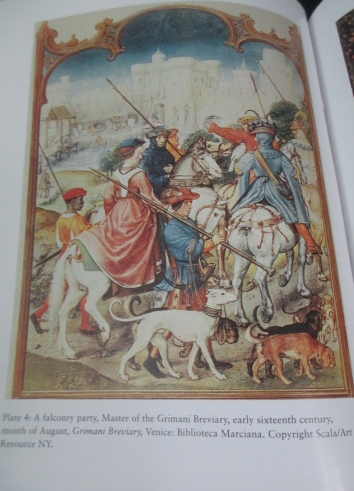
This is a fascinating book about medieval English kings and the noble, but largely forgotten sport of falconry. It is a surprisingly good read and has beautiful depictions of falconry from breviaries, illuminated manuscripts and tapestries.
flacon 2

flacon 3

Falconry was an important part of life for medieval nobles. Admittedly I have mainly read the chapters regarding falconry from the reign of William I to  the reign of Henry II as these were the parts I required for my novel. During Henry II’s reign he was often described as travelling with his hawks and was hawking at key moments in his life. For example when Thomas Becket was summoned to Henry’s court to answer a charge of contempt Becket had to wait because Henry had stopped to hawk along the river banks.

Hawks also played a role in William I’s life. He is depicted in the Bayeaux tapestry as carrying a hawk that had possibly been brought by Harold Godwinson as a gift.

flacon bayeaux. JPG

Eyries of hawks were also listed as assets in the Domesday Book, which was written under the orders of William I.

Hawking and falconry in general was very much part of the life of the nobility. Different birds were seen as having different characteristics, for example goshawks were generally flown at ducks, pheasant and partridge. Goshawks were seen as the lower bird, often used for hunting for food rather than just for sport. Whereas Sparrowhawks were seen as a more noble bird and were often used to hunt prey like teal.

Falcons like the gyrfalcon would come from places like Iceland and could take down cranes and herons. The gyrfalcon was the most highly valued bird by the English Kings and King Haakon IV of Norway sent Henry III three white and ten grey gyrfalcons in 1225 as a gift.

These falcons could also be very productive. In c. 1212 King John’s falcons bagged seven cranes in one day and nine in another.

This book gives a truly interesting insight into medieval falconry, both the birds themselves and the men who flew them.

Title: The Kings and Their Hawks

Author: Robin S Oggins

ISBN: 9780300100587

Strata Florida Tiles

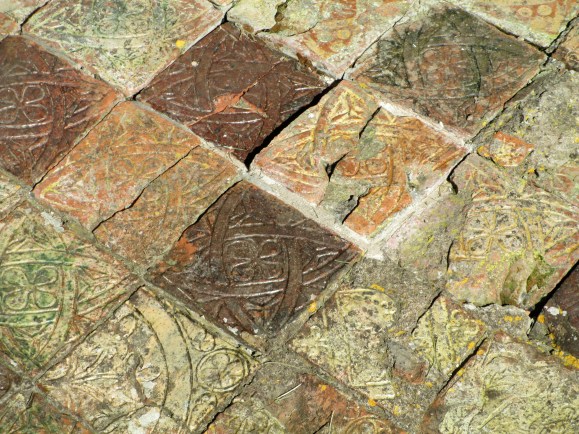
These are medieval tiles from Strata Florida Abbey in Wales.Tiles Strata Florida

The abbey itself is absolutely beautiful, though there isn’t much left. It was not a casualty of the Dissolution of the Monasteries, which is the reason most of the abbeys in the UK are ruins. Strata Florida was a casualty of the repeated English incursions because it always strongly supported the Welsh Princes.

Strata Florida

The abbey is also where the important Welsh Chronicle Brut y tywysogion was written. It was a year by year account of the main events in Wales from AD682 to AD1282. It finished with the death of Llywelyn ap Gruffudd, known as the last true Prince of Wales. The full text of the chronicle can be found at https://archive.org/details/brutytywysogiono00cara.

The abbey is also the burial place for some of the Welsh Princes of Deheubarth and their families.

burial

The tiles themselves are interesting just because they survived. Not many medieval tiles did. These particular ones date to the early 14th century. They were uncovered in excavations in the 1880s and the large section that is now in the south transept are made up of many of these fragments. Their discovery helped Strata Florida become a tourist attraction to wealthy Victorians, though it is rumoured that the occasional tile was taken as a souvenir. The tiles were made in England but laid in Wales and only important guests and choir monks were allowed to stand on them. They also have patterns and designs. See if you can see any of them.tiles strata floridaCommon symbols include the fleur de lis which is a reminder of the origins of the Abbey. It was founded by the Norman lord Robert FitzStephen. The fleur de lis is also a link back to the Abbey’s mother house in Clairvaux in Burgundy. The tiles are also decorated with images of a man gazing into a mirror, which might be trying to say something about the perils of vanity. One of the more intriguing designs is that of the coat of arms of Hugh Despenser, it can be seen in the top right hand corner of the above photo. He was reviled by the Welsh so the presence of his coat of arms is somewhat perplexing, it is possible that it just happened to be placed there when the tiles were made in England. tile ex

As you can see the tiles are now covered by a modern roof to protect them. The tiles are truly beautiful and even the relatively small collection that survives today gives a good idea as to just how spectacular the full expanse must have been when the abbey was whole.


A Very Historical Door.

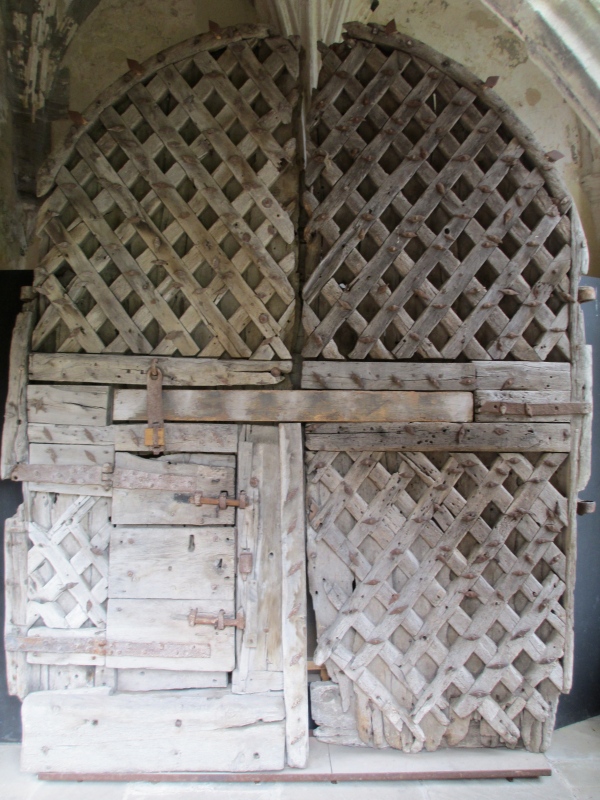
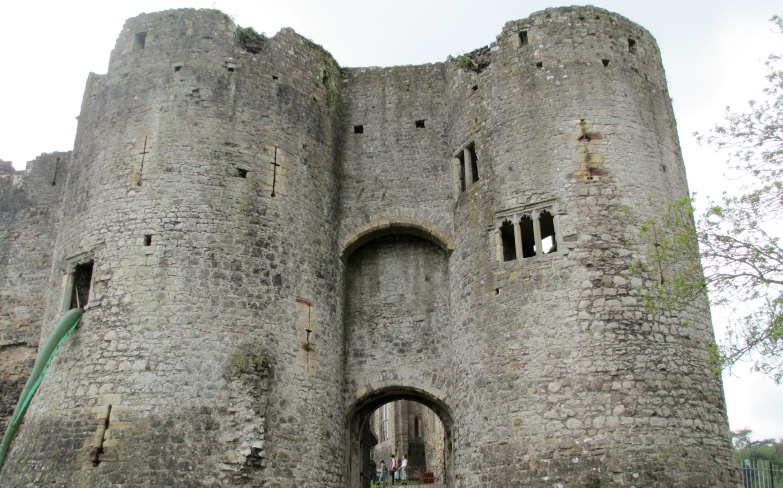
doorThis door is to be found in Chepstow Castle in Chepstow (called Striguil in the 12th century) in Wales. The door dates from the 12th century. While this in itself makes the door interesting, how it was discovered and what it meant adds even greater significance. This door hung in the doorway of the main gatehouse of the castle.
IMG_2519

The building of the gatehouse can be dated with reasonable certainty to  the rule of William Marshal. Marshal gained the castle in 1189 through  marriage to Isabel de Clare. This can be surmised for three main  reasons.

1. A Short Cross Silver penny of Henry II  was found in the foundations of the gatehouse. These pennies weren’t minted until the mid 1180’s.

2. The wood of the doors was dated using dendrochronology to an estimated felling date of between 1159 and 1189.

3. Pre 1189 the castle was in the hands of the crown as part of a wardship, held by Henry II, until its heiress Isabel de Clare married. Thus Henry II had no incentive to build a huge gatehouse at a castle which he was going to have to hand over to Isabel’s husband.

This is where it gets interesting. Marshal most likely built the gatehouse shortly after he became Lord of Striguil. There is no way he should have had the funds for such an impressive construction, because prior to his marriage he only had a very small landed estate. So where did the money come from?  Marshal was known as the most successful tourney knight of his age, but the fact that he had the resources to at least begin the construction of the gatehouse show he must have been truly spectacular.

Information sourced from

Richard Avent & Dan Miles, “The Main Gatehouse” in Rick Turner & Andy Johnson, (eds) Chepstow Castle, Its History and Buildings, Logaston: Logaston Press, 2006, pp. 51-62, pp. 52-53.