Bayeux Tapestry

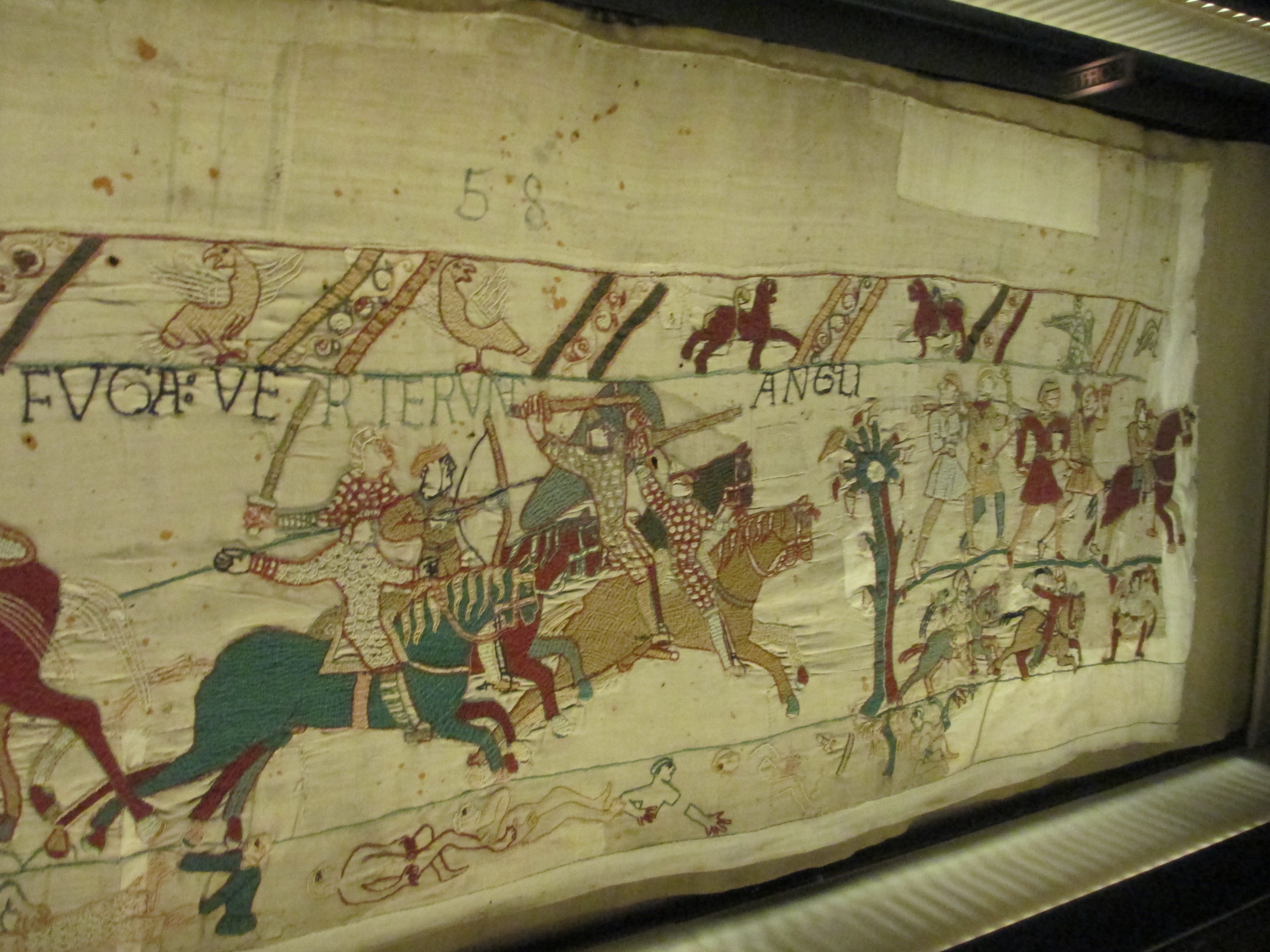
The Bayeux Tapestry. Probably the world’s best known embroidery, it covers the lead up to and the immediate aftermath of the Battle of Hastings, one of the most important battles in English history. You can see a video of the tapestry below.

The Bayeux Tapestry.

Sorry about the heads in the way and the speed. I had to film around the tourists. It does give you a really good idea of how long the tapestry is though.

This post is going to be a combination book preview, I haven’t done one for a while, because I have two lovely and quite different books on the Bayeux Tapestry.

IMG_1245

The book on the left is The Bayeux Tapestry and the Norman Invasion by Lewis Thorpe published in 1973. The book on the right is The Bayeux Tapestry by Eric Maclagan CBE (Director and secretary V&A) published 1943. Both books give an historical background to the tapestry, though Thorpe’s has more detail. Both also have analysis of each scene of the tapestry though Maclagan’s is more detailed. Maclagan’s focus is very specific to the tapestry while Thorpe takes a broader view. Thorpe also includes a translation of one part of William of Poitiers work History of William Duke of Normandy and King of the English.

Both books are also second hand and Maclagan’s has some extra information in the front cover. Pasted there is a newspaper article discussing another tapestry.

 IMG_1246

The article is from the early fifties and outlines the plan by Miss Sandell of Southampton to make a tapestry, inspired by the Bayeux Tapestry, of Southampton’s Town Quay at the Dday landings. This led me to do some research and I found what I think is the same tapestry. It was completed in 1953 and now hangs in the civic building in Southampton. [1] Unfortunately I have not yet been able to find a photo.

As I said both books depict the scenes of the tapestry. They do it a little differently though. Two examples can be seen below. The first is a depiction of the famous scene that may or may not illustrate, it depends who you ask, King Harold getting shot in the eye with an arrow. [2] The second is a depiction of William the Conquerer showing his face to his men to prove he isn’t dead.
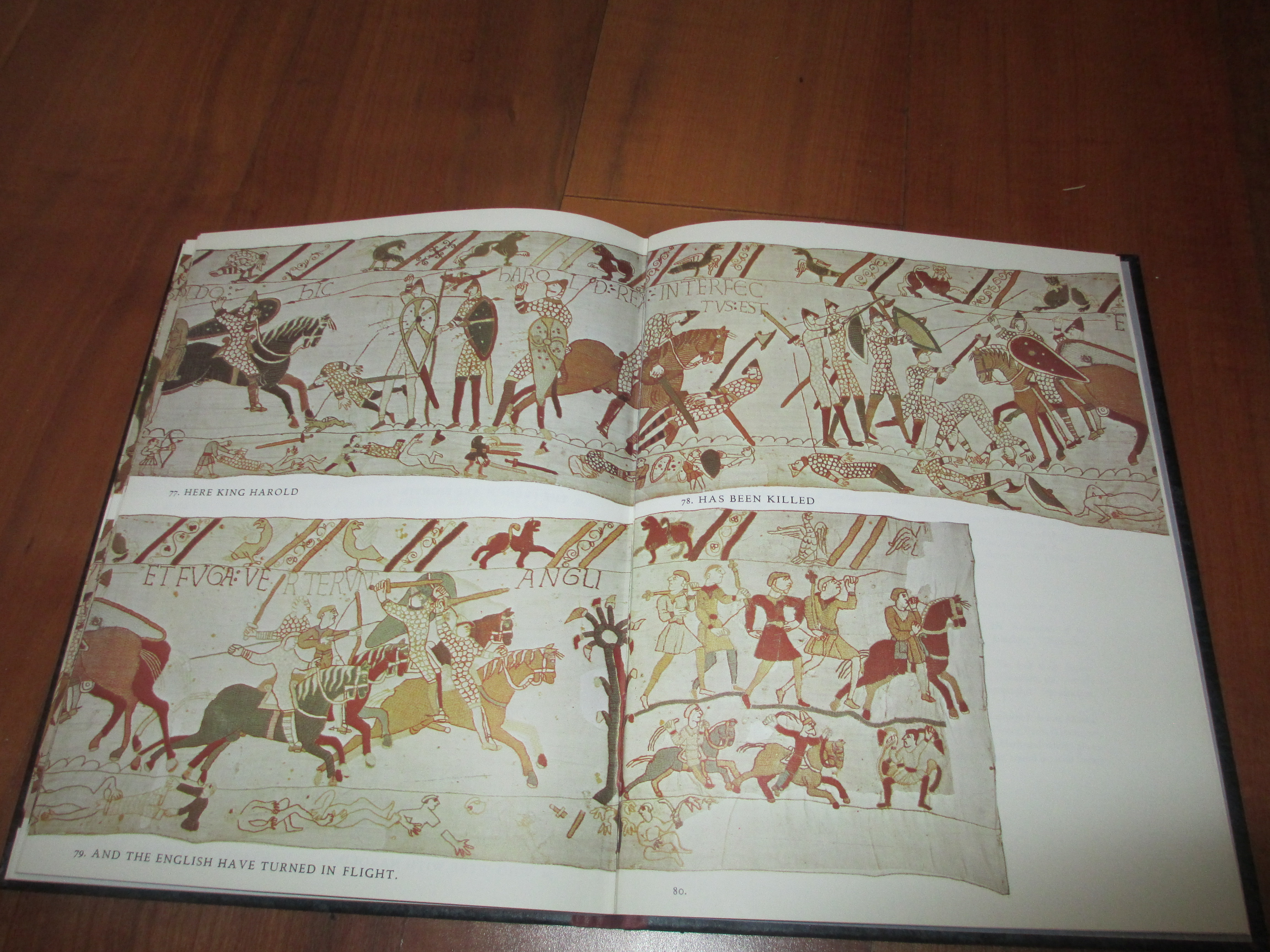
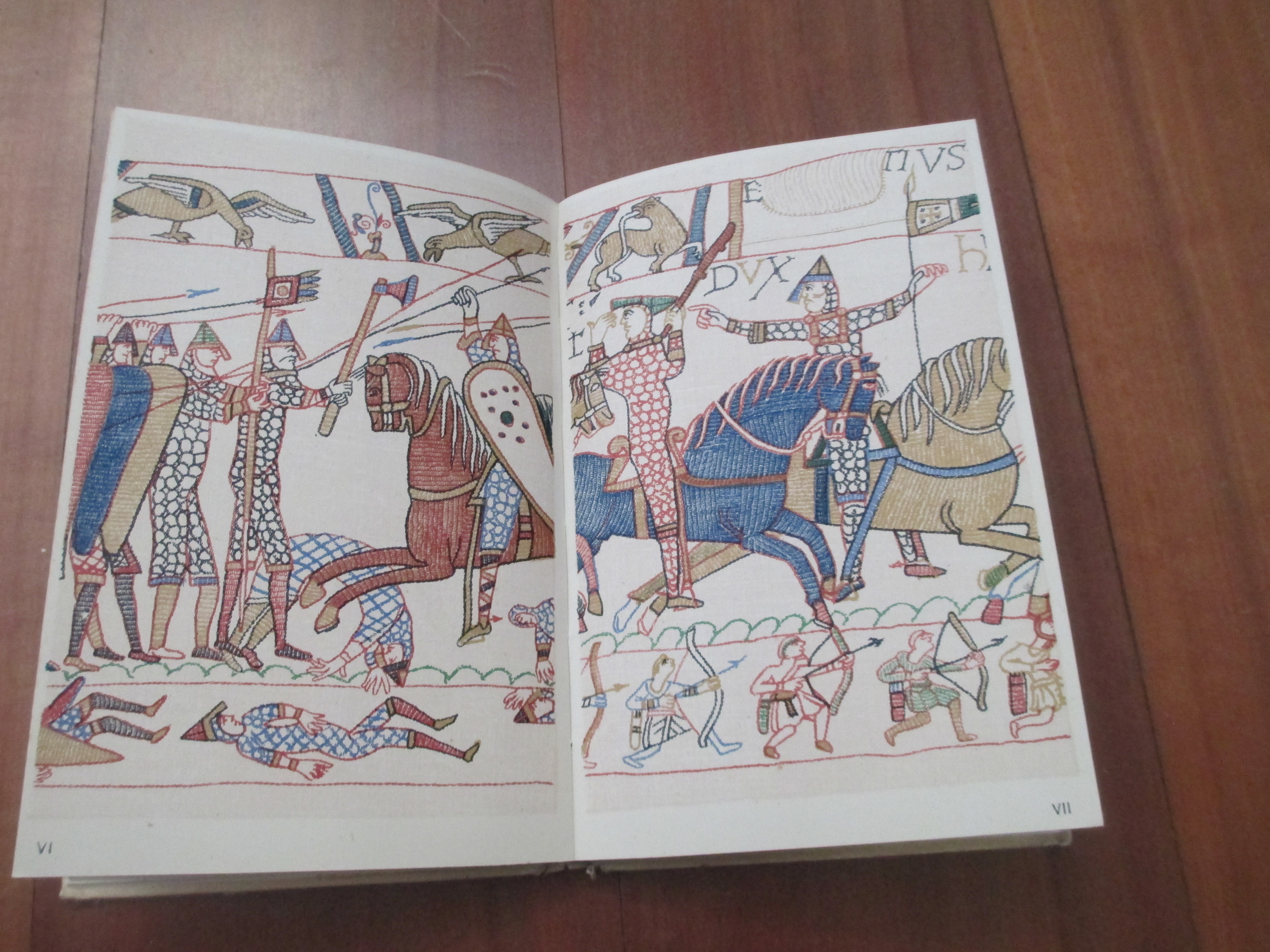
IMG_1248 IMG_1247

The first picture is Thorpe’s book, and as you can see it provides a translation of the latin embroidery below each picture. The second picture is Maclagan’s and it depicts the whole image alone, he provides a summary of the events in an earlier section. Maclagan only covers a handful of the scenes in colour where as Thorpe does all of them.

There isn’t a great deal new to write about the tapestry, I’m not offering any fantastic revelations, but it is an abidingly interesting story depicted in threads. So I thought I’d narrate that here. To begin with though, it isn’t a tapestry. It’s an embroidery.

I wanted to start with a little background about both the history behind the tapestry and about the physical tapestry itself. The tapestry was embroidered on coarse linen and two different kinds of woollen thread, including eight colours, can be seen. The Bayeux Tapestry is 70.34 m in length and 50cm wide, but it is made up of half a dozen or more pieces of linen. It has also been ‘fixed’ at various times throughout its life. (Maclagan, p.16-17). [3] The tapestry depicts the lead up to the invasion and the invasion of England by William the Conquerer. It was most likely commissioned by Bishop Odo, William the Conquerer’s brother, for the consecration of his cathedral in Bayeux in 1077. It was then probably stitched by two teams of women. (Thorpe, p. 24).[4] Though it is thought that the design was probably drawn on sections of the linen background by one master craftsman. Each scene is captioned in latin and it was designed to hang around a wall, probably Bayeux Cathedral

IMG_7081

Bayeux Cathedral.

After its creation and dedication ceremony, probably in 1077, there is not much record of the tapestry. In 1476 it is specifically listed in an inventory of Bayeux Cathedral. It is then mentioned in a paper in 1724 and in 1728 Dom Bertrand de Montfaucon, a Benedictine from Saint-Maur, took an interest in it and 12 months later sent someone to examine it. The drawings made of it at this time was published in Montfaucon’s book Monument de la Monarchie Francais. There were several attempts to destroy it or to use it ignobly during the French Revolution. For example it was almost used as a protective tarpaulin before a last minute reprieve.[5] It was exhibited in the Musee de Napoleon in Paris by Napoleon. During Napoleon’s reign a comet was sighted. Although it wasn’t Halley’s Comet, which is depicted in the Bayeux Tapestry, it was thought that it was a good omen for an invasion of England. Napoleon changed his mind though and in 1804 it was returned to Bayeux where it has hung pretty much ever since, apart from a short period of time during the Franco Prussian War. Also during WWII it was spirited away to stop it being sent to Germany with other significant French art. It was also briefly exhibited in the Louvre in 1944 after the liberation of France. (Lewis, pp. 58-59).

So in some ways it is somewhat of a miracle that the tapestry still exists.

The story it depicts is very much from the Norman perspective but is still of great interest. I will now set the scene for the story of the tapestry. Edward the Confessor was King of England but he had no direct heir. There were several contenders. William Duke of Normandy and Harold Godwinson were the primary claimants as far as the tapestry is concerned. However the tapestry leaves out other contenders including Edgar the Aethling who had the best hereditary claim being descended from England’s older kings, but he was quite young and no one seemed to seriously consider him until after the Battle of Hastings. The tapestry also doesn’t depict Harald Hardrada King of Norway who made a spited attempt to claim the throne, though unsuccessfully, but more on Harald Hardrada later. William of Normandy was related to Edward the Confessor as Edward’s mother had been Emma of Normandy who was the daughter of William of Normandy’s great grandfather. William also claimed that Edward offered him the throne in 1051. Harold Godwinson’s claim to the throne was not one of blood but rather one of power, he was the son of Earl Godwin Earl of Wessex and his sister was the wife of Edward the Confessor. Earl Godwin died in 1053 and Edward and his brothers Tostig Earl of Northumbria, Gyrth Earl of East Anglia and Leofwine , who ruled the area of the south east, wielded an immense amount of power in England. During the last 13 years of Edward’s life they were virtually ruling England. (Lewis, pp.7-8). This is the situation when the Bayeux Tapestry begins.

I have photos of most of the tapestry, but there are a few panels I missed when trying to photograph it around people. The photos below give a good general idea though.

The story begins with an image of Edward the Confessor talking to Harold Godwinson. Bayeux Tapestry 1

Harold is then sent to Normandy and he can be seen crossing the sea.

Bayeux Tapestry 2

When he lands he is seized by Count Guy of Ponthieu.
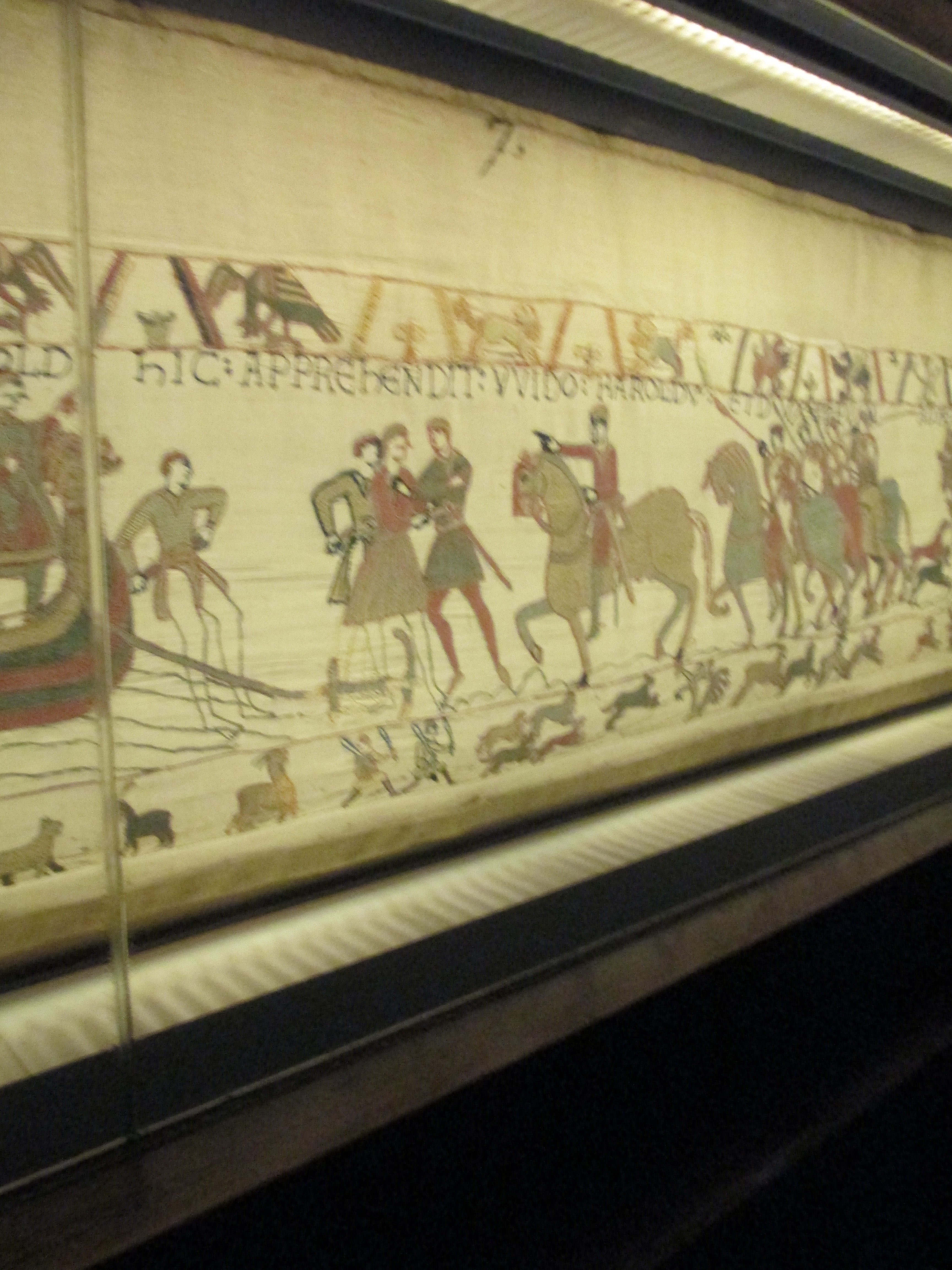
Bayeux Tapestry 3

And he is taken to Beaurain Castle where Harald and Guy talk.
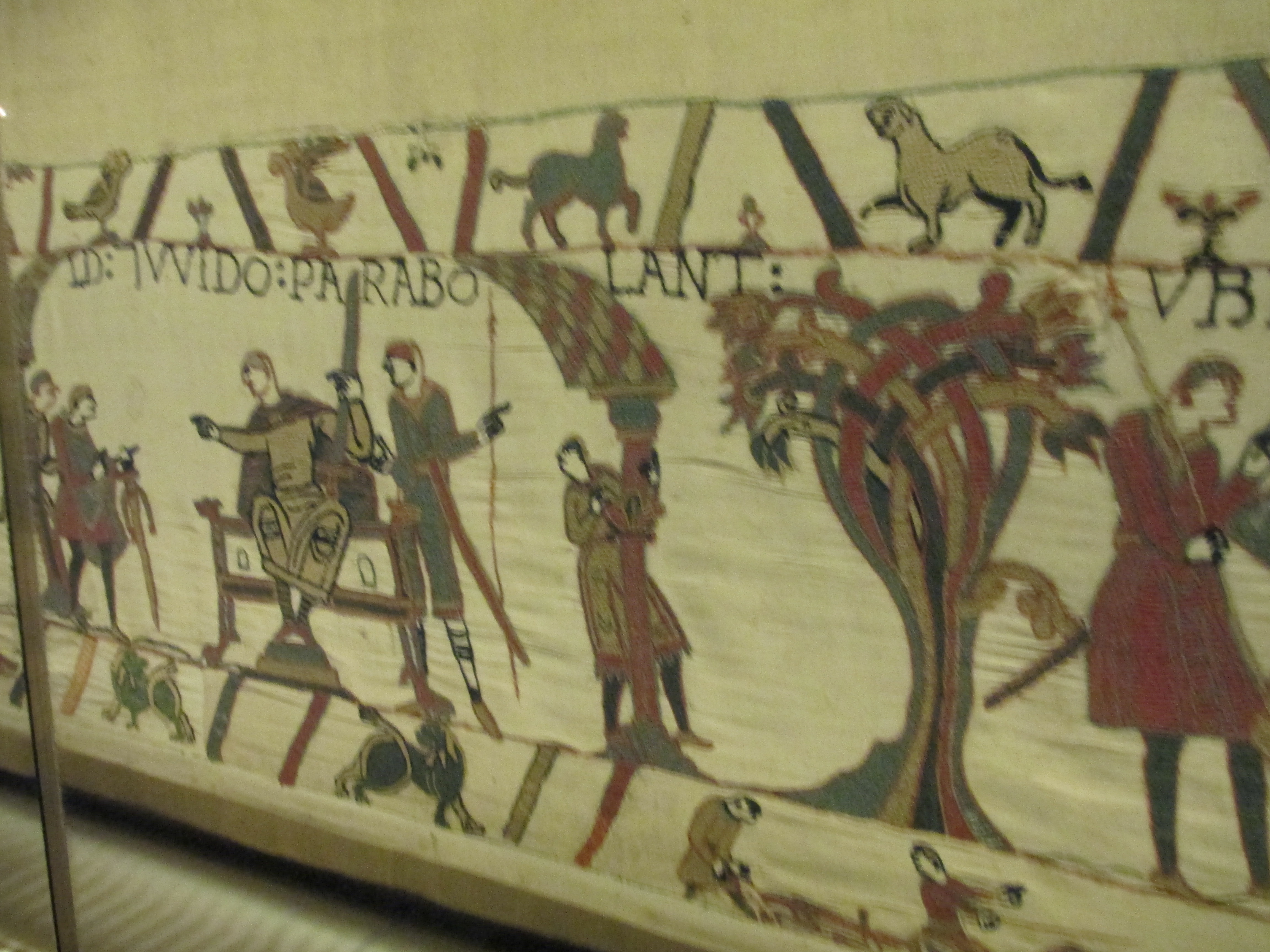
Bayeux Tapestry 4

Duke William finds out about Harold’s capture.

Bayeux tapestry 5

Duke William sends envoys to Guy.

Bayeux tapestry 6

Harold is taken to Duke William, you can see Duke William below on the black horse.
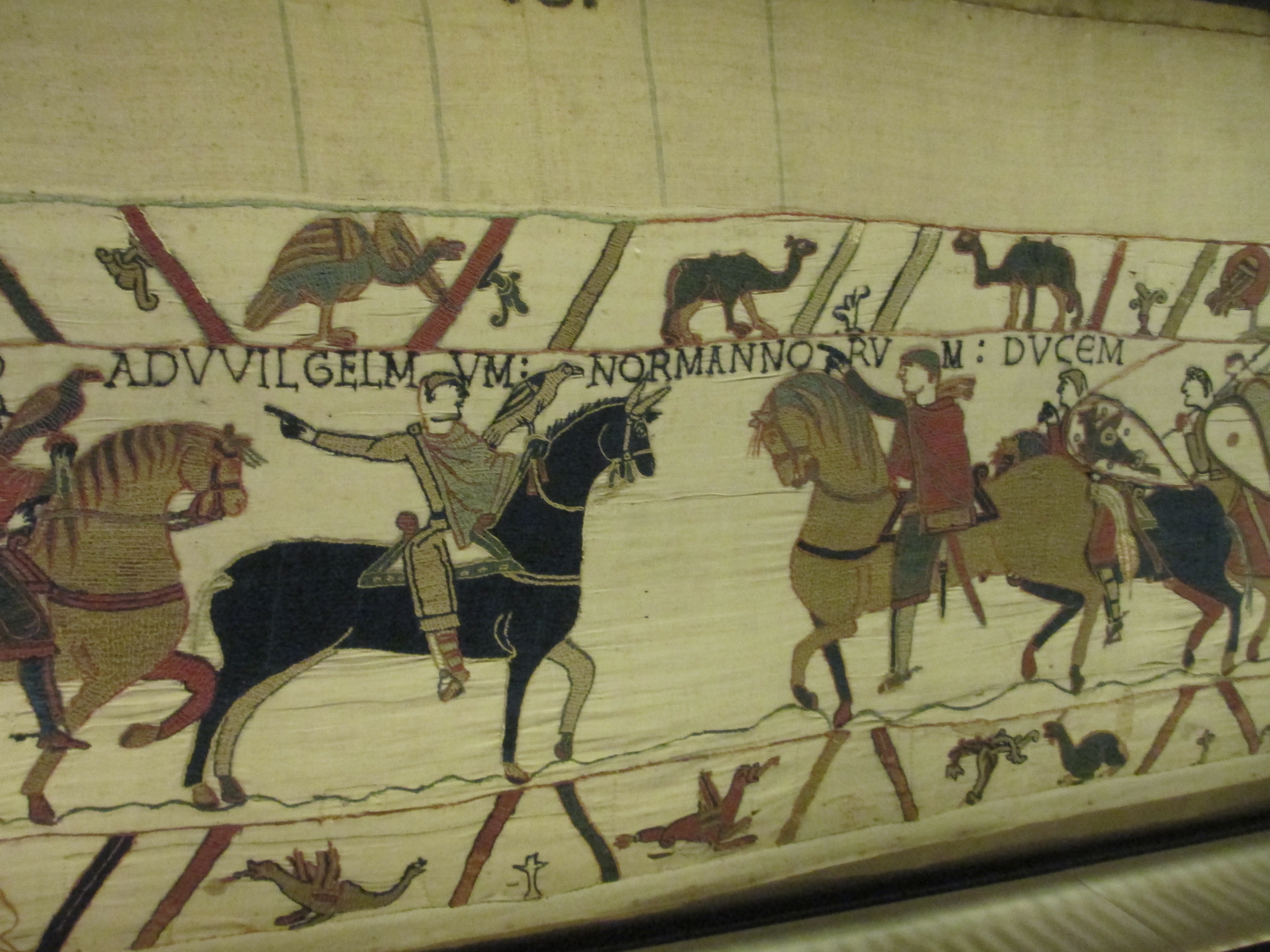
Bayeux Tapestry 7JPG

They go to Duke William’s palace.

Bayeux Tapestry 8

A churchman and Aelfgyva were at the palace. Aelfgyva was a woman who’s identity is unknown to the historical community, though there is much debate.
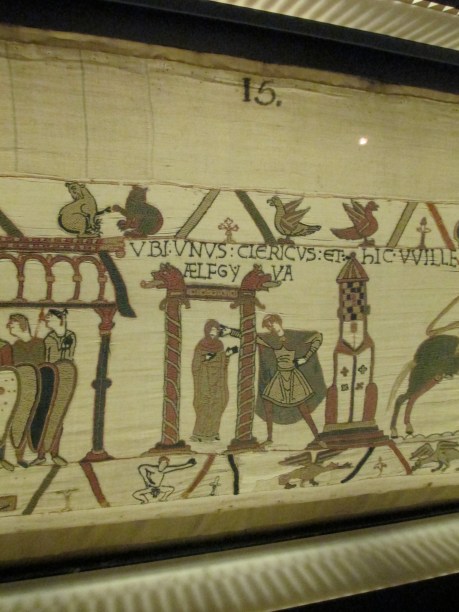
Bayeux tapestry 9

Then Duke William, Harold and Duke William’s army go to Mont Saint Michel. This is an account of Duke William’s campaign in Brittany.
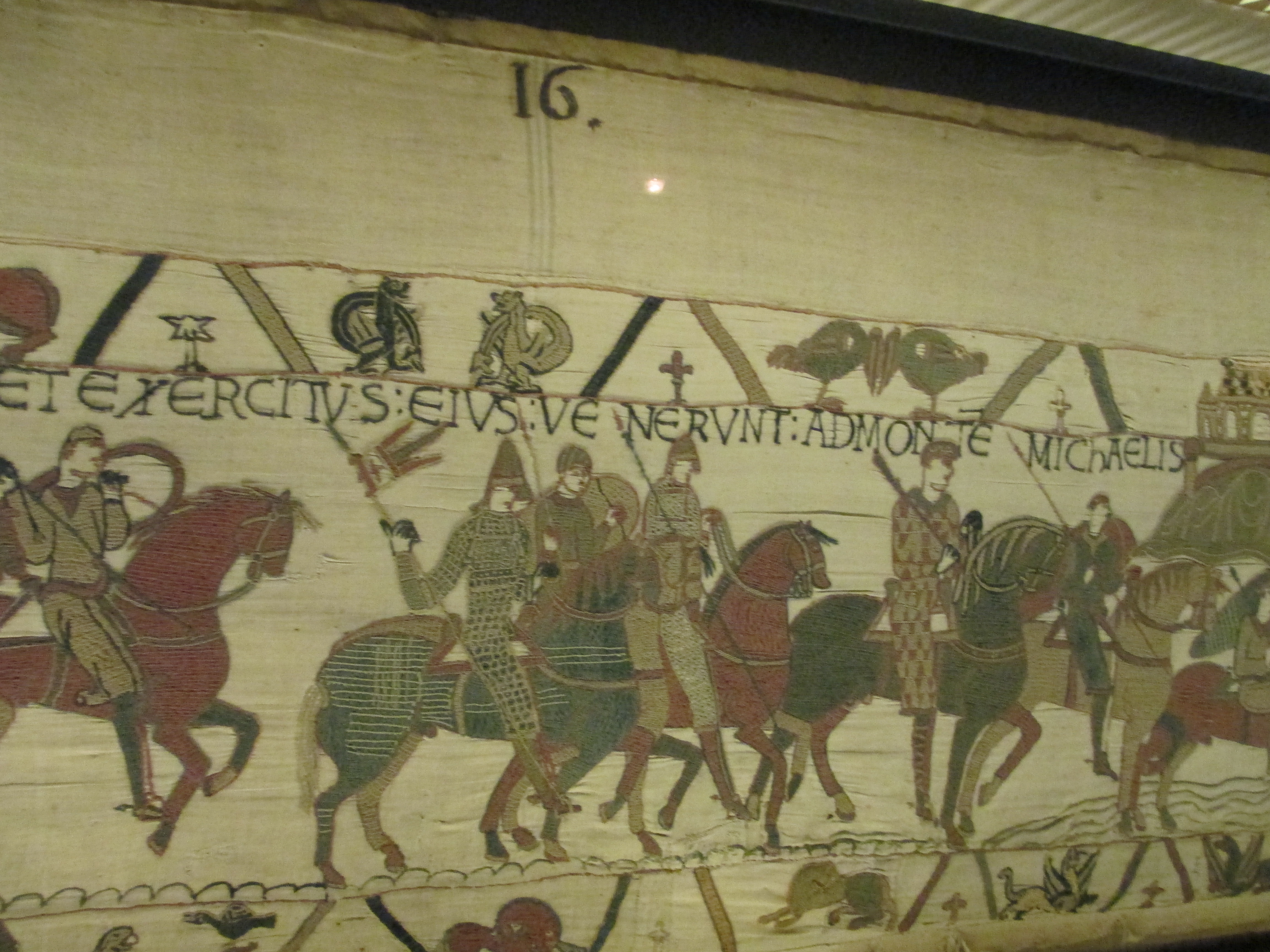
Bayeux Tapestry 10

They cross the river Couesson.

Bayeux tapestry 11

 They arrive at Dol and Duke Conan of Brittany flees. You can see him doing it on the left.

Bayeux Tapestry 12

They then attack Rennes and are fighting against the men of Dinian.
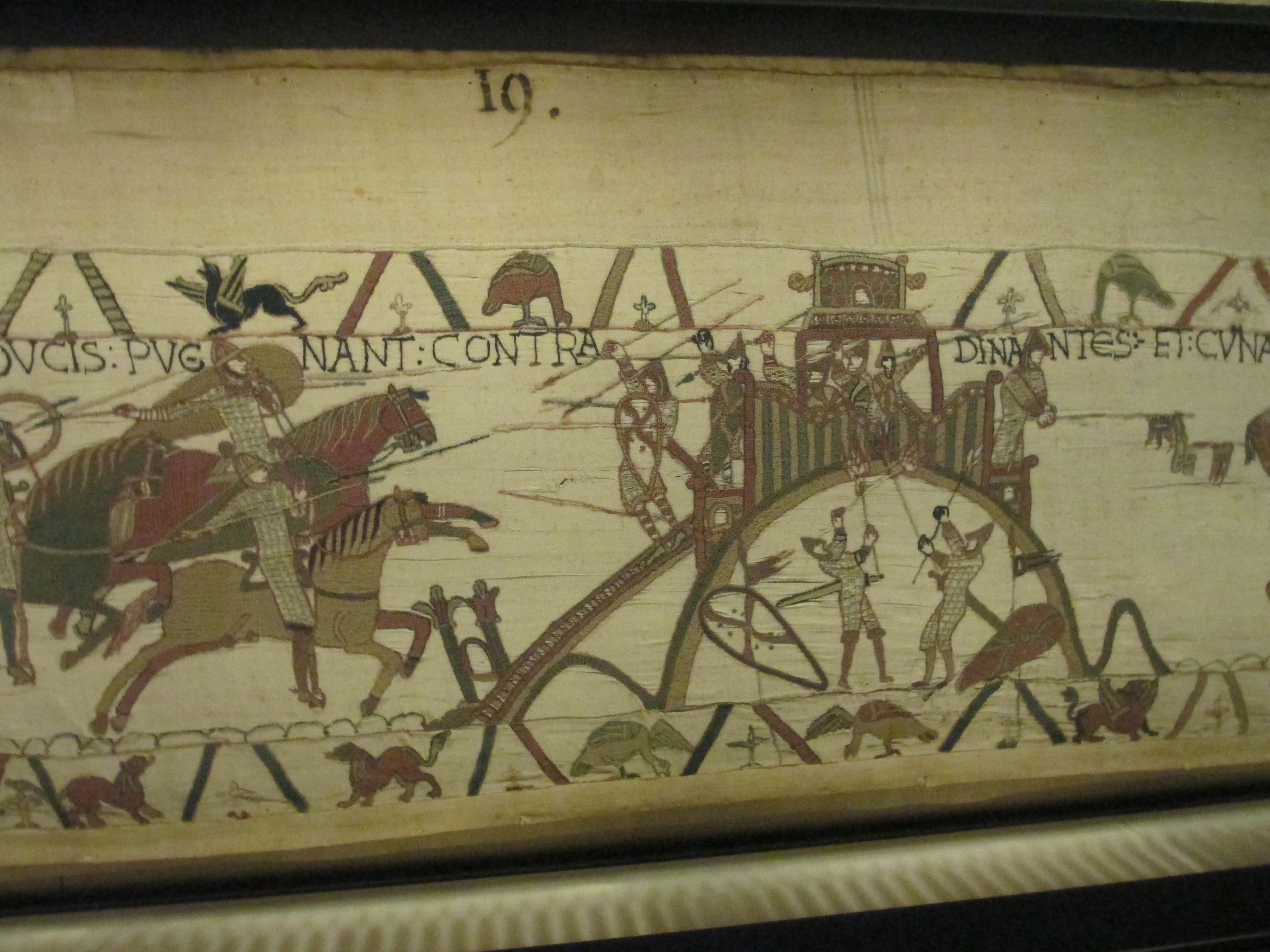
Bayeux Tapestry 13

Conan hands over the keys to William, no photo, and Harold and William arrive at Bayeux, no photo, where Harold makes an oath to back Duke William. You can see him swearing on the holy relics on the right.

Bayeux Tapestry 14

Harold returns to England, no photo, to find that King Edward is dying.

Bayeux Tapestry 15

The Hand of God is pointing at the very new Westminster Abbey and King Edward’s body is carried off.
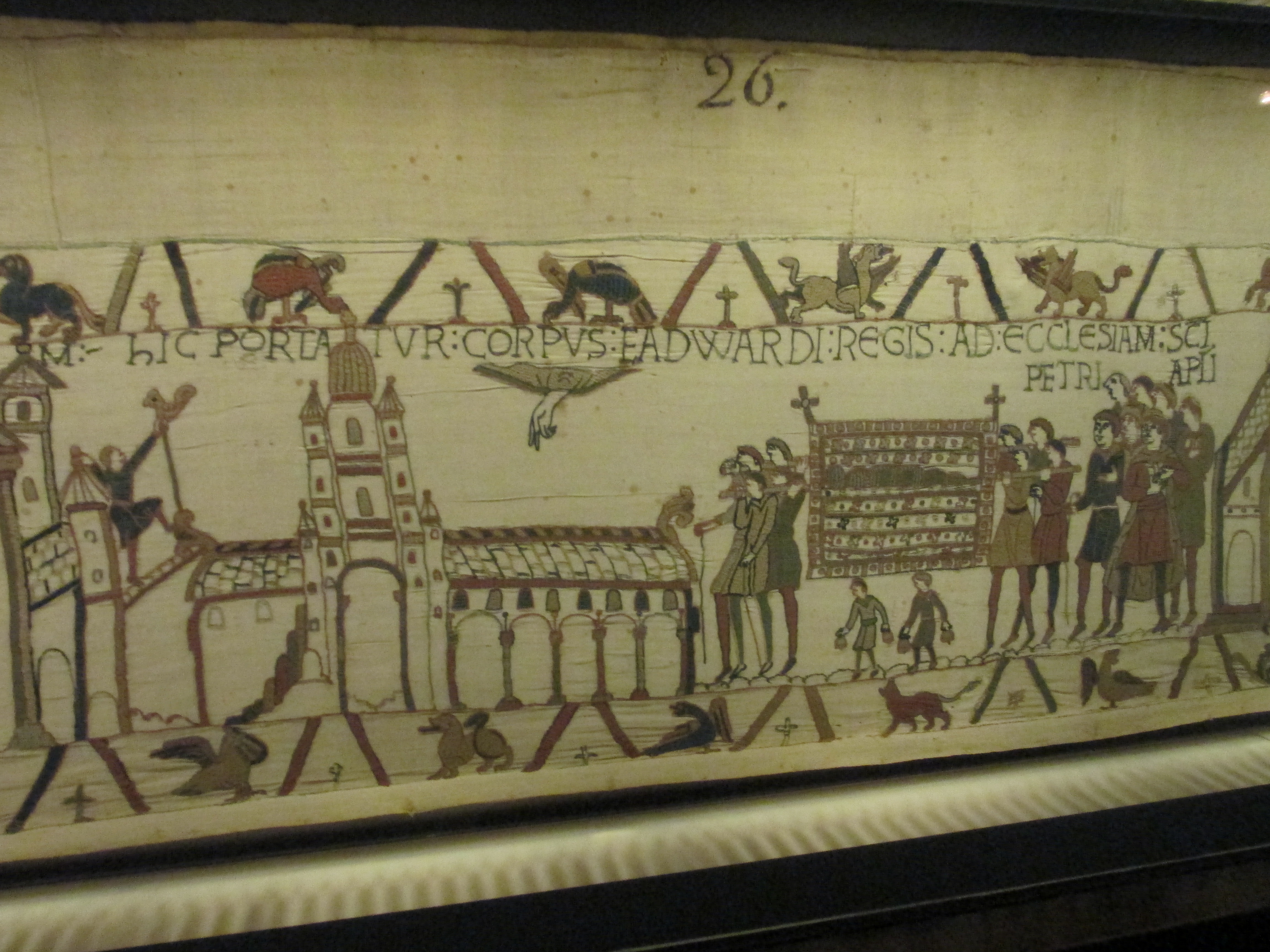
Bayeux Tapestry 16

King Edward is shown addressing his faithful servants before his death.

Bayeux Tapestry 17

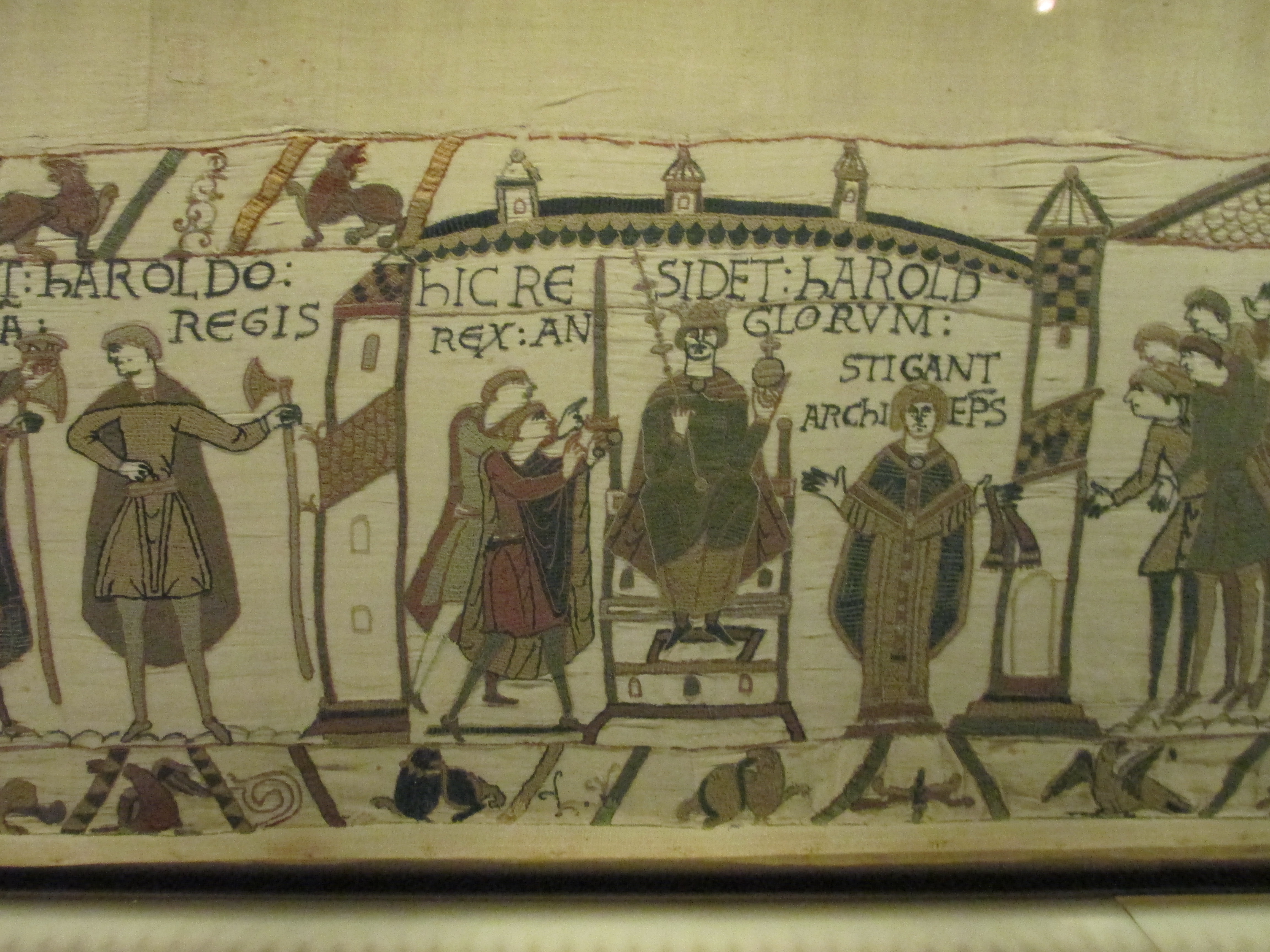
Harold is named King.

Bayeux Tapestry 18

The men marvel at a star, which is Halley’s Comet. One of them comes to tell Harold about it. You can see shadowy ships in the bottom border, which could be taken as an omen.
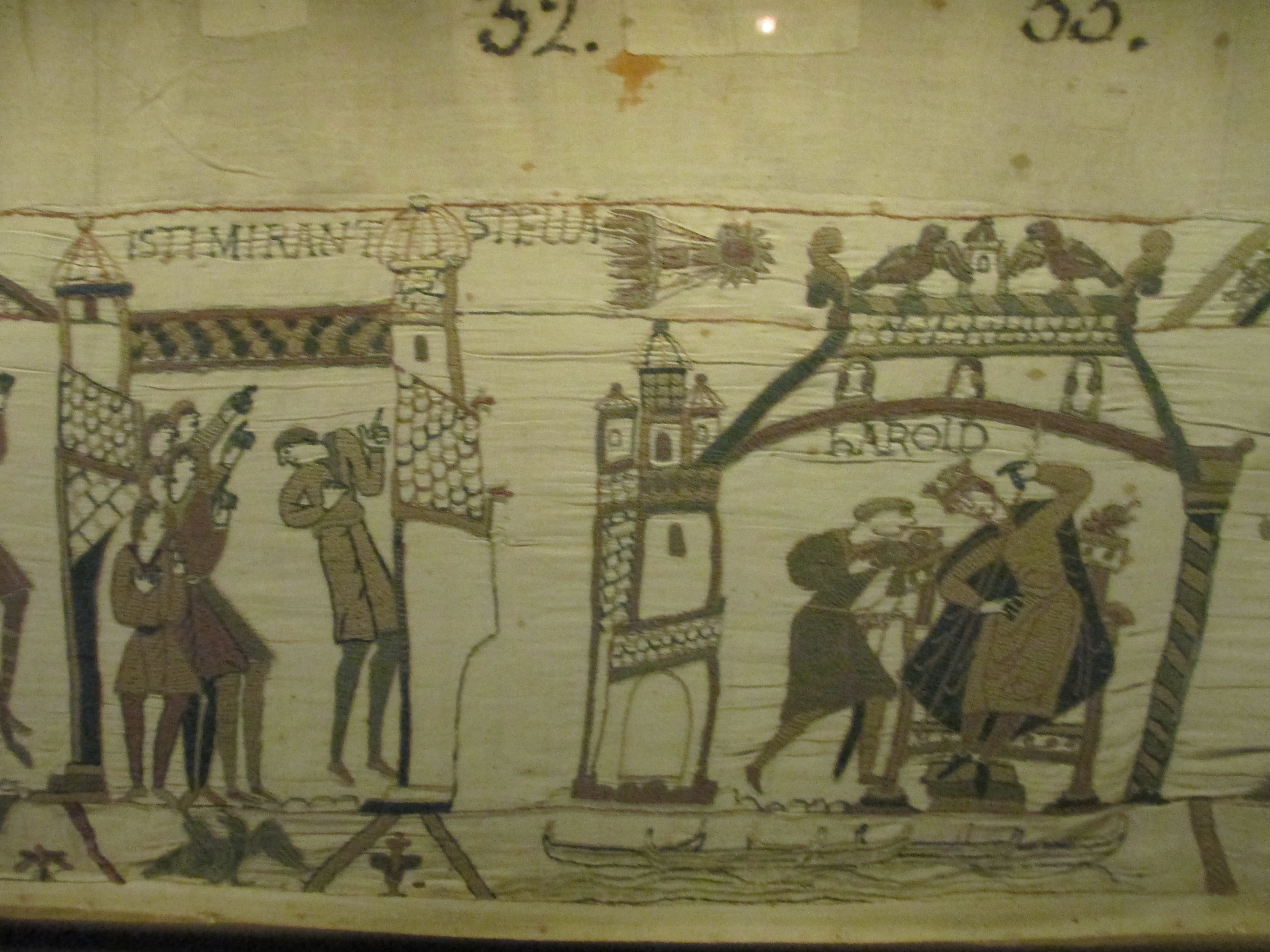
Bayeux Tapestry 19

Duke William is told of what he sees as Harold’s treachery.

Bayeux Tapestry 20 JPG

Duke William’s men are ordered to chop down trees to make ships and the ships are built.
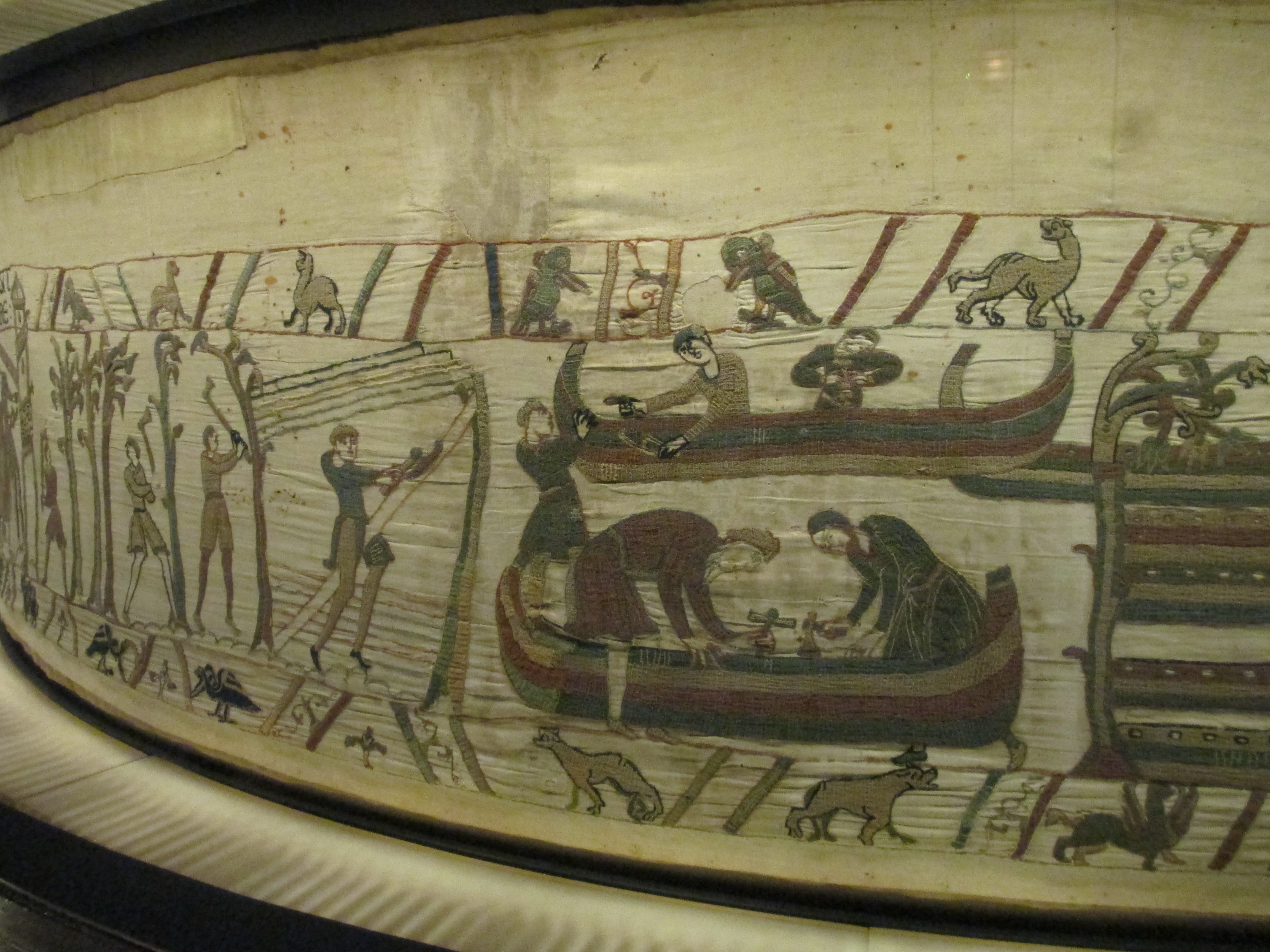
Bayeux Tapestry 21

The ships are dragged to the sea, no picture, and loaded with weaponry and food and wine.

Bayeux Tapestry 22

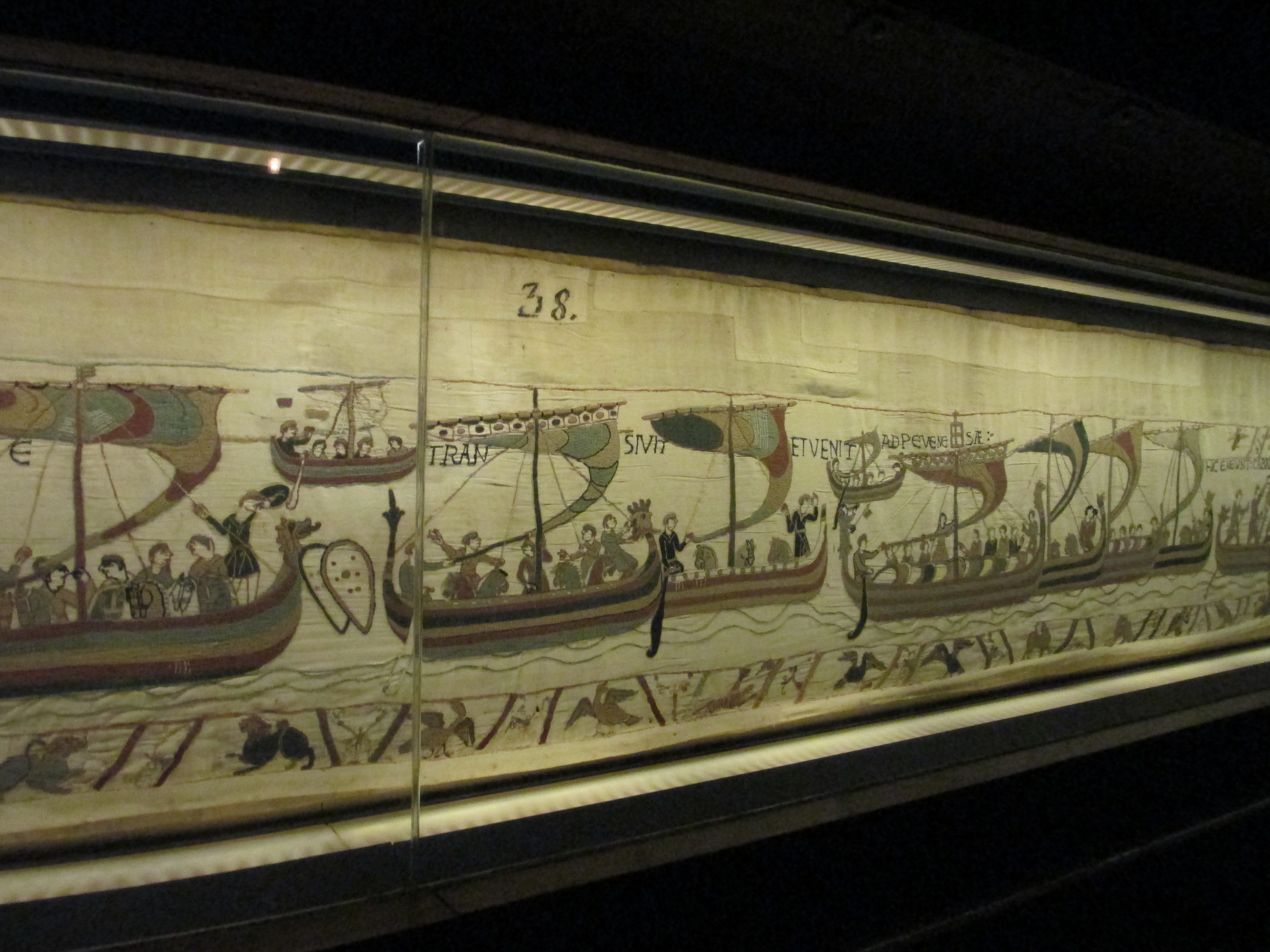
They set sail.

Bayeux Tapestry 24

Bayeux Tapestry 23

They arrive at Pevensey, unload the horses and the knights hurry off. They can be seen hurrying on the right.
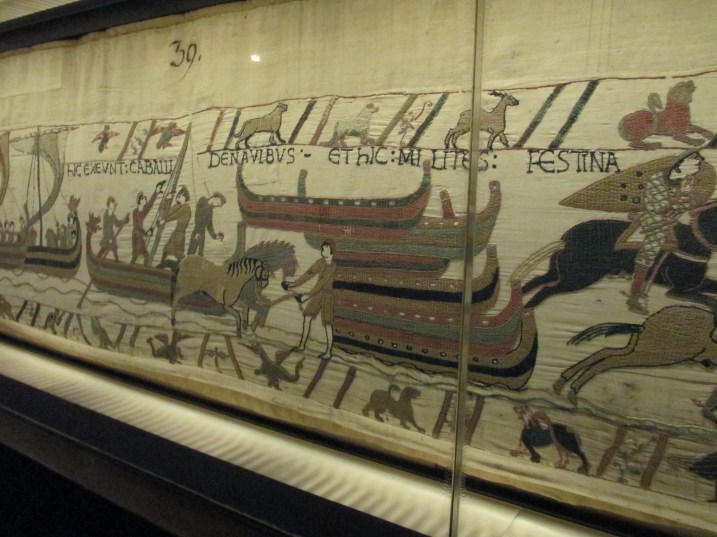
Bayeux Tapestry 25

They head for Hastings so they can forage for food, no pictures, they then arrive and meet Waddard, probably a vassal of Odo’s.
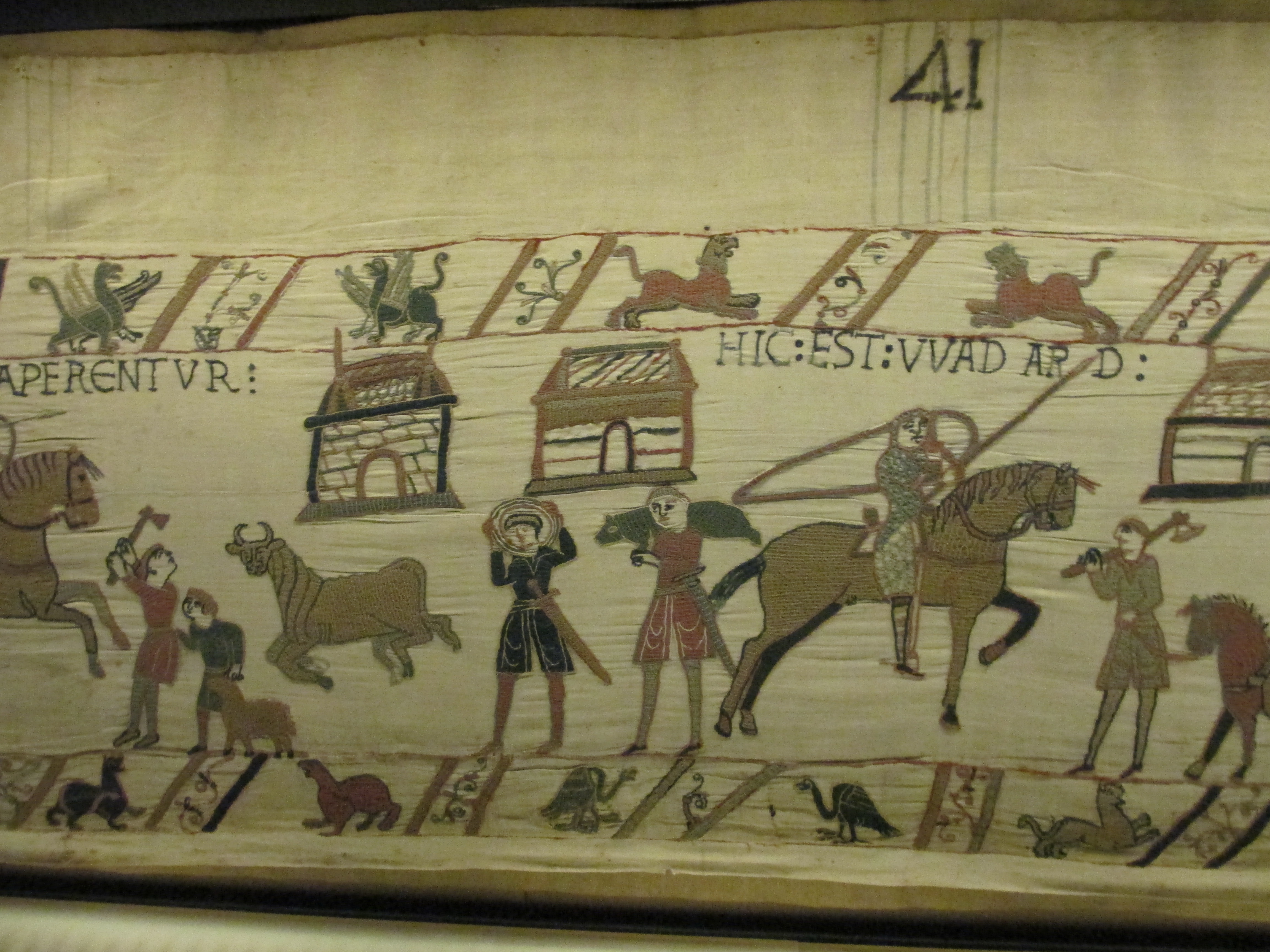
Bayeux tapestry 26

Meat is cooked and served by servants, no picture. They have a large meal and the bishop blesses the food.
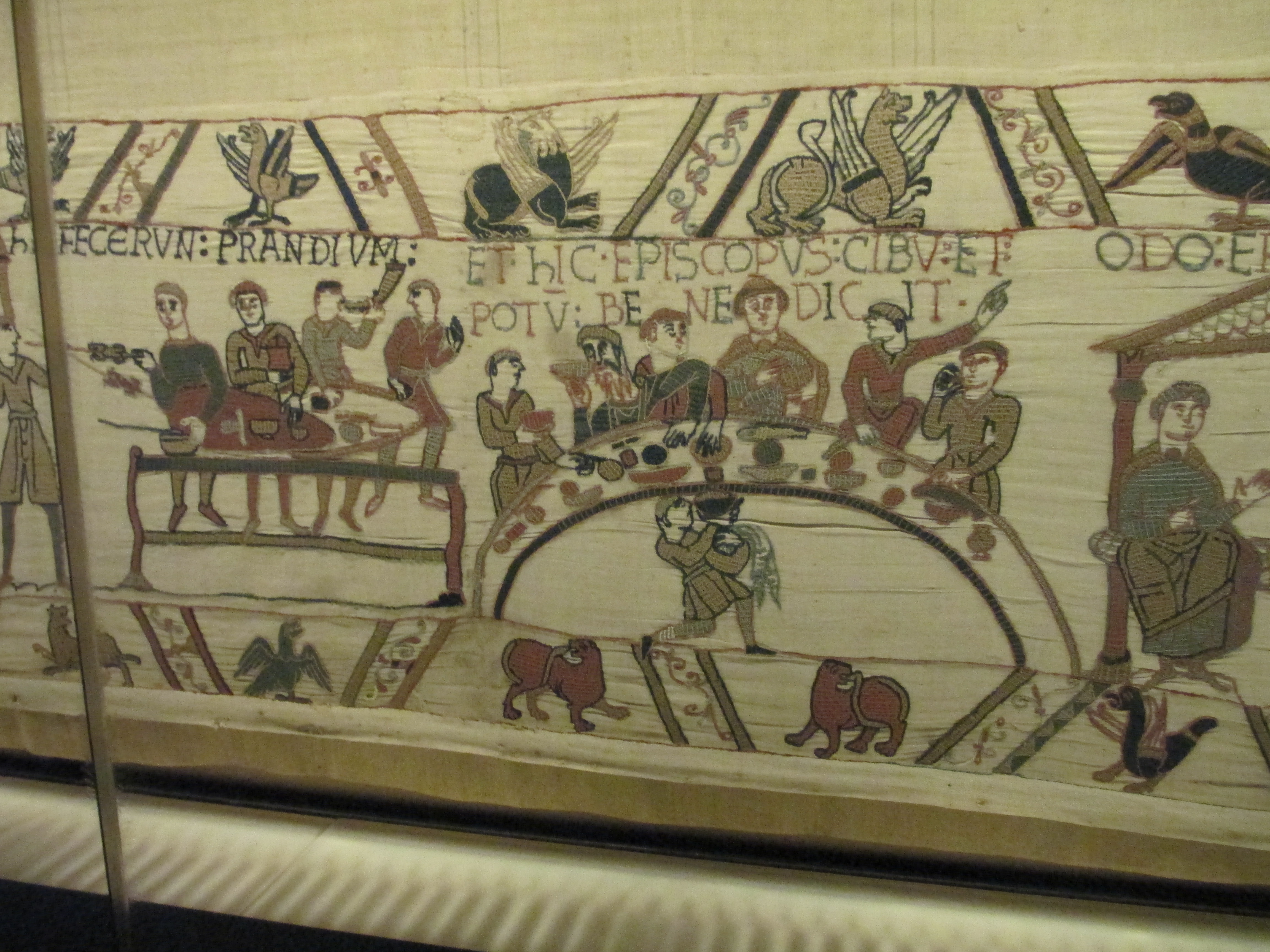
Bayeux Tapestry 27

Duke William talks to his two half brothers Bishop Odo and Robert of Mortain, no picture, the order is then given for a fortification to be dug at Hastings.
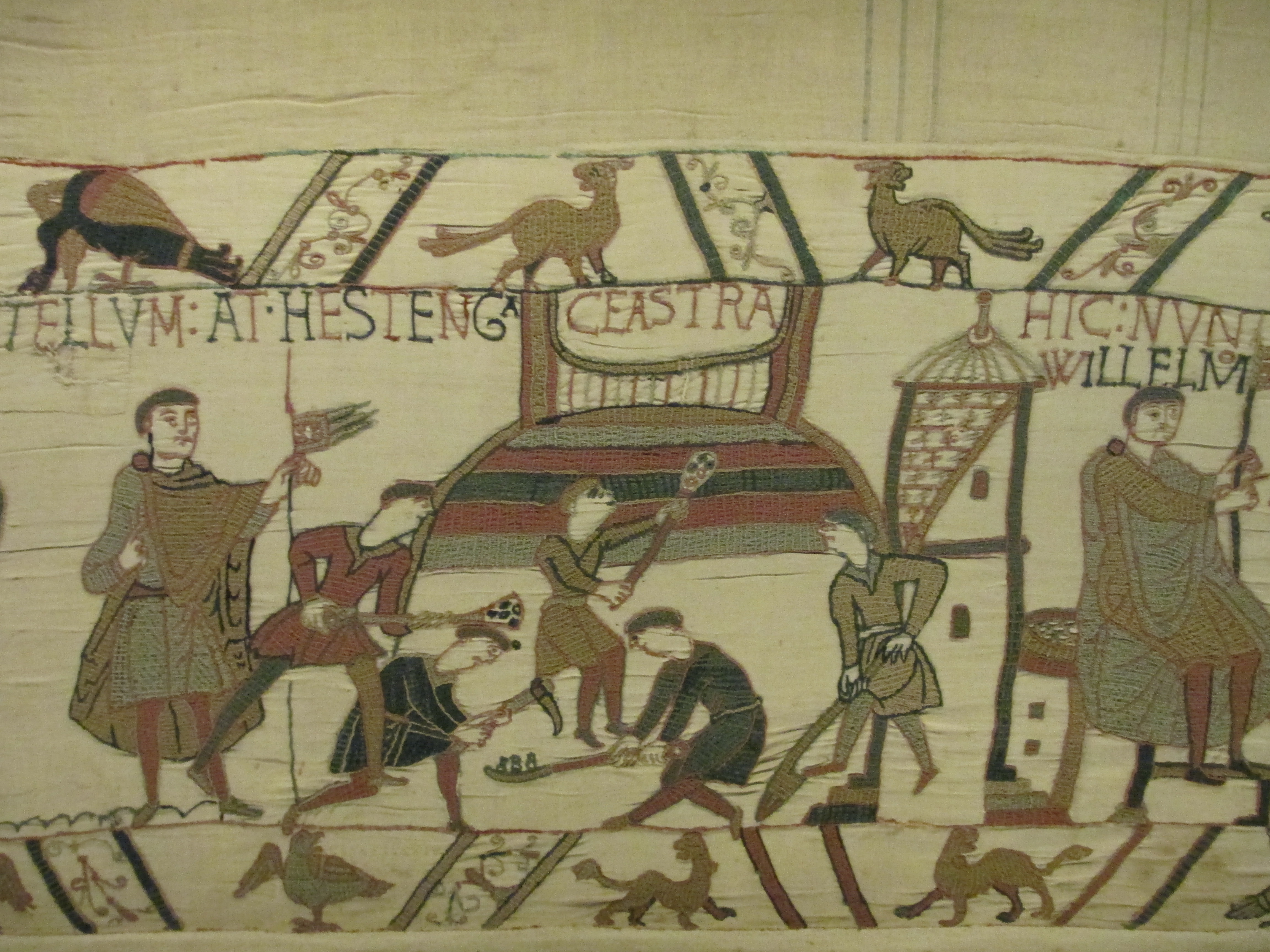
Bayuex Tapestry 28

News about Harold is brought to Duke William and a house is burnt, possibly an indication of the countryside being ravaged to provoke battle.
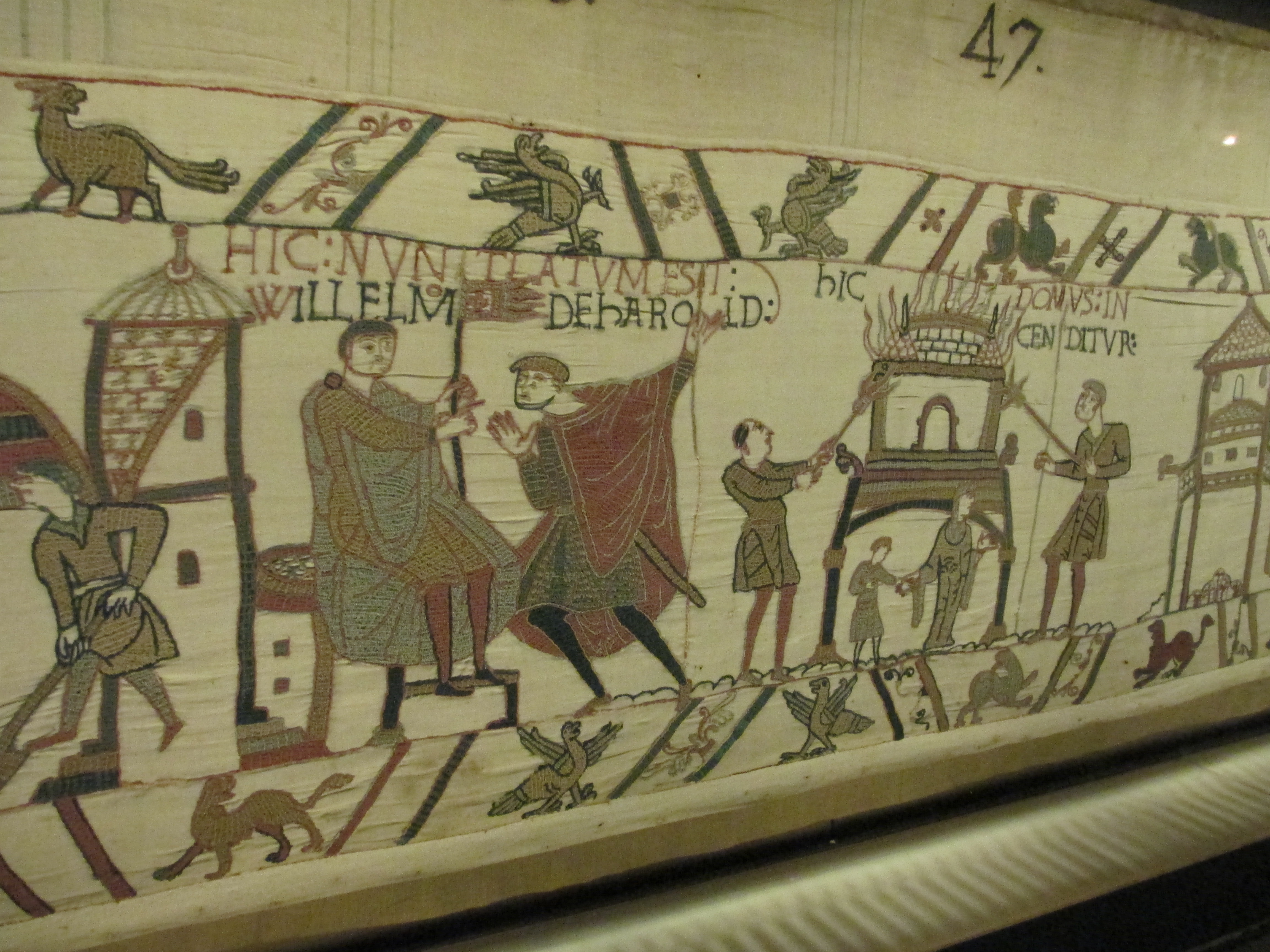
Bayeux Tapestry 29

The knights set out from Hastings, no picture, and reach the battle against Harold.
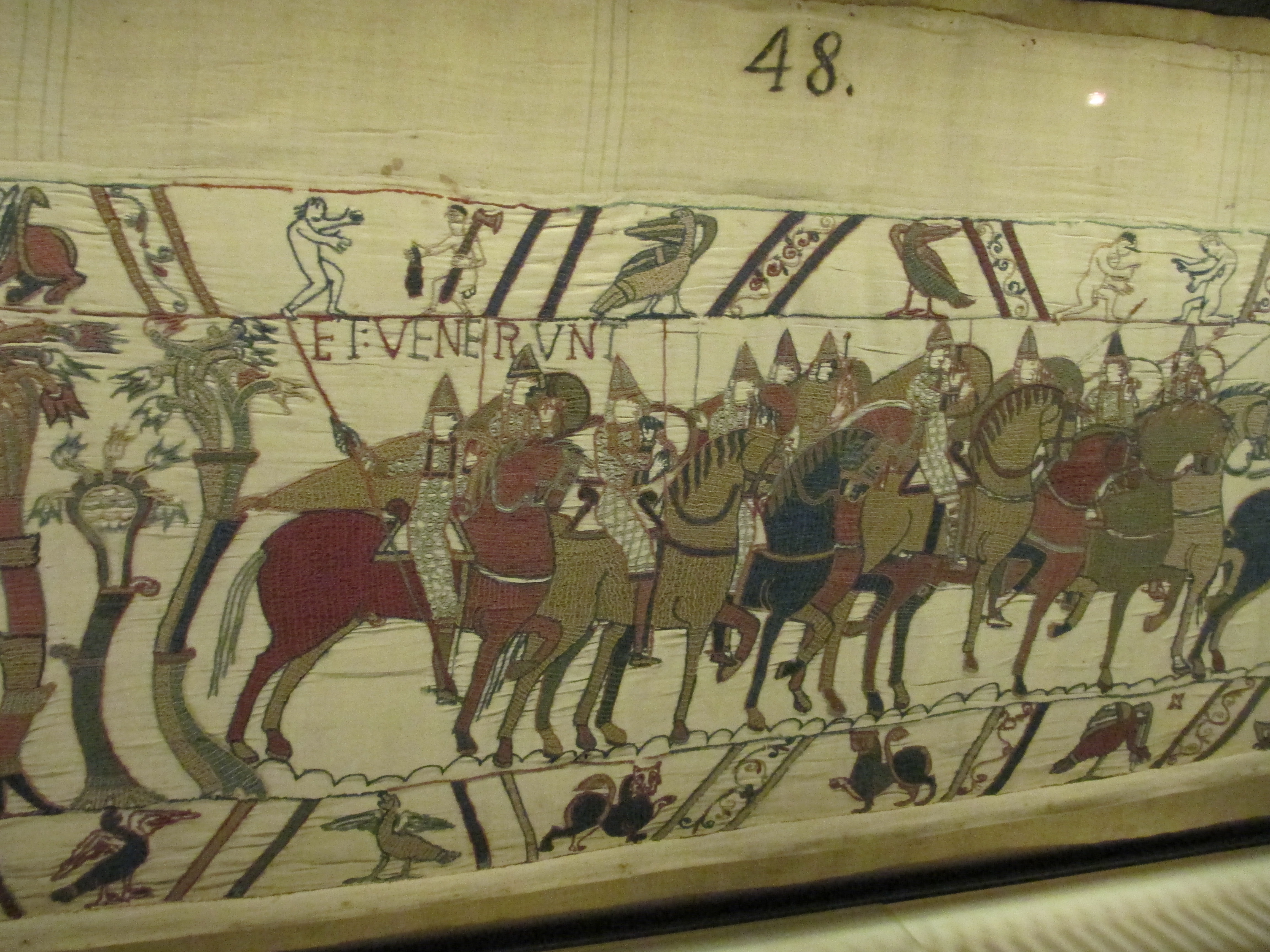
Bayeux Tapestry 30

Duke William questions Vital, who was probably Odo’s vassal and has been scouting, if he has seen Harold’s army.
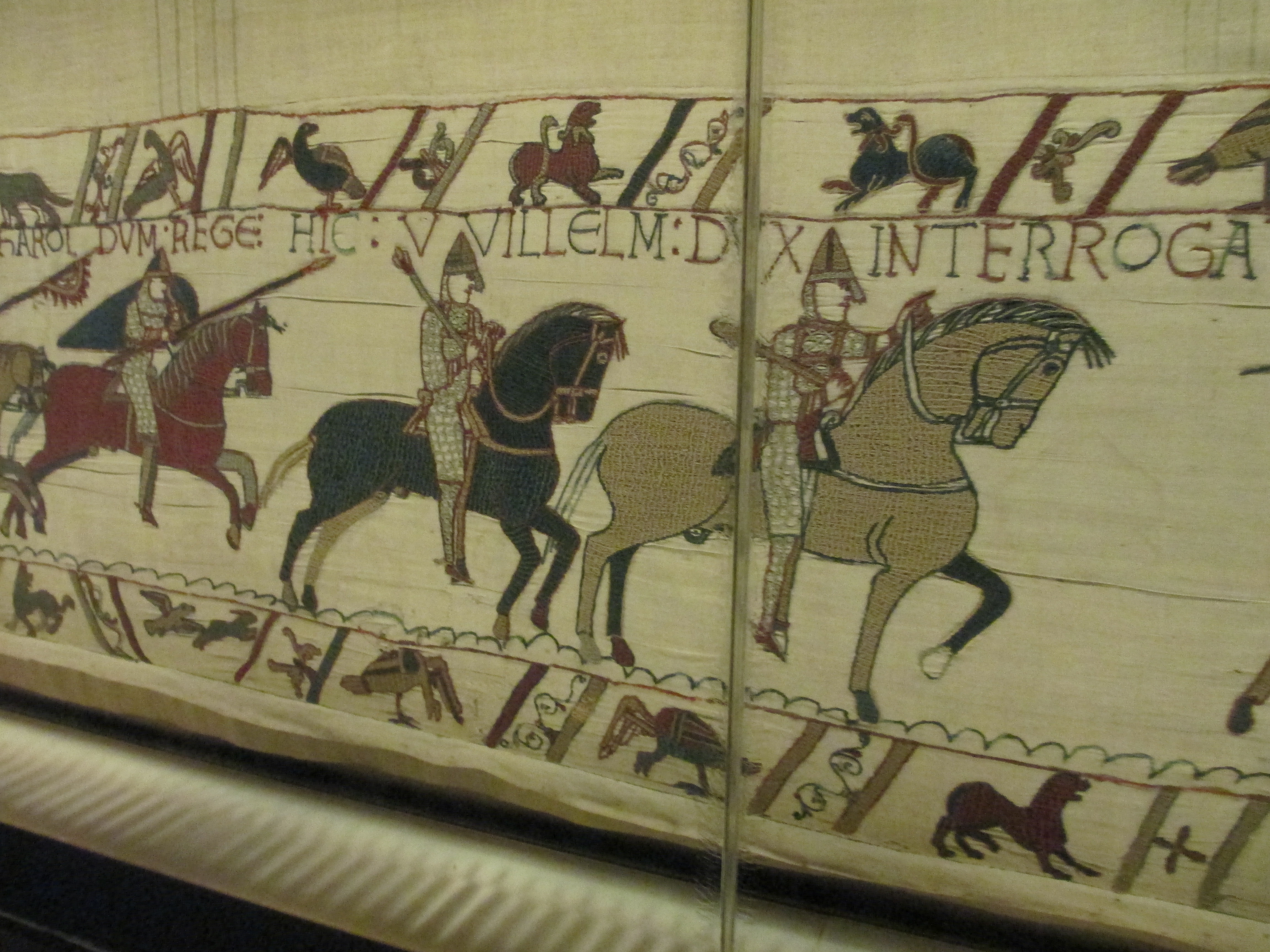
Bayeux Tapestry 31

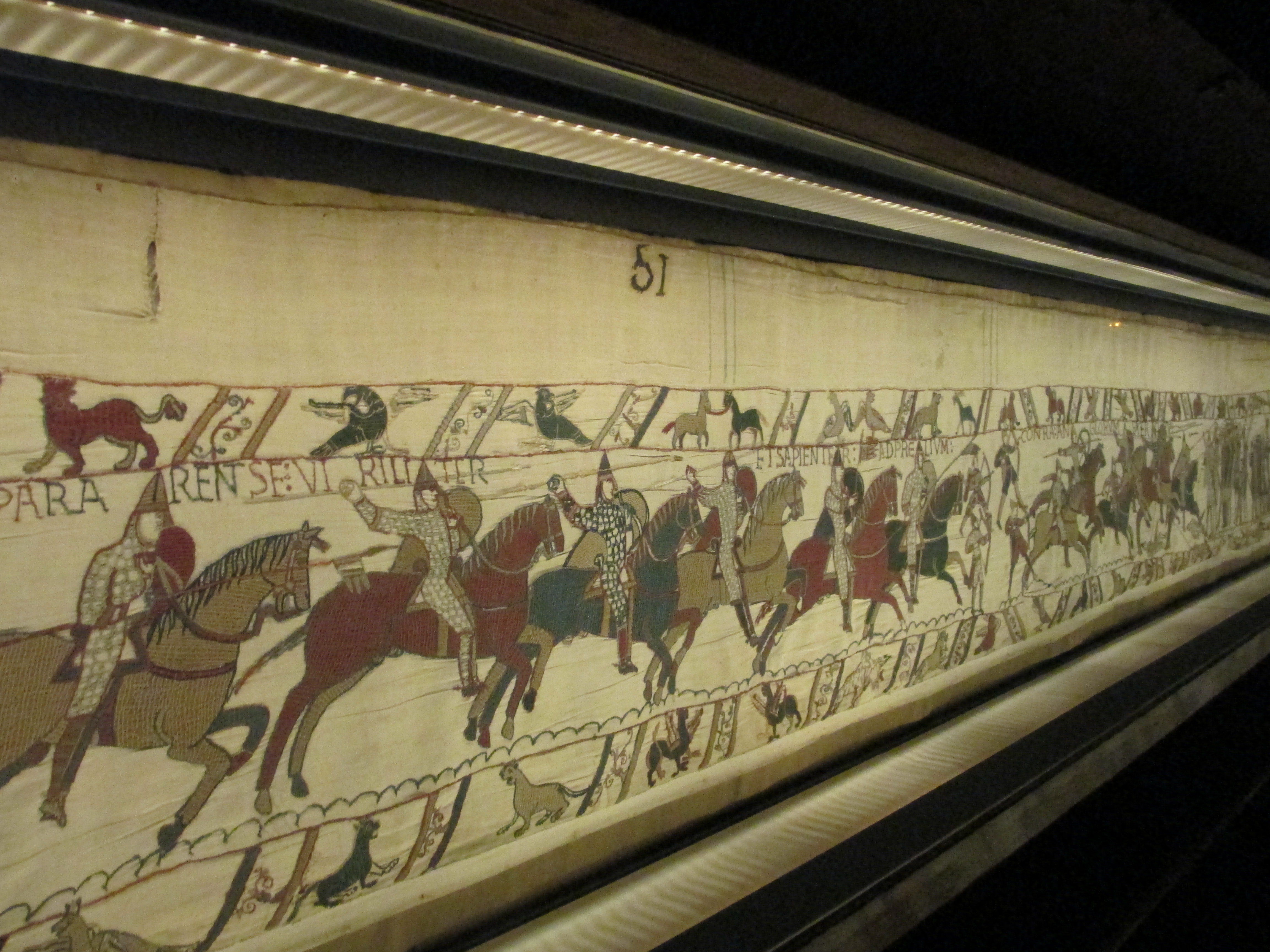
It is worth pausing the story here to say that at this point King Harold has ridden and marched his army from Stamford Bridge, just out of York. Where after a forced march of more than 200 miles King Harold’s forces had defeated the army of Harald Hardrada the King of Norway and Tostig, King Harold’s brother who he’d been forced to exile some months earlier. Harald Hardrada had sailed at Tostig’s request to claim the English Crown for himself. He’d sailed with a fleet of some 200 ships, not including the supply ships. King Harold won the day, the Norwegians were annihilated and Hardrada and Tostig were both killed. So few survived that only approximately 24 ships were needed to carry them home. Oderic Vital wrote seventy years later that “To this day a great congeries of skeletons of those who died still lies there, as evidence of the wholesale slaughter of two peoples.” (Thorpe, p.15). News of Duke William’s landing probably reached Harold while he was in York and he turned around and marched south from just out of York to face Duke William, he left London on the 12th of October and The Battle of Hastings was fought on the 14th of October 1066. The image below on the left is King Harold receiving news of Duke William’s army before the battle begins and on the right you can see Duke William exhorting his troops.
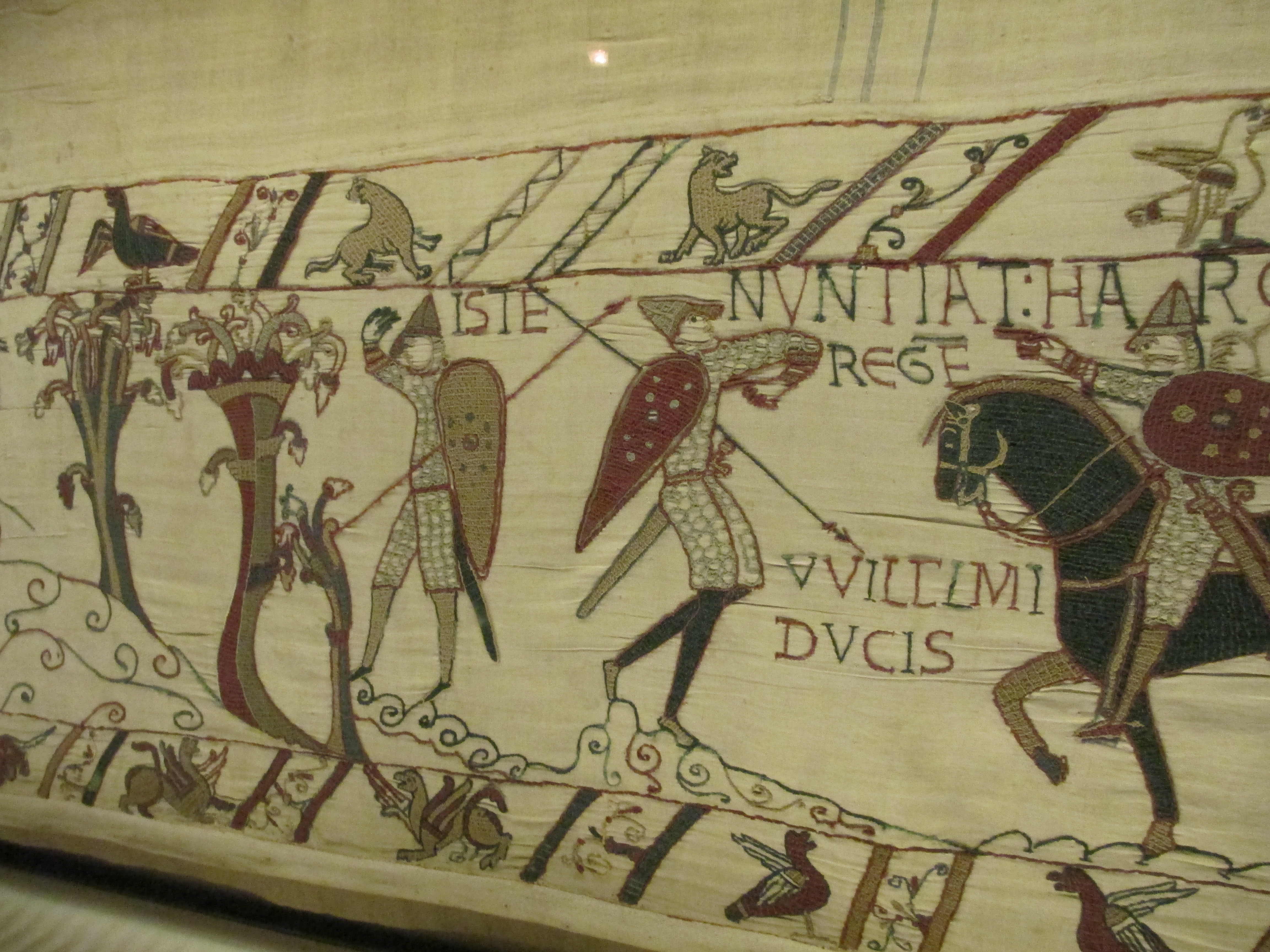
Bayeux Tapestry 32

The battle then commences. Bayeux Tapestry 33 Bayeux Tapestry 34

King Harold’s brothers, Leofwine and Gyrth, fall.Bayeux Tapestry 35 Bayeux Tapestry 36
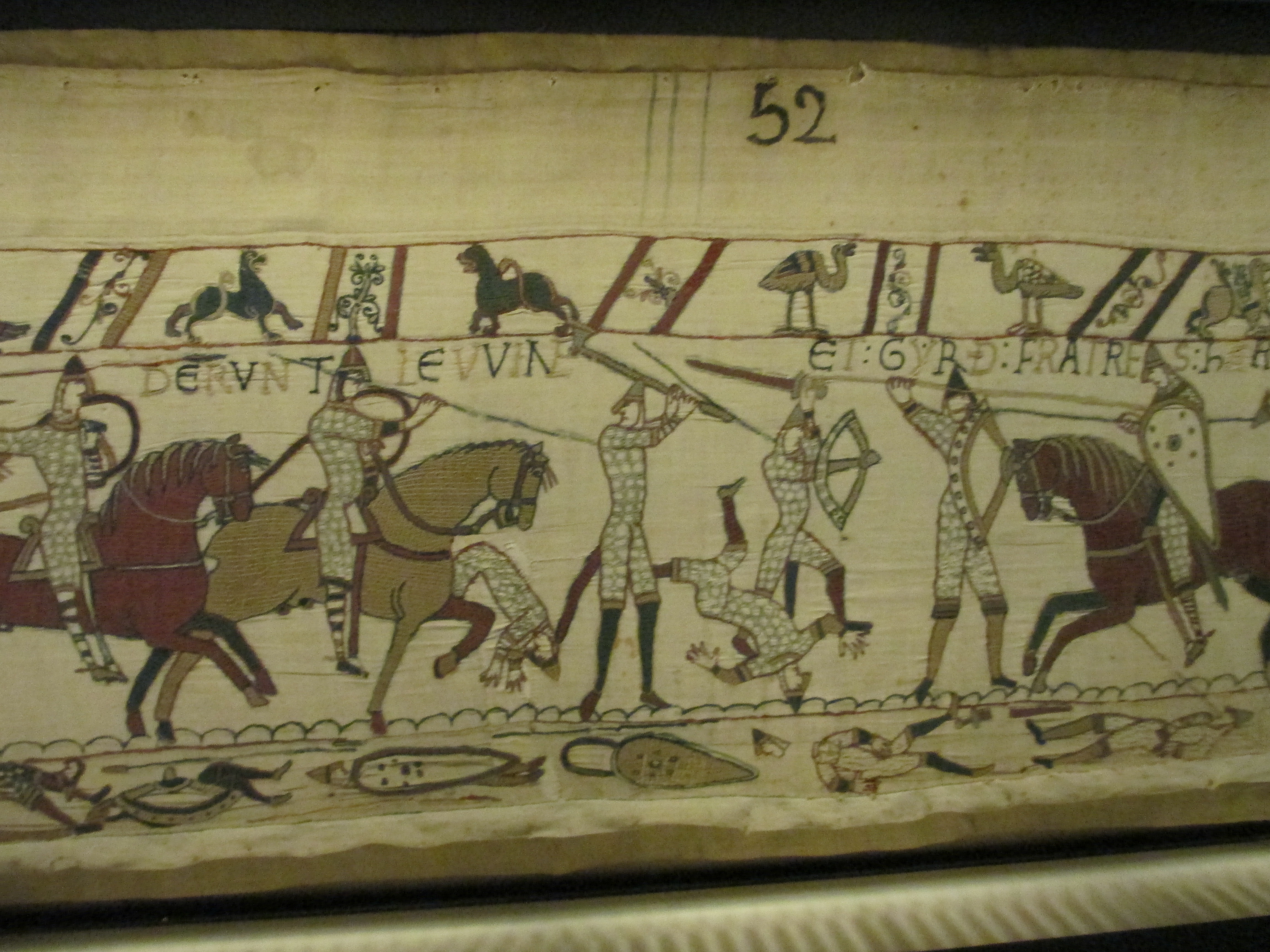
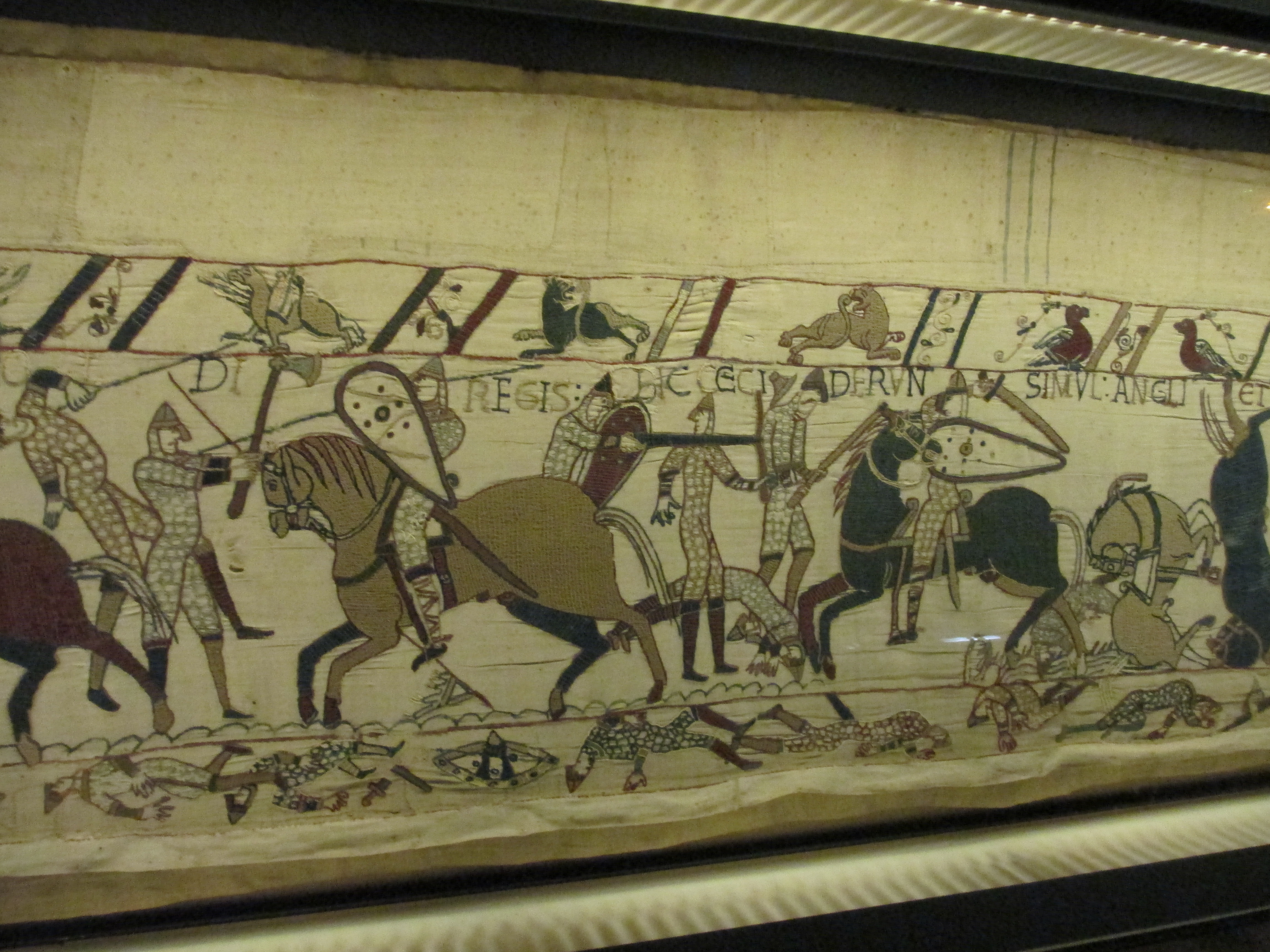
The Battle continues.

Bayeux Tapestry 37

Bayeux Tapestry 38

There is concern that Duke William has been killed. You can see him showing his face below to prove that he isn’t dead.
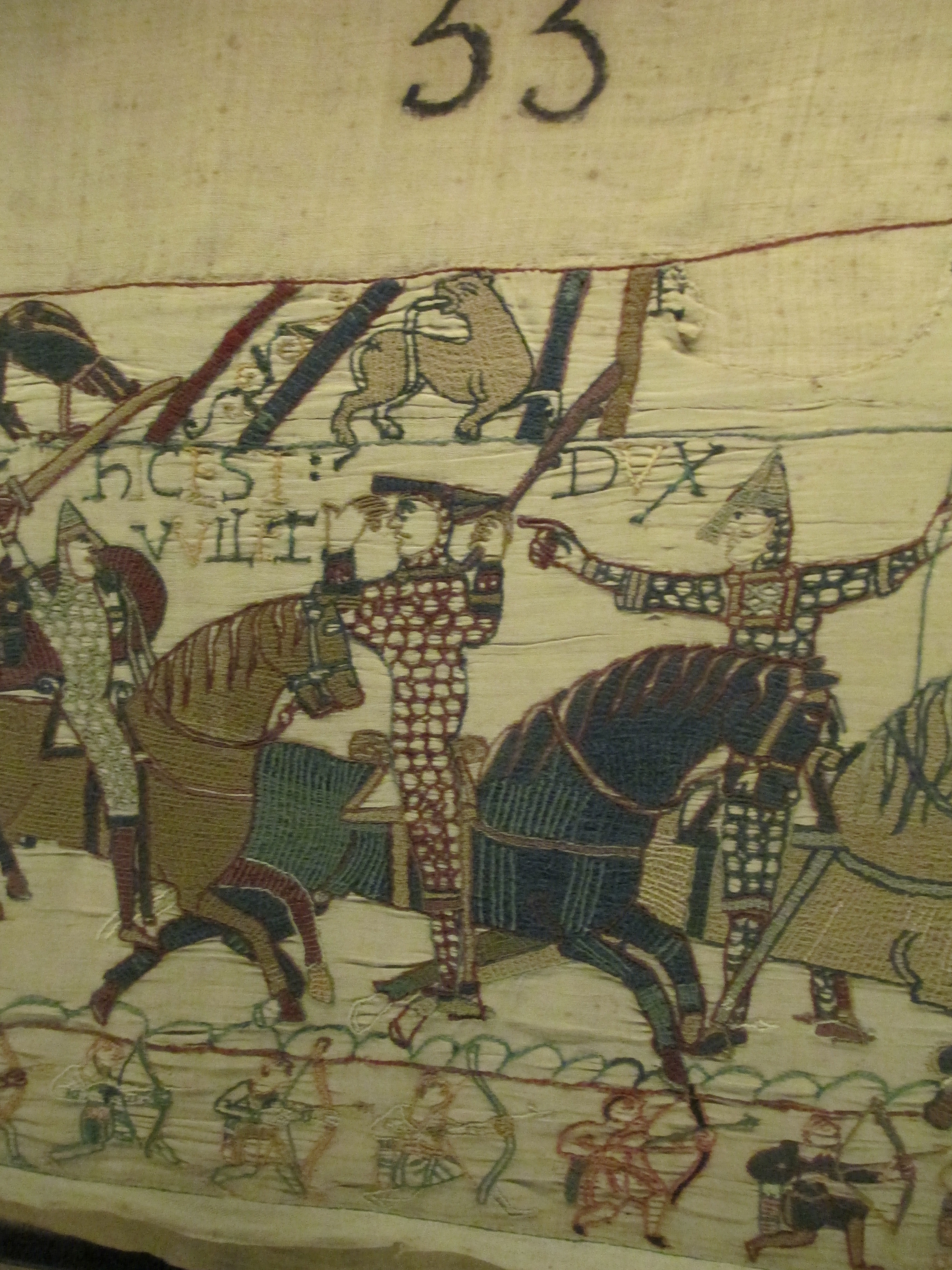
Bayeux Tapestry 39

There is more fighting, no photos,  and then King Harold is killed. You can see latin below. Harold Rex interfectus est. Which translates as here King Harold has been killed. See above for the discussion as to how he died.
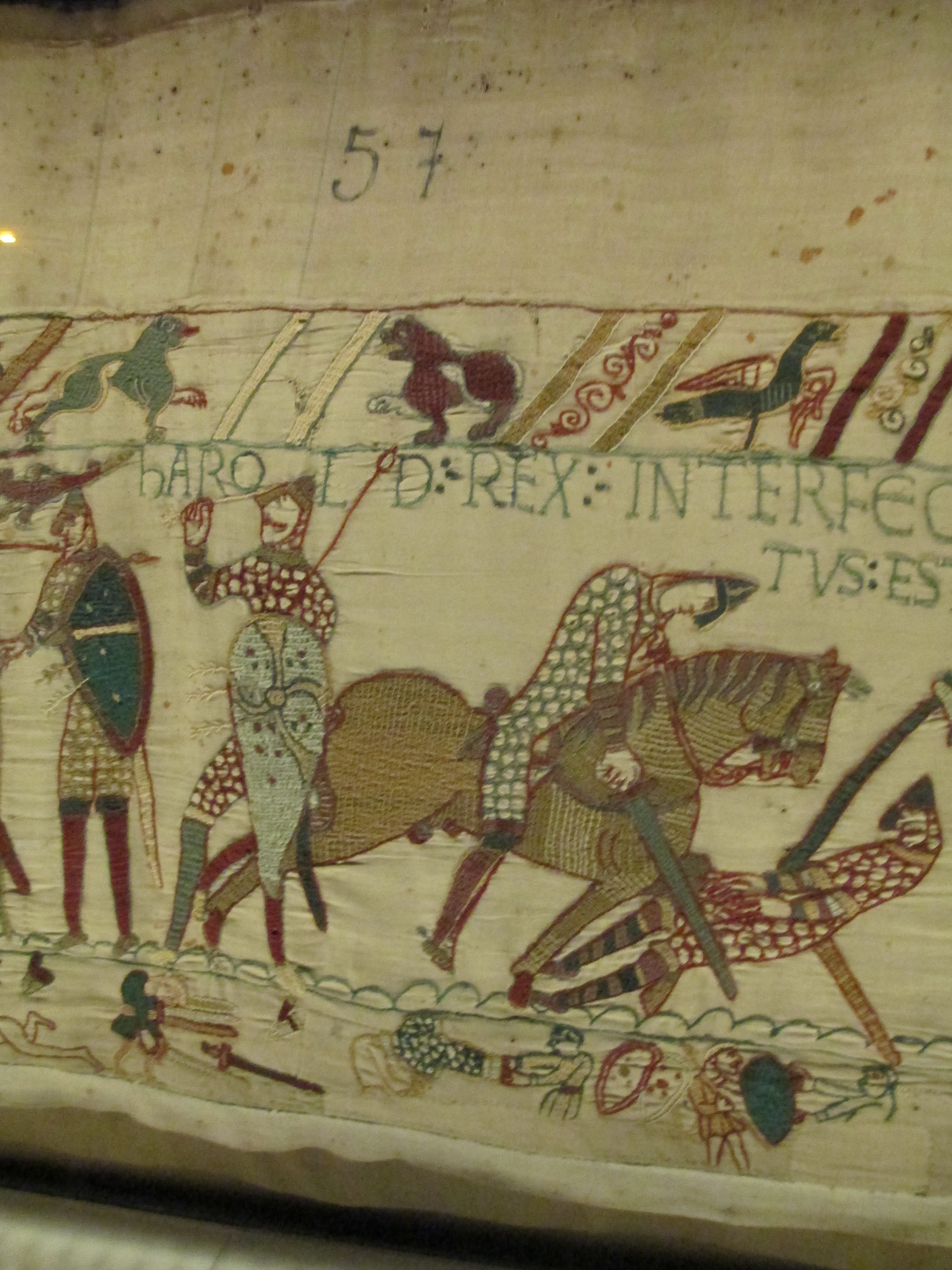
Bayeux Tapestry 40

And the English flee.

Bayeux Tapestry 41Bayeux Tapestry 42

And that is the end of the tapestry.

It is by no means the end of story as Duke William still had to establish dominance over a reasonably hostile country. But that is a story for another post.

The photos are all mine as is the video.

[1] http://www.watchashore.org.uk/southampton

[2] http://www.history.org.uk/file_download.php?ts=1254494939&id=3946. This is a link to a discussion about whether or not King Harold was shot in the eye. While the author draws the conclusion that he was not and I don’t believe this can be said absolutely definitively the article outlines the problems with the argument that he was shot in the eye with an arrow. There are absolutely arguments on both sides, but this is not the place to go into detail.

[3] The Bayeux Tapestry by Eric Maclagan. published 1943 by Penguin Book Limited: London and New York.

[4] The Bayeux Tapestry and the Norman Invasion by Lewis Thorpe. Published 1973 by the Folio Society.

[5] http://www.britannica.com/EBchecked/topic/56821/Bayeux-Tapestry
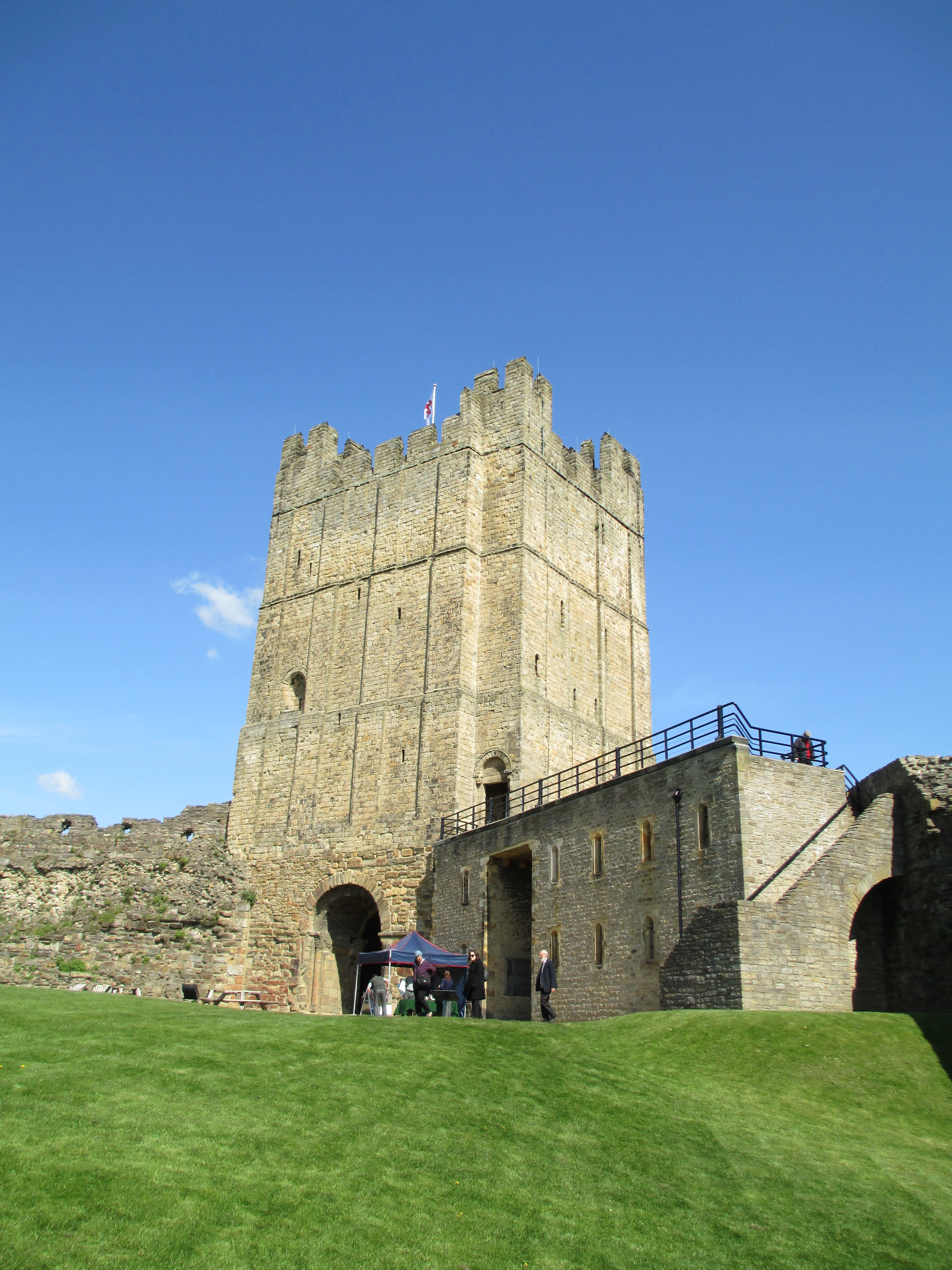
What is your favourite castle

Just a very short post. I was wondering what everyone’s favourite castles are. I have listed a few of mine in the poll below, but please feel free to add your own answers or to chose one of mine. Also I’d love to hear some of the reasons in the comments.

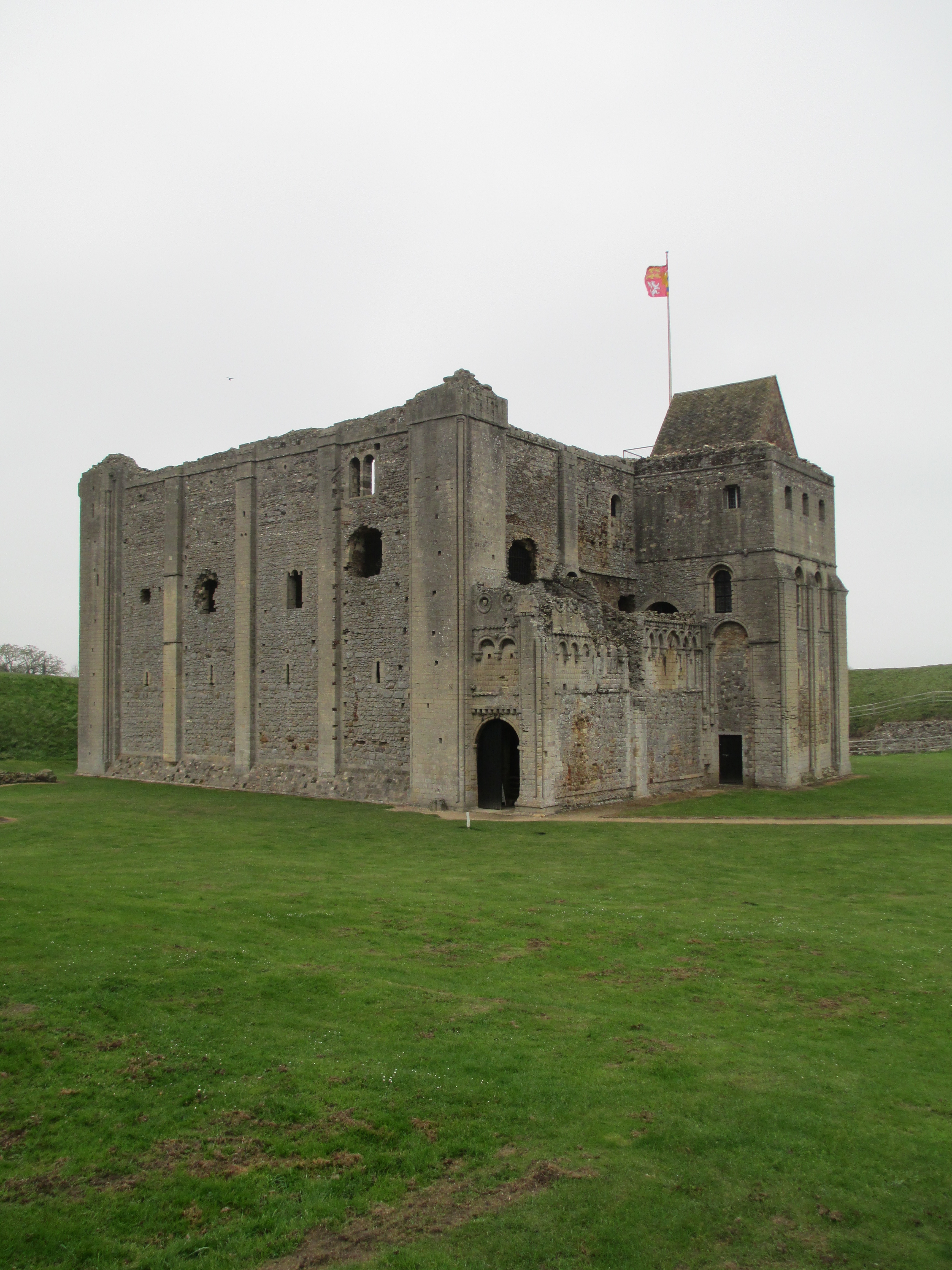
For inspiration here are photos of the castles I’ve listed.


IMG_1147Richmond Castle

Chepstow Castle Wales

Chepstow Castle

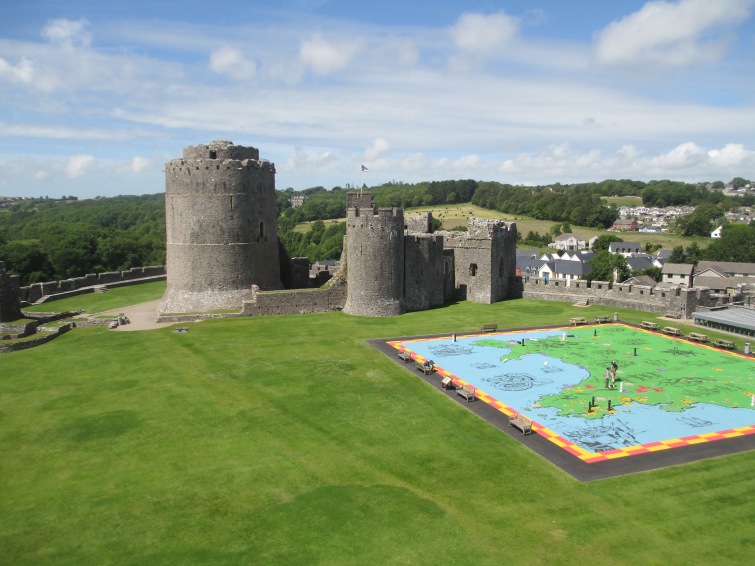
pembroke

Pembroke Castle

IMG_0548

Peveril Castle

IMG_2041

Conwy Castle

ferns castle irland

Ferns Castle

IMG_0363

Castle Rising. 

IMG_1488

Doune Castle. Yes I have a soft spot for Doune because of its Monty Python connections.

IMG_9125

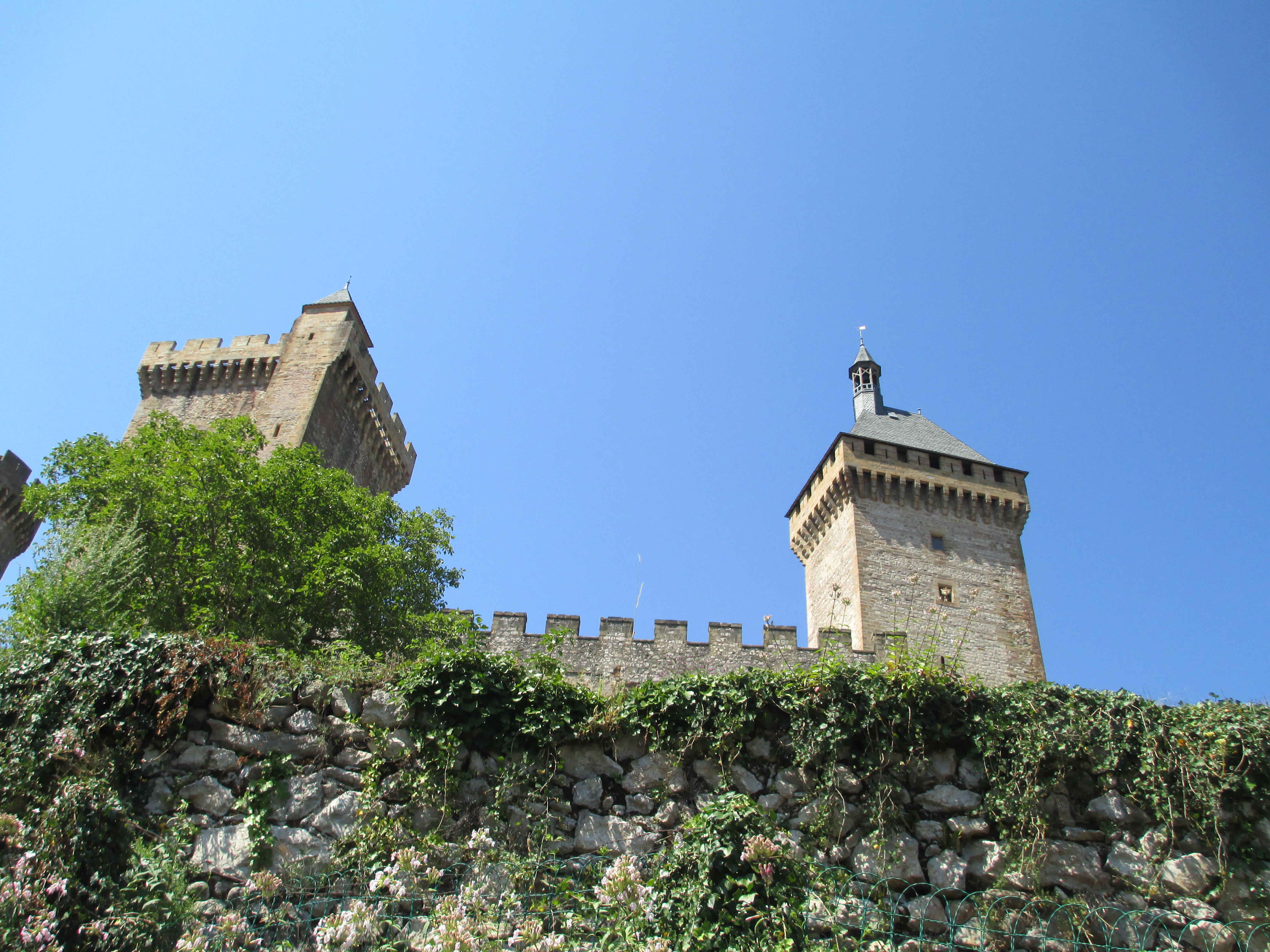
Foix Castle

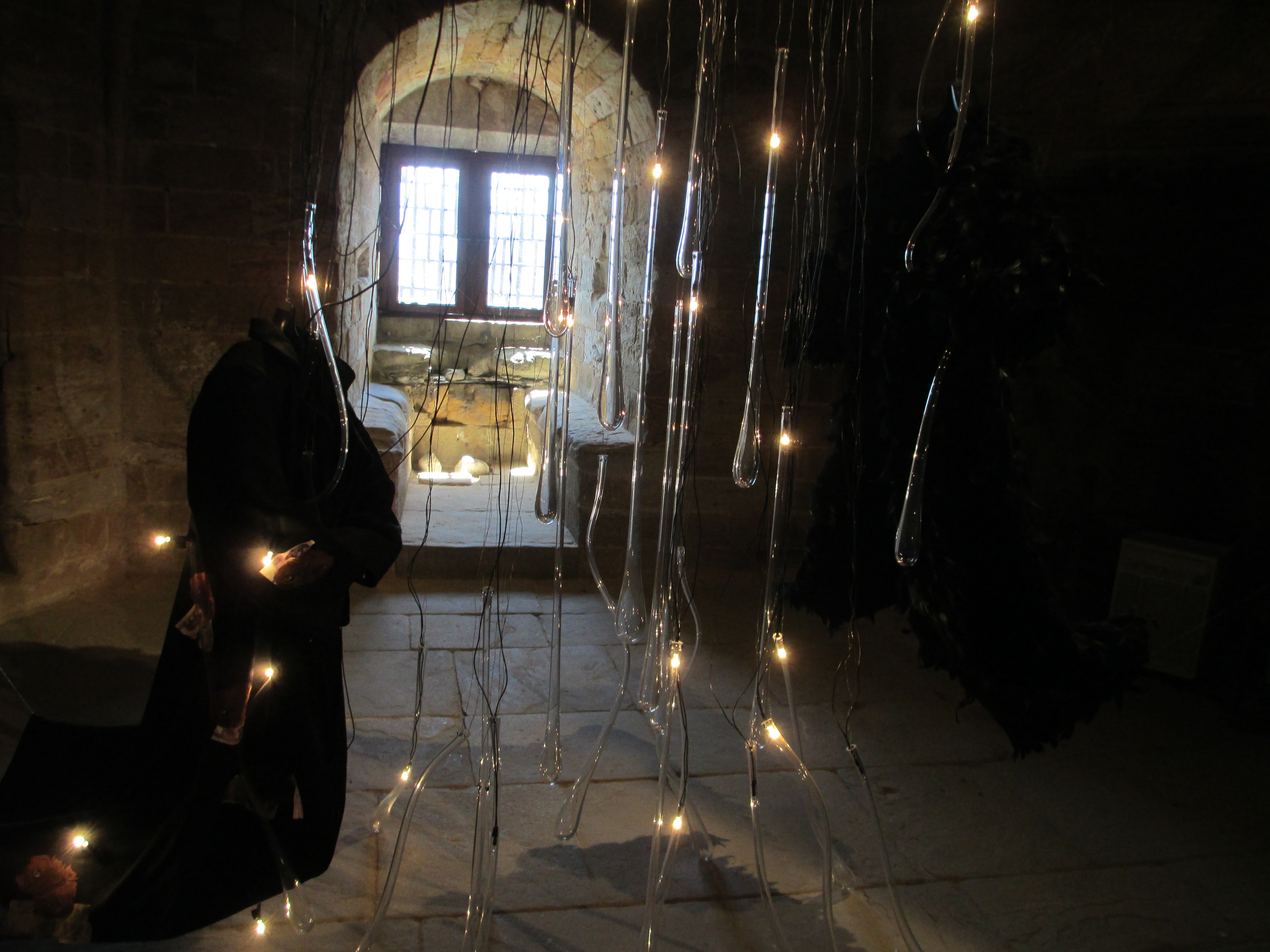
Historic Buildings, Modern Art.

In many cases historic buildings are finding a new meaning in an increasingly technological world as canvases for modern art. Whether it is as a cinema, or a projection space or as a place for installations. This sort of repurposing brings new life and new significance to historic buildings.

There are many examples, but I thought I’d just discuss a few. I’d like to begin with some I have previously mentioned in an earlier post.

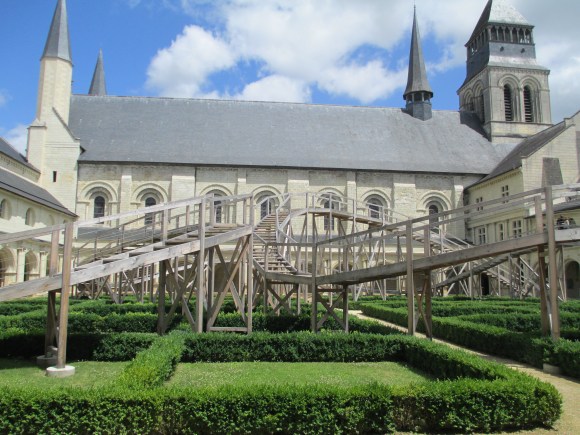
Fontevraud is an abbey in France that was founded in the 11th century. Various parts of it have been used for artistic installations. Font art The Cloister. You can walk on this sculpture, creating whole new ways of seeing an ancient building.Font DormThe dormitory. You are able to lie in these boats, simulating the experience of the sleeping monks.

The two installations in Fontevraud both work with the history of the building to give alternative ways of experiencing it.

Another example from France is Foix Castle not that far from Toulouse.  You can see the castle below. It is perched on a a lump of carboniferous limestone and parts of the castle itself date from the 11th century. It was involved in the Albigensian Crusade and was part of an area of known Cathar sympathisers.

IMG_9125 IMG_9037

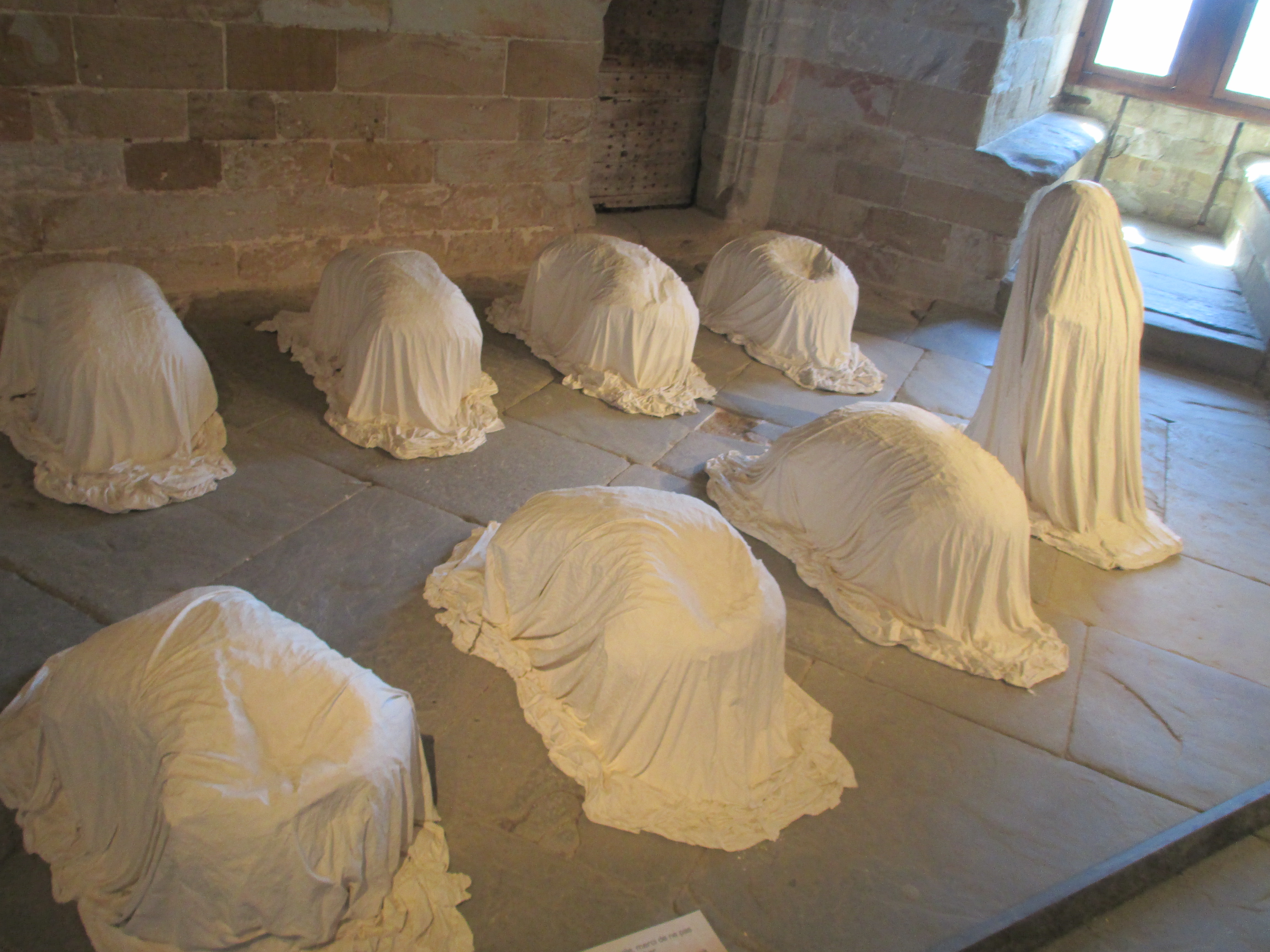
The installations below could be found inside and were both representations of people at prayer. Again repurposing an old building and using its own history for art.

IMG_9095

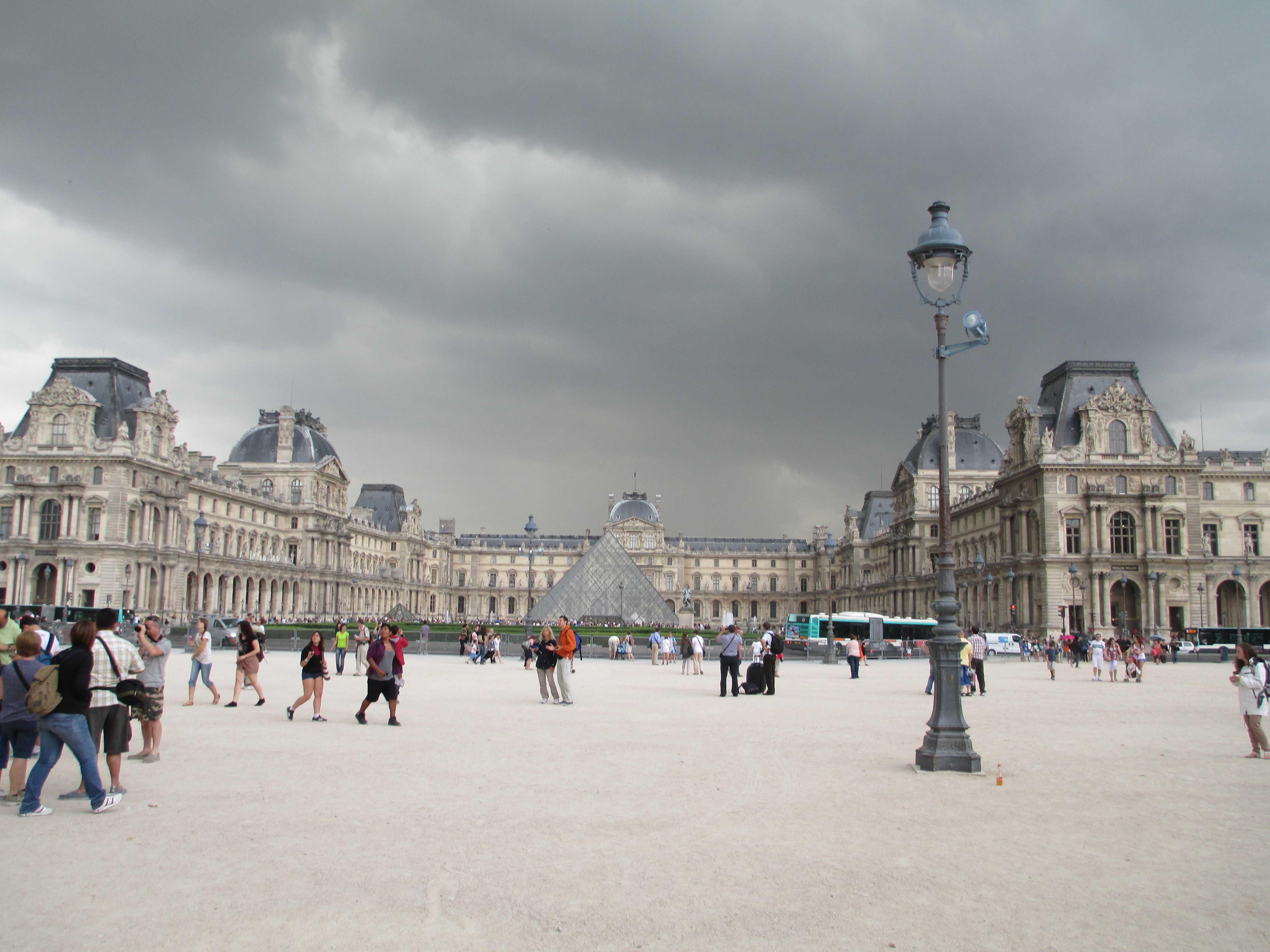
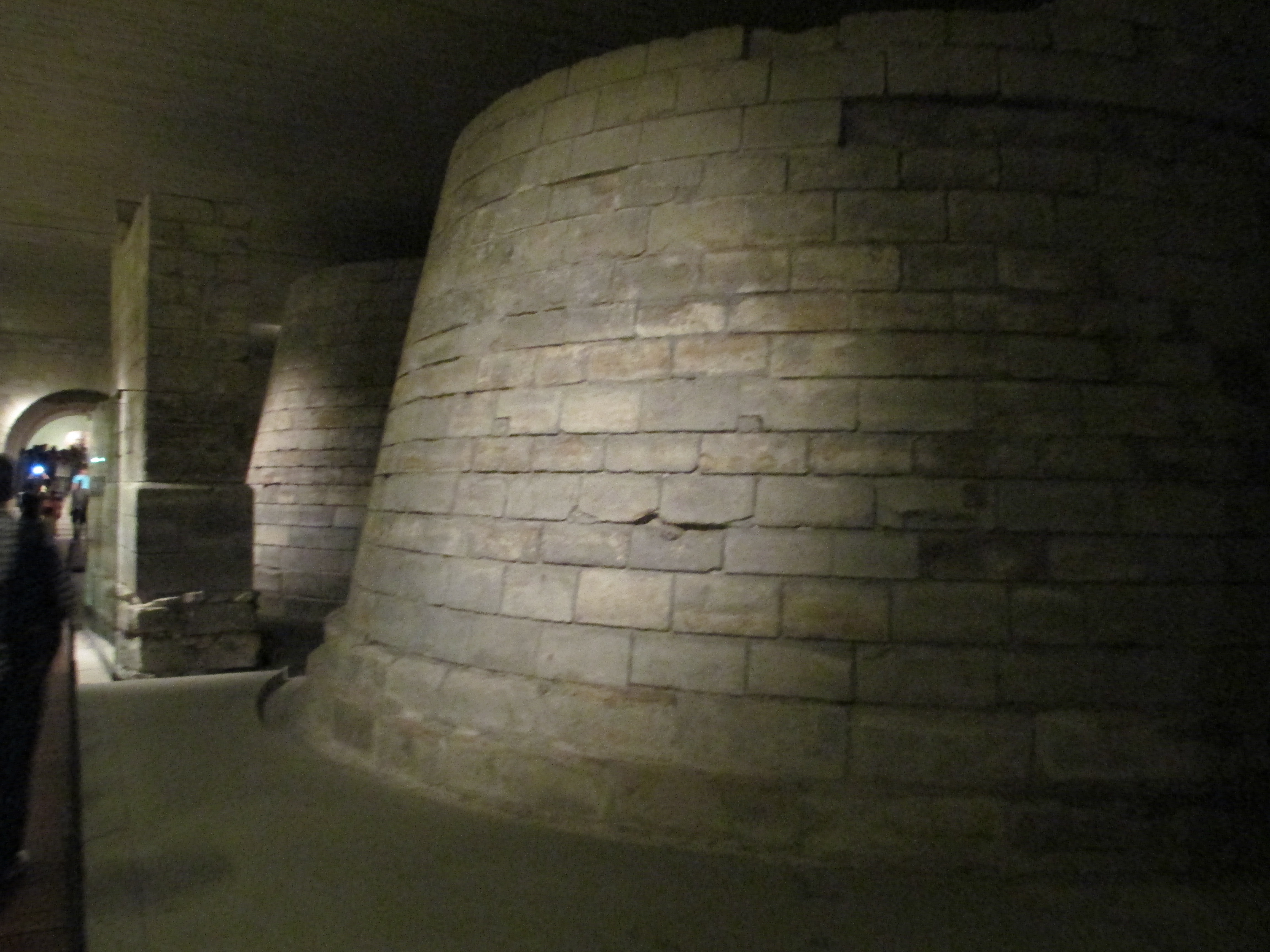
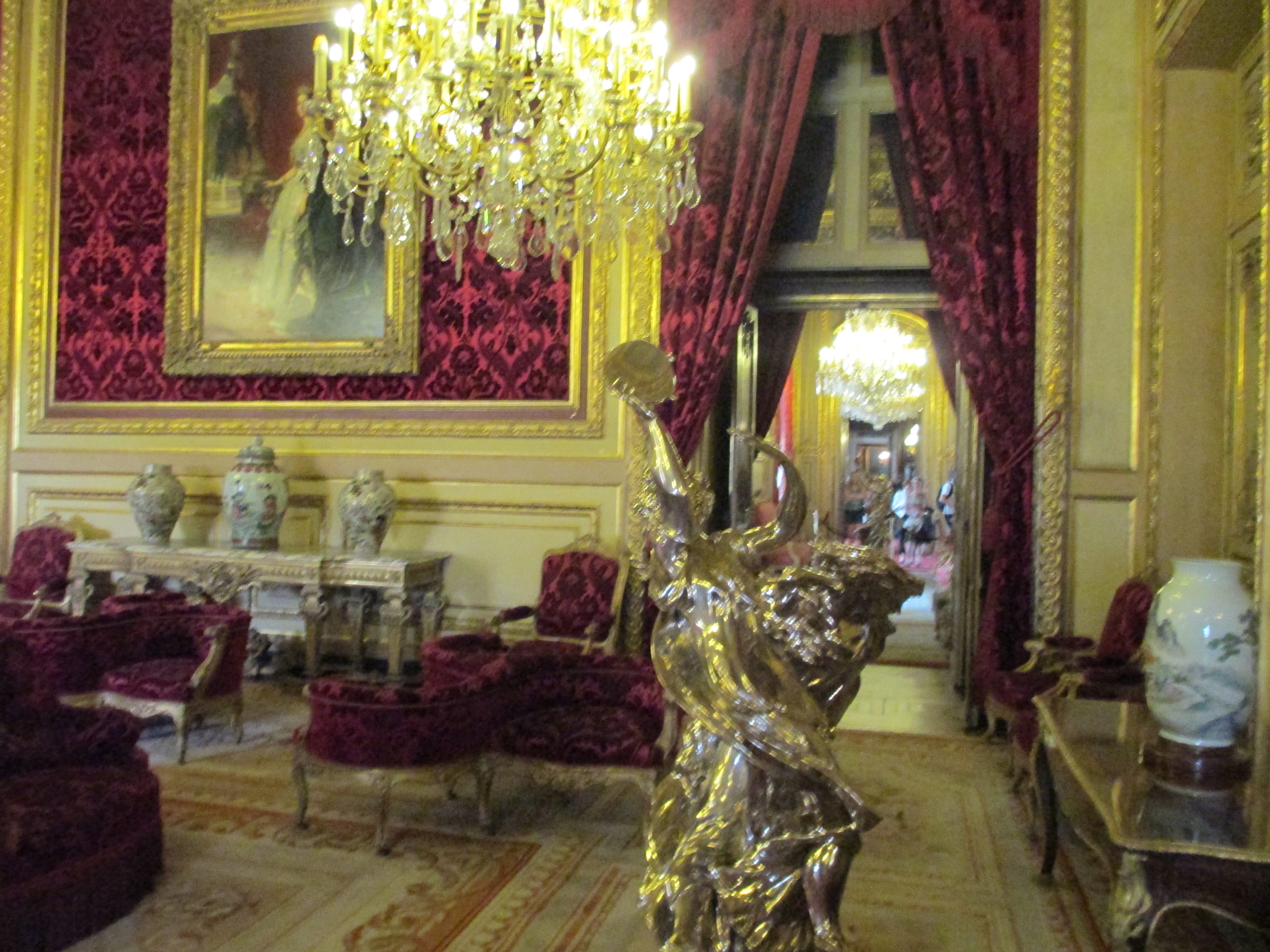
IMG_9103Fontevraud and Foix notwithstanding, probably the best known historic building repurposed for art is The Louvre itself in Paris. IMG_7023It is an ancient palace and castle and now one of the most famous art galleries in the world.  As you can see from its foundations, incidentally one of my favourite parts of The Louvre, it has been there for a long time. In fact it began its life as a fortress commissioned by Phillip Augustus to protect Paris in c. 1190. This fortress was large even for its time, with a keep measuring roughly 15m diameter and 30m in height. IMG_6997Within the Louvre itself you also have the repurposing of rooms, such as Napoleon III’s apartments, for the display of modern art. In this particular case they were integrated to simultaneously blend in with the overt opulence and to reflect it. IMG_6944 IMG_6939 IMG_6937IMG_6929

Historic buildings are not just used for static art. They are also used for performances, such as the Vivaldi concert in the stunning Sainte Chapel you can see below.  Sainte Chapel was commissioned by Louis IX, later Saint Louis, and was originally built to house his collection of holy relics. It is one of the few survivors of the full colour that would have been present in many of the larger churches and cathedrals. It also has one of the largest collections of 13th century stained glass. IMG_7918IMG_7930 IMG_7922

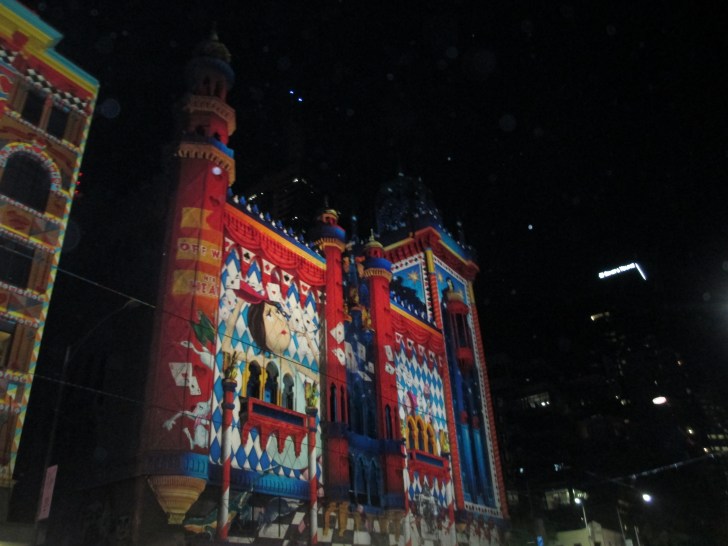
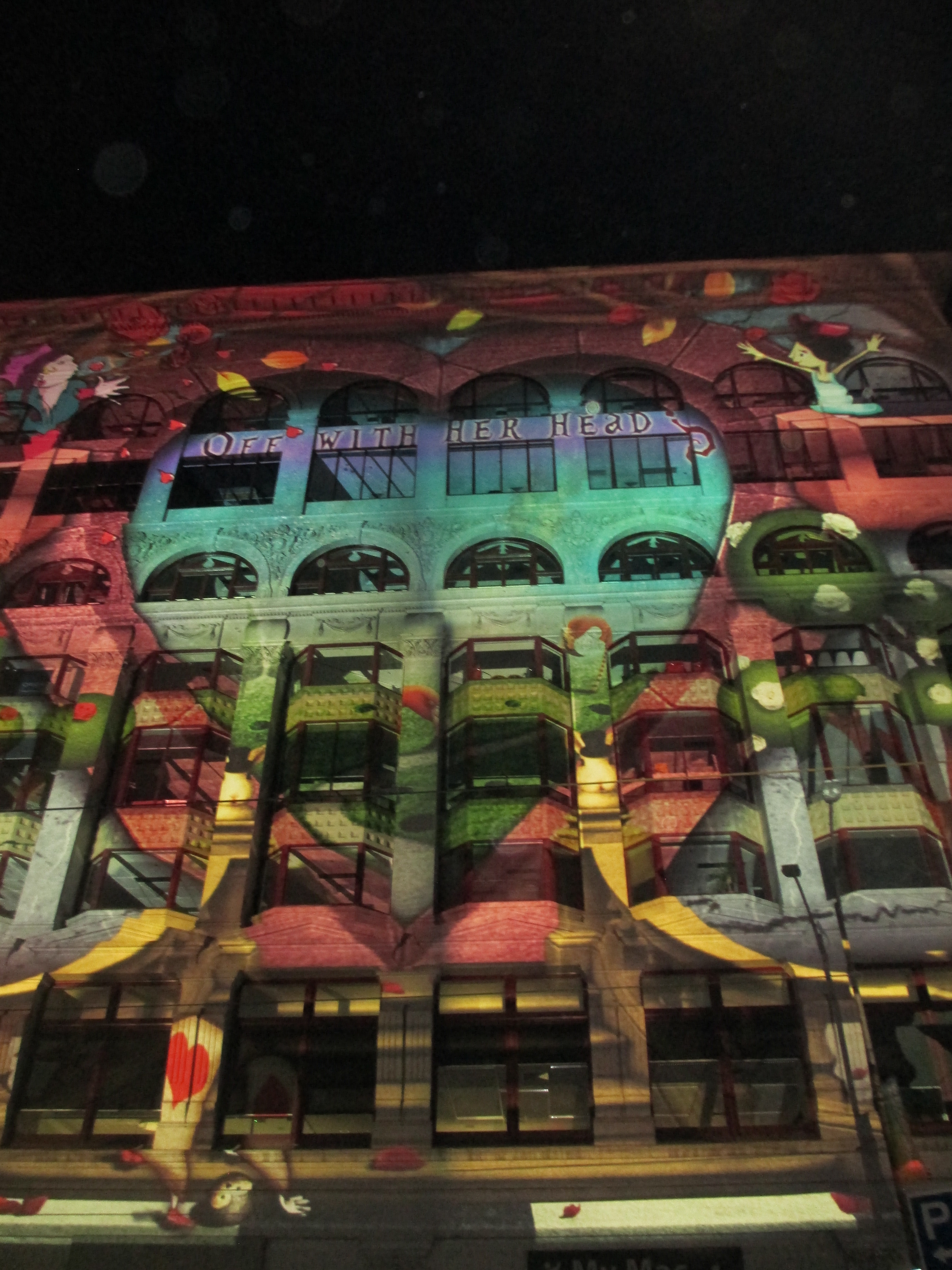
Aside from music and art installations historic buildings are becoming canvasses in their own right. This often happens in festivals such as the recent Melbourne White Night. Melbourne has many historic buildings, by historic in Melbourne I mean 1800s and early 1900s not medieval, and on White Night several come alive with astounding light and sound displays.

The State Library of Victoria is one of my favourite buildings in Melbourne. The SLV has been on its site, though in a smaller building, since it opened in 1856. The founders wanted to create a place of learning for all Victorians and a place to preserve Victoria’s heritage. It is not one building. It is actually made up of 23 individual buildings that have been repurposed and integrated over the years. In the SLV my favourite room is the Latrobe domed reading room which was opened in 1913. The dome itself is 114 feet in diameter and 114 feet high. It is a wonderful place to study or write. During a normal day it looks like this. lobBut on White Night this year, this happened.

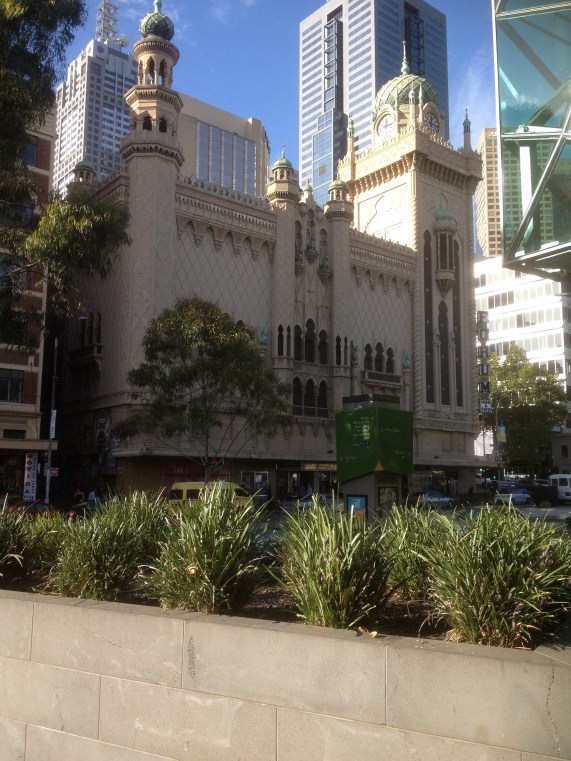
Other buildings were illuminated externally. Such as the Forum Theatre. The Forum opened in 1929 and is slightly insane in its own right even without illumination.  It was built as an immersive theater and the interior has a large number of greek and roman statues as well as a blue sky with stars. This is what is looks like normally.

Interior

IMG_0943Exterior

And this is what it and its surrounding buildings look like when they’re lit up. IMG_1186

IMG_1187IMG_1181IMG_1182 IMG_1183

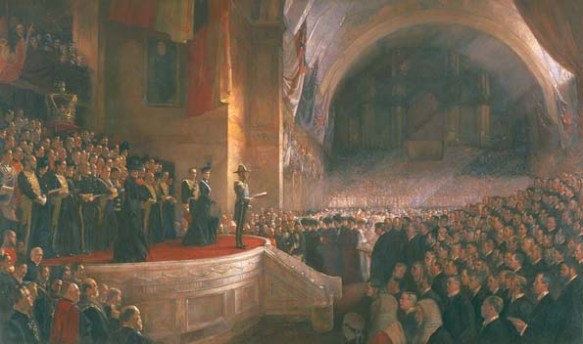
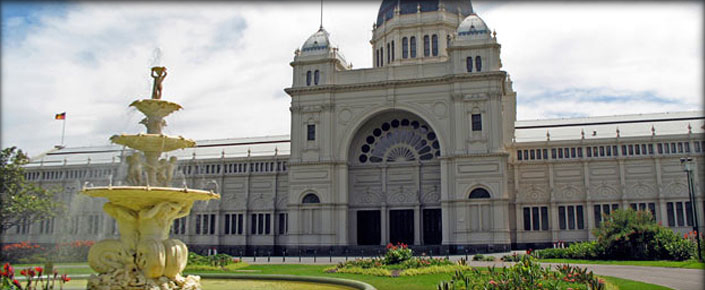
The final building I wanted to look at is in some ways the most spectacular and the most important historically. The Royal Exhibition Building in Carlton Gardens was completed in 1880 for Melbourne’s first international exhibition. It is one of the world’s oldest examples of exhibition pavilions. It was also the site of Australia’s first parliament in 1901.  The Argus described the event as.

The atmosphere was radiant and illuminated the vast spaces of the building and the great sea of faces with a bright Australian glow. A sight never to be forgotten was the assemblage which, in perfect order but with exalted feeling, awaited the arrival of the Duke and Duchess in the great avenues which branch out from beneath the vast dome of the Exhibition Building. (Argus 10 May 1901)

And it was depicted in the famous Tom Roberts painting below.

PA0013

This is what the Exhibition Building looks like during the day, a beautiful example of exhibition architecture. promo-reb-thebuilding

Below is the truly stunning work of moving modern art it became on White Night. Sorry about any talking in the background.

Historic buildings have their own story and their importance and purpose is fundamental to what they are. Integrating modern art allows whole new interpretations of the past, new ways of viewing history and art and the ability to bring these buildings to brand new audiences.

For more information see…

http://museumvictoria.com.au/reb/

http://www.aph.gov.au/Visit_Parliament/Parliament_House_Art_Collection/Tom_Roberts_Big_Picture

http://www.forummelbourne.com.au/history.php

http://www.slv.vic.gov.au/search-discover/history-our-building

http://guides.slv.vic.gov.au/content.php?pid=405532&sid=3319092

http://www.grands-sites-ariege.fr/fr/chateau-de-foix/detail/34/presentation-2

http://www.louvre.fr/en/history-louvre

The photos and videos are all mine apart from:

The inside of the Forum, which can be found at http://www.tripadvisor.com/LocationPhotoDirectLink-g255100-d258068-i46387954-Forum_Melbourne-Melbourne_Victoria.html#85255678

The Exhibition Building which can be found at http://museumvictoria.com.au/reb/

The Tom Roberts painting which can be found at http://www.aph.gov.au/Visit_Parliament/Parliament_House_Art_Collection/Tom_Roberts_Big_Picture

Abelard and Heloise

A very short post for Valentine’s Day. Abelard and Heloise: one of the medieval period’s more interesting couples. I will write about them in more detail at another date. Though I will say that they had a son called Astrolabe.

Just for Valentine’s Day I thought I’d share one of my favourite of their surviving love notes. This is from Heloise to Abelard.

“To his soul, her soul: may we be in one soul for a long time.”

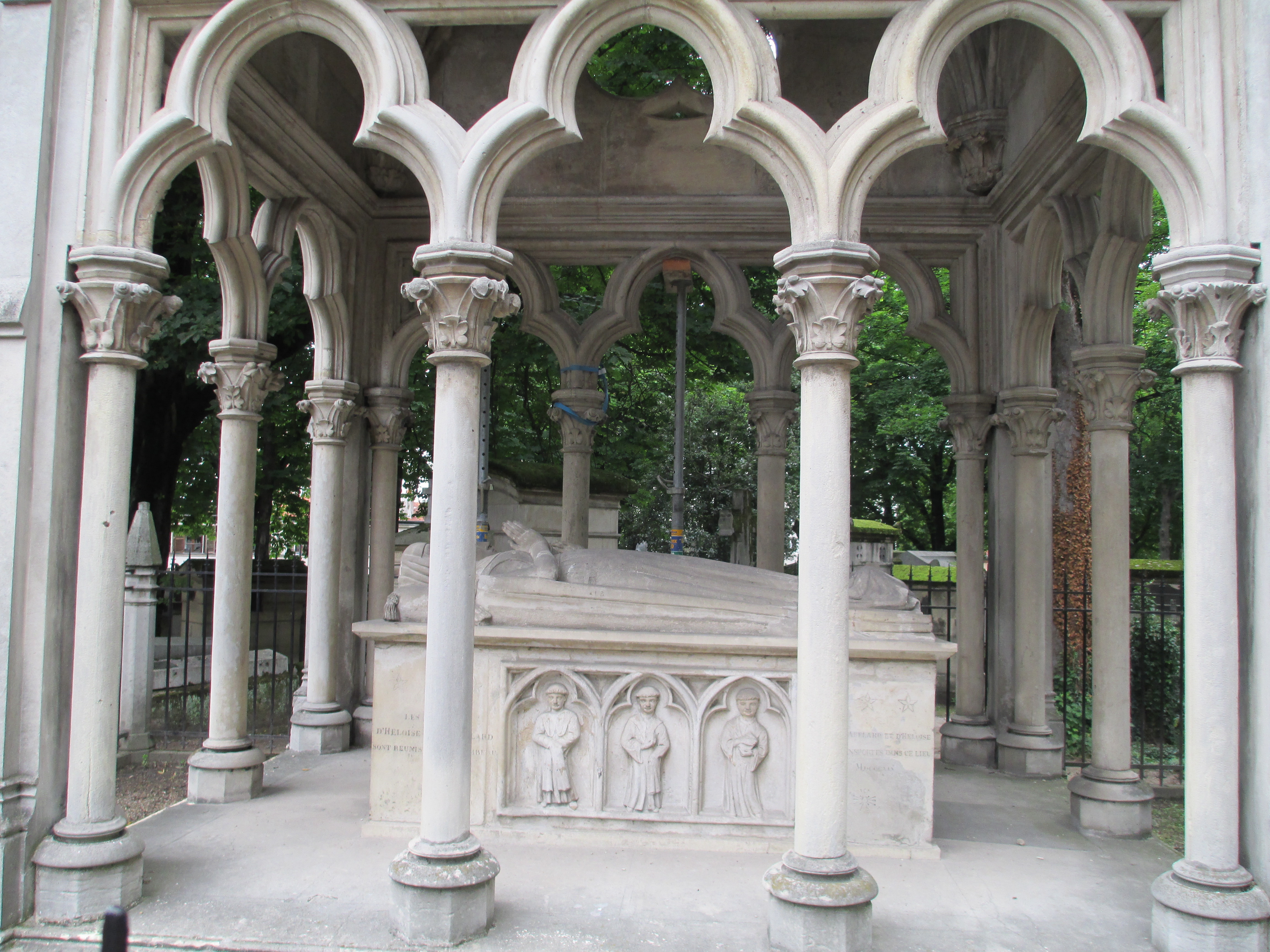
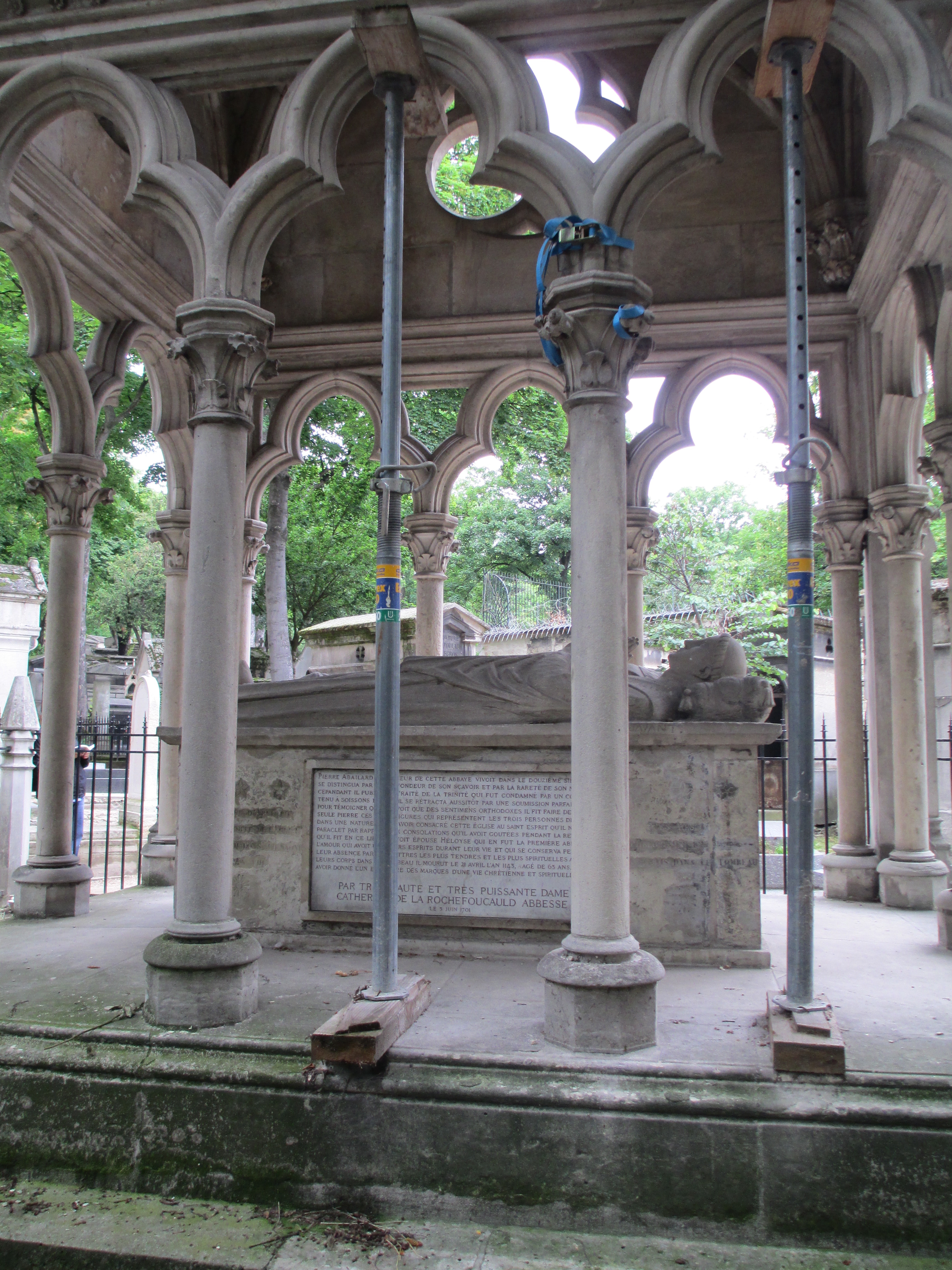
The photos below are their tomb in Pere Lachaise Cemetery in Paris. It is not contemporary.
IMG_7444 IMG_7447 IMG_7450

Fontevraud, Robert d’Arbrissel and Monasticism.

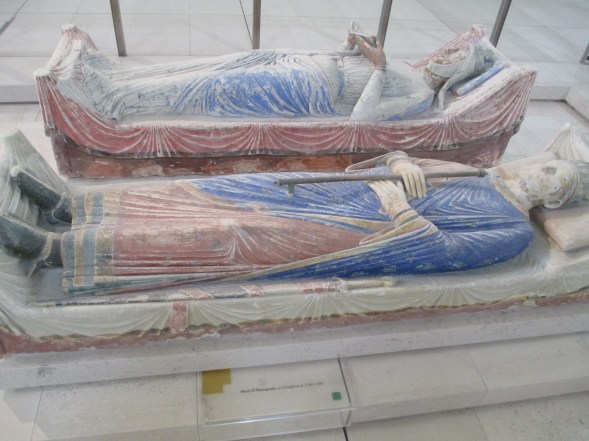
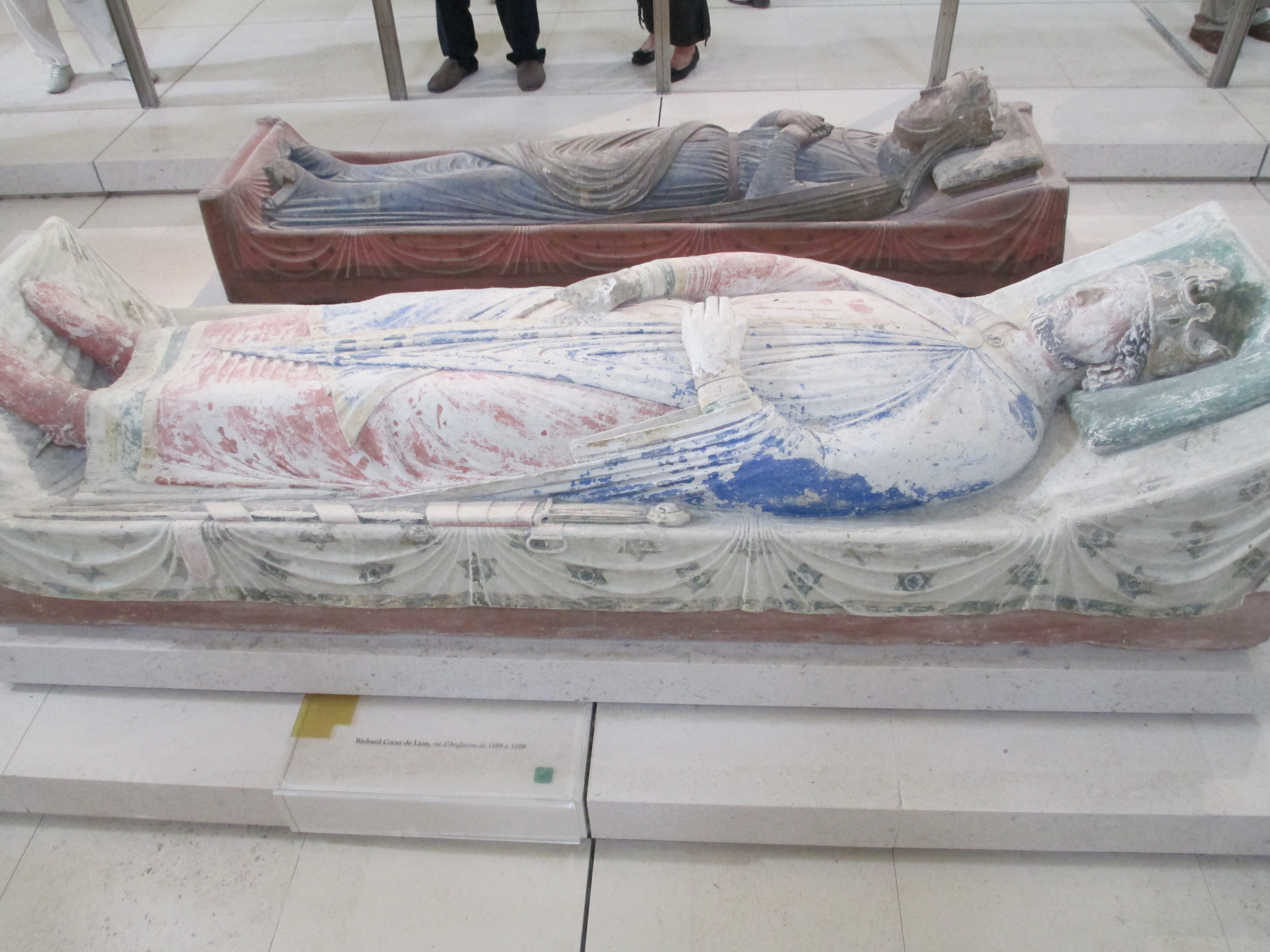
Fontevraud has appeared in some of my other posts because Henry II, Eleanor of Aquitaine, Richard I and Isabelle of Angouleme are buried there.

richard and is

Isabelle of Angouleme and Richard I

henry and eleanor

Henry II and Eleanor

It is, however, an absolutely fascinating place in its own right and one of the most beautiful buildings I’ve ever seen.

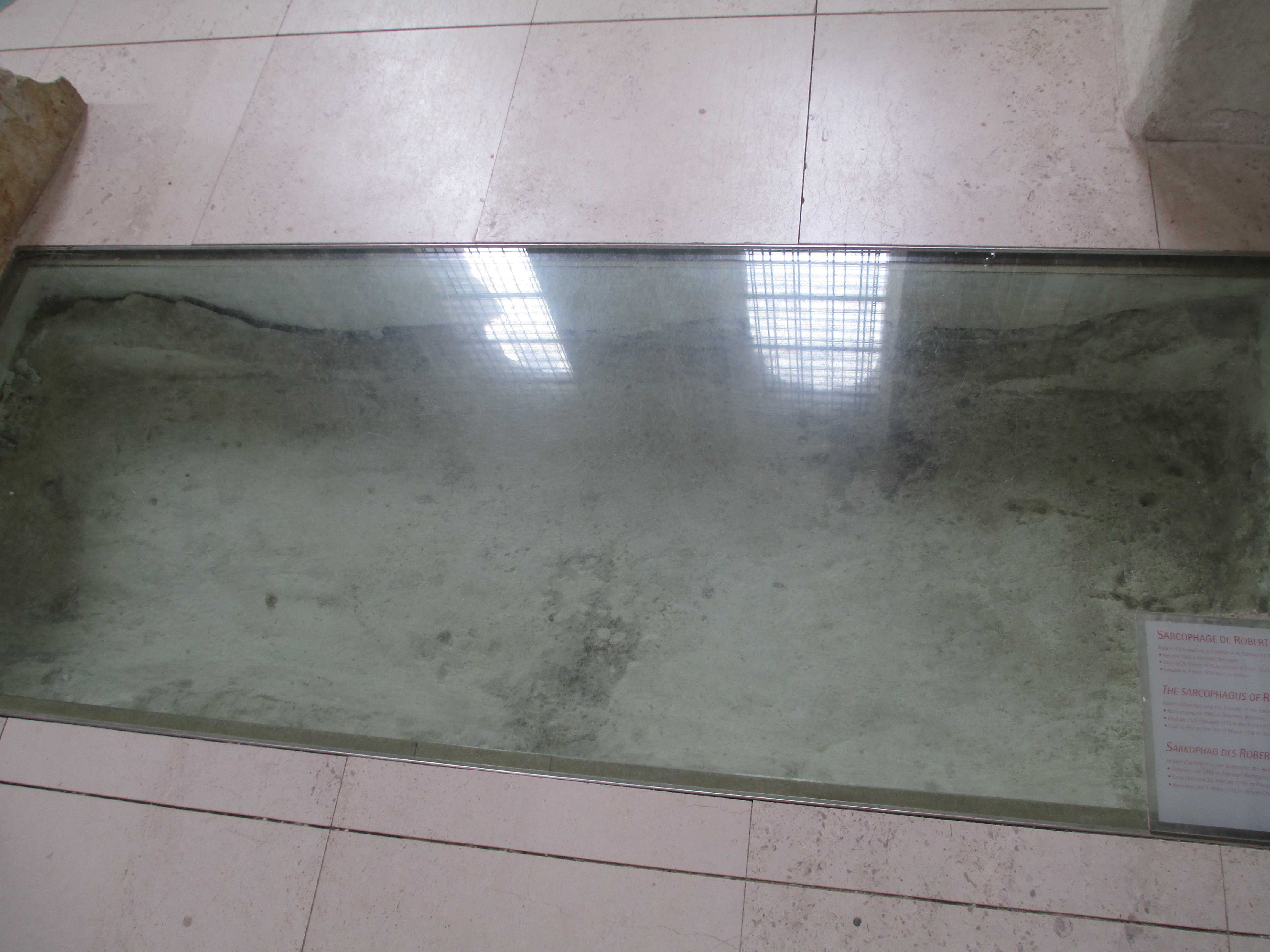
Fontevraud was founded in c. 1101 by Robert d’Arbrissel. The remains of his tomb can be seen below.

robert of A

Robert d’ Arbrissel was an enigma even in his own time. Fulke V of Anjou described him as a thunderclap of holy exhortation which lit up the whole church with its eloquence. Peter Abelard, a fascinating figure in his own right, called him “That outstanding herald of Christ.” But many contemporary churchmen viewed Robert as a danger to his own soul and the souls of his female followers. Robert was everything from a parish priest, to a student, to a hermit, but he has been remembered as the founder of Fontevraud.

Fontevraud was an atypical abbey even for its time because it was founded as a mixed community of men and women and the Abbess ruled over the whole community, male and female. This was exceptionally unusual. The fact that many of Robert’s followers were women was part of the reason he was distrusted, but was also in a way a product of his times. With older men marrying much younger women widowhood was common, but it is clear at Robert’s message and personality attracted not only widows but unhappy wives. Some of his followers were also former clerical wives cast aside in the newer push for chastity amongst the clergy. This was also a time where clerical celibacy was seen to imply a strict separation of men and women in religious life. An ideal that Robert definitively did not share. (Venarde, xi-xxix).

In fact it is quite possible that the majority of Robert’s followers were women. The only piece of surviving spiritual writing from Robert himself is directed to Countess Ermengarde of Brittany who was the sister of Robert’s main patron Count Fulke V of Anjou.

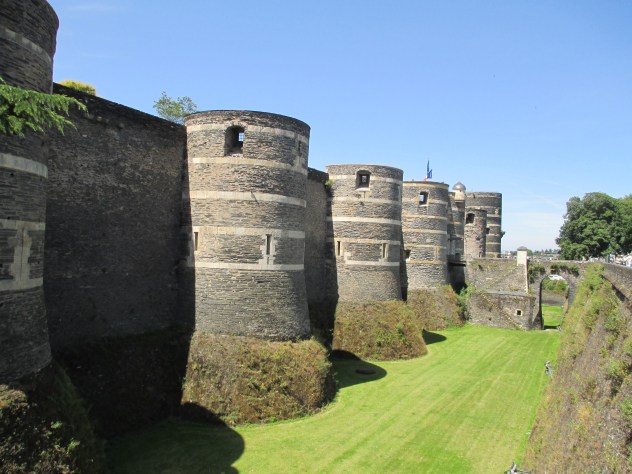
angers

The walls of Chateau d’Angers the home of the Counts of Anjou, though these were built after the time of Count Fulke V.

Ermengarde herself was fascinating. She was the daughter of Fulke the IV of Anjou, engaged but never married to Duke William IX of Aquitaine, the grandfather of Eleanor of Aquitaine, and then the wife of Count Alan IV of Brittany. She was her husband’s regent while he was on crusade from 1096 till 1101. She became dissatisfied with her marriage and attempted to end it through flight and an appeal to an ecclesiastical court, but she failed to get the annulment. It was shortly after this in 1109 that Robert wrote to her. She was described by poet-bishop Marbode of Rennes, who hated Robert, as powerfully eloquent, extremely astute and the glory of Brittany. In later life, after her husband retired to a monastery in 1112, she played an important role in the court of her son before following Bernard of Clairvaux to Burgundy. Bernard himself was an interesting figure, if very strange and in my opinion quite annoying, and I will write more on him in a later post. In Burgundy she became a nun before going with some fellow nuns to the Holy Land where her brother Fulke was King of Jerusalem. She returned to Brittany where she remained active at the court until she died in 1147. The extent of her relationship with Robert is unknown, it is possible that she visited Fontevraud but it can’t be proven. The letter he wrote to her just after she attempted to have her marriage annulled is very interesting.(Venarde, 68-69).

It is too long to go into great detail here, but a basic breakdown is possible.

1. The spirit of pride is bad

2. Do not trust or yield to every spirit

3. Take heart and be strong.

4. Do not regret too much that you are bound to an infidel husband. You can still benefit God’s people.

5. Don’t be too anxious about changes of place and appearance.

6. Fear not enemies of Christ for they will not harm you unless God allows it.

7/8. Do not get puffed up by good fortune or shattered by adversity, for those who fear God want for nothing.

9. Believe, love, hope in God, do good, settle in the land of your heart and feed on its riches.

10. Flee the wicked words of savage men in your heart.

11. Alms and prayer are good if done for God but profit nothing if done for the praise of mankind.

12. Many clerics are hypocrites

13. You can not get out of your own marriage but you should do what you can to get your daughter out her her’s as it consanguineous.

14. Don’t disclose all your plans to all your household and friends, many are self serving.

15. Exercise caution and discretion in all things.

(Venarde, 68-79).

Fontevraud also rose out of a period of change for monasticism in general. There was the beginnings of a shift in the way monasticism was practiced. The Cistercians rose out of a reaction against the interpretation of benedictine monasticism which created great wealth and power for the institutions, not the monks themselves necessarily. The best example of this was the monastery of Cluny which was founded  in 910 and financed by Duke William I of Aquitaine. Cluny created a number of brother and sister houses which answered directly to Cluny. By Robert’s time it had gained exceptional wealth.

musee de moyen age

The Exterior of the Musee du Moyen Age in Paris. Which was originally the Paris townhouse of the Abbots of Cluny.

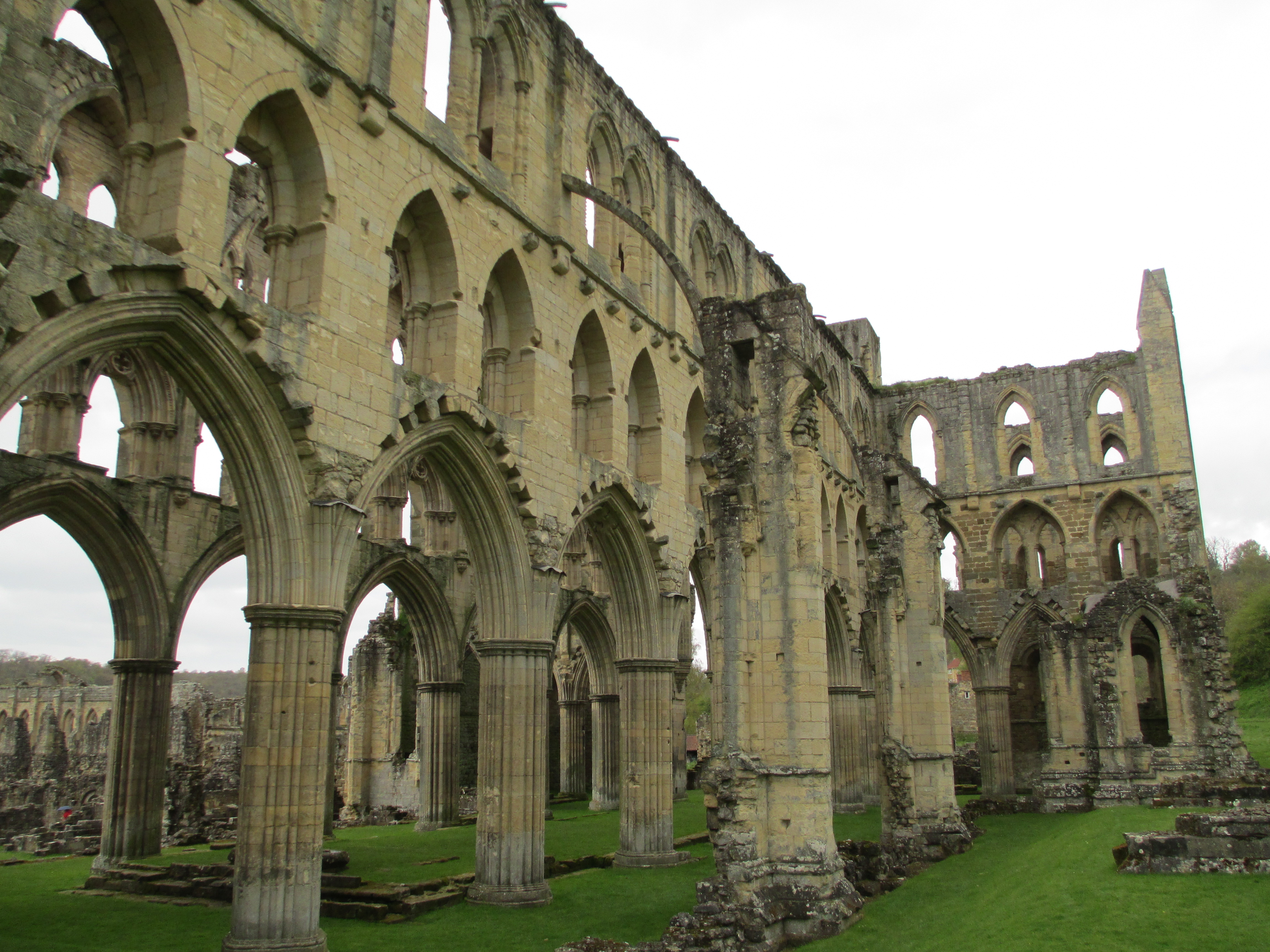
The Cistercians were a reaction against the opulence and focus on wealth that Cluny represented. They favoured a strict adherence to the rule of Benedict and Bernard of Clairvaux was one of the leading lights. The Cistercians wanted to go back to the basics and their monasteries were heavily focused on self sufficiency, simplicity and were often remote and agrarian.

riveauxRiveaux Abbey, a Cistercian abbey in England.

Robert’s Fontevraud was different again. In c. 1101 Robert settled his followers at what would become Fontevraud. Until that point he had been an itinerant preacher, albeit with a significant number of followers including a number of noble women. In fact he departed to continue preaching by c. 1103 having seen the beginning of permanent monastic settlement and appointed two female superiors. However it was not until October 1115 that an Abbess of Fontevraud was appointed after Fontevraud has been recognised by papal authority. Robert’s intentions for this mixed community were never exactly clear, except for working towards spiritual excellence. Despite this when he died on February 25th 1116 and was buried at Fontevraud, Fontevraud and the daughter houses it had established were, as described by Venarde, “Well on the way to becoming the wealthiest order of monasteries for women in Roman Catholic Europe.” (Venarde, xxii).

font outside

The statutes of Fontrevraud are reasonably clear but they don’t conform exactly to specific monastic orders. Sisters and brothers lived and worshipped together. The women were guided by the rule of St Benedict, but the statutes don’t make clear whether the male members are to follow Benedictine or Augustine rule. So they are neither monks nor cannons, they are simply called brothers and Robert makes clear they are in the service of and obedient to the women of Fontevraud. (Venarde, 84-87).

There were a number of interesting women who became Abbesses of Fontevraud, Petronilla the first Abbess being one of them. She was a noble widow who became a follower of Robert’s and he personally appointed her the first Abbess of Fontevraud. Another was Matilda of Anjou. She was abbess from c. 1150 -1158. She is remarkable because if not for one of the most interesting accidents in the medieval period she would have been Queen of England. She was the daughter of Fulke the V of Anjou, the brother of Ermengarde and patron of Robert, but she was married to William the only legitimate son of Henry I. William drowned on the White Ship in 1120 along with much of the young nobility of England and France. Matilda could have remained at court and she did for a time. Henry I was more than happy to have her and he would have married her off again. In the end though she took vows at Fontevraud in c. 1128 and became Abbess there in c. 1150.

Many of the early Plantagenets were patrons of Fontevraud, as evidenced by the fact that four of the them are buried there. Indeed Eleanor of Aquitaine spent her last years there and died there in the 1204. She was a great patron of Fontevraud throughout her life. One of her surviving charters is evidence of her patronage. In this charter she gives the abbey and the “nuns serving God there” the “rent of one hundred pounds, in perpetual alms, from the provosture of Poitiers and the vineyard of Benon, particularly what is received from Marcilly.” (Epistolae).

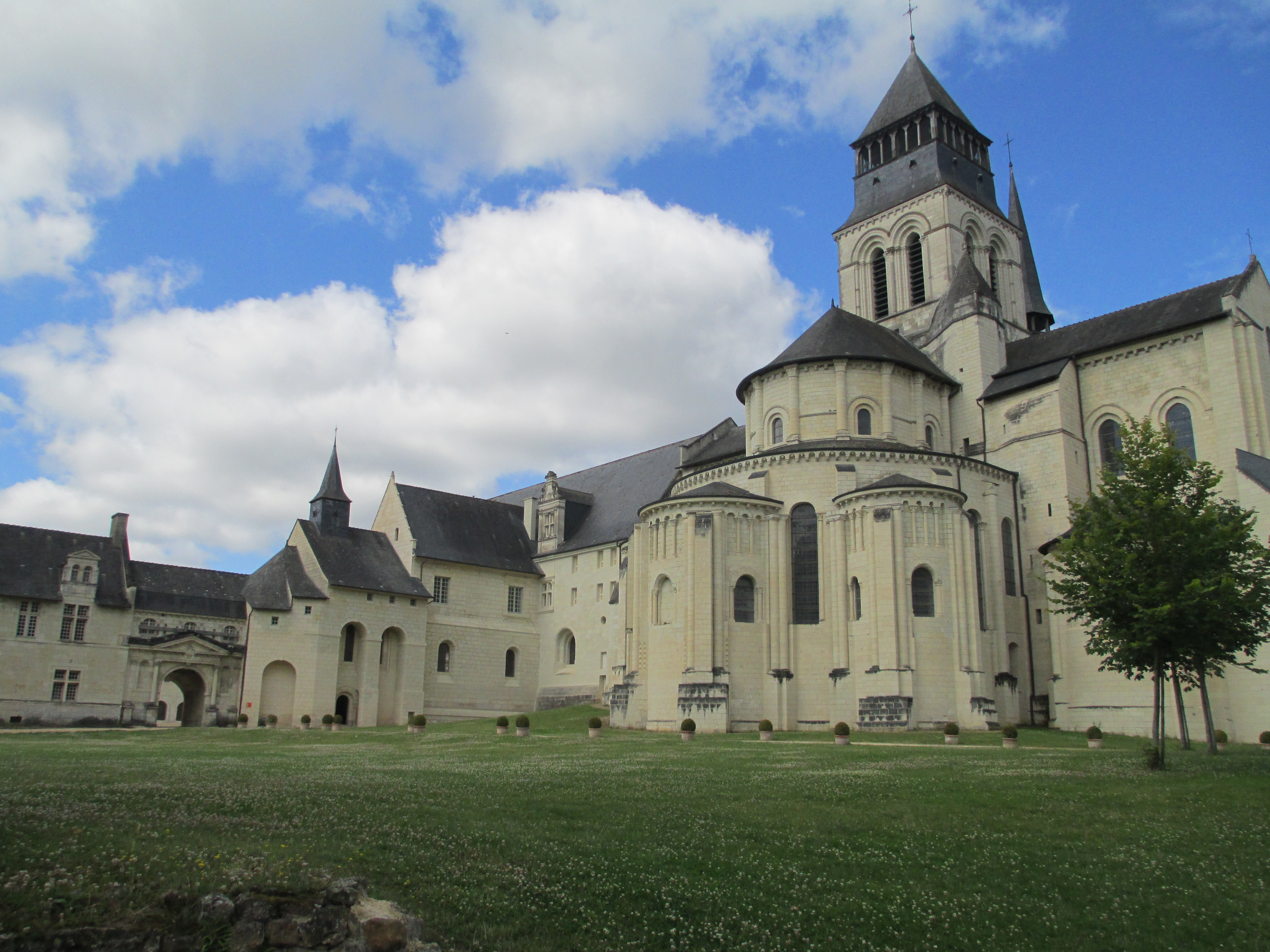
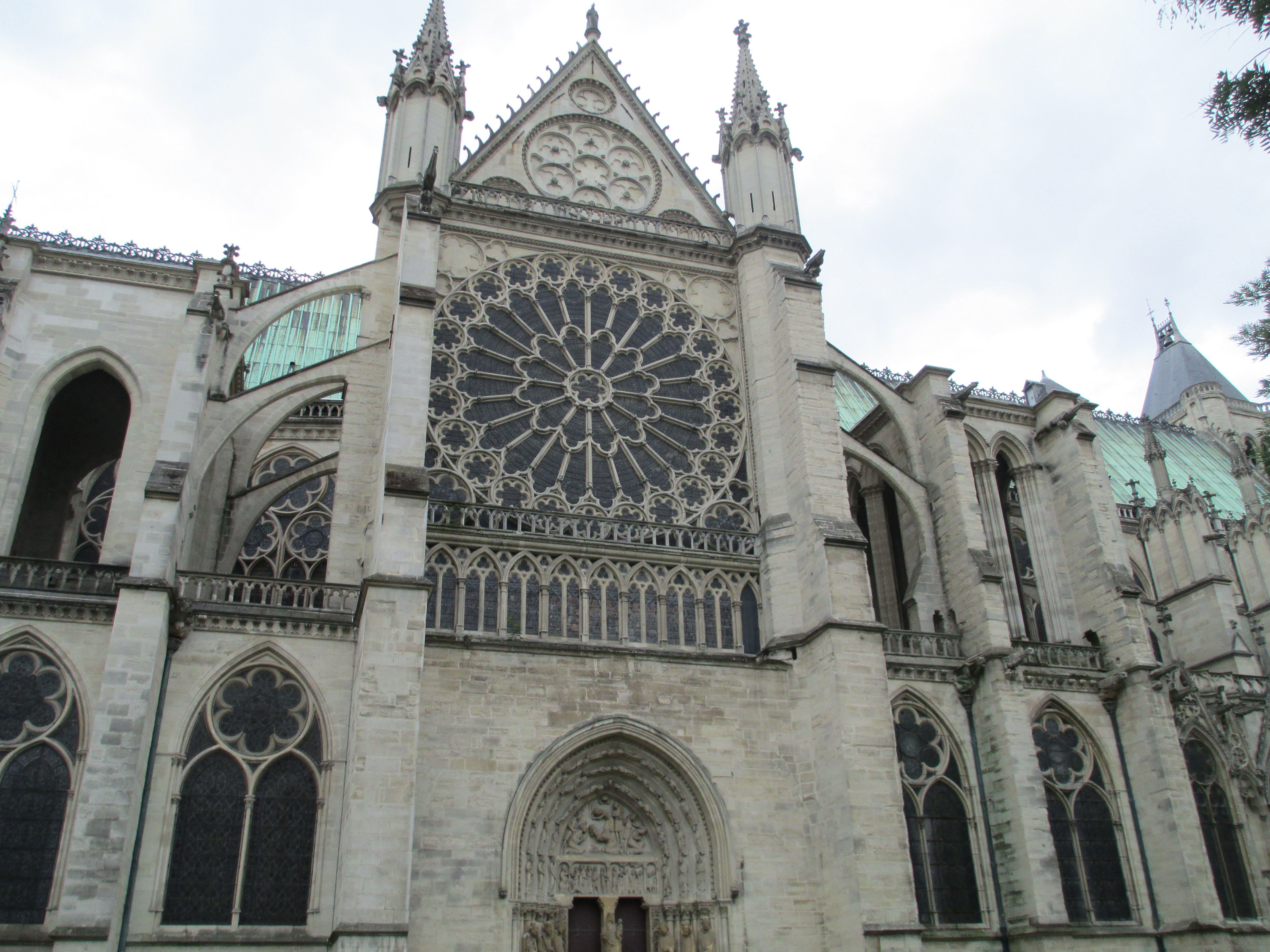
Fontevraud as a complex of buildings has gone through many changes since it was built. The church was begun to hold the body of Robert and is Romanesque in style with a Byzantine influence. It dates from successive periods in the 1100s. You can see the interior below.

roof font main hallside chapel

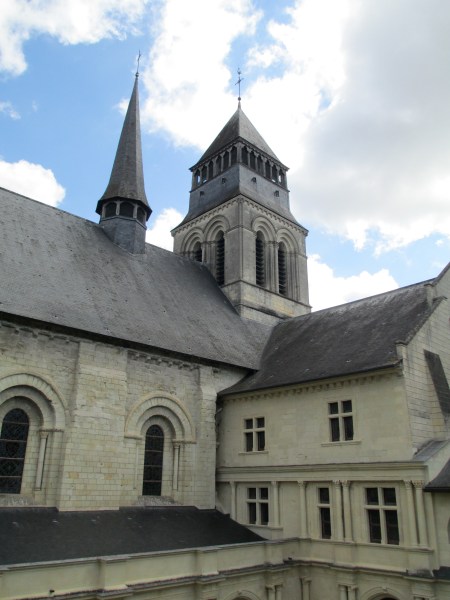
You can see the spectacular grandeur of Fontevraud’s exterior built in the beautiful creamy local tuffeau stone in the photos below.

IMGFont church est_8136 Font long

When it was built much of the interior would have been painted.  Some of the early paint remains in fragmented sections.

Font paint

Some of the later paintings can be seen in more detail. As can be seen in the  chapter house photo below, which was painted and remodelled in the 16th century to show the wealth and prestige of King Francis I.

font side chapel painting

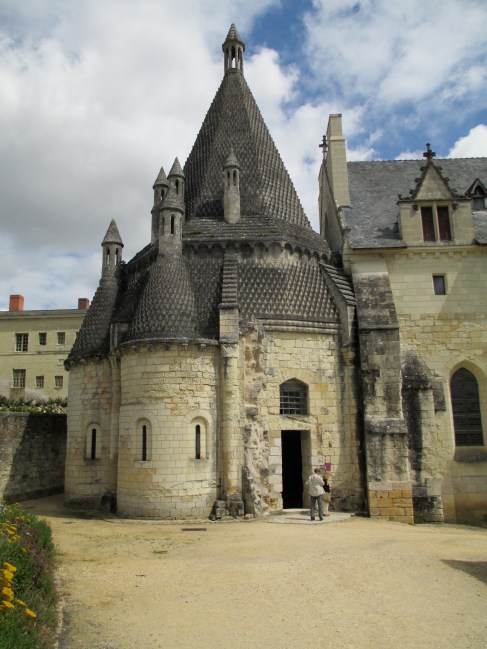
 Probably my favourite of all the buildings is the kitchen. It  dates to the early 1100s though it has been remodelled. It is built of the more heat resistant charente stone. It is also built in the Byzantine Romanesque style brought back from the crusades.

font kitchen from back

font kitchen

The interior is constructed so one embrasure was used to make hot coals and the meals were cooked in the embrasures away from the prevailing wind to prevent the blowback of smoke. The central chimney got rid of both smoke and vapours.

font kitcehn inside font kitchen inside

The fact that anything of Fontevraud survives at all is really saying something because it was deconsecrated in the revolution and  Napoleon decided to use it as a prison in 1804 and it remained one for a long time. In fact the last prisoners left in 1985.  The abbey was completely restored in the 20th century and now is also used for a variety of art installations such as the two that can be seen below. The first was in the dormitories and the second was in the cloister and could be walked on, giving you different perspectives of an ancient building.

Font Dorm

Font art

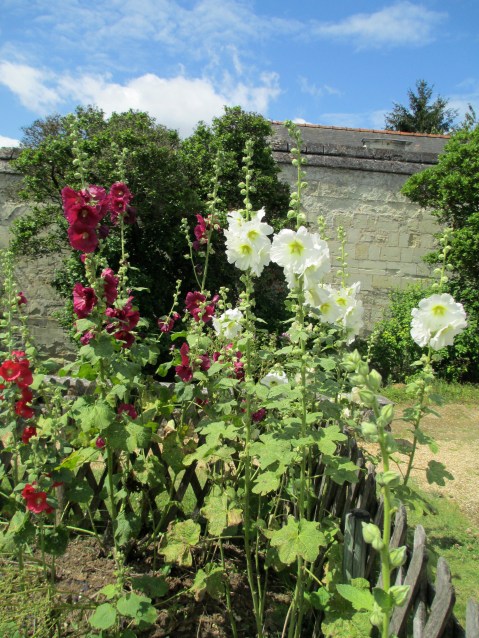
The gardens are also absolutely worth visiting.

font gardensfont gardens2
Font garden

It is a truly beautiful place with a fascinating history. A place where the calm seems to have seeped into the stone.font cloisterI went to Fontevraud so I could see Eleanor of Aquitaine’s tomb but it is much more than that. It is truly one of the most incredible places I have ever been.

font back

Bruce L. Venarde. Robert of Arbrissel. ISBN: 9780813213545.

Eleanor of Aquitaine Charter to Fontevrault, 1185 at http://epistolae.ccnmtl.columbia.edu/letter/885.html, accessed 26/9/2010.

Other sources include the signs at Fontevraud, and my university course notes on monasticism.

The photos are all mine.

Marriage Alliances 1180-1250: Part 4 Isabel de Clare.

One of the most interesting heiresses of the period, not in the least because she was married to William Marshal, was Isabel de Clare. Isabel’s marriage to Marshal typified the incredibly important political role that the marriage of these heiresses played. These marriages were not only used as rewards, they were used to elevate men to real positions of power. In some occasions these men could help to change the face of a country, I would argue that Marshal was one of these and his marriage to Isabel was what gave him the status to have a real political affect.

Isabel herself is a little hard to pin down. In essentials she was the perfect medieval wife possessing of great fortune and very fecund, they had ten children, but she makes her own mark in a variety of interesting ways. While the History of William Marshal can not be taken entirely at face value the sentiment that is expressed throughout the work is that Isabel was actively involved in the rule of domains that were essentially hers.

marriage of aoife and storngbow

The marriage of Marshal and Isabel de Clare as depicted in the modern  Ros tapestry in New Ross in Ireland.

Marshal’s marriage to Isabel de Clare was the most significant elevation in his life. The lands that he gained, the children that he had from the marriage and the qualities of Isabel herself were the building blocks on which Marshal’s status was established. Marriage to Isabel gave Marshal substantial and geographically diverse lands as well as titles and wealth. In comparison, materially, Marshal brought little to the marriage because he was a virtually landless knight who only had one small estate in England and probably the rents of some lands in France. He had amassed considerable wealth however from his prowess on tourney field and he was known and respected by King Richard. Isabel gave Marshal lands in England, Ireland, Wales and what is now France and these lands gave Marshal both wealth and authority.[1]  Marshal’s marriage to Isabel mean that he made an indelible mark on her lands, not the least in Ireland. The affect Marshal had on these Irish lands illustrates just how much political change the marriage of an heiress could generate.

medieval irelandjpeg


Ireland under the Normans. You can see Leinster, Marshal’s lands, on the right.

David Carpenter, The Struggle for Mastery: Britain 1066-1284, London: Penguin Books, 2004, p. xx.

 Isabel’s Irish lands came to her from her father Earl Richard de Clare, known as Strongbow, who had gained them by force, and through her mother Aoife, the daughter and heiress of King Dermot MacMurchada of Leinster who was deposed as king in 1166.[1] Strongbow was a leader in a force spearheaded by English lords who won Leinster back for King Dermot. They were given permission to do so by their king Henry II in a letter recorded by Giraldus Cambrensis c. 1166. This was the beginning of the English occupation in Ireland.[2] The rewards Dermot gave Strongbow in return for his services were recorded in the relatively contemporary poem The Song of Dermot and the Earl: his daughter Aoife in marriage and his kingdom after his death. Dermot died in 1171.[3]


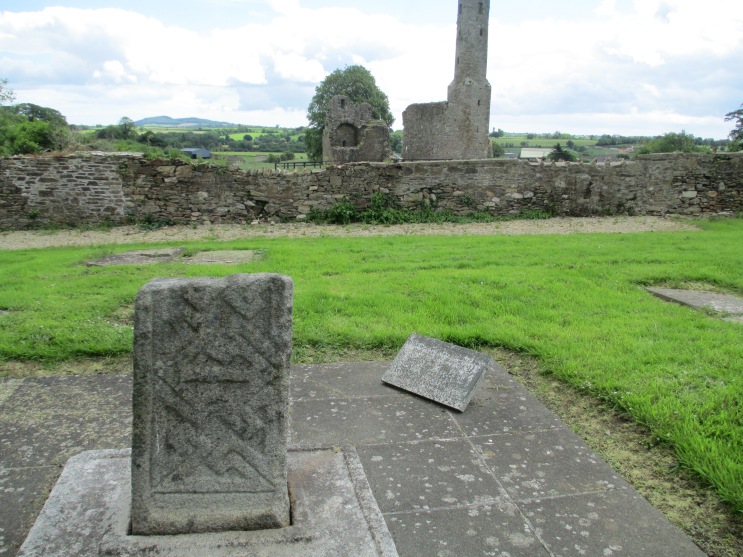
Diarmut grave


Dermot’s grave in Ferns, Ireland.

Strongbow died in 1176 leaving a son and daughter too young to inherit and so Leinster was in the hands of the Crown until Strongbow’s son came of age. The son, Gilbert, died as a minor in 1185 and thus Isabel de Clare inherited everything. Marshal on marrying Isabel gained lordship of her entire estate.[4] Trouble could be expected from the local Irish population who were not likely to welcome a new overlord. These peoples included the English lords who had been settled there for more than a decade and the original Irish lords. Marshal faced an uphill challenge in controlling and developing Leinster and it was one at which he certainly succeeded

On taking possession of Leinster Marshal sent deputies but did not go himself until c. 1201, and then only for a brief visit. The Irish Annals found in The Chartularies of St Mary’s Abbey in Dublin recorded that Marshal was in Ireland c. 1201.

st mary's dublin

All that remains of St Mary’s Abbey in Dublin.

They said that he came in a storm and, in thanks to God for his survival on the unforgiving Irish Sea, he founded the abbey of Tintern Parva.[5]

tintern parva

Tintern Parva on the Hook Head Peninsula in Ireland.

ship on the way to ireland

Depiction of the near disaster on the Irish Sea from the Ros Tapestry.

Marshal returned to Ireland in c. 1207 and faced rebellion, mainly from Meyler Fitz Henry. Fitz Henry was one of the original settlers, a bastard grandson of Henry I and had been appointed Justiciar of Ireland, ruler in the king’s absence, by King John. He was tenant in chief of some small fiefs, most of which he held from Marshal. Fitz Henry and Marshal were in repeated conflict and King John involved himself in Fitz Henry’s favour. Fitz Henry led many battles against Marshal’s lands both when Marshal was in Ireland and when he was not.[6] As can be seen in two charters from King John in 1216 Marshal ultimately managed to prevail and found his way back to John’s favour with Fitz Henry disgraced. The first granted Marshal Fitz Henry’s fees, a form of rent or tax, in Marshal’s own lands. The second said that if Fitz Henry should die or take the habit Marshal was to receive Fitz Henry’s fees in the Justicary’s jurisdiction, which effectively disinherited Fitz Henry’s son.[7]

As well as exercising control Marshal was responsible for developments such as the port town of New Ross. Marshal began New Ross, which still exists today, in c. 1207.[8] Once it was established, Marshal set about making it a viable port town. When he was back in favour with King John, c. 1212, Marshal negotiated to ensure that shipping could continue through Waterford and onto New Ross. Waterford was the main port and the Crown had controlled it since 1171.[9] Marshal needed his own port and New Ross suited well because of its deep harbour, river access to the heart of Leinster and links with nearby lordships.[10]

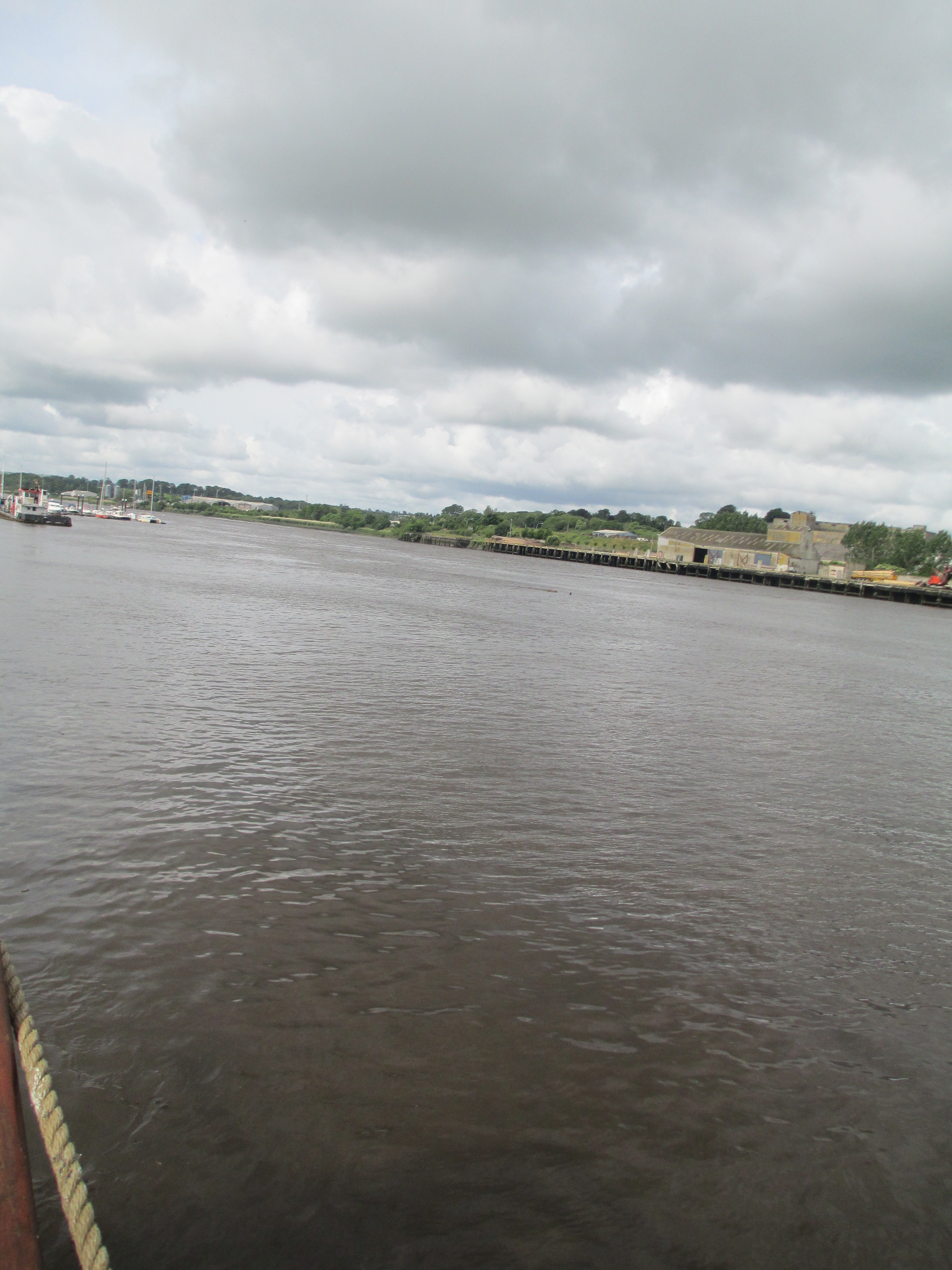
river new ross

 The Barrow river in New Ross.

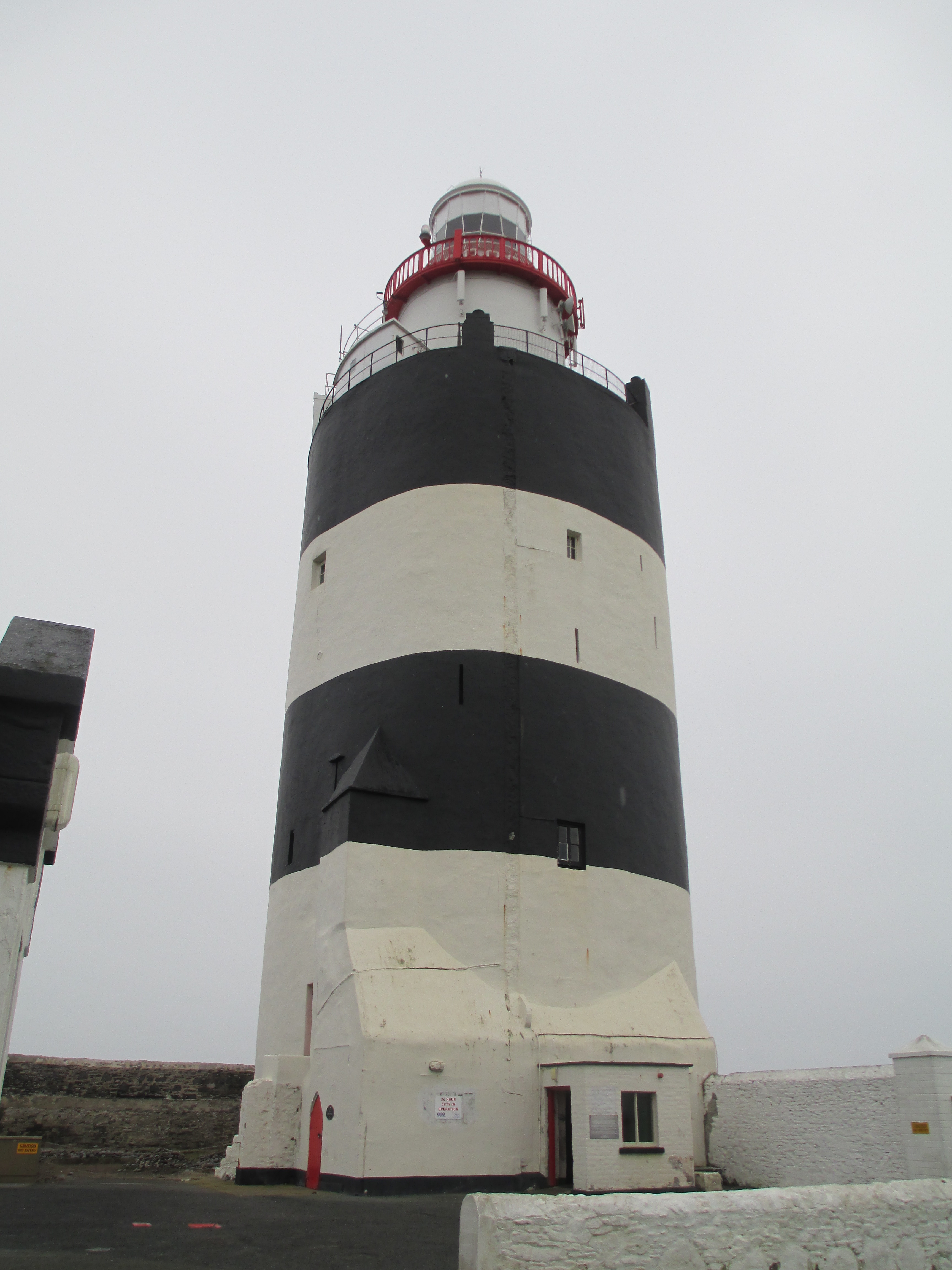
New Ross is only one of the building and consolidation projects that Marshal undertook in his Irish lands during his lordship. He established other towns and also built a number of castles. He made settlements on the edges of nearby counties, retook land that had been previously lost and established monastic foundations and built a lighthouse which still stands today.

lighthouse

 Marshal’s lighthouse on the Hook Head Peninsula.

ferns castle irland

Ferns Castle which Marshal also built.

Marshal also took over lands that had lacked any kind of central authority because the Crown had run them for many years from a distance.[11] Marshal managed to establish a strong and stable lordship, despite the fact that he was so caught up in English affairs. This administrative skill ensured that he maintained his position as Lord of Leinster, as well as his other lands, and that he was sufficiently influential and experienced to become first the Earl of Pembroke, a title which he came to through right of Isabel, under King John in 1199 and then Regent in 1216.

IMG_5435

Pembroke Castle in Wales.

When Marshal married Isabel de Clare he became one of the most influential barons of his time because the marriage laws meant he became ruler of everything that was hers. When it came to marriage, a woman’s lineage, her family and connections, were as important as her lands. In Marshal’s case through Isabel he gained the physical lands themselves but also the eminence of her background as the daughter of an earl and the granddaughter of a King of Ireland.

Lineage and land were not all that Marshal gained from his marriage because the couple also had ten children, five sons and five daughters, all of who survived to adulthood.[12] All five daughters married influential and high ranking noblemen and only the youngest, Joan Marshal, was unmarried when her father died.[13] This gave Marshal alliances in a variety of noble families, another use for heiresses, and helped to give him the support he needed to stay in power even when he was out of favour with King John. It is due to his eldest son William that his memory survives today in such detail because it was he who commissioned the History. Marshal achieved what eluded many prominent landholders of his time because he had five sons thus having multiple heirs. When Marshal died his authority and legacy seemed safe and his position solidified, which must have made reaching the top of his society seem worthwhile because he had been able to protect all his family and to pass on what he created secure in the knowledge of its survival. Success in this time was intended to be dynastic rather than just personal. Unfortunately this was not to come to pass because, although Marshal never knew it, his sons all died childless and his lands were dispersed.[14]


Chepstow Castle Wales

Chepstow Castle which Marshal gained from marriage to Isabel. He also built significant proportions of it.

Children, lineage and land aside, Isabel as a person and the role she played in the marriage and thus in Marshal’s ascent is much harder to define but just as vital and fortuitous. Isabel came to the marriage probably in her late teens while Marshal was in his early forties. Despite the age difference by all accounts she was an active participant in the marriage and in the governing of the lands. If she had not been it is unlikely that Marshal would have succeeded so well in holding together his disparate domains. She was not only his entrée into the high aristocracy, but her support was important to the retention of his authority. There may have been no legal repercussions if Isabel had not supported Marshal, but the people he ruled were her vassals and would have been more likely to rebel against their new untried lord without Isabel’s support.

Marshal trusted Isabel and her abilities enough to leave her in an administrative position in Ireland c.1207 during the fragile military and political situation, when King John forced him back to England. Before returning to England in c. 1207 the History reports that he said to his men.

My Lords, here you see the countess whom I have brought here by the hand into your presence. She is your lady by birth, the daughter of the earl who graciously, in his generosity, enfieffed you all, once he had conquered the land. She stays behind here with you as a pregnant woman. Until such time as God brings me back here, I ask you all to give her unreservedly the protection she deserves by birthright, for she is your lady, as we well know; I have no claim to anything here save through her.[15]

While it is very unlikely that he spoke these exact words the sentiment is clear. Isabel was Marshal’s key to ruling.

Isabel was a potent symbol to Leinster. She was the daughter of the Princess of Leinster and the granddaughter of its last king, which would have pleased the Irish lords. She was the daughter of Richard Strongbow who had been responsible for establishing many of current English lords, or at the least their fathers, in their lands in Leinster and because she was pregnant she represented the future of the lordship. By leaving her behind Marshal had a reasonable chance that many of his lords would cleave to her and thus his cause, which would leave him free to deal with King John.

Isabel proved a very able defender of Marshal and their lands in Ireland. Almost as soon as Marshal left, she found herself embroiled in war and by 1208 she was besieged in Kilkenny castle and “she had a man let down over the battlements to go and tell John of Earley that it was the very truth that she was besieged in Kilkenny.”[16] John of Earley came and Isabel’s men were victorious. It was also Isabel with whom Meyler Fitz Henry first made peace and it was recorded in History that “he [Fitz Henry] had made peace first with the countess and then with the earl’s men, and … he had given his son Henry as a hostage for his inheritance.”[17] Isabel was very much in command of the defence of her lands even if she could not physically lead men. Isabel was a unifying figure because of her lineage and without her presence in Ireland and her willing participation Marshal could have easily lost Ireland while he was trapped at John’s court.

kilkenny

 Kilkenny Castle as it is today.

Defending her lands was not Isabel’s only involvement because she was also engaged in their creation and improvement. Marshal took the fact that his only claim to the lands was through Isabel very seriously because he made many developments in Leinster with charters that had Isabel’s ‘counsel and consent’ recorded on them.[18] According to Cóilín Ó Drisceoil there is a tradition that Isabel had been heavily involved with making the decision to locate the foundation of the town of New Ross on the Wexford bank of the Barrow River. This was not necessarily the most practical bank on which to build a town, as it was steep and required the building of one of the longest bridges in medieval Ireland. It was perfect however from a political point of view because Wexford was the centre of the former Kingdom of Leinster.[19] The earliest written mention of the tradition of Isabel’s involvement in New Ross’s foundation was in the 1607 work Britannia by William Camden.[20] Isabel understood the political imperatives in building a new city and made sure that they were carried out correctly. She also helped to ensure that Marshal remained lord of all their other lands as well because unlike other noble wives she commonly travelled with him throughout their domains and was involved in their governance. She was the symbol by which Marshal governed as well as an active participant.

st mary's New ross

 St Mary’s Abbey which Marshal and Isabel built in New Ross.

Marshal and Isabel’s match seems to have become one of love. This was exemplified by the way Isabel behaved during and after Marshal’s prolonged death. Marshal first began to fall ill around the end of January 1219 and it took him until midday on May 14th 1219 to actually die.[21] A very moving picture of Isabel just after his death was painted in History “whilst mass was being sung it was observed that the countess could not walk without danger of coming to grief, for her heart, body, her head and limbs had suffered from her exertions, her weeping and her vigils.”[22] This was a final testament to a woman who had stood strongly by Marshal throughout much of his life and his protracted death and had continued to love him. Isabel died only a year later and was buried at Tintern Abbey in Wales.

temple churchIMG_3419

The Temple Church in London where Marshal was burried and his effergy.

tinturn abbey

Tintern Abbey in Wales where Isabel was burried, no trace of her burial remains.

Marshal was given Isabel as a reward and as a way of binding a skilled warrior and an admired man to the new King Richard I in 1189. The authority bestowed on him by this land and the wealth he acquired through marriage meant that he had the ability to make an indelible mark on England. When King John died in 1216 he left a country in turmoil with many of the country’s barons in rebellion. The then approximately 70 year old Marshal was made Regent for the nine year old Henry III and under his direction the country was brought back from the brink and Henry III’s kingship saved. The situation was dire enough to prompt Marshal to declare, according to the History, when he assumed the Regency that “if all the world deserted the young boy, except me, do you know what I would do? I would carry him on my shoulders and walk with him thus,” “ and never let him down from island to island, from land to land.” [23] Marshal was the head of the government who defeated the rebellious barons and the French Prince Louis, later Louis VIII, who was the barons’ candidate for the throne of England.[24] Marrying wards to loyal followers as rewards was a long held practice and one that continued. Much of the time it had little overall effect, however on occasion it elevated a man such as Marshal to a prominent position in society which enabled them to have a far-reaching consequences on the political situation, often in multiple countries.

This will for the moment be the end of my series of noble marriages. I may come back to it at a later date.

All the photos, obviously baring the map at the beginning, are mine.


[1] Catherine A. Armstrong, William Marshal Earl of Pembroke, Kenneshaw: Seneschal Press, 2006, pp. 60-61.

[2] Giraldus Cambrensis, The Conquest of Ireland, (trans.) Thomas Forster, Cambridge: Parenthesis Publications, 2001, p. 13.

[3] Anonymous, The Song of Dermot and the Earl, (ed.) & (trans.) Goddard Henry Orpen, Oxford: the Clarendon Press, 1892, pp. 19-27.

[4] Armstrong, Earl of Pembroke, p. 77.

[5] John T. Gilbert, (ed.) Chartularies of St Mary’s Abbey Dublin with The Register of its House at Dunbrody and Annals of Ireland, Volume II, London: Longman and Co, 1884, pp. 307-308.

[6] Sidney Painter, William Marshal: Knight Errant, Baron and Regent of England, Baltimore: John Hopkins Press, 1933 pp. 145-146.

[7] H.S Sweetman, (ed.) Calendar of Documents, Relating to Ireland, 1171-1251, London: Longman and Co, 1875, p. 106.

[8] Cóilín Ó Drisceoil, “Pons Novus, villa Willielmi Marescalli: New Ross, a town of William Marshal” in John Bradley & Cóilín Ó Drisceoil, (eds) William Marshal and Ireland, Dublin: Four Courts Press, pp. 8-9. A note about this particular text. I am unsure what is happening with the publication of this text. I was very kindly sent advanced chapters and given clear permission to use them for reference in my thesis. I feel that as the sections of this post in which I am using this information are almost verbatim from my thesis that this permission should extend to this post. I am endeavouring to discover what has happened to the publication of this book, but it seems as if it may have actually fallen through, I’m not sure. I still think the information is worth including though.

[9] Sweetman, (ed.) Ireland, p. 99.

[10] Ó Drisceoil, “New Ross” in Bradley & Ó Drisceoil, (eds) William Marshal and Ireland, pp. 10-11.

[11] Adrian Empy, “The Evolution of the Demesne in the Lordship of Leinster: the Fortunes of War or Forward Planning?” in Bradley & Ó Drisceoil, (eds) William Marshal and Ireland, pp. 36-38.

[12] T.L Jarman, William Marshal: First Earl of Pembroke, Oxford: Basil Blackwell, 1930, p. 99.

[13] Anonymous, History of William Marshal, (ed.) AJ. Holden, (trans.) S. Gregory & (notes.) David Crouch, Volume II, London: Anglo-Norman Text Society, 2002. pp. 410-411.

[14] Matthew of Westminster, The Flowers of History: Especially as they Relate to the Affairs of Britain from the Beginning of the World to the year 1307, (ed.) & (trans.) C.A. Yonge, Volume II, London: AMS Press, 1968 , pp. 257-258.

[15] History, Volume II, pp. 177-179.

[16] History, Volume II, p. 193.

[17] History, Volume II, p. 195.

[18] Ó Drisceoil, “New Ross” in Bradley & Ó Drisceoil, (eds) William Marshal and Ireland, pp.11-12.

[19] Ó Drisceoil, “New Ross” in Bradley & Ó Drisceoil, (eds) William Marshal and Ireland, pp. 9-11.

[20] William Camden, Britannia, (trans.) Phillemon Holland, at http://www.philological.bham.ac.uk/cambrit/irelandeng1.html#ireland1, accessed 05/12/14.

[21] David Crouch, William Marshal, Knighthood, War and Chivalry, 2nd ed, London: Pearson Education, 2002, pp. 138-140.

[22] History, Volume II, p. 453.

[23] History, Volume II, p. 287.

[24]D.A Carpenter, The Minority of Henry III, Los Angeles: University of California Press, 1990, pp. 17-64.

Marriage Alliances of Noble Women 1180- 1250: Part 2 Eleanor of Aquitaine

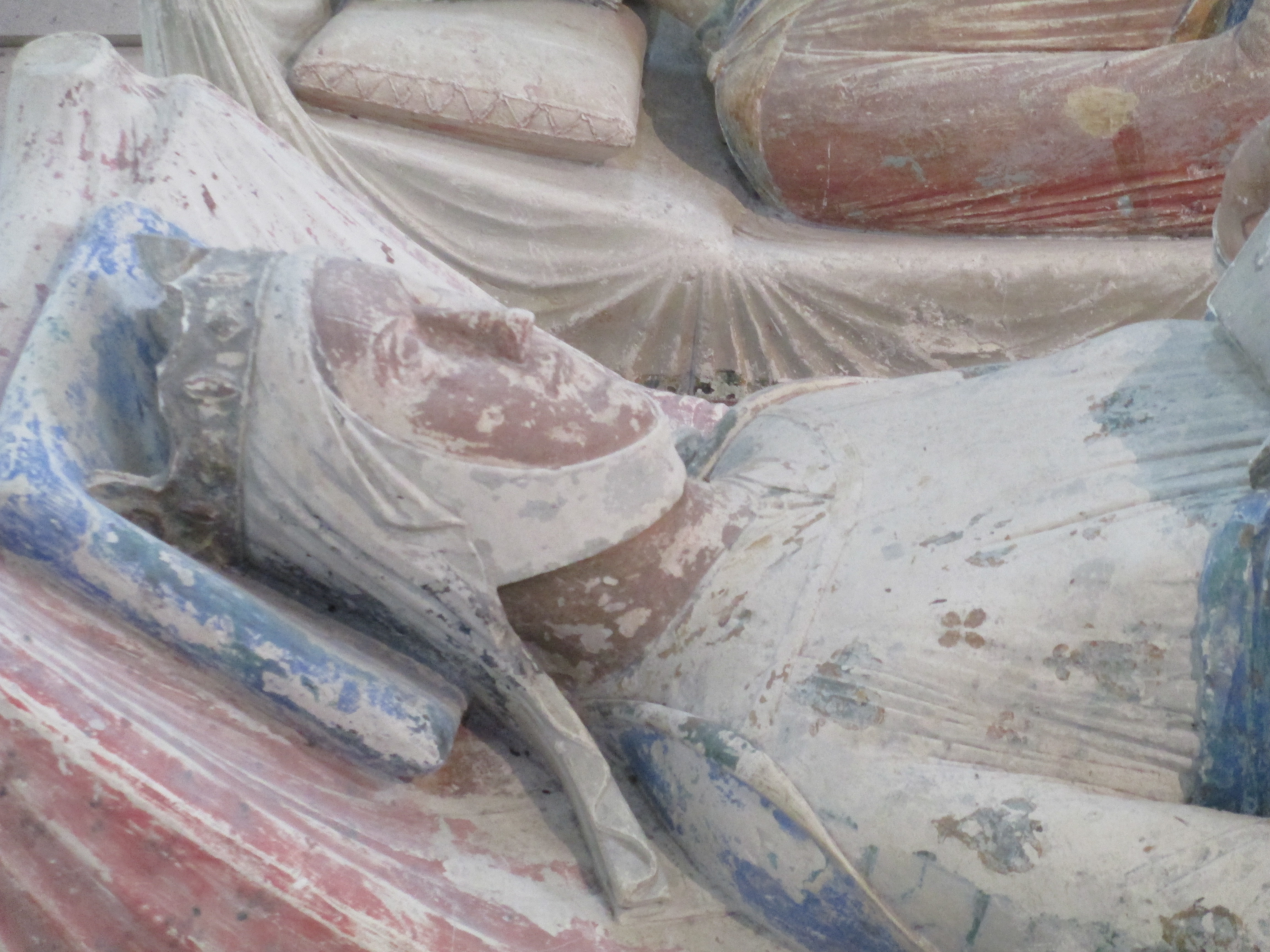
Due to the fact that the majority of interest seems to have been in Eleanor of Aquitaine from part one of this series I am going to begin my investigation of individual women with her. There has been so much written about Eleanor of Aquitaine and I am the first to admit that there isn’t that much new to say, but she is one of my favourites from this time period so I’m always happy to write about her. eofa

Eleanor of Aquitaine’s effigy at Fontevraud Abbey.

Royal marriages changed the political face of the country and ensured the transmission of states between families. They also formed alliances that helped to stop wars, start wars and disseminate culture between different countries. The royal bride who had the most profound effect on England during this time period was Eleanor of Aquitaine. Eleanor of Aquitaine was married to Henry II from 1152-1189. [1] Her marriage was made for political reasons, on her side as well as Henry’s, but it did later come to involve affection and it appears there was some form of initial attraction on both sides. Her marriage to Henry II also changed English politics. She brought the Duchy of Aquitaine to the English Crown and thus was instrumental in the creation of the Plantagenet Empire on the continent. The Plantagenets ruled substantially more of what we would now consider France than did the French. Eleanor was also the mother of the three kings: Henry the Young King ,who was crowned during his father’s lifetime but died in 1183, Richard I and John I. Richard and John were both kings who made strong marks, good and bad, on the political landscape. Medieval English queens did have authority, but it was largely ceremonial and dependant on their husbands. They had their own unique status, as they were the only ones beside the king who were officially anointed and appointed by God as part of the royal authority.[2] Medieval queens also had their own land in the shape of their dower lands, which were given to them by the king on their marriage. However, how much say the queen had in the running of these lands was dependant on the queen herself and the amount of authority the king allowed her. [3] The queen was also often at the cultural centre of the court.  Even contemporaries who were not otherwise remarkably complimentary of Eleanor of Aquitaine acknowledged the immense cultural downturn the court took in her absence.[4] Patronage was another area in which queens could have great influence.  An example of such patronage is Eleanor of Aquitaine’s 1185 charter to the abbey of Fontevraud. In this charter she gives the abbey and the “nuns serving God there” the “rent of one hundred pounds, in perpetual alms, from the provosture of Poitiers and the vineyard of Benon, particularly what is received from Marcilly.” [5] Fontevraud

Fontevraud Abbey.

It was primarily because of her background that Eleanor of Aquitaine was able to wield a little more real authority than some other queens of England, though she was still subject to the power of her husband. She was born in c 1124 and was a great heiress in her own right. [6] Her father was Duke William X of Aquitaine and when he died on pilgrimage in c 1137 he left Eleanor as the ruler of one of the biggest and most powerful duchies in Christendom. Contemporary writer William of Newburgh described the duchy as “very extensive” and stretching “from the borders of Anjou and Brittany to the Pyrenees.”[7] In dying William X left Eleanor very vulnerable, because she became a desirable marriage prize.[8]  A little over a month after her father’s death, probably to ensure her own protection, she married Prince Louis the heir to the French throne and the future Louis VII. However for the next fifteen years of her marriage, despite her title as Queen of France, she would have little control over Aquitaine, as Louis took it for himself and installed French administrators.[9] Her marriage was annulled in 1152 and she found herself once again a vulnerable heiress. She married Henry the young Duke of Normandy and the future Henry II of England only eight weeks after the annulment of her previous marriage. This marriage would eventually begin her time as Queen of England, and help to establish her as a woman of authority and power as well as a duchess in her own right.[10] St Denis St denis

 St Denis Cathedral where Louis VII is buried with the majority of the Kings of France. Eleanor would have been very familiar with it.

In the first twenty or so years of her reign as Queen of England Eleanor did have power and involvement, but it was not that dissimilar to the traditional power of a queen. She did originally have some say in the running of Aquitaine, but it was more a position of advising Henry II rather than having a free reign to run the Duchy she had inherited.[11] She also acted as a regent both in England and in various parts of the continental domains. Additionally Eleanor and Henry II seem to have acted in some sort of partnership for the first decade or so of their marriage. This is illustrated with Henry II’s campaign to try to enforce Eleanor’s rights in Toulouse in 1170. This was not a campaign that was particularly advantageous to Henry and it was one that Eleanor had also persuaded her previous husband to undertake.[12] Eleanor also had eight children, including five sons, with Henry II and this helped to increase her standing because she was fulfilling the main role of a queen. Eleanor was not a queen who was just left at home to bear children while the king was out fighting wars. She was present with Henry and without Henry all over their disparate empire and seems to have been very involved in the culture as well as the political side. [13]

henry close

 Effigy of Henry II at Fontevruad Abbey.

However it is also important to note that Eleanor was not necessarily well liked in her new kingdom. Gerald of Wales, a contemporary writer, describes her as having a reputation of “sufficient notoriety,” citing her apparent “carnal knowledge” of Henry’s father Geoffrey of Anjou as evidence.  While it is unlikely this particular accusation was true it does show that Eleanor was very much at the mercy of a masculine world where she was subject to ridicule by male chroniclers. This was a world in which independent authority by a woman, however powerful, was very difficult.[14]

Also her role during the reign of Henry II was curtailed by her fifteen years of imprisonment for her part in her sons’ rebellion. Henry forgave his sons due to their relative youth and the fact that he needed them, but he never forgave Eleanor. The imprisonment was relatively comfortable and it began in the 1174. She was not released until Henry II’s death and Richard I’s ascension to the throne in 1189. In this period she had little influence.  She lost her dower lands and most of her revenues, losing even the traditional trappings of power for a queen. What she did receive she could not dispose of as she wished.[15] Despite the appearance of some autonomy, any power Eleanor did have during the reign of Henry II, like other queens, came courtesy of her husband. She was able to work in partnership as long he allowed her to. So most of her authority came from any influence she might have had over Henry II and his actions. Her acting as regent, while it was a position of significant power, was not independent power.[16] This changed abruptly when Henry II died in 1189.  Eleanor’s certainly shaped the political situation in England with her involvement in the reigns of her sons. It can be seen specifically in her actions in the governance of the kingdom while Richard was on crusade. It was her backing that gave legitimacy to Walter de Coutances, Archbishop of Rouen, when he was appointed as the joint authority with Chancellor Longchamp, Bishop of Ely, who had been left nominally in charge. de Coutances was primarily appointed to check Longchamp’s excesses.[17] Eleanor also mediated in any arguments between the justiciars who were sharing authority in Richard’s absence. Eleanor was also one of the few people who had some influence on Prince John who, as Richard’s most likely heir, caused significant trouble when Richard was out of the country. Eleanor was also not in England all the time that Richard was absent because she traveled across the Plantagenet Empire, helping to hold it together and to bring Richard his new wife Berengaria of Navarre.[18]  In 1191, despite the fact that she was in her late 60’s, she traveled to Navarre, in the modern day Spanish and French borderlands, to bring Berengaria back to marry Richard in Limassol in Cyprus.[19]

Richard I

Richard’s effigy in Fontevraud Abbey. The effigy beside him is that of Isabel of Angouleme. She was the wife of his brother John and another heiress who will be discussed in a later post.

Eleanor’s influence was most apparent when Richard was captured and held for ransom in 1193 on the way back from crusade.[20]   Richard had been taken by Duke Leopold of Austria and the ransom set was the exorbitant 100, 000 silver marks, plus 200 hostages from his vassals’ families.[21] Richard’s lands had already been heavily taxed to help pay for his crusade and now they were squeezed even harder to raise a ransom that was twice England’s annual revenue.[22] One of the ways Eleanor raised the ransom was to approve, with Walter of Coutances,  a levy of one quarter of all moveable goods, a percentage of all knights’ fees and significant contributions of gold and silver from the churches. The only churches that were exempt were the Cistercians and Gilbertines, who were too austere to have gold and silver. From these she demanded a percentage of their wool clip. Her integral involvement in these levies is illustrated by the fact that the treasure was stored with her seal on it as well as Walter of Coutances’.[23] riv2 riveaux

Cistercian abbeys like Riveaux were exempt from providing gold for the ransom.

Richard I also placed great importance on his mother’s role in keeping his kingdom together. This is very well illustrated in the letter that he wrote to her in 1193, requesting her assistance in ensuring that Hubert Bishop of Salisbury would be made Archbishop of Canterbury. Firstly in this letter he describes Eleanor as by the grace of God “Queen of England.” Which clearly shows that he considers her authority paramount. Additionally he thanks her for the “faithful care and diligence [she gave] to [his] lands for peace and defense so devotedly and effectively.” He goes on to say that her “prudence and discretion” is the “greatest cause of [his] land remaining in a peaceful state until [his] arrival.”[24] This independence of action is further illustrated in another letter of Richard’s, regarding the appointment of Hubert.  He appeals to “his dearest mother Eleanor, by that same grace Queen of England, greetings and the inviolable sincerity of filial love”. He appeals to her to ensure that the justiciars the bishops of Canterbury Church, and anyone else she believes needs to be involved, instate Hubert of Salisbury as Archbishop of Canterbury. The fact that Richard I assumes that Eleanor will have the influence and power to achieve his request, indicates the power and independent authority that she wielded during his reign.[25] Henry II married Eleanor as a royal bride mainly for political reasons, they barely knew each other when they were married, but she made an indelible mark on England primarily in holding the country together. The next post in this series will be about Joanna Princess of Wales. She was the wife of Llywelyn ap Iorwerth, know as Llywelyn the Great, and the illegitimate daughter of King John.

[1] Marie Hivergneaux, “Queen Eleanor and Aquitaine 1137-1189”, in Bonnie Wheeler & John Carmi Parsons, Eleanor of Aquitaine Lord and Lady, New York: Palgrave Macmillan, 2003, p 55.

[2] Lisa Hamilton, Queens Consort, London, 2008, pp. 1-3.

[3] Anne Crawford, The Letters of the Queens of England, Stroud, 1997, pp. 8-9.

[4] Lisa Hamilton, Queens Consort, London, 2008, pp. 8-9.

[5] Eleanor of Aquitaine Charter to Fontevrault, 1185 at http://epistolae.ccnmtl.columbia.edu/letter/885.html.

[6] Desmond Seward, Eleanor of Aquitaine, London, 1978, pp. 13-14.

[7] William of Newburgh, The History of English Affairs, trans. PG, Walsh and M.J Kennedy, (eds), William of Newburgh History of English Affairs, Warminster, 1988 pp.129-131.

[8] Melrich V Rosenberg, Eleanor of Aquitaine, Massachusetts, 1937, pp. 4-5.

[9] Desmond Seward, Eleanor of Aquitaine, London, 1978, pp. 21-23.

[10] Ibid., pp. 63-69.

[12] Ralph V Turner, Eleanor of Aquitaine, Padstow, 2009, p. XVIII.

[12] Ibid., pp. 123-125.

[13] Ibid., pp. 139-141.

[14] Gerald of Wales, The Death of Henry II and Comments on the Angevin Family, at http://www.fordham.edu/halsall/source/geraldwales-dip1.html.

[15] Ralph V Turner, Eleanor of Aquitaine, Padstow, 2009, pp. 233-237.

[16] Richard Barber, Henry Plantagenet, Ipswich, 1964, pp.182-183.

[17] Ralph V Turner, “The Role of Eleanor in the Government of Her Sons,” in Wheeler and Carmi Parsons, (eds) Eleanor of Aquitaine, pp. 79-83.

[18] Crawford, Queens of England, pp. 32-34.

[19]. Anne Crawford, “Berengaria of Navarre,” in Anne Crawford, The Letters of the Queens of England, Stroud, 1997, pp. 43-45.

[20] Ibid., pp. 299-301.

[21] Andrea Hopkins, “Eleanor of Aquitaine,” in Andrea Hopkins, Six Medieval Women, London, 1997, pp. 56-57.

[22] Alison Weir, Eleanor of Aquitaine By the Wrath of God, Queen of England, London, 1999, pp. 229-230.

[23] Ralph V Turner, “The Role of Eleanor in the Government of Her Sons,” in Bonnie Wheeler and John Carmi Parsons (eds) Eleanor of Aquitaine, Lord and Lady, New York, 2003, pp. 83-85.

[24] Richard I Letter to Eleanor of Aquitaine, 1193, at http://epistolae.ccnmtl.columbia.edu/letter/148.html.

[25] Richard I Letter to Eleanor of Aquitaine, 1193, at http://epistolae.ccnmtl.columbia.edu/letter/149.html.

The marriage alliances of noble women 1180-1250: Part One

eofa

The photo is of the effigy of Eleanor of Aquitaine, one of the greatest heiresses of the time. She will be featured in greater detail in later posts.

This is the first in a series I am intending to write on marriage alliances . I am looking specifically at the 12th and 13th century and focusing on England. Part One will be an overall look at marriage alliances and what they meant to the society and how they shaped the political future of 12th and 13th century England. I will then move on to look at individual noble women, both heiresses and daughters of the nobility.

To begin with it is worth noting that 1180-1250 was a time of codification of secular and ecclesiastical law, both of which impact strongly on the marriage customs of the time. In a secular sense the law was primarily concerned with inheritance and transmission of property. The primary focus of ecclesiastical law, canon law, was remarriage and consent.

Consent is an interesting aspect of medieval marriage as free consent was something that the Church was adamant about. In some cases in ecclesiastical courts a marriage could be overturned if free consent had not been given.[1] This is not to say that all marriages of heiresses were undertaken with free consent because there were varying degrees of pressure placed on the women for their ‘free’ consent to be given. The age of consent under cannon law for boys was 14 and for girls 12 so it would have been incredibly difficult for a child to defy their family.[2] Even if a woman was older and politically powerful they were often given very little choice in their marriage and making a stand could be almost impossible.

When I say women I am using the term liberally as many of the heiresses and noble daughters were little more than girls. Some were even infants when they were sent off to the family they were to be married into. Though this was more common in royal marriages. I will discuss some of these women in later posts

There were really two types of noble women involved in marriage alliances. Noble daughters who brought an alliance and a dowry to the marriage and heiresses who brought sometimes significant property and titles.

I will begin with a brief discussion of the more common marriage alliance. That is the alliance between two families primarily for economic gain, sometimes achieved through a contract.

Marriage contracts could be very complex and quite often the actual couple involved was irrelevant. Such was the case in the contract between Humphrey, Earl of Warwick and Sir Ralph Thosney in 1236. This particular contract was between the fathers and not the children to be married. The children themselves were “Roger, eldest and first born of Sir Ralph of Thosney” and “Alice” the daughter of Humphrey.[3] The contract stated, “Earl Humphrey has given in free marriage 40 pounds worth of land in the village of Newenton, in Wiltshire, to Roger, eldest and first born son of Sir Ralph of Thosney, with Alice his daughter.”[4] The gift of the daughter was more an afterthought to the economic transaction. Here a daughter was being used as political currency in an agreement between two nobles who both wanted something from the other. It is true that Ralph’s son Roger also seemed to have little input into the marriage, but it was Alice who was being gifted to Roger and not the other way around.

In the case of this contract Alice herself was irrelevant. A later clause said, “if said Alice shall die before the contracting of marriage, the younger daughter of the said Earl Humphrey born in legitimate marriage shall succeed in place of the aforesaid Alice in marriage together with the aforesaid land.”[5] This contract had no connection with emotion because it was entirely mercenary and economic. Earl Humphrey also received land because Sir Ralph gave his son and heir “40 pounds worth of land in Carleton and Helland in Cornwell to endow the said Alice.”[6] The remainder of the précis of the contract, which is all that is available, went into great detail about exactly what would happen if either party died and who would get what of the land.[7]

These marriage alliances could also be primarily political in focus as well as economic. An example from a little earlier in the period was the marriage of Matilda the eldest daughter of William Marshal Earl of Pembroke and Hugh the eldest son of Roger Bigot Earl of Norfolk. Matilda married Hugh c. 1206 when she would have been about 13.[8] This marriage joined two of the most prominent noble families of the time. History of William Marshal, which was a biography of Earl William commissioned by his son and written in the vernacular and in verse in the 1220s, made the situation clear. It described the marriage as

“Marshal spoke with earl Robert Bigot a man who was never very slow in doing what was to his advantage and honour when it was appropriate for him to do so. He asked graciously, being the wise man that he was, to arrange a handsome marriage between his own daughter and his son Hugh. The boy was worthy, mild-mannered and noble hearted, and the young lady, for her part was a very young thing and both noble and beautiful. The marriage was a most suitable one and pleased both families involved.”[9]

There were obvious similarities between this alliance and the contract that has been previously discussed. The emphasis in this case was on the alliance between the two families rather than the economic advantages. Hugh and Matilda had three sons and one daughter and they also all married into noble families forming new alliances. Hugh died in 1225 and Matilda remarried William of Warrenne Earl of Surrey. [10] I will discuss Matilda in more detail in a later post.

Wards and heiresses, not just noble daughters, also played a crucial role in changing the face of English politics. They perhaps more than any other marital situation were used as political and dynastic currency. A ward was an underage heiress whose father was not alive so her marriage and property were in the hands of her father’s lord. Wards and heiresses were the prizes on the marriage market because they brought more substantial land and titles with them than would be received if a man married a noble daughter who was not an heiress. The marriage laws meant that whatever the heiress held became the property of her husband upon their marriage.

A woman being a ward was a relatively common situation because men often married when they were older so they died while their children were still young. The processes of wardship were often complicated and there were substantial amounts of writing on the legal procedures. Bracton said “sometimes the chief lord is entitled only to the wardship of the land that belongs to his fee and not to the wardship of the heir or his marriage.”[11] As can be seen here Bracton is talking about male wards as both underage males and females could be wards. There were all sorts of conditions and complications but the basic premise behind the wardships was that underage wards could not perform their obligations and therefore they needed a guardian to undertake them.[12] The process of wardships was that when a father died with an underage heir, be they male of female, their guardianship could go to their father’s lord and only in some cases to their mother. It was not automatic that their father’s lord gained hold of everything. As Bracton alluded to above the guardianship of the land, the marriage and ward themselves could go to entirely different people. In some cases even the lands could have multiple lords if they were geographically under different jurisdictions. The basic three way split that occurred most commonly was one guardian for the lands, one guardian for the right of marriage of the ward and one guardian for the ward themselves. When a mother was allowed to be part of the process it was usually as guardian of the physical ward themselves.[13] A ward could be literally bought and sold as political currency. A guardian could sell the right to choose the marriage of the ward, the right to govern the lands of the ward and they could also in some cases marry the ward themselves.[14]

The issue of marriage of female wards was a difficult one because consent became a real problem. There were several cases where a guardian forced his ward to marry into his family so he could retain the land. One such guardian was Adam de Hopeton. He was the guardian of Constance de Skelmanthorpe and he abducted her from her contracted marriage to a John de Rotherfield and forced her to marry his infant son William specifically so he could keep control of her lands. He was her guardian and refused to recognise her marriage to John de Rotherfield and threatened physical force to make her agree to marry his son William. Once of legal majority she disavowed her marriage to William, remarried and successfully took de Hopeton to court to regain control of her lands. Not all cases of a guardian taking control of a ward’s land by forced marriage ended so well for the ward.[15]

A guardian could not only be grossly unfair to a ward in relation to their marriage, but also in the way he dealt with their property. Ranulf de Glanville was a legal writer and a powerful man very early in the time period. He said that a lord who had control of a ward’s lands must look after them with “moderation” and cause no loss to the heir.[16] Unfortunately this did not always happen as evidenced by the many court cases involving a guardian who had misused the land and entitlements. [17]

As Bracton said a female ward could not be married off without her consent but as discussed earlier there was differing degrees of consent.[18] Marrying a favourite retainer or a landless son, illegitimate or not, to a ward was one of the easiest ways for a lord to reward or establish these people. It occurred from the lower levels of the nobility all the way to the king himself on numerous occasions. For example in the late 1100’s Richard de Clare Earl of Hereford gave his ward Belesent, daughter and heiress of Roger son of Odo, to Hugh the brother of Master Robert de Kent in marriage “in return for his service.”[19] Marriage to wards could be used as a reward to a loyal follower.

These women were used to cement alliances to form political affinities, for economic gain and to reward followers. This is just the background to the complex effects of the marriage alliances of noble women in this period. In following posts I will look at specific instances and specific women. I will also discuss how royal alliances changed the face of countries and how kings used wards and heiresses to not only reward their loyal followers but to give their illegitimate children a place in life.

Later posts will also have more photos.


[1] “Earl of Warwick and Ralph Thosney (1236)”, in Helmholz, “Marriage Contracts in Medieval England”, in Reynolds & White Jr., (eds) To Have and to Hold, pp. 277-278.

[2] “Earl of Warwick and Ralph Thosney (1236)”, in Helmholz, “Marriage Contracts in Medieval England”, in Reynolds & White Jr., (eds) To Have and to Hold, p. 278.

[3] “Earl of Warwick and Ralph Thosney (1236)”, in Helmholz, “Marriage Contracts in Medieval England”, in Reynolds & White Jr., (eds) To Have and to Hold, pp. 277-278.

[4] “Marriage Contract between Humphrey, Earl of Warwick and Ralph Thosney (1236)”, in R.H Helmholz, “Marriage Contracts in Medieval England”, in Phillip L. Reynolds & John White Jr. (eds) To Have and to Hold, Cambridge: Cambridge University Press, 2007, p. 277.

[5] “Earl of Warwick and Ralph Thosney (1236)”, in Helmholz, “Marriage Contracts in Medieval England”, in Reynolds & White Jr., (eds.) To Have and to Hold, p. 277.

[6] Nöel James Menuge, Medieval English Wardship in Romance and Law, Cambridge: D.S Brewer, 2001, pp. 84-85.

[7] Jeremy Goldberg, “The right to choose: women, consent and marriage in late medieval England”, in History Today, Vol. 59, (2008), pp. 16-21, pp. 16-18.

[8] Catherine Armstrong, William Marshal Earl of Pembroke, Kennesaw, Seneschal Press, 2006, pp. 288-289.

[9] Anonymous, History of William Marshal, (ed.) AJ. Holden, (trans.) S. Gregory & (notes.) David Crouch, Volume II, London: Anglo-Norman Text Society, 2002, pp. 166-169.

[10] Armstrong, Earl of Pembroke, pp. 288-289.

11] , On the Laws and Customs of England, (trans.) & (rev.) Samuel E. Thorne, Volume II, London: Oxford University Press, 1968, p. 250.

[12] Menuge, Wardships, p. 1

[13] Sue Sheridan Walker, “Widow And Ward: The Feudal Law of Child Custody in Medieval England” in Feminist Studies, Vol. 3, (1976), pp. 104-116, pp. 104-105.

[14] Sue Sheridan Walker, “Free Consent and Marriage of Feudal Wards in Medieval England”, Journal of Medieval History, Vol. 8 (1982), pp. 123-134, pp. 123-124.

[15] Menuge, Wardships, pp. 87-91.

[16] Ranulf de Glanville, Glanville, (trans.) John Beames, Volume I, Washington: John Byrne & Co, 1900, pp. 138-139.

[17] Menuge, Wardships, p. 2.

[18] Bracton, Laws and Customs, Volume II, p. 255.

[19] “Grant of marriage of Belesent, daughter and heiress of Roger son of Odo, by her lord, Richard de Clare, earl of Hereford, 1173-1190”, in Jennifer Ward, (ed.) & trans. Women of the English Nobility and Gentry 1066-1500, New York: Manchester University Press, 1995, pp. 24-25.

Paris Catacombs

A post for Halloween

The catacombs beneath Paris are one of the most haunting, but in many ways most beautiful places I have ever been.

The catacombs are entered through a very inconspicuous building. cata entrance

But once you walk down the 126 steps what you find is a completely different world.
Catacombs 15

catacombs 2The catacombs occupy only 1/800th of the quarries that honeycomb the earth beneath Paris and they were begun in the 1700s. They are the largest catacombs in the world and hold around six million skeletons.

catacombs 1 Catacombs 7

The catacombs were built to solve a very specific problem. By 1785 the cemetery of innocents, in the vicinity of Les Halles, had been in use for nearly ten centuries and had become overcrowded and was a serious source of infection. On the 9th of November 1785, after many complaints from local inhabitants, the Council of State decided to close the cemetery to any more internments and to remove its contents. A general survey of the quarries of Paris had just been completed and it was decided to use them to re-inter the inhabitants of the cemetery. Rebuilding work to strengthen them was undertaken on the sections of the quarries that were to be used and a staircase was put in. The first re-internments in the catacombs began after the consecration and the blessing of the site on the 7th of April 1786.

catacombs 4 Catacombs 11 Catacombs 13

This particular period of re-internment continued until 1788. The re-internment was always done at nightfall and followed a ceremony where a procession of surplice garbed priests sang the service for the dead along the route of the carts carrying the bones. The carts were covered by a black veil. The bones were then placed in the catacombs.

Catacombs 9 Catacombs 6

This process was continued until 1814 as remains from other cemeteries were removed and re-interred in the catacombs. More remains were re-interred between 1842 and 1870.

catacombs 3Catacombs 5Catacombs 10

The catacombs became an unlikely tourist attraction. In 1787 the future Charles X made the descent accompanied by some ladies of the court. In 1814, Francis I, the Emperor of Austria, visited them and in 1860 Napoleon III went down accompanied by his son. They remain a tourist attraction today with thousands coming each year and queueing for hours for entrance. The outwards facing sections of the walls of bones are built mainly of leg and arm bones with skulls interspersed in between. As you can see from the photos much of the building has been quite decorative. Sadly some of the skulls have been graffitied, see photo below, and some people try to steal bones. All bags are searched on the way out.

Catacombs 8

I have never had a greater sense of the mortality of humanity and the crushing passage of time than I have had in the catacombs. The one phrase that kept going around and around in my head like a broken record was: remember man thou art but dust and unto dust thou shall return. Nowhere have I seen greater evidence of that.

Catacombs 12 Catacombs 14

The photo from the entrance to the catacombs is from http://en.wikipedia.org/wiki/Catacombs_of_Paris. The remainder are my own.

For more information see

http://www.catacombes.paris.fr/en/catacombs or visit if you are ever in Paris. Though I recommend getting there really early.