Hanging Rock

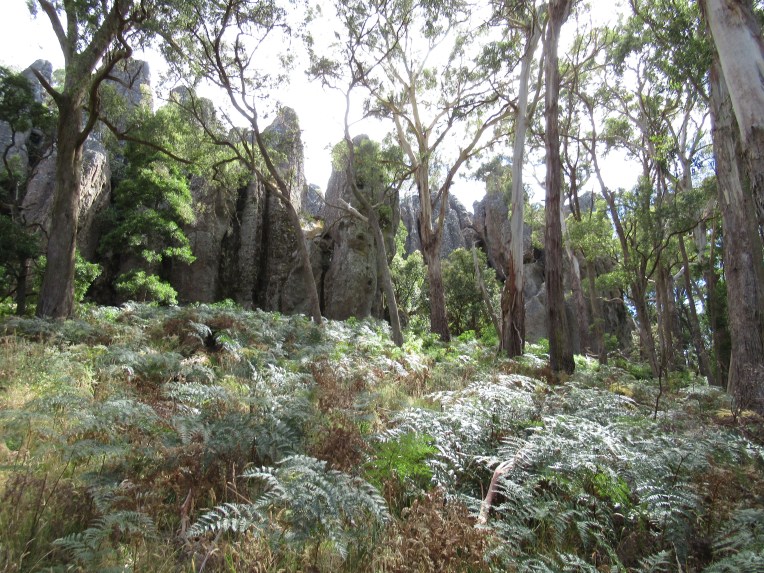
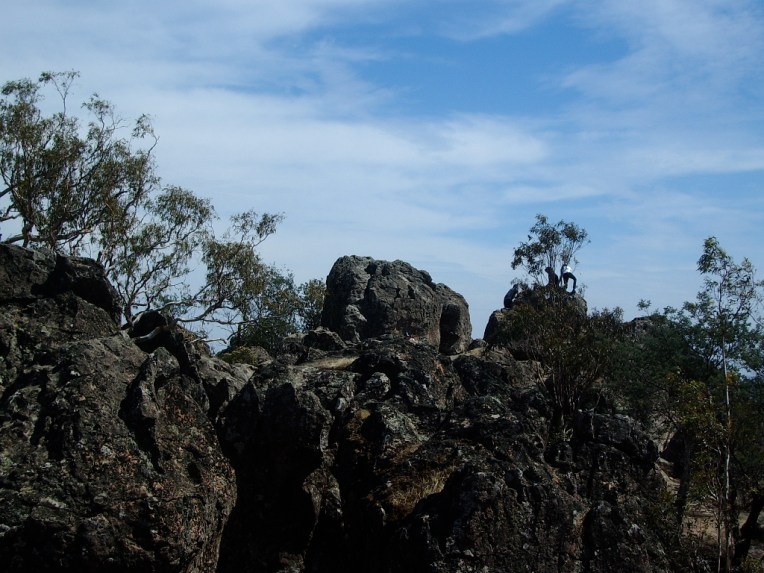
Directly ahead, the grey volcanic mass rose up slabbed and pinnacled like a fortress from the empty yellow plain. The three girls on the box seat could see the vertical lines of the rocky walls, now and then gashed with an indigo shade, patches of grey green dogwood, outcrops of boulders even at this distance immense and formidable. At the summit, apparently bare of living vegetation, a jagged line of rock cut across the serene blue of the sky.

Picnic At Hanging Rock by Joan Lindsay pg 14.

IMG_0695

The story and the history of Hanging Rock will always be inextricably linked both with Joan Lindsay’s 1967 book Picnic at Hanging Rock and with Peter Weir’s 1975 film adaptation.

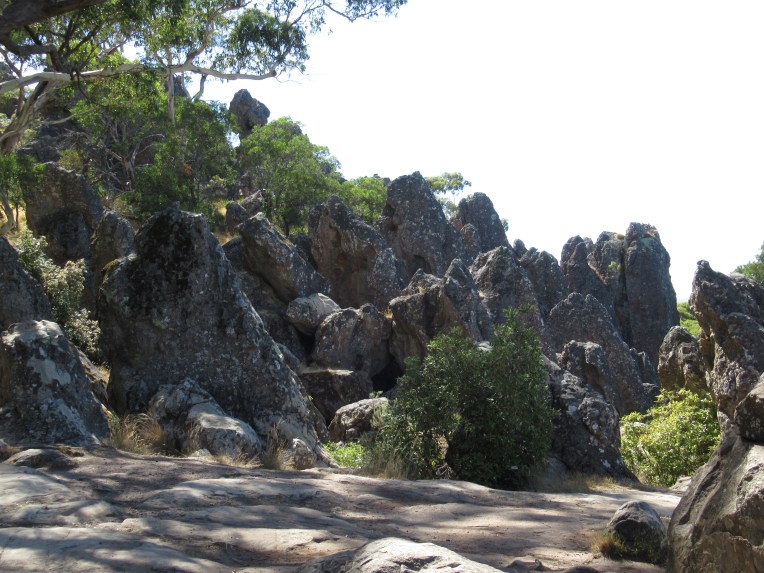
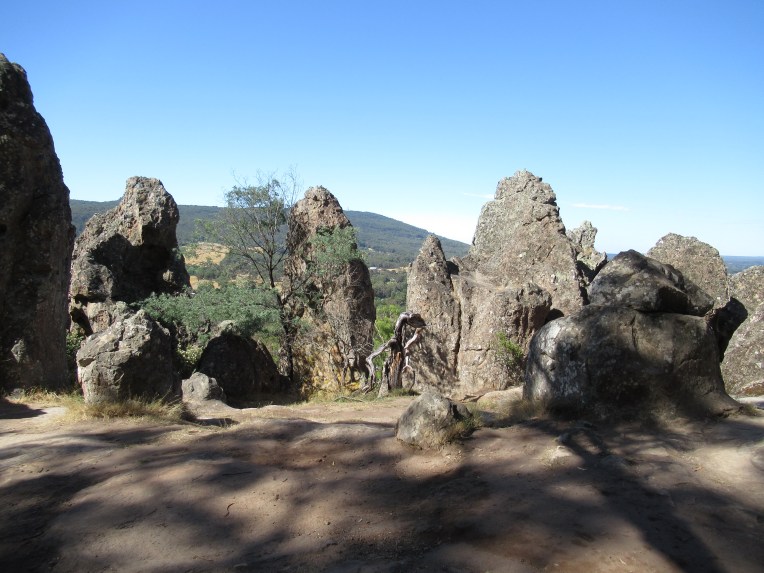
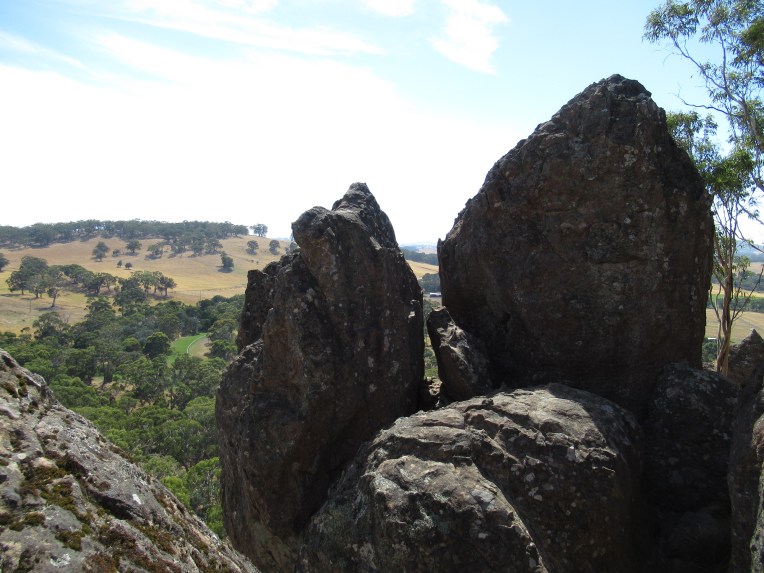
Hanging Rock is an extinct volcano just out of Woodend Victoria that last erupted about seven million years ago. It stands 711 metres above sea level and rises 100 metres above its surrounding plain. It is largely composed of volcanic mamelon. In this particular type of mamelon there was a very high soda content so when it got rained on it was eaten away into the distinctive shapes you see today.

IMG_0661

I have been there twice and until very recently, in fact so I could write this post, I had neither seen the film nor read the book. Even if you haven’t read the book or seen the film, the story of Picnic at Hanging Rock has seeped into Australian culture. The first time I went to Hanging Rock was nearly 11 years ago with my school. We were on a creative retreat and we had a day out to explore the rock. Naturally being a bunch of 17 and 18 year olds we spent most of the time climbing over as much of the rock as we could and running around shouting “Miranda, Miranda” thinking we were very clever.  If you haven’t read the book or seen the film, or aren’t Australian, the reference will become clear a little later.

IMGP2496IMGP2499

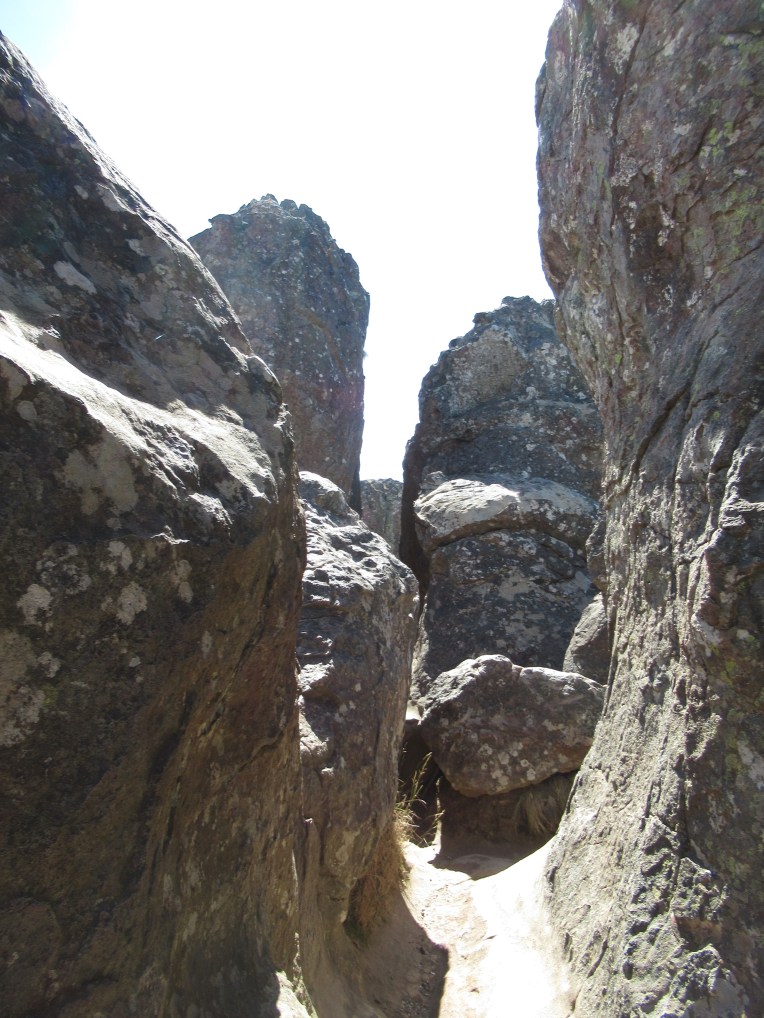
I went back a couple of weeks ago because I wanted to have another look. It is a place of great beauty and great history. I’ve never found it as haunting or mysterious as many do, but it is easy to become disoriented and lost up amongst the rocks which all look eerily similar once you lose your sense of direction.

IMG_0686IMGP2482.JPGIMGP2478.JPGIMG_0677

Ironically enough, on this visit I actually ended up leading two groups of people back down the rock because they couldn’t find the path. I can’t claim especial prescience, I just happened to have been watching where I had come from because I knew it could be tricky, but it still felt kind of appropriate.

The sense of mystery that hangs around  is largely because of the book and the movie. The story of the rock itself will always be linked with them, so I’m going to start there.

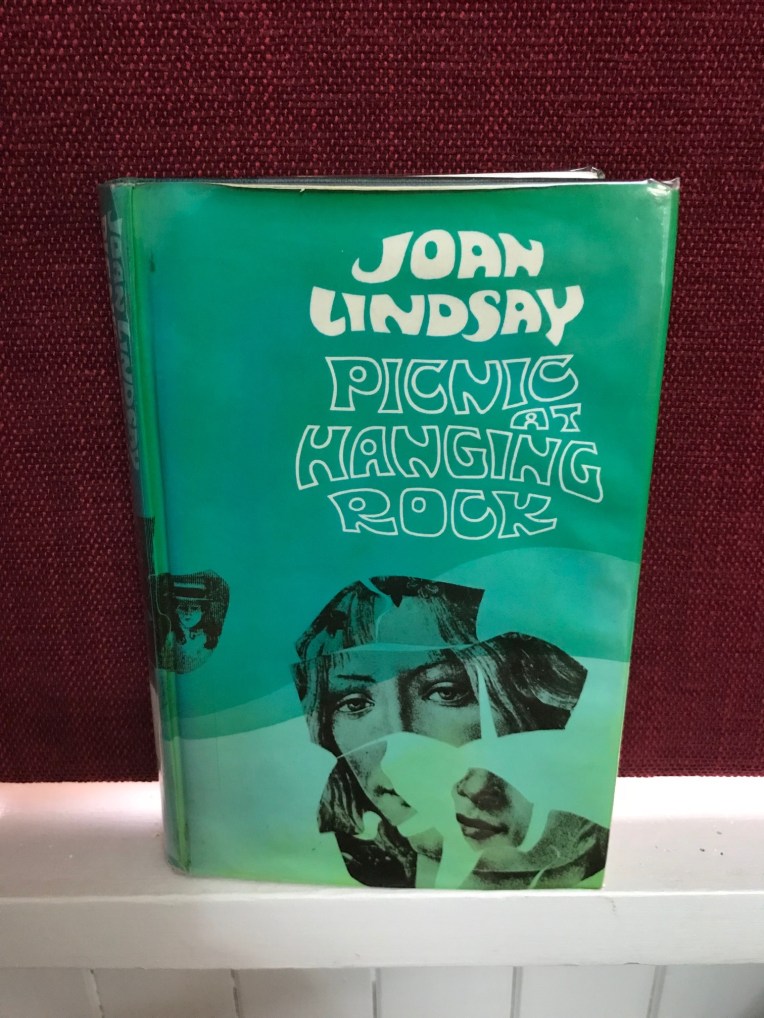
Picnic at Hanging Rock by Joan Lindsay is at its most basic level a gothic novella, the story of a group of school girls who go on a picnic at Hanging Rock on Valentine’s Day in 1900 and three of them and one teacher don’t come back. It is however more than that. It is the story of the Australian landscape and the attempt to superimpose an European ideal onto it. It is a haunting mystery, it’s a story of friendship and obsession and it is one of the most evocative books I’ve ever read. I know it might sound odd to say that a book which is considered a classic is really very good, but too often for me I find that I read ‘classics’ and appreciate them for their craft but can’t come to lose myself in them. This was the complete opposite with Picnic at Hanging Rock. It helped that by accident I was reading a 1967 original edition. It not only has the most fabulous late 60s cover.

IMG_1873

But also the start of each chapter has a beautifully decorated letter, and each one is different.

IMG_1874 copy

It is an involving, extraordinarily visually descriptive and haunting story that hangs around long after you’ve finished reading. And for the Miranda reference? Miranda is one of the missing school girls, the most perfect, the idolised one. There are a number of scenes in both the book and film where searchers are clambering over the rocks shouting “Miranda Miranda”.

This history of the book itself is an interesting one. Joan Lindsay wrote it over two weeks at her house in Mulberry Hill in Baxter Victoria and some of it came to her in a dream. There are large portions of the book that are based on Joan’s life, she went to a school quite similar to the one depicted in the novel and she also spent a lot of time around and at Hanging Rock in the early 1900s. She and her family were in fact staying in the area in 1900, when the book is set. Joan recreated the long hot late Victorian early Edwardian summers in Picnic at Hanging Rock.  She also refused for all her life to say whether the book was based on a true story or not. In fact she recorded in the forward :

Whether Picnic at Hanging Rock is fact of fiction, my readers must decide for themselves. As the fateful picnic took place in the year nineteen hundred, and all the characters who appear in this book are long since dead, it hardly seems important. 

This blurring between fiction and reality is one of the most enduring aspects of the story and the lack of conclusion to the mystery, you never find out what happened to the girls, keeps drawing you back in. It has definitely defined the mystique of Hanging Rock itself. However there was a final chapter to the book, which Joan requested to be published posthumously, in which the girls disappearance is a supernatural event. Personally I prefer the conclusion of the original novel where nothing is really known and the reality is very blurred.

Joan Lindsay died on the 23rd of December 1984, but her work continues to live on and has settled as a mantle over the very stone of Hanging Rock.

Peter Weir’s film is a core part of the construction of the legend. While the book was known and appreciated before the film, it was the film which pushed it into a mainstay of Australian cultural history.

You can see the trailer below.

Weir’s film made the name of several well known Australian actors and in its depiction of the Australian bush and its eerie setting and soundtrack was ground breaking for the time. The most memorable part of the soundtrack was probably the pan pines. The dreamlike atmosphere of the film was created by placing bridal veils over the lens of the camera. The cast of school girls was largely amateur, which is one of the reasons there is so little dialogue. It was shot in six weeks, partly on site at Hanging Rock, but most of the scenes that were not actually on the rock were shot in South Australia. Joan Lindsay was involved in the filming and her house in Mulberry Hill in Baxter and her background as a painter was a strong influence on the film’s remarkable aesthetic. Once the film was released the story of Picnic at Hanging Rock became cemented in Australian culture (with Joan Lindsay besieged with letters and visitors and the media wanting to know what was true) and the narrative of Hanging Rock itself.

IMG_0647

The history of the rock itself is in many ways as interesting as the story of the novel and the film.

Hanging Rock has been an important site to the local Indigenous Australians for thousands of years. The Edibolidgitoorong, a sub-clan of the Wurundjeri, used it as a vantage point, for monitoring the weather, maintaining security of the area and probably for mediations and possibly initiations. The Wurundjeri people still have strong ties to the area and the rock. When settlers began to arrive in the area diseases like smallpox and the deliberate clearing of land for grazing and mining impacted the Wurundjeri very seriously. In 1863 everyone who was left in the area were rounded up and sent to the Coranderrk Aboriginal Mission, mainly as a result of conflict with local colonists. As with all of Australia, the land was very much inhabited before the arrival of the European settlers and colonists and as with much of Australia the indigenous people suffered greatly due to their arrival.

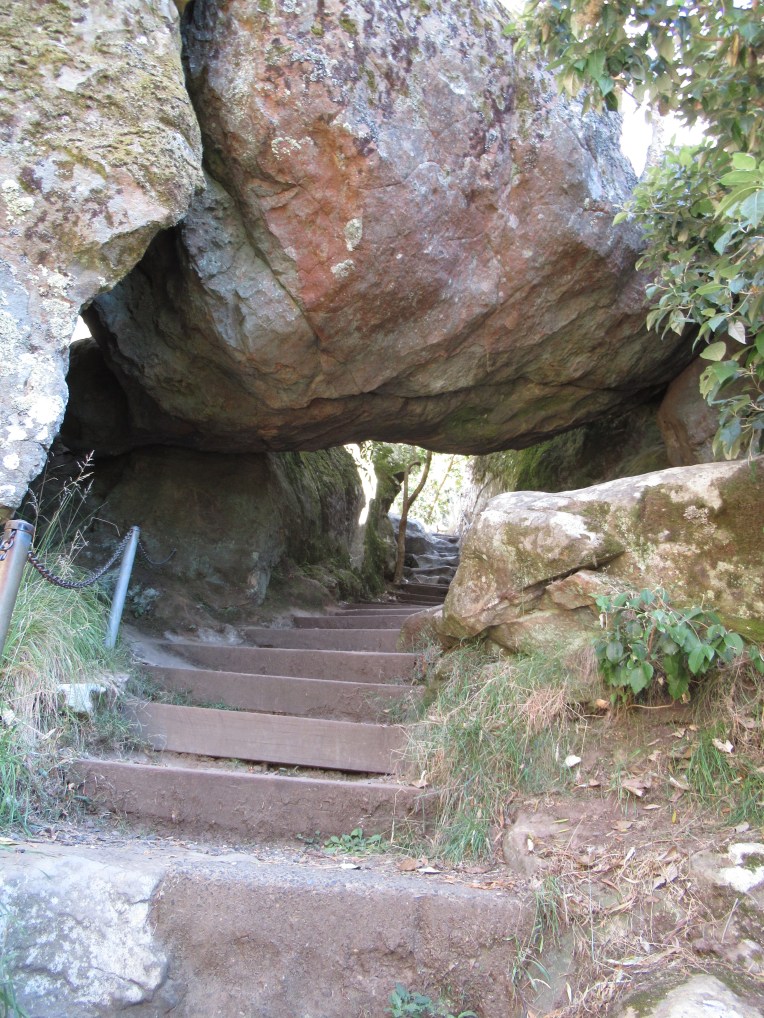
When the settlers did arrive the name “Hanging Rock” was not used originally. Hanging Rock is technically a nickname that begun to be used in roughly the 1850s and it comes from one rock that ‘hangs’ over the path to ascend to the top.

IMG_0637

It is officially called Mount Diogenes in line with the ancient greek theme of the surrounding area such as Mount Macedon, and Alexander’s Crown (which later came to be known as Camel’s Hump). These other names were largely bestowed by surveyor Major Thomas Mitchell, who is responsible for naming large portions of Victoria. I have written about him and his influence on Victoria’s Western District before and you can find the post here. 

The name Mount Diogenes first appears, however, on Robert Hoddle’s map of 1844. Hoddle is best known for laying out Melbourne’s grid and it is quite possible that he chose Diogenes to fit in with Major Mitchell’s slightly earlier naming scheme. Some people argue that Mitchell in fact named the rock, though it was out of his way on his journey south. Hanging Rock had one other name as well, Dryden’s Rock after Edward Dryden who leased the run that the rock sat on in 1837, he was one of the area’s first settlers. Whatever the past naming issues Hanging Rock had, “Hanging Rock” had become the common usage name by the mid to late 1800s.

There has been a settlement near the rock since the second half of the 19th century, at least partly fuelled by the railway coming to Woodend in 1861. The first settlers were pastoralists and squatters who leased and then later bought the land. No one ever lived actually on the rock but there were settlements surrounding it, boasting a hotel, church, recreations reserve and racetrack.

The racetrack has been in operation since 1880, when the inaugural Hanging Rock Cup took place. You can see it today in the photos below.

IMG_0725IMG_0724IMG_0723IMG_0722

Racing wasn’t the only social draw of the rock. Deciding to have a picnic on the rock was  a common occurrence. There was a picnic ground beneath the rock and picnicking on the rock itself in the 1800s was a common social activity for the time. In Picnic At Hanging Rock Miranda mentions a painting of “people in old fashioned dresses having a picnic at the rock”. The picture she is referring to is At The Hanging Rock by William Ford and it was painted in 1875. You can see it below

Dd105451

From the National Gallery of Victoria:

https://www.ngv.vic.gov.au/explore/collection/work/5568/

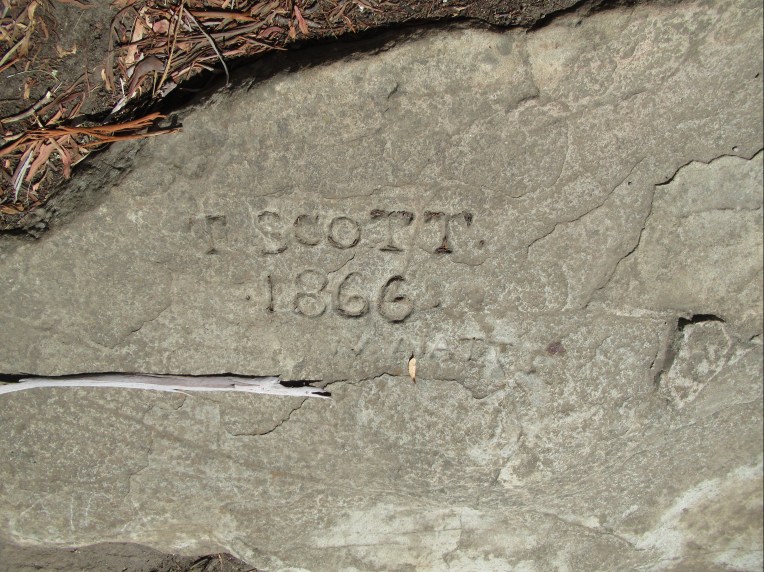
The is also plenty of evidence of people climbing the rock in the 1800s, including the graffiti you can see in the photo below.

img_0684.jpg

Despite its celebrity status through books and film today Hanging Rock remains surprisingly unspoilt. It still sits in its patch of pristine bush.IMG_0691And it continues to hold a fascination that goes beyond the book and the film. It is a truly majestic place.

IMG_0656

IMG_0644

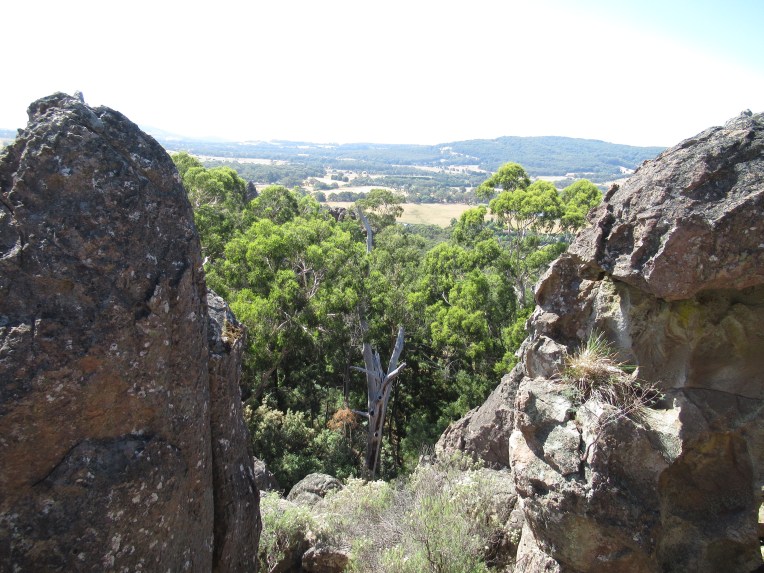
And has some of the most amazing views of the surrounding area.

IMG_0669

IMG_0658

IMG_0650

The walk to the top is absolutely worth it.

IMG_0634

References:

Picnic at Hanging Rock by Joan Lindsay 1967

Beyond the Rock: The life of Joan Lindsay and the mystery of Picnic at Hanging Rock by Janelle McCulloch

The Hanging Rock by Marion Hutton

Site visits 2007 and 2018

The photos are all mine.


Rural Buildings: St Thomas’, Bunyip Victoria

Bunyip is a small town in Victoria about 84km from Melbourne. The name comes from a creature of aboriginal myth. A bunyip like creature was said to live beneath the waters of the swampland below Bunyip and prey on humans who ventured into the water after nightfall.  The area that Bunyip now stands on is the land of the Bunurong people of the Kulin nation and it was very much inhabited when Europeans settled there and claimed it.

When the Europeans arrived they changed the surrounding land, including draining the swamp. While the area was surveyed and the name first used in the 1850s it wasn’t until the 1860s that the present iteration of the town was surveyed and established. The railway arrived in 1877, it remains today.

IMG_9104 2

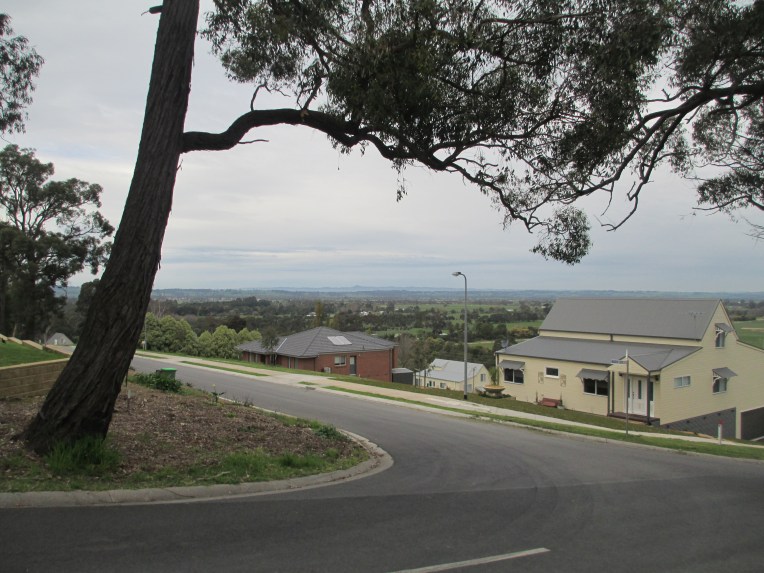
View down the hill at Bunyip.

This is the first of an ongoing series of posts I’m going to do on rural buildings, churches, halls etc in Australia.

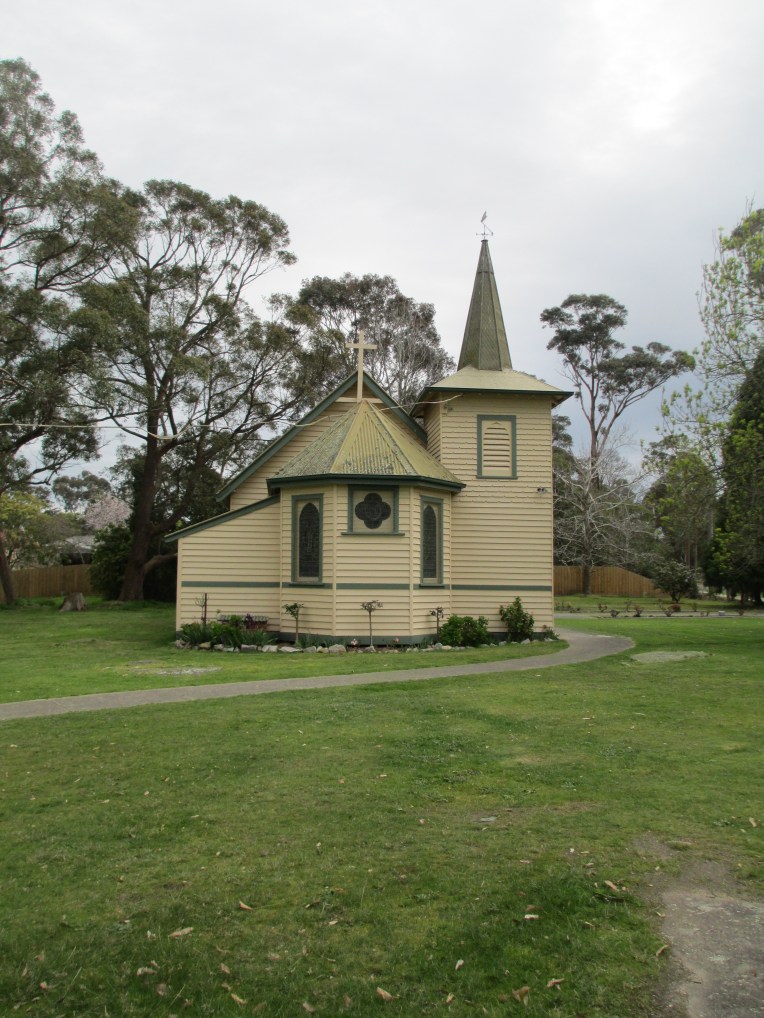
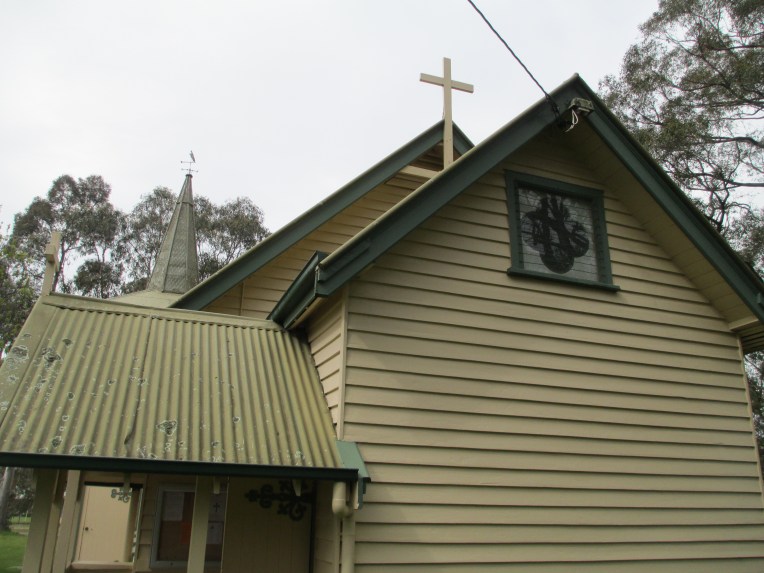
The foundation of St Thomas’ Church was laid in 1902

IMG_9079

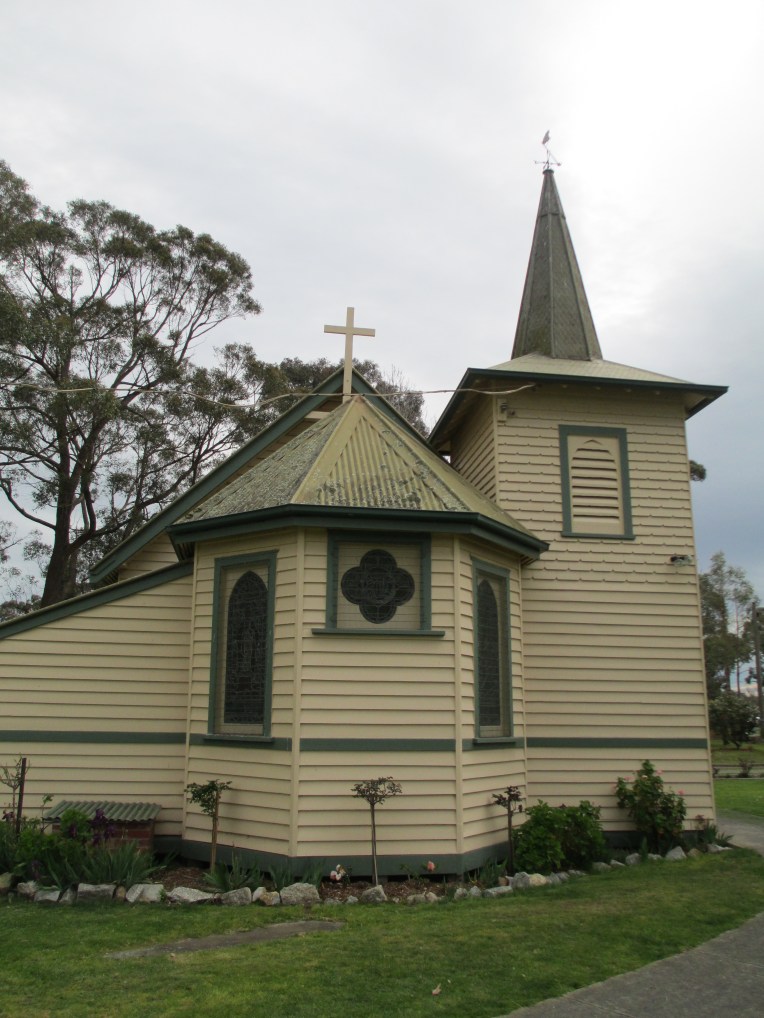
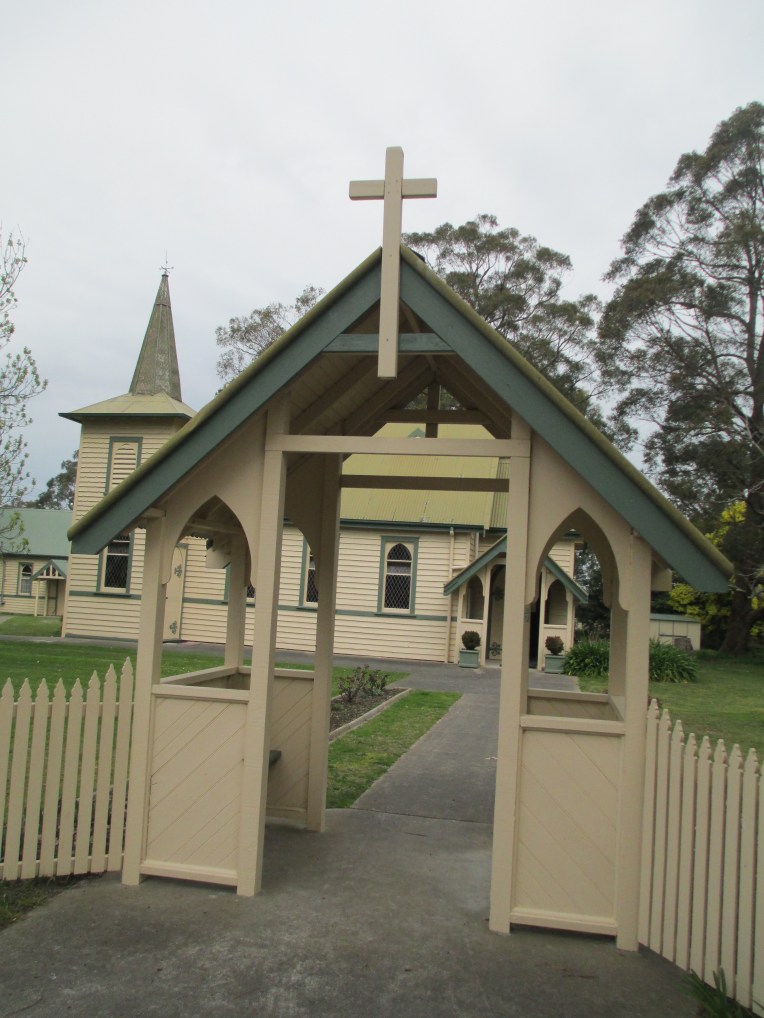
St Thomas’ is a Church of England church and an excellent example of a turn of the century Arts and Crafts church. It’s built of weatherboard and was designed by Frederick Klingender and has remained in near original condition.

IMG_9102IMG_9097

The total cost of the building was over 377 pounds and when it was opened by Rev Bishop Pain on the 29th of December 1902 approximately 400 people attended the service and 14 baptisms were registered.

Alterations to the church were needed in 1919 because of white ant damage and an entrance gate to the church ground was erected in 1943. The lych gate you can see in the photos below was erected much more recently and is modelled on the original church porch. IMG_9078IMG_9077

The Sunday School building was erected in 1906 to meet the increasing demand of pupils attending. IMG_9099

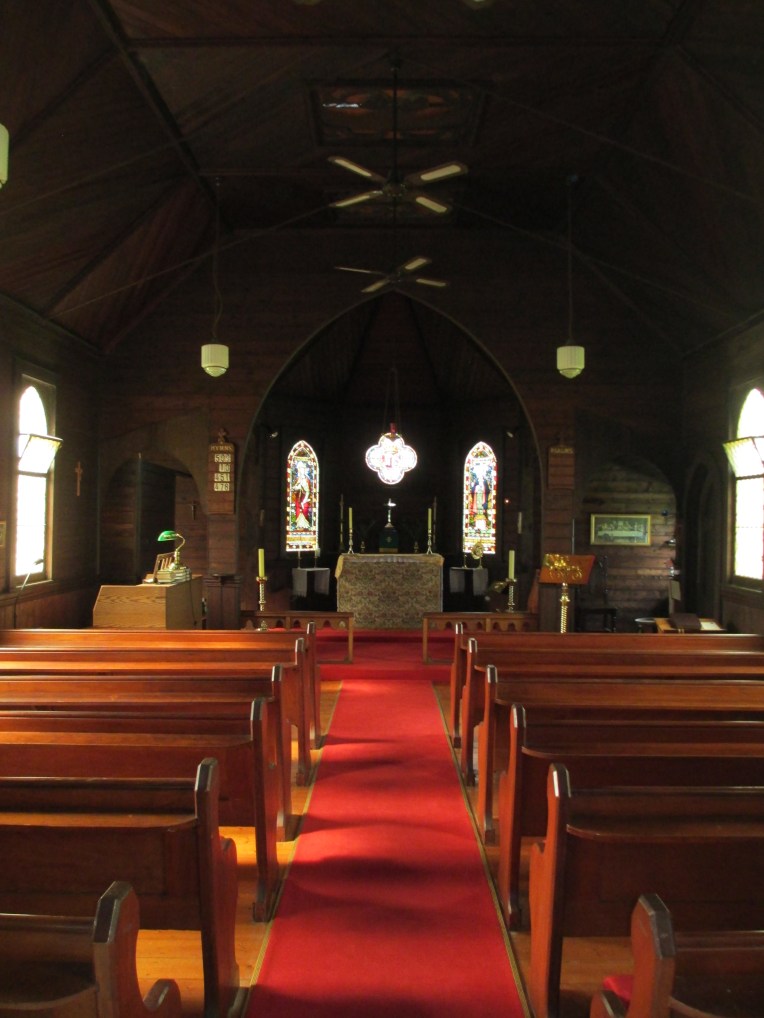
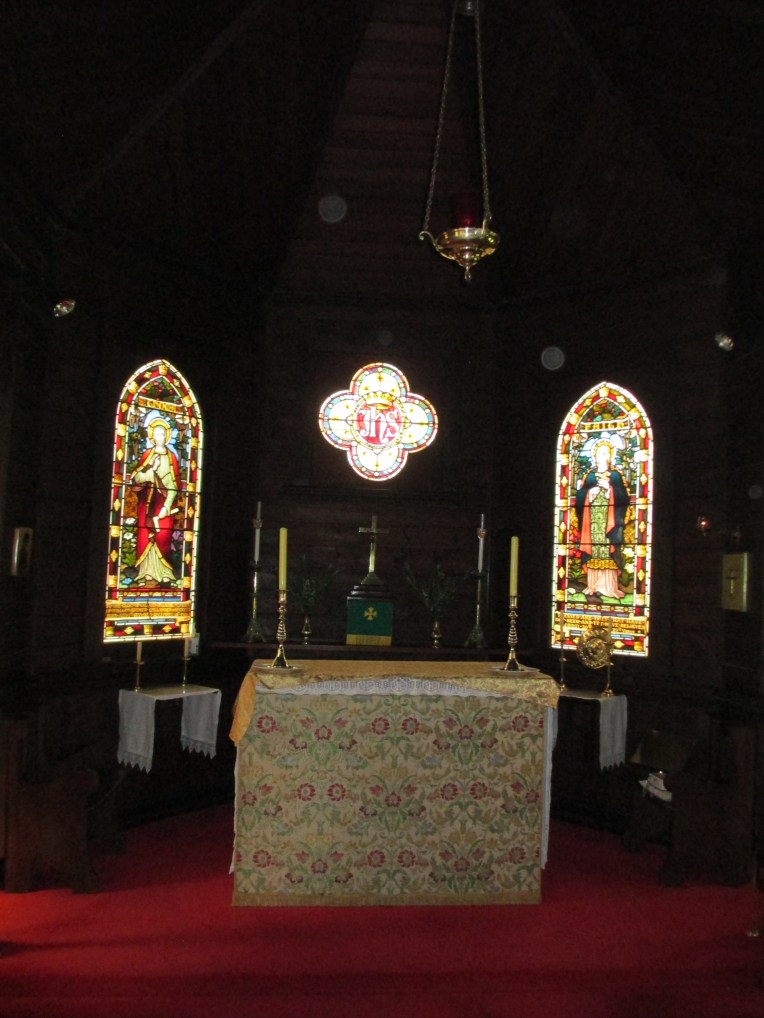
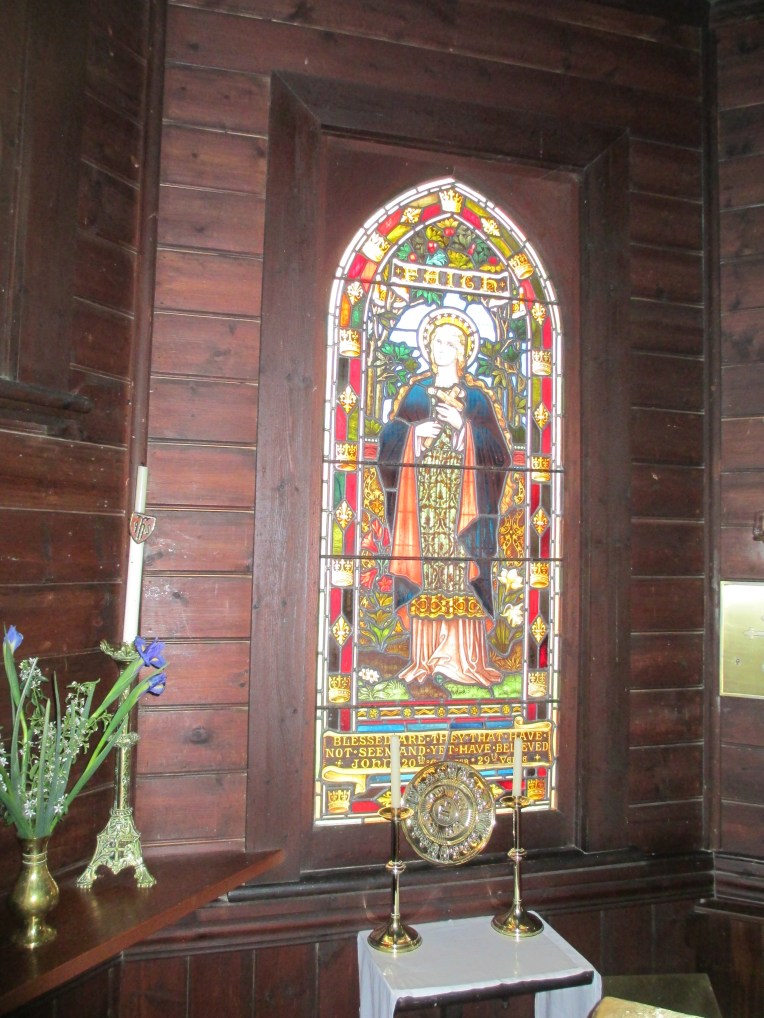
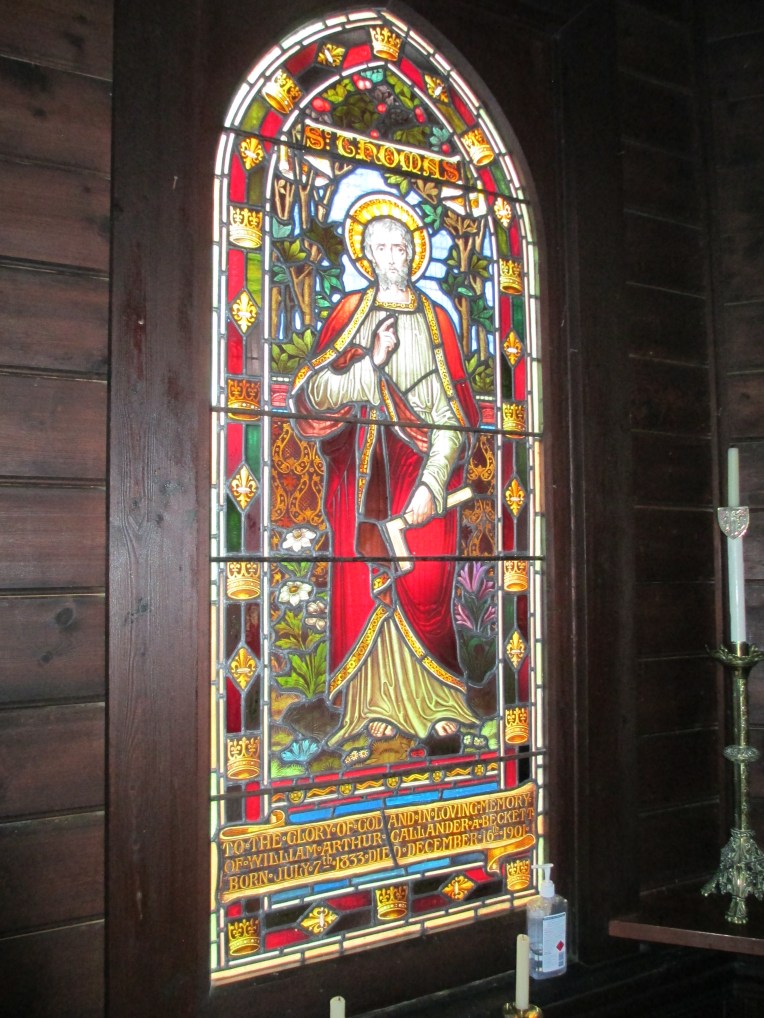
The interior of the church continues the Arts and Crafts style, and is augmented by a number of lovely stain glass windows.

IMG_9083IMG_9084IMG_9086

IMG_9089The stain glass window dedicated to St Thomas also carried a dedication for the A’Beckett family on its base

IMG_9087The A’Becketts were a prominent district family and the font is also dedicated to one of their number.

IMG_9085

St Thomas’ is a beautifully preserved example of a rural Victorian church and is still an important part of life in Bunyip.

IMG_9096

References:

Site visit 2016

http://vhd.heritagecouncil.vic.gov.au/places/30126/download-report

http://pandora.nla.gov.au/pan/78302/20081023-0000/www.cardinia.vic.gov.au/Files/Cardiniaaboriginalstudy.pdf

http://www.victorianplaces.com.au/bunyip

St Thomas’ Church information brochure.

A Tale of Two Lighthouses

I’ve always liked lighthouses, I like their solidness, their proximity to the coast and their utility whilst still being beautiful. Growing up on the coast there were two that were constant fixtures in my life, Cape Schanck Lighthouse and Griffiths Island Lighthouse in Port Fairy.

You can see both below

IMG_0138

Cape Schanck

IMGP2417.JPG

Port Fairy

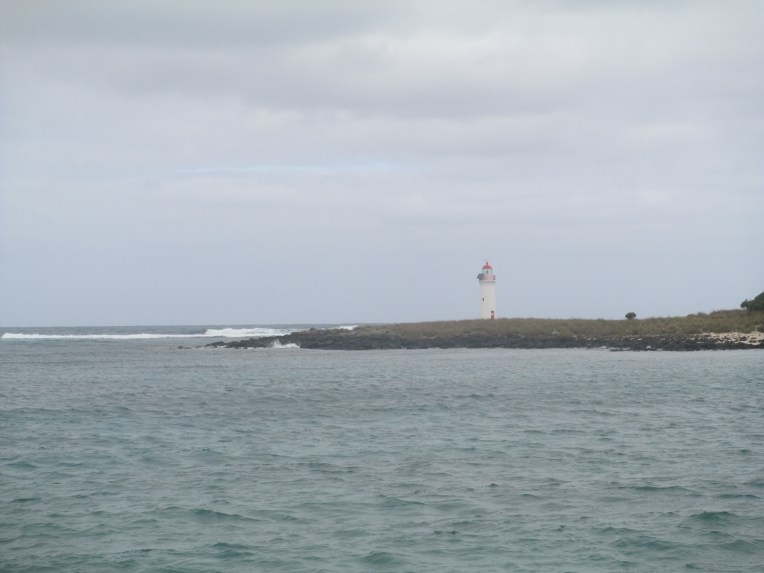
Cape Schanck is part of the Mornington Peninsula just south of Melbourne in Victoria. Port Fairy lighthouse is on Griffiths Island at the head of the entrance to the Moyne River in Port Fairy, which is in western Victoria. I grew up on the Mornington Peninsula and have been visiting Port Fairy my whole life. So I couldn’t fail to notice the similarities between the two lighthouses.

There are clear visual similarities between the two structures and they were actually built at almost the same time as well. Cape Schanck was constructed between 1857 and 1859, along with the other buildings of its lightstation, by the Victorian Public Works Department. Port Fairy was built by the Victorian Public Works Department in 1859, it was originally painted red. Cape Schanck stands at 21 m and Port Fairy at 11m. Cape Schanck was built of limestone and Port Fairy of bluestone with a basalt base.

Both lighthouses are now automated, but their original lamps, which would have run on oil, were both constructed by the Birmingham company Chance Bros. The original clockwork mechanism survives at Cape Schanck. Cape Schanck’s beam reaches nearly 30 miles into Bass Strait and Port Fairy’s reaches 12 miles. They are both Fresnel lamps. The other key similarity is that both lighthouses have internal stone spiral staircases, two of only 3 surviving pre 1863 lighthouses to do so.

You can see the spiral staircase in the Port Fairy lighthouse in the video below. (the music is the Wellington Sea Shanty Society and is called Great Open Sea, it’s licensed under Creative Commons)


Port Fairy is, unusually for a lighthouse, built at sea level, as you can see below.

IMG_0397

Where as Cape Schanck stands on an 80 m cliff

IMG_0164

The two lighthouses were built in a time when lighthouses were key to travel and commerce in the fledgling colony. Cape Schanck was built as part of a sea road of 3 lighthouses patrolling Bass Strait. The other two were Cape Whickham and Cape Otway see below.

IMG_9999

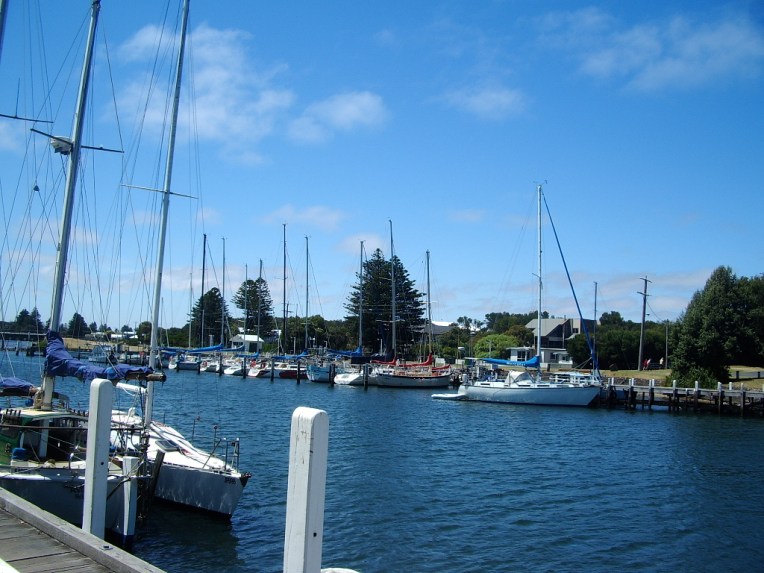
Port Fairy was built to mark the entrance to the Moyne River and Port Fairy harbour, which at the time was a thriving port. See below

imgp2398

They have both been in continual operation since the 1850s, though they are both now automated. They are fantastic examples of the remoteness of Victorian lighthouses and their lighthouse keepers.

Cape Schanck stands on an isolated peninsula, which is now a national park, and commands its part of Bass Strait.

IMG_0158IMG_0153IMG_0145IMG_0144

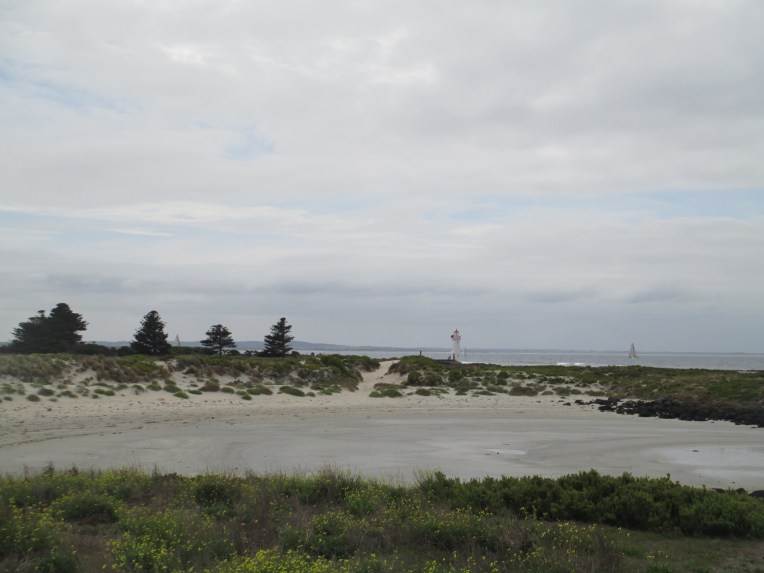
IMG_0156Port Fairy’s Griffiths Island is now connected to the mainland by a causeway, IMG_9161But in the 1800s the island was only accessible by boat and it was often dangerously rough so was cut off completely from the mainland. It was extremely isolated. The island was originally 3 islands, Rabbit (on which the light house stands), Goat and Griffiths. They have joined together as one island, partly from coastal erosion and partly from the construction that surround the islands. They serve to protect the entrance to Port Fairy. Rabbit island would have been extremely remote in the 1800s.

IMG_0408IMG_0435

IMG_0469

IMG_8428

IMG_8441

Nothing survives of the lighthouse station at Port Fairy apart from the stand of Norfolk pines, which you can see in the photo above, which were planted by the lighthouse keeper as a windbreak. The quarters were demolished after the Harbour Master was relocated in 1956. The last lighthouse keeper who lived on the island was there from 1929-1954.

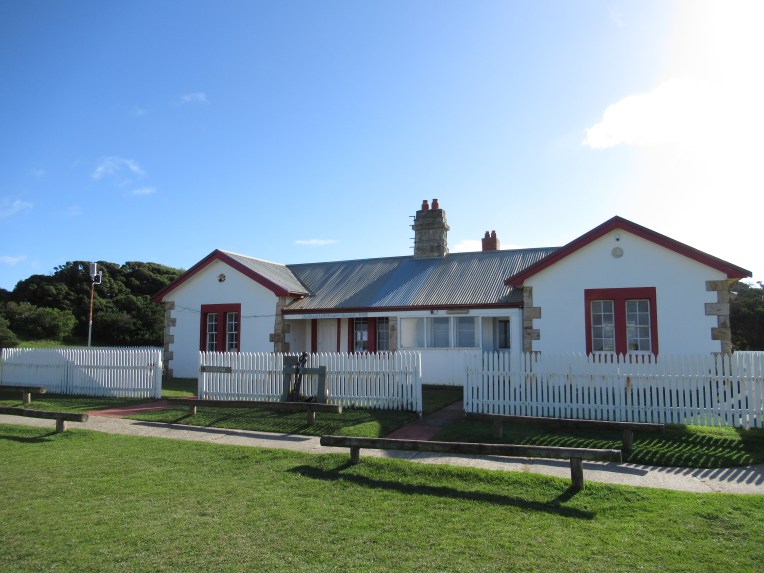
At Cape Schanck a number of buildings survived, as well as some later additions. There were lighthouse keepers living on site until 2016, though they had little to do with the running of the light and more to do with running the tourist accommodation that is also on site. The site is now run by Parks Victoria. The original Assistant Lighthouse Keeper’s cottage from 1859 can be seen below.

IMG_0140

While both lighthouses had a different specific purpose they both stood as a bastions against the wildness of the sea and protected ships, in an era when shipping was, apart from gold, the lifeblood of the growing colony. In the future I hope to look at more of Victoria’s lighthouses, but I thought this was a good place to start.


References:

Port Fairy

http://www.lighthouses.org.au/lights/Vic/Griffiths%20Island/Griffiths%20Island%20Lighthouse.htm#History

http://www.visitportfairy-moyneshire.com.au/activitiesattractions/coastal/466-port-fairy-lighthouse

http://vhd.heritagecouncil.vic.gov.au/places/2711/download-report

Numerous site visits over the years.

Cape Schank

http://vhd.heritagecouncil.vic.gov.au/places/8661

http://capeschancklightstation.com.au/history-of-cape-schanck-victoria/

http://www.lighthouses.org.au/lights/Vic/Cape%20Schanck/Cape%20Schank%20Light.htm

http://mpnews.com.au/2016/05/02/keepers-farewell-light-on-the-hill/

Numerous site visits over the years.


The photos are all mine.

Mechanics’ Institutes

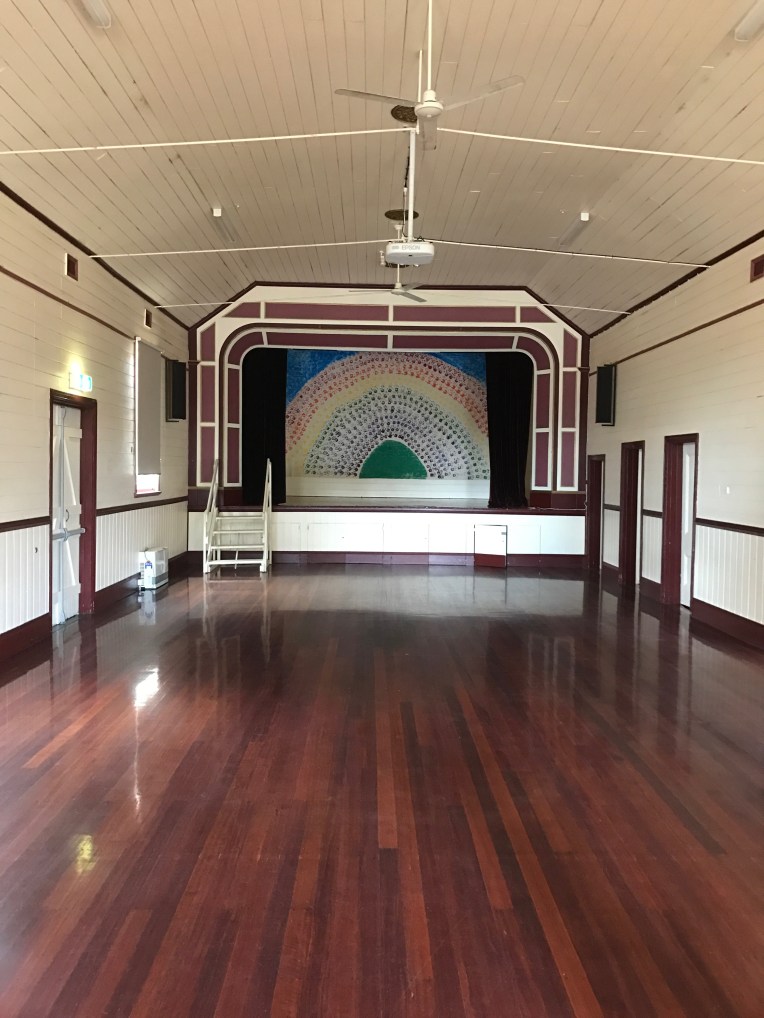
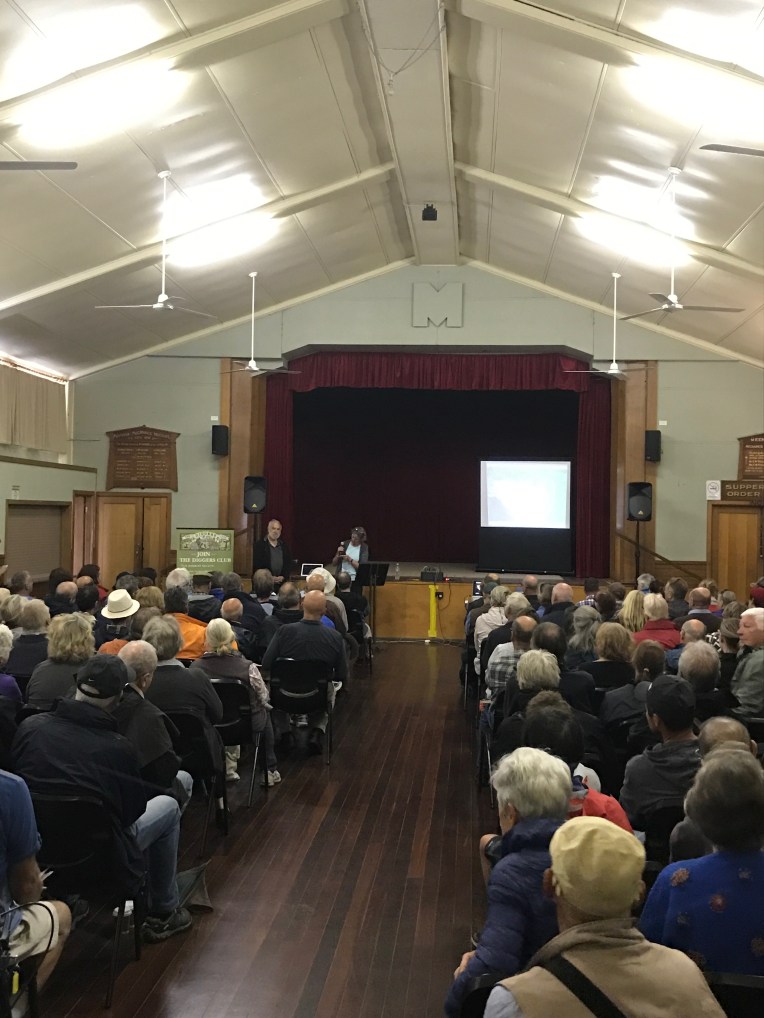
Mechanics’ Institutes are something that most people will be vaguely familiar with. They’ll have some idea of halls in country towns, possibly something to do with cars? But the concept of Mechanics’ Institutes is much more than this. This post is not intended to be an exhaustive history of Mechanics’ Institutes, but rather an introduction to the concept and the ideals, a little of their origin and a brief run through some examples of Mechanics’ Institutes that still exist today in Victoria, Australia.

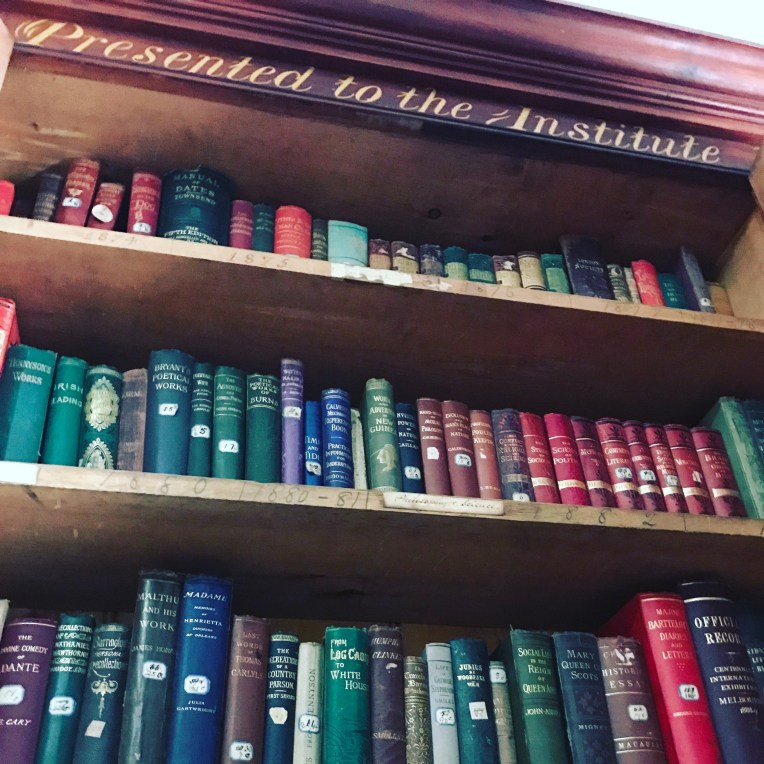
To begin with, the term mechanics in this case has nothing to do with cars. In the sense that it was used in the early 1800s it simply meant ‘worker’. Sort of the equivalent of blue collar workers today.  The basic concept of a Mechanics’ Institute is usually a member owned and run group, set up by the community that provides self educational opportunities.  These opportunities were normally through lectures, entertainments and often through the provision of a lending library. These were institutions that were run for members, providing free, or largely free, educational opportunities at a time when formal education was for the wealthy and the clergy. The lectures were usually run in the evenings to allow workers to attend. These were not government run institutions, they were started by local communities and had no centralised control, which makes their prevalence and ongoing existence even more remarkable.

The first Mechanics’ Institute was begun in Glasgow in c.1800 with Dr George Birkbeck of the Andersonian Institute in Scotland when he gave a series of lectures to local workers. The lectures proved to be very popular and the Edinburgh School of Arts was formed in 1821 and the London Mechanics’ Institute in 1823.

The movement spread quickly to Britain’s colonies and they were extremely prevalent in Australia, which is where I’m going to be focusing. The first Mechanics’ Institute in Australia formed in Hobart 1827, but it wasn’t long before they reached Victoria. It is worth pausing here to note that these institutions weren’t always known as Mechanics’ Institutes. They usually were in Victoria, but in New South Wales School of Arts is the more common name. They have many other names though, from Athenaeum through to Temperance hall, through to Agricultural Institute. They all held to the same principle of the provision of opportunities for self education.

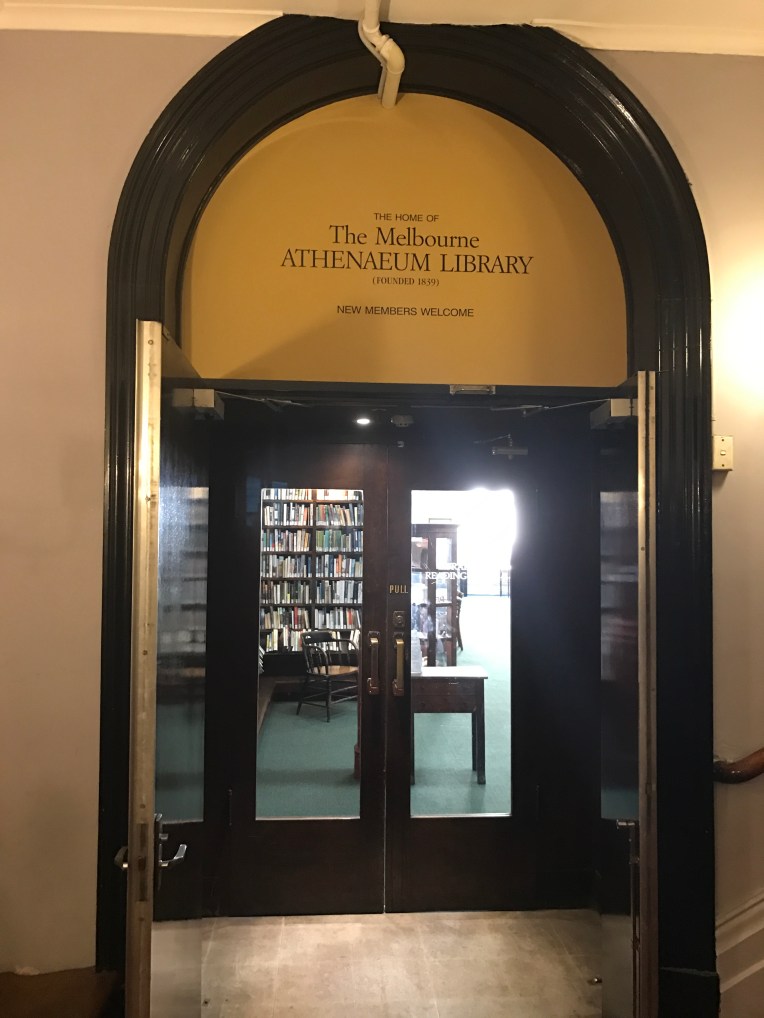
The first Mechanics’ Institute in Victoria Australia was the Melbourne Mechanics’ Institute, which was founded in 1839 and is now known as the Melbourne Athenaeum (the name was changed in 1872). Ultimately there were over 1000 Mechanics’ Institutes in Victoria at their peak, which is truly remarkable given that there was not a centralised organisation setting them up, though many did receive government funding. Most of these were in country towns and most held: a hall, a library, reading rooms, facilities for games and programs for educational activities. More than 500 remain physically, with the halls used by the local community. There are only a handful though that continue to operate as Mechanics’ Institutes. 12 are still operating from their original buildings, 10 have their original library collections, and four others  exist on other sites with their collections. Roughly 6 are still operating as a lending library service. There is even one that is still incorporated with its own act of parliament.

With this number of Mechanics’ Institutes there is no way I am going to cover them all, but I have visited quite a few and I thought I’d go through and provide a few photos and a bit of history on each of them. I am using the remarkable book These Walls Speak Volumes for the majority of the history for these sites, so if you want to know more get your hands on a copy. It covers all the Mechanics’ Institutes in Victoria. The below list is alphabetical and is only based on Institutes I have been to and have photos of.

Ballan Mechanics Institute. 

ballan

Ballan Mechanics’ Institute. The institute was established in 1860, though the current building dates to 1887. The ‘new’ building was erected in 1887 because the previous 1860 site was not central enough. In 1894 the Mechanics’ Institute had 1680 books.  The building was fully renovated in 1922. Today the building is used as the local council library as well as being used by many community groups.

Berwick Mechanics’ Institute and Free Library. 

BerwickBerwick2

Berwick Mechanics’ Institute and Free Library was founded in 1862, though the current building dates to the 1980s. Berwick didn’t have a substantial hall the way other Mechanics’ Institutes did, but they still hosted events. After the early 1900s the focus shifted to the library, a function it maintains to this day. In the 1980s Lady Casey provided funding for the construction of the new building which was completed in 1982 and the pre existing 500 year lease was extended. Berwick  holds the private library of Lord and Lady Casey as well as some of their art and an extensive general collection. It operates as a public library.  You can search their collection here. 

Briagolong Mechanics’ Institute Hall.

briagolongbriagolong1jpgBriagolong3briagolong4

Briagolong Mechanics’ Institute Hall was established in 1874 and still stands in its original building.  The hall was the first part built with the reading room and kitchen added in 1879, the third addition, including the stage, was opened in 1887. There were further additions as time went on including a 1999 addition which houses the Briagolong Community House. The library ran from 1874 for 90 years. The fact that a significant part of the original library collection survives intact is because the doors to the library were locked for some time and the books just left in there. You can see some of the remaining collection, which is housed in what was for a time the billiard room, in the photos above.

Bunyip Public Hall
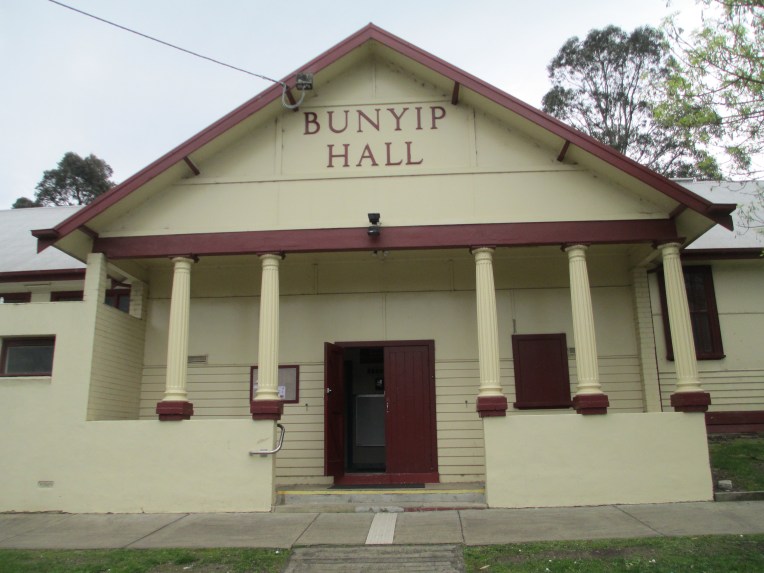
bunyipThe Mechanics’ Institute dates to 1905, but the current building was built in 1942. The hall was used for everything from ANZAC celebrations to rollerskating. The hall burnt down in 1940 but it was rebuilt, as you can see it today, by 1942. The new building is built in greek revival style and is under the ownership of the council. Today it is used for everything from tai chi to playgroups.

Glengarry Mechanics’ Institute
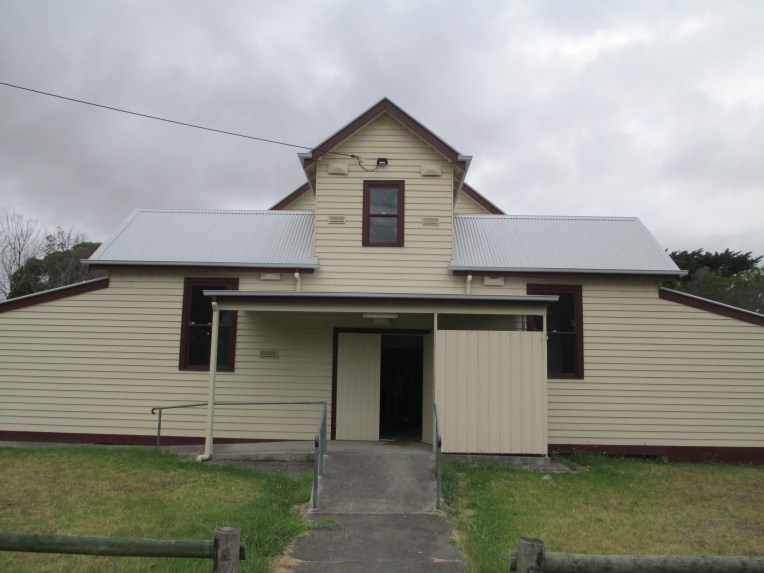
Glengarry1Glengarry2The Institute was established in 1886 and the current building dates to the 1920s. Glengarry began as a library and was much used with hundreds of people visiting the library every year in the 1800s. When the new hall was opened in 1920, it was moved across the road, it was used as a library, a picture theatre, and by many local organisations. The hall had reached a fairly degraded state, on the outside, by 2013 and funding was raised to restore the outside including the hall roof which was in a perilous state. It is still used extensively by the community today.

Longwarry Public Hall
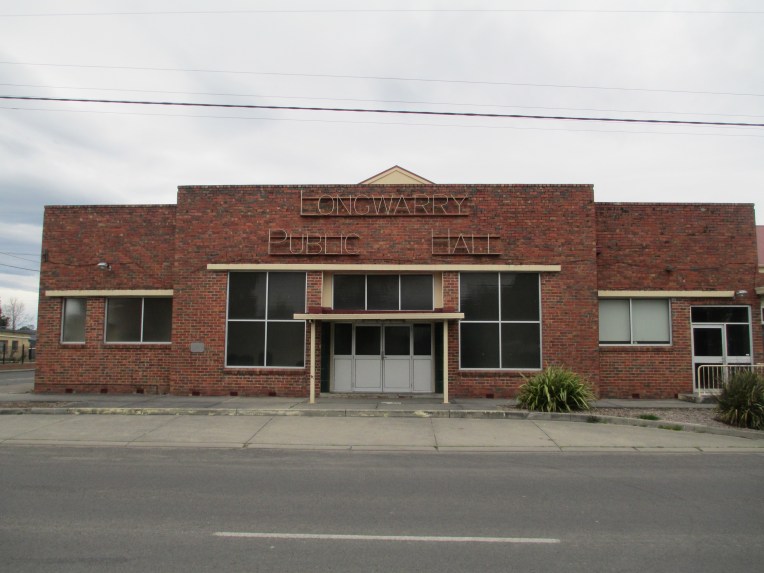
longwarryThe Longwarry Public hall, formerly Longwarry Mechanics’ Institute and Free Library, was established in 1886, and the first building built in 1889, though the current building dates mainly to the 1950s. Longwarry operated as a free library and lecture hall as well as being the home of the local brass band and health centre in the 1800s and early 1900s. The hall burnt down in the 1950s and the hall you see today was constructed, it was opened in 1953 with additions in the 1960s. In 2009 it was significantly upgraded including a new roof. It is still used by many community groups and an old time dance has been running every Monday evening and every fourth Saturday since, roughly, 1900.

Malmsbury Mechanics’ Institute

malmsbury

Founded in 1862, the current building dates to 1876. This is the original Malmsbury building though. Due to various factors, including lack of funds and council involvement, the building wasn’t completed till 1876 despite the institute being founded years earlier. Malmsbury was still functioning as a Mechanics’ Institute in 1919, including a library, but by World War II the building had largely fallen into disuse and for a while it was used as a bank branch. The Shire now owns the building and it is the home of the historical society, as well as various community events.

Meeniyan  Hall
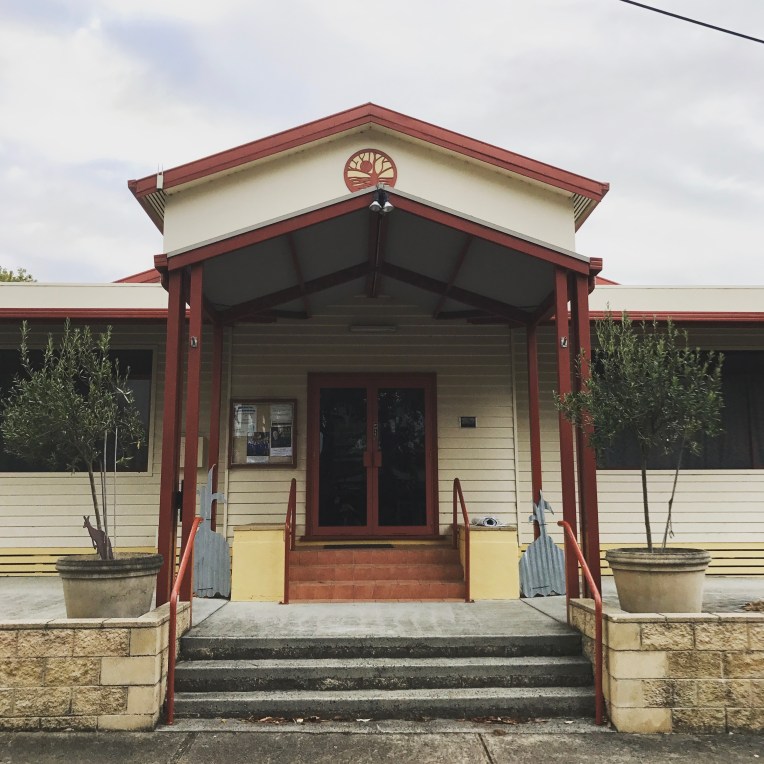
meeniyan1meeniyan2

Meeniyan Hall, formerly Meeniyan Mechanics’ Institute, was established in 1892, but the current building dates to 1939. The hall was never a library and it was mainly used for visiting entertainers and for music lessons. The building burnt down in 1938, but a new hall was built and opened in 1939. It was used for local dances in 1960s often holding as many as 600 people. It is currently used for a wide variety of community programs, including the inaugural Meeniyan Garlic Festival in 2017. The hall was the home of the Garlic institute and you can see the crowds attracted in the photo above.

Melbourne
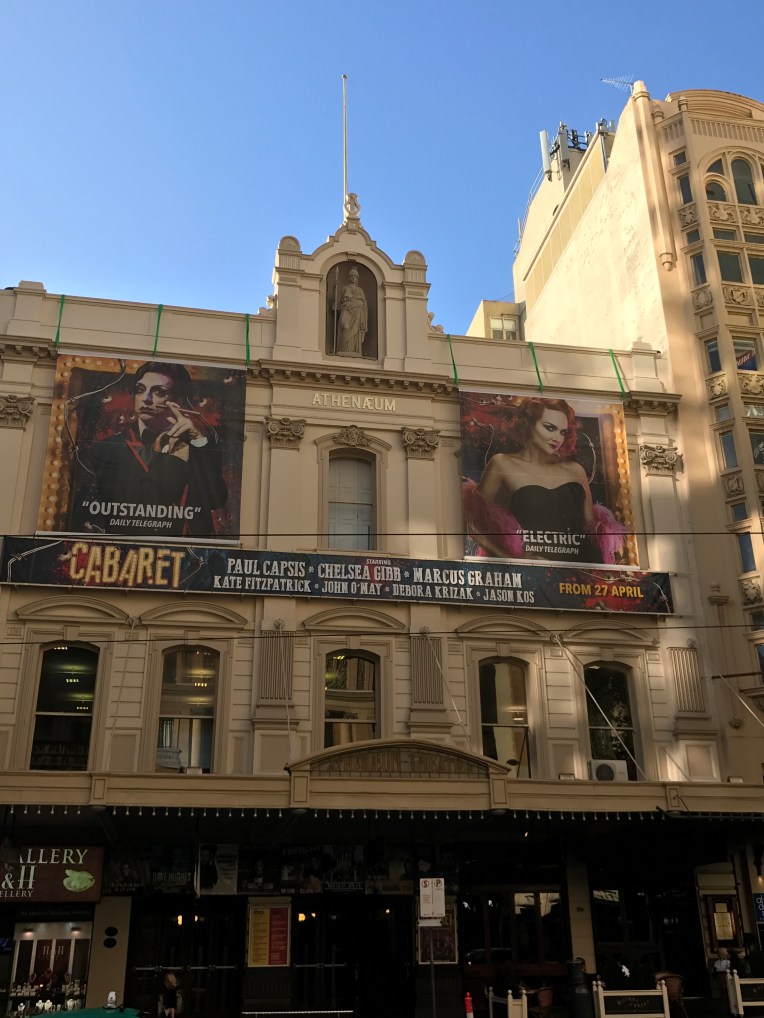
IMG_0584IMG_0578IMG_0579

The earliest Mechanics’ Institute in Melbourne. The Melbourne Mechanics’ Institute was founded in 1839 and the current building dates to 1886. The original library, and collection of scientific specimens, was housed in rented accommodation. A permanent hall was built in 1842, but the programs offered including: entertainments, political and business meetings, social gatherings and church services proved to be so popular that it was decided that a bigger building was needed. The funds weren’t found until the 1870s and in 1872 the new facilities were opened, including a 100 foot long hall and significant space for the library upstairs. At the same time it was decided to change the name to the Melbourne Athenaeum. In 1886 the building was significantly remodelled, including the facade, which you can see today. In the early 1900s it was determined that a theatre was needed and the Athenaeum Theatre, built inside the old hall, was completed in 1924. The theatre is still very much in use today by acts from all over the world and is one of Melbourne’s most popular venues. The library is also still in existence and runs as a subscription library. You can search their collection here.

Port Fairy Library and Lecture Hall

portfairy

IMG_0463Founded in 1860 and the current building dates to 1865. A library was functioning in Belfast, as it was then known, as early as 1856 but an institute wasn’t officially formed until 1860. In 1864 land was granted by James Atkinson to build a library for Belfast and it has remained in the same position since it was opened in 1865. The Lecture Hall next door was also opened at roughly the same time. The library is now used as the public library, after 120 years of independent operation it joined the Corangamite Shire libraries in 1981. The lecture hall is used by lots of community groups including the local theatre group and the spring festival.

Prahran Mechanics’ Institute. 

IMG_0593IMG_0588IMG_0016IMG_0017IMG_0018

The Prahran Mechanics Institute was founded in 1854 though the building they currently reside in, a converted 1960s fabric factory, was not their home until 2015. The original building was in Chapel Street and is still owned by the institute, though it is rented out as shops.

The PMI started as a lending library and as an institute for education and lectures. Due to a dispute with the the Secretary/Librarian in the mid 1800s (he wouldn’t vacate the building and the roof of the institute was removed to force him to leave) and the neglect of another secretary/librarian in the late 1800s the PMI building was rebuilt onsite in 1900. However there was not enough space, so in 1915 they moved to High Street in Prahran, also starting the Prahran Technical School (this building can be seen in the photo above). In the 1980s a decision was made to move away from being simply a general collection library to being a library which specialised in Victorian history.

This specialisation continues today with the PMI holding a collection of over 30 000 books and being dedicated to preserving the history of Victoria. In 2009 space was desperately need for the rapidly expanding collection. So the PMI sought to end the 99 year peppercorn lease which allowed to Minister for Education to use the buildings that formerly held the Prahran Technical School, which was now being used by Swinburne University. The Minster agreed to relinquish the lease if the PMI sold their High Street building to Swinburne University. They did and moved around the corner to St Edmonds Road into a more modern building with the extensive space that the collection needed (you can see the exterior and interior of the new building in the photos above). The PMI is still functioning under its original rules and incorporation and is the only Mechanics’ Institute in Victoria which has its own Act of Parliament for its incorporation. It is run by a committee with four professional staff running the library. You can check out their catalogue here

Rosedale Mechanics’ Institute Hall

rosedalerosedale3

The Rosedale Mechanics’ Institute was established in 1863 and the current building dates to 1874. Rosedale began operating in 1868 in rented premises and the original form of the current building was built in 1874 after being designed by William Allen. Rosedale was originally called The Mechanics’ Institute and Library and Scientific Association. It contained a surprisingly large hall, a stage, a supper room, several meeting rooms and a library. The stage was removed at some point and an extension with toilets added in roughly the 1950s. The hall was also extended fairly early in the process, you can see the addition in the photo above, and much later a floating ceiling was added. The hall used to house the public library, but it was moved. It is now home to the op shop and is used by community groups.

Stratford Mechanics’ Institute.

stratfordStratford2The Stratford Mechanics’ Institute was founded in 1866 and the current building was constructed in 1888. When it was originally founded Stratford lapsed very quickly and another attempt to form a Mechanics’ Institute was tried in 1874, which didn’t work either. However, by 1882 a committee was formed and the library was set up in the shire hall and books bought. By 1888 they’d built the existing hall. In the 1950s a spectacularly ugly addition was built on the beautiful 1800s facade. It mainly housed toilets. In the early 2000s, through fundraising and government grants, the hall was restored to its former 1800s glory. It is run by an active committee and is the home to many local events, including the parts of the Stratford Shakespeare festival.

Toongabbie Mechanics’ Institute.

Toongabbie1toongabbie

Toongabbie Mechanics’ Institute was established in 1883 and the building you see today was also constructed in 1883. It was a fascinating example of a two story weatherboard construction from this period. The second story was a 1890s rear extension. The hall contains a stage, where many local performances were held, and was home to a library. There are also a number of smaller rooms in the two story extension. It was used as the local Court of Petty Sessions and as a bank. By 1983 the building was in extremely poor condition and it had been suggested that burning it down was the best option. Thankfully the local community rallied and with government funding it was saved. Now it is used for everything from weddings, to school concerts, to old time dances.

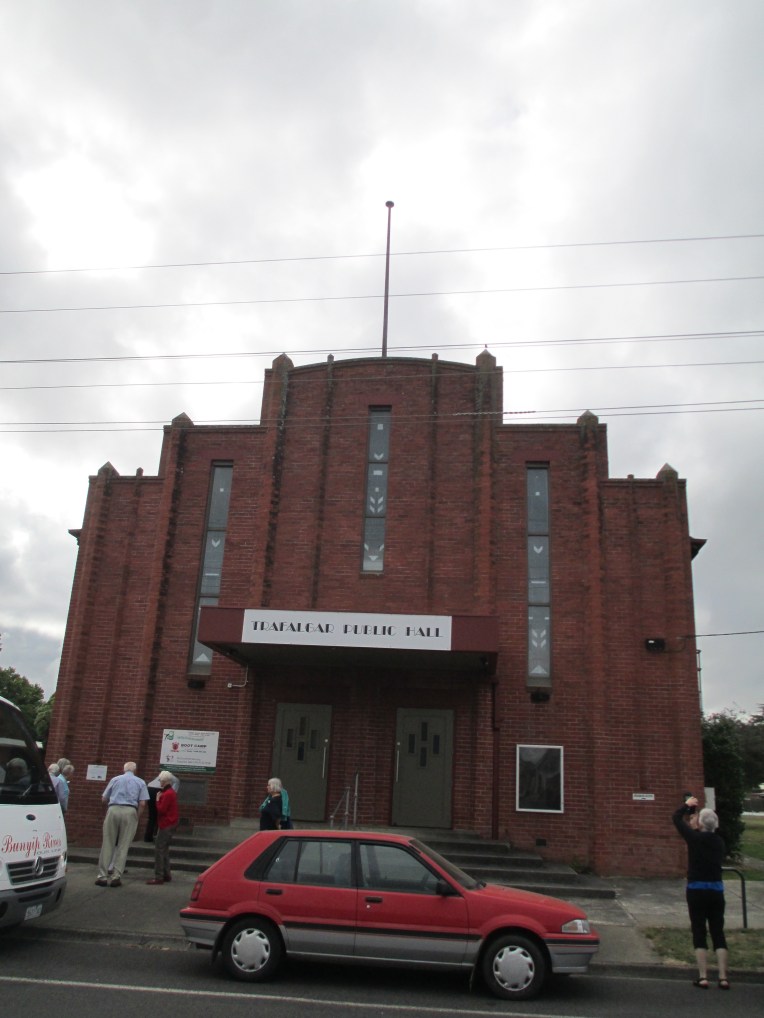
Trafalgar Public Hall
Traflagar1traflagr2

The Trafalgar Public Hall, formerly the Trafalgar Mechanics’ Institute and Free Library, was founded in 1889, though the current building dates to 1935.  The original hall operated as free library and it was rebuilt in 1908 when it became the home of the Naracan Shire. The hall became the focus of the community with traveling shows performing there and it was used as a library and a dance hall. The hall and all its contents were destroyed in a massive fire in 1934 and a new hall was finished by 1935. The new hall contained a bio cabin for the showing of movies. There was also a library, but by 1957 this had become a kiosk, and by 1964 a ladies toilet. The hall was used for everything from badminton to school concerts and is now the home of the local amateur dramatic society as well a number of other community uses including weddings and family reunions.


So that’s the end of my collection of Mechanics’ Institute photos and information. As I stated, this is by no means anywhere near all the Mechanics’ Institutes in Victoria and they can be found in other states as well as all over the United Kingdom and in Canada and America. As a concept they are a fascinating example of communities helping themselves and coming together. Even if many of the institutes themselves don’t survive today the halls are still very much at the heart of the community.

References.

Site visits, 2017, 2016 and 2015.

http://www.pmi.net.au/home/timeline/

http://www.pmi.net.au/home/mihistory/

http://home.vicnet.net.au/~mivic/

http://www.melbourneathenaeum.org.au/

http://www.berwickmilibrary.org.au/

These Walls Speak Volumes: A history of Mechanics’ Institutes in Victoria by Pam Baragwanath and Ken James ISBN: 9780992308780 you can borrow it from the Prahran Mechanics’ Institute Victorian History Library here library.pmi.net.au/fullRecord.jsp?recno=23726


The photos are all mine.


Disclaimer: I work at the PMI Victorian History Library.

Cemeteries: Port Fairy

img_9133Port Fairy is a town in Western Victoria that was founded as a town in 1843. There were settlers in the area before this date, and the current name for the town comes from the ship the Fairy which is believed to have arrived in the area in c.1828. The area was also regularly visited by whalers and sealers. The date of 1843 comes from the special survey which was granted to James Atkinson at that time. The special surveys were a system where the government of the Colony of New South Wales was able to control ownership of the land in the Port Phillip District. This was well before federation of Australia as a country in 1901, but also before Victoria became a colony independent from New South Wales which happened in 1851. The basic premise behind the special survey system was to stop squatters just claiming land, because when they did there was little ability to regulate it and there was no fee for the government.
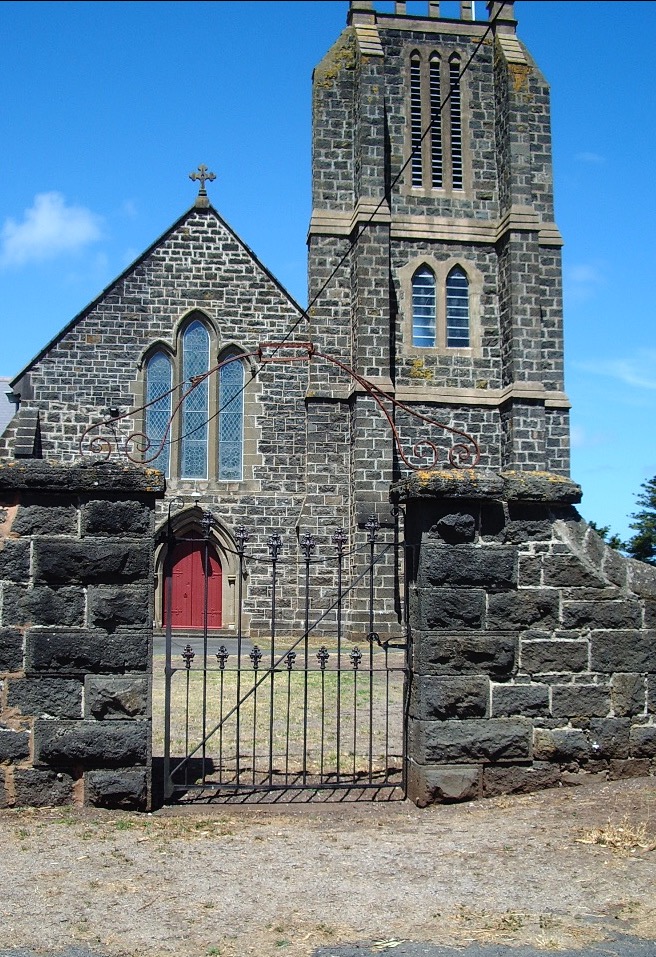
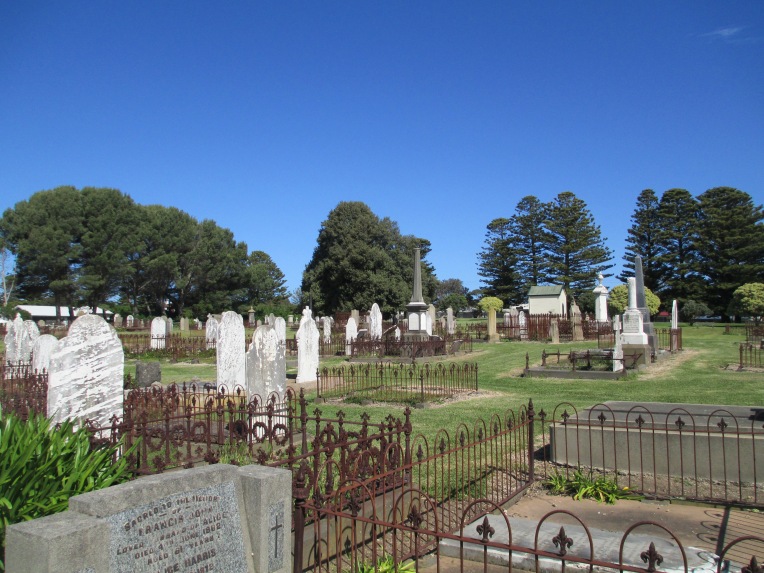
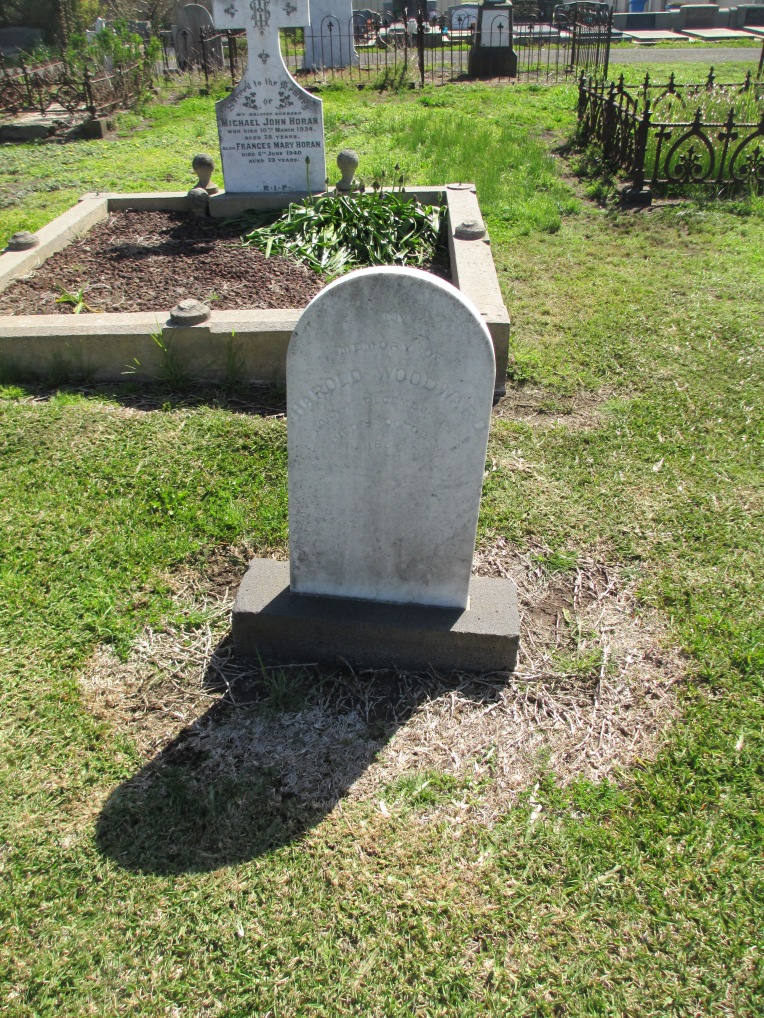
Atkinson arrived in Sydney in 1830 from Ireland and became a prominent and well connected member of Sydney society, at least partly due to his family connections to Colonel Charles Wall of the 3rd Buff regiment who was married to his sister. As he had a high social standing he couldn’t use trade to make money, so he turned to land. He was granted the right to the special survey of the Port Fairy region in 1843. He worked with the existing settlers, but also moved to attract new settlers to the town he named Belfast. He most likely applied for the special survey rights to the land without ever seeing it, as there is no evidence he set foot there before arriving in 1846 with his wife and seven children. He offered very long term leases for land in the town he established, but while he was definitely trying to encourage settlement he was not immediately successful. In 1848 he appointed his nephew (and my great, great, great, grandfather) Robert Henry Woodward, who was farming in the area, as his land agent. Woodward was 25 and oversaw the majority of the establishment of the town proper. It was also Woodward who oversaw, with the blessing of Atkinson, the gifting of parcels of land within the town for churches of different denominations and for community purposes, such as a post office, a hospital, government offices, public wharves, a savings bank, a town hall, public meeting places and a cemetery.

IMGP2243.JPG

St John’s Anglican Church Port Fairy built between 1854 and 1856. It was the first church in Victoria to have a chancel. The tower was added later in the 1950s.

Atkinson did not remain in Belfast, returning to Sydney and to Ireland, but he did visit to survey the progress of the town in 1859, 1861 and 1864. Atkinson died in Sydney in 1864, though Woodward continued to administer the lands until 1869. The town petitioned, successfully, to change its name to Port Fairy in 1886

Before continuing to discuss the cemetery I would also like to acknowledge the indigenous people of the land which Atkinson bought as the special survey. This area was the land of the Gunditjmara people. If, when Atkinson arrived, there seemed to be a lack of indigenous inhabitants it is not because there wasn’t any ever, but because between the 1830s and the 1840s the indigenous population of the area was destroyed by settlers. A monument to them now stands in Port Fairy on Bank Street. It reads:

In memory of the thousands of aboriginal people who were massacred between 1837 and 1844 in this area of Port Fairy.

Today we pay our respects to them for the unnecessary sacrifices they made.

Your spirit still lives on within our people.  Wuwuurk

This was not isolated to the Port Fairy area. The early history of Western Victoria is mired in bloodshed. A list of the frontier wars in which the indigenous population were by and large overwhelmed and destroyed by superior western weaponry can be seen here.

http://www.australianfrontierconflicts.com.au/index.php/conflicts/chronology/vic

It was also a time of severe retaliations against any interference with livestock and systematic killings, taking of land of the beginning of the removal of children. Not to mention the introduction of alcohol and western disease and their long term affects. This article from the Warrnambool local paper The Standard out lines clearly the actions against the local indigenous population

http://www.standard.net.au/story/792108/the-south-wests-bloody-past/

It is essential that the past of indigenous Australians and the brutal suppression of them is recognised as part of the history of Victoria and Australia. This is especially true when discussing somewhere like a cemetery which provides concrete and tangible records of the deaths of early pioneers, a record that is not available for the deaths of the indigenous population.

img_9148

Port Fairy cemetery was founded in the 1850s. There is confusion as to whether it is the ‘old’ or ‘new’ cemetery as many descriptions seem to use the term interchangeably. The other cemetery at Port Fairy was laid out by Robert Hoddle, famous for Melbourne’s CBD grid, at the orders of Governor La Trobe. This other cemetery was in the sand hills out of town, was discontinued and little survives today. The current Port Fairy cemetery has many very early burials and is believed to be one of the first cemeteries in Victoria to have adopted the concept of a lawn cemetery.

The earliest burials in the cemetery are of the local pioneers and their families. These people are often listed as from a local ‘station’ on their tombstones. The pioneers of the area did not have an easy life and as such there are a high number of young burials, very few survived to old age. One of the earliest and one of the youngest is the grave of Harold Woodward, a son of Robert Henry Woodward and his wife Letitia Wall (daughter of Colonel Wall). Harold died on the 8th of October 1856, but was only born on the 4th of December 1855. img_9147

Of Robert Henry and Letitia Woodward’s 11 children Harold was the only one to meet such an early end. I am descended from his brother Albert William Woodward, the youngest of Robert Henry and Letitia’s  children. Robert Henry and Letitia are buried in St Kilda Cemetery.

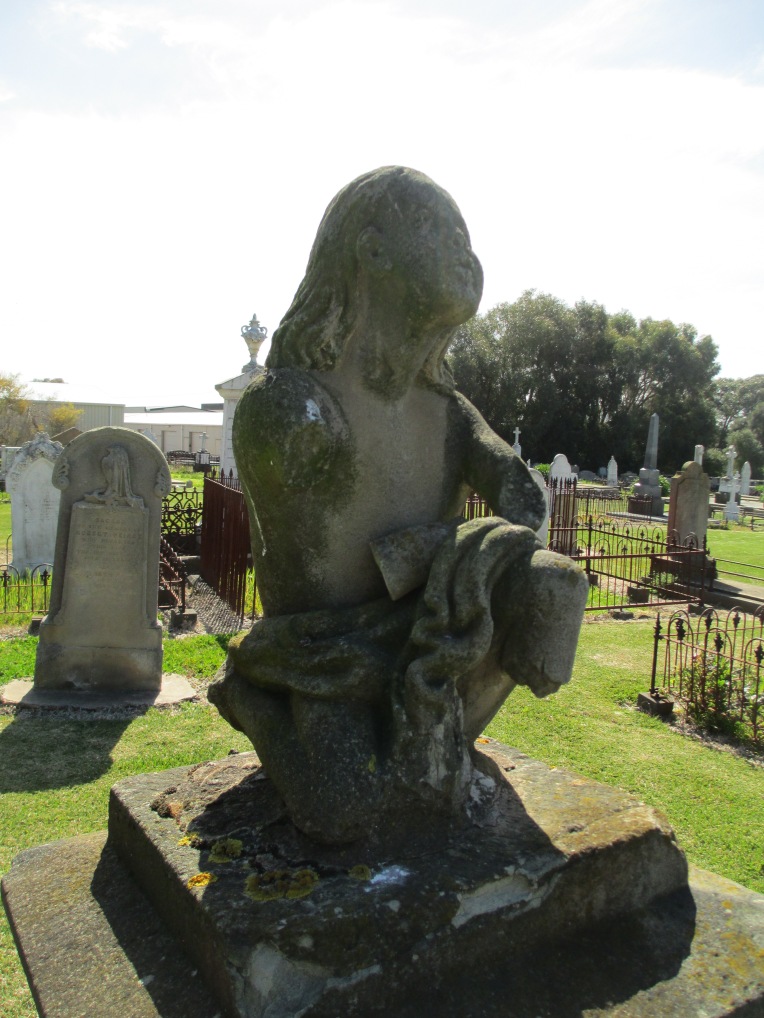
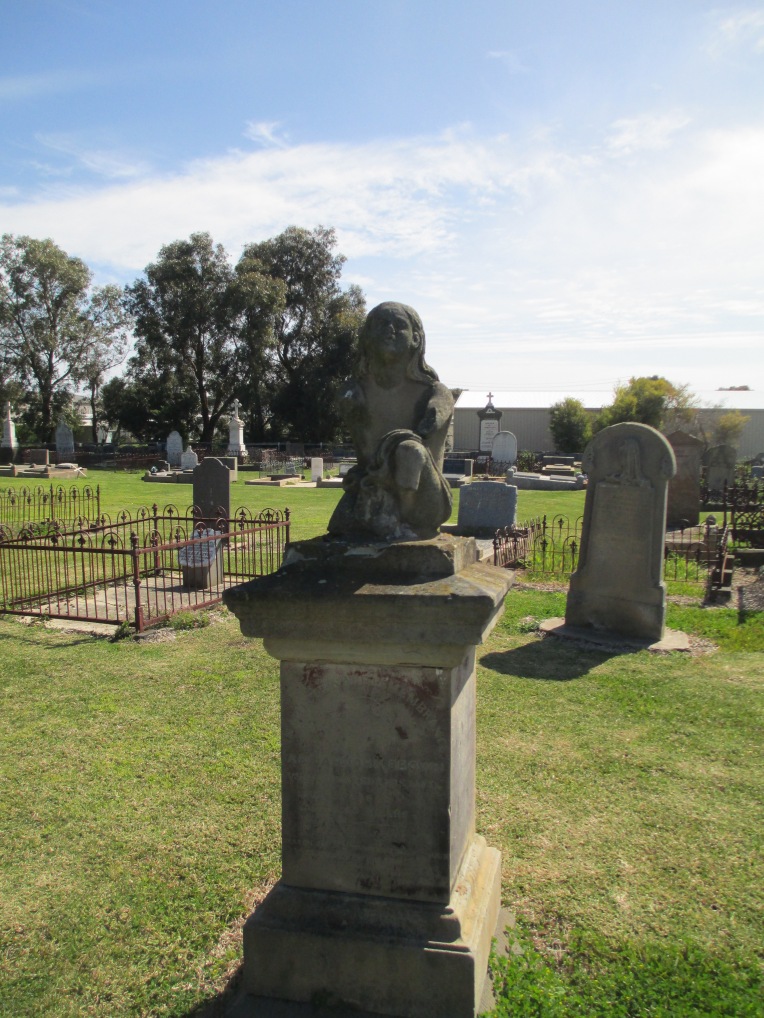
Much of the stone in the cemetery displays intricate examples of early stone masonry. The best example of which is probably the tomb of Abijah Brown.img_9146img_9144He died in 1862 at the age of 40 and the tomb reads:
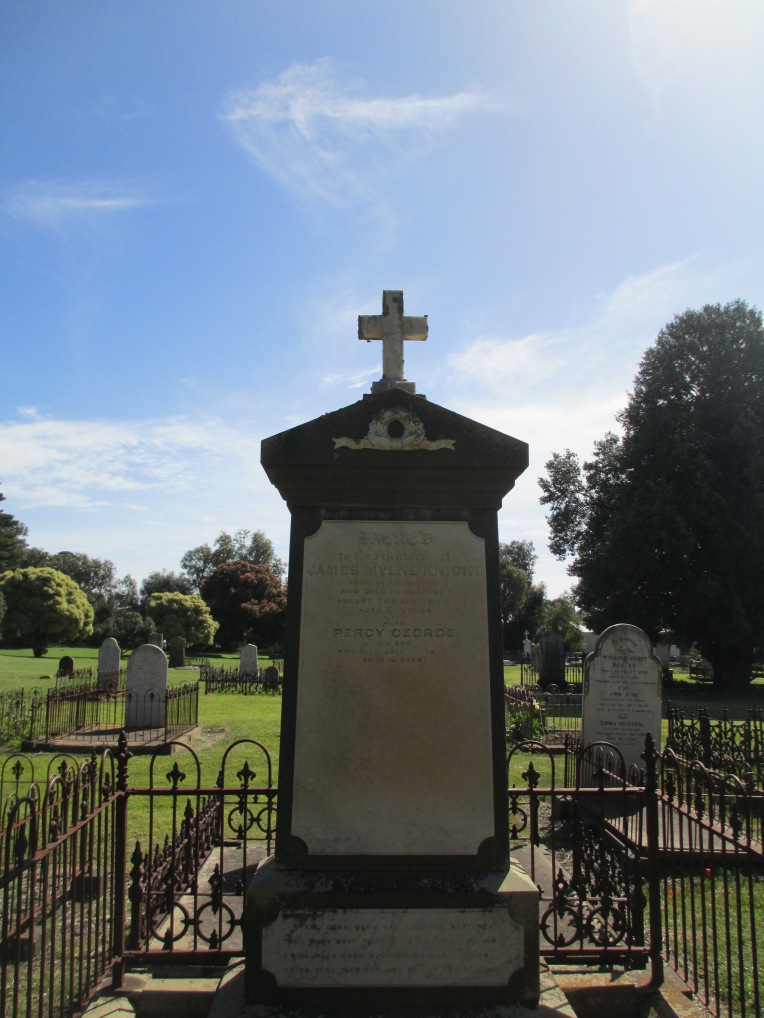
In affectionate memory of Abijah John Brown who departed this life July 19th 1862 aged 40 years. Watch for ye know not what hour your Lord doth come. 

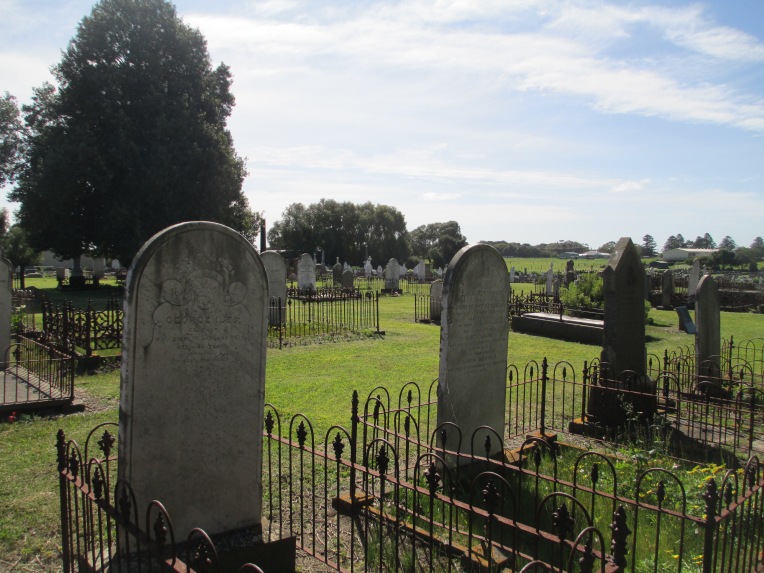
It is an interesting monument because it does not fit any regular pattern seen in Victorian era funeral monuments. It is a, sadly much worn, figure of a young man looking skywards. This man is not an angel or a cherub but a person. It is also a remarkable piece of sculpture in its own right. The Brown tomb is not alone is being striking in the cemetery. The older section of the cemetery is a combination of plain and ornate funeral monuments. Some can be seen in the photos below.

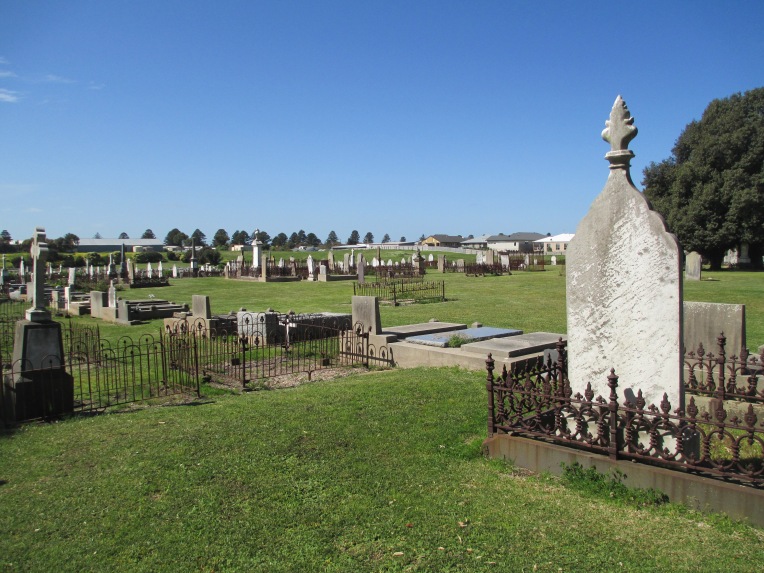
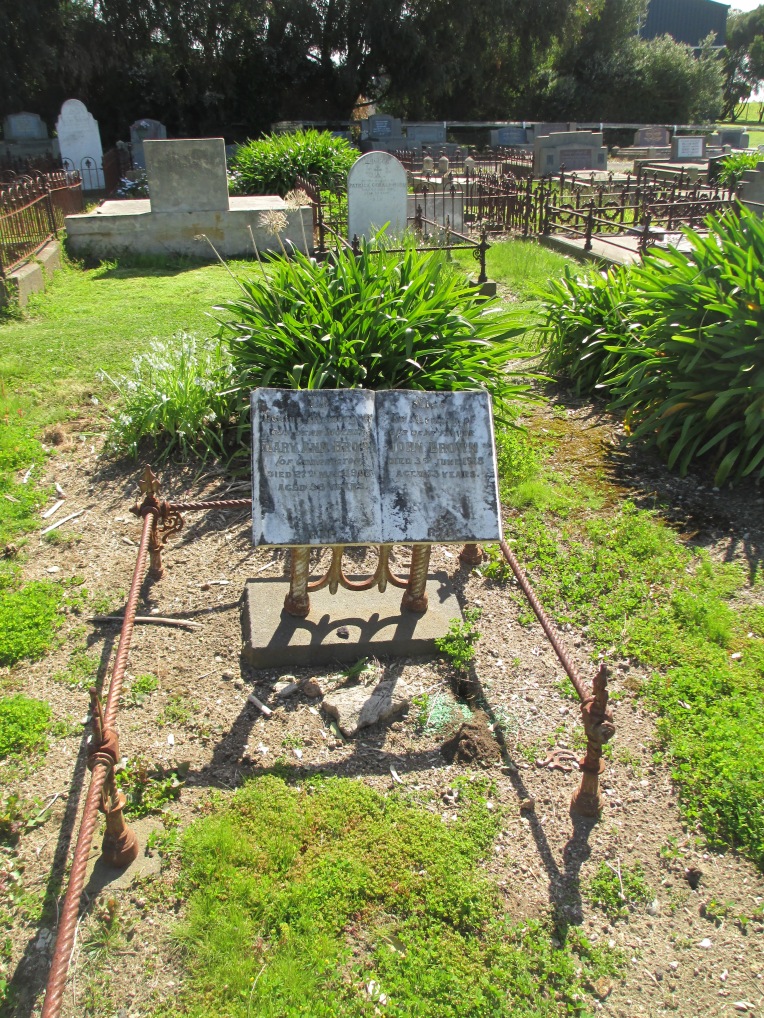
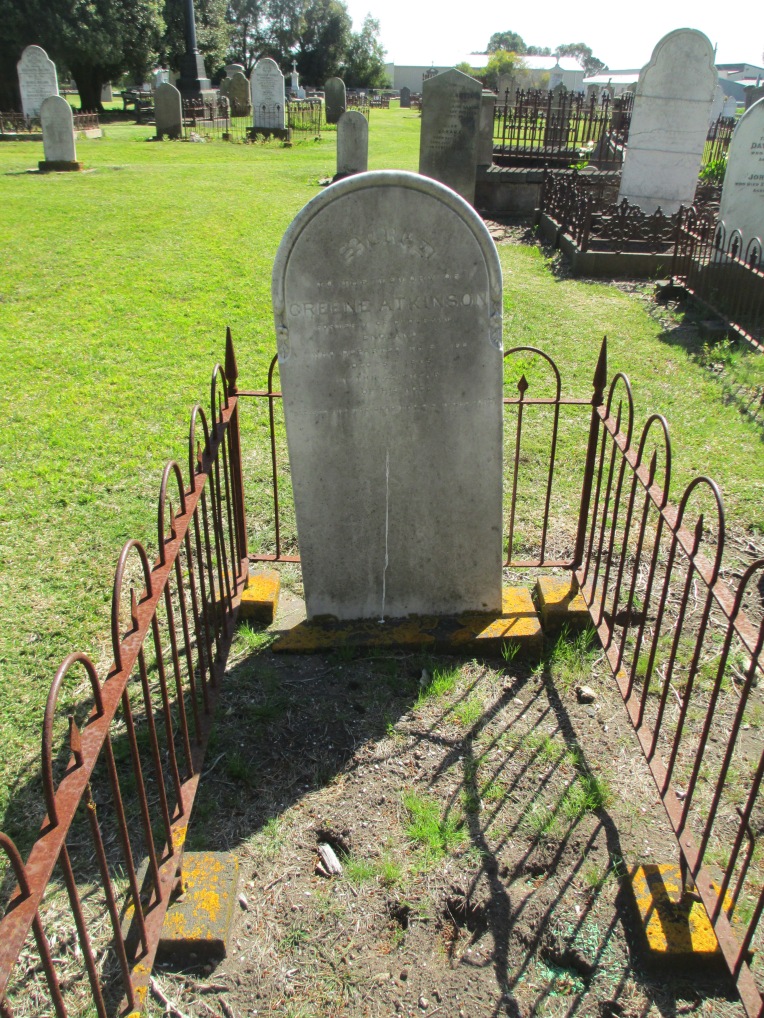
img_9140img_9141img_9150img_9143There are more people buried in the cemetery than are known about. Many of the early burials would have been laid to rest under simple wood crosses and these simply wouldn’t have survived the harshness of Port Fairy’s coastal weather. Despite this, the surviving burials provide a fascinating record of the life and death of the early inhabitants of the district.

References:

http://www.ohta.org.au/organs/organs/StJohnsPortFairy.html

http://www.portfairypubliccemetery.com.au/

An Historic Graveyard: Some early records of Port Fairy Cemetery by P. Frazer Simons.

A Special Survey: Aspects of the development of Port Fairy from 1843. Edited by Rod Collins.

Both books can be borrowed from the Prahran Mechanics Institute Victorian History Library

The photos are all mine.

Cemeteries: Tower Hill

Tower Hill Cemetery lies between Port Fairy and Warrnambool in Western Victoria.

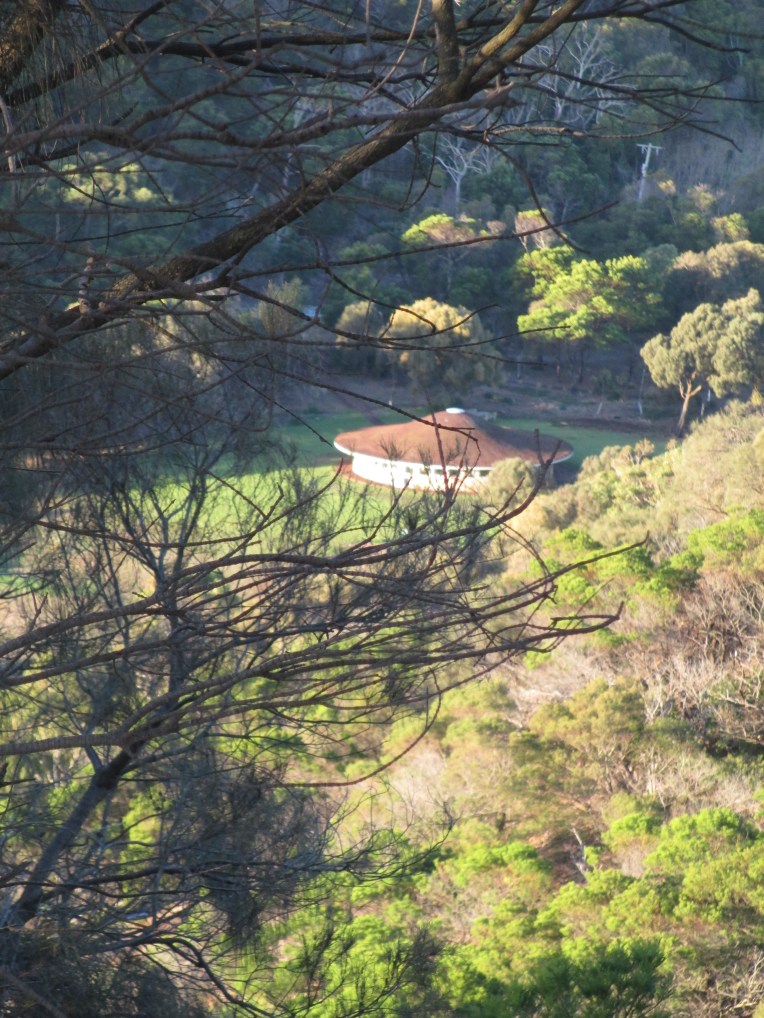
img_9230Tower Hill itself is a former volcano not far from Port Fairy and about 3 hours drive west of Melbourne. You can see the view looking over the remains of the Tower Hill crater and looking out towards the sea from the top of Tower Hill in the photos below.
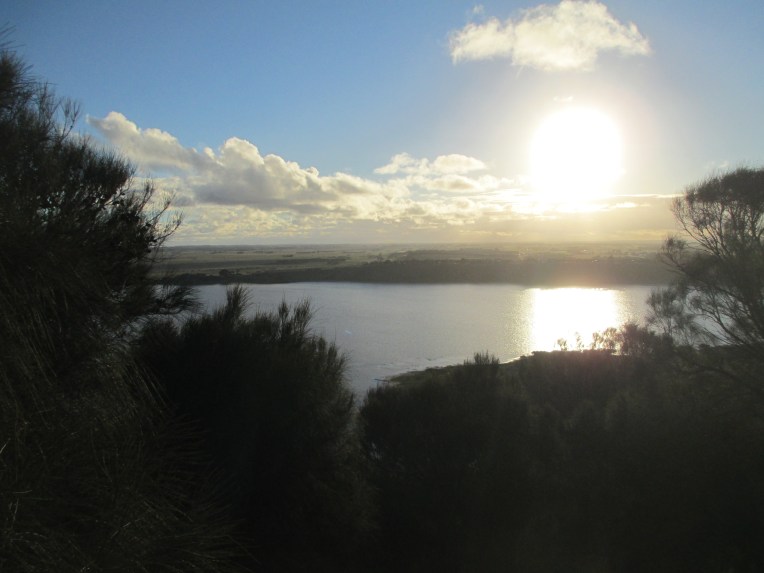
img_1206img_1212

Tower hill itself is not really a town, though there are a few houses around it. Tower Hill was first sighted by Europeans in 1802, the sighting was made by the Frenchmen in the ship the Geographe, but it wasn’t surveyed until 1846. In the surveys conducted between 1846 and 1850 it is described as heavily wooded, with descriptions of ferns and large trees. It was also a favourite site of settler James Dawson of the near by Kangatong station. He had it painted in oils in 1855 so he could show others how beautiful it was. The painting was done by Eugene Von Guerard and you can see the view from the lookout point he painted it from below.

IMG_2581

However between 1857 and 1860 the hill itself and the surrounding area was heavily deforested, mainly for the use of the timber but also for grazing. This use of the land continued until 1961 when Tower Hill was proclaimed Victoria’s seventh state wildlife reserve. There has been significant re planting done since.

I would like to pause in the ongoing narrative of Tower Hill at this point to discuss its pre-European importance. When Tower Hill was first sighted by Europeans it was certainly not an unknown hill. For the local Koroitgundij people it is a site of great importance and their ancestors undoubtably would have witnessed the eruption that created the funnel shaped crater 30 000 years ago. Today there is the Worn Gundidj  visitor’s centre in the middle of Tower Hill which tells the indigenous history of the site.  You can see the visitor’s centre in the picture below.

img_1208

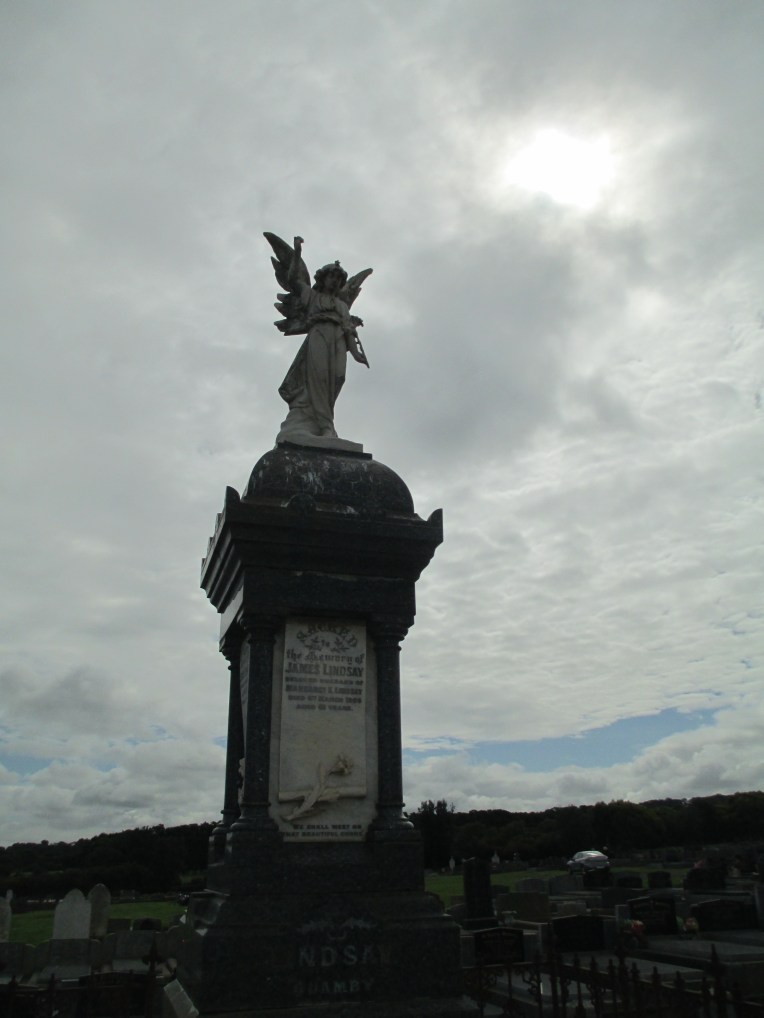
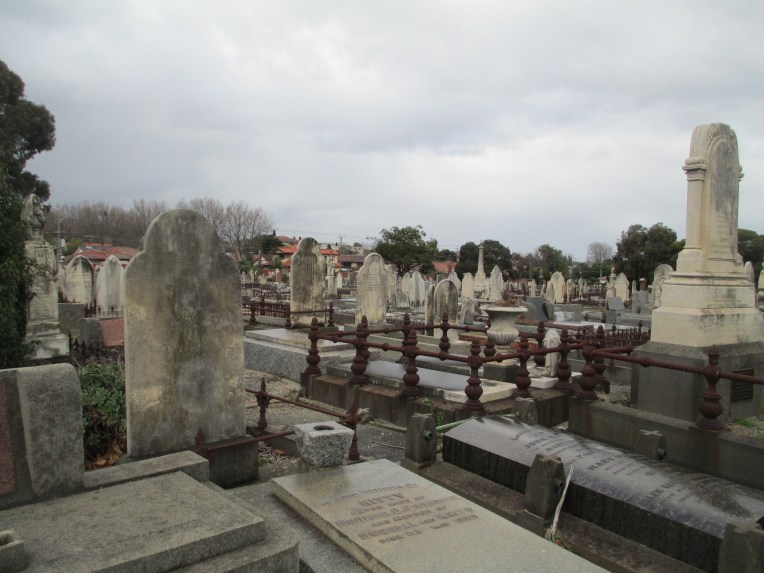
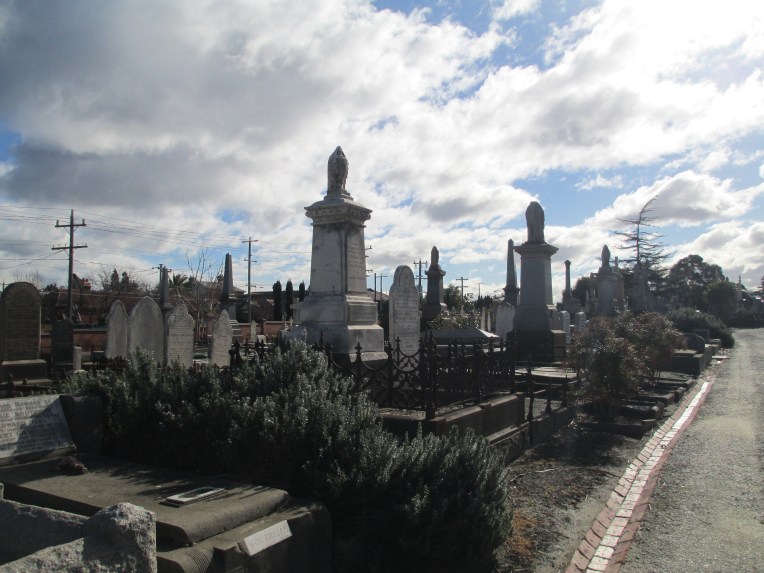
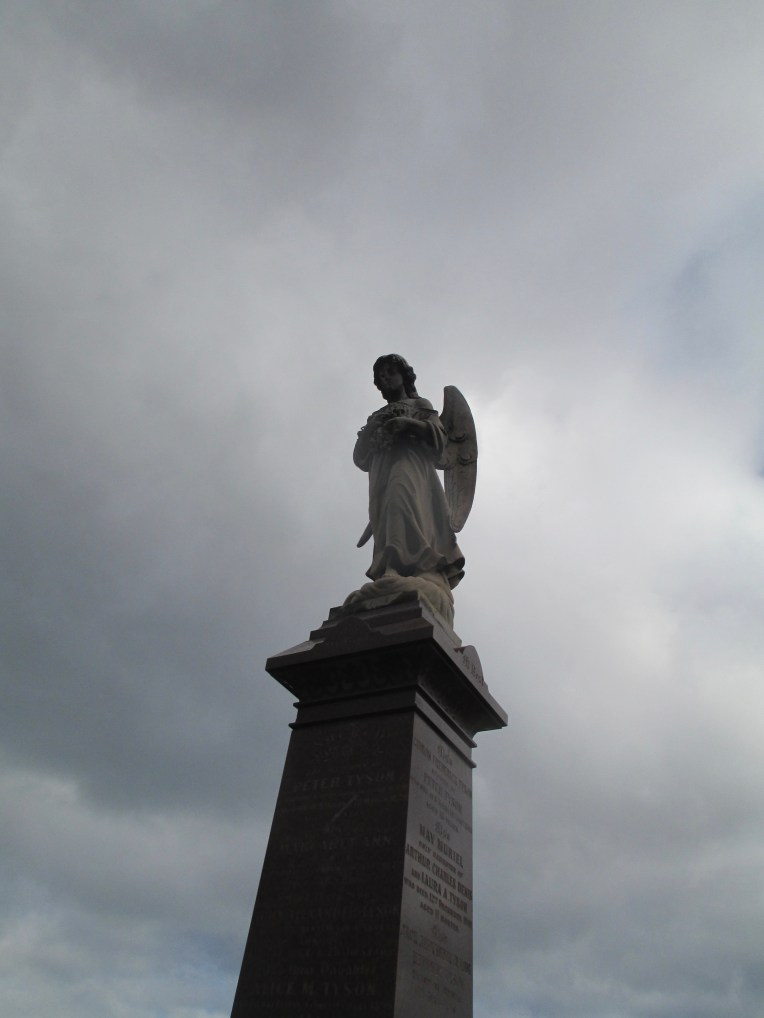
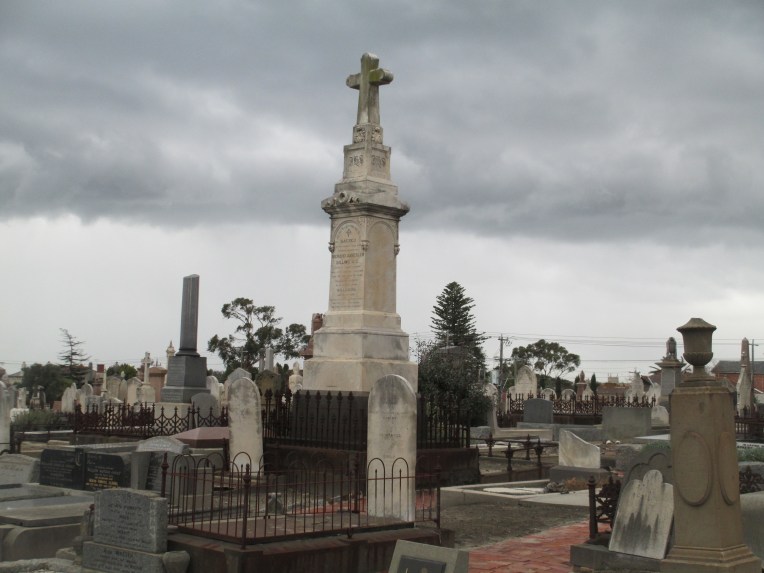
The cemetery at Tower Hill stands at the base of the hill’s slope. It was established in 1856 and contains some of the most impressive monuments for a cemetery of its size that I’ve ever seen.

img_9226

img_9208-1

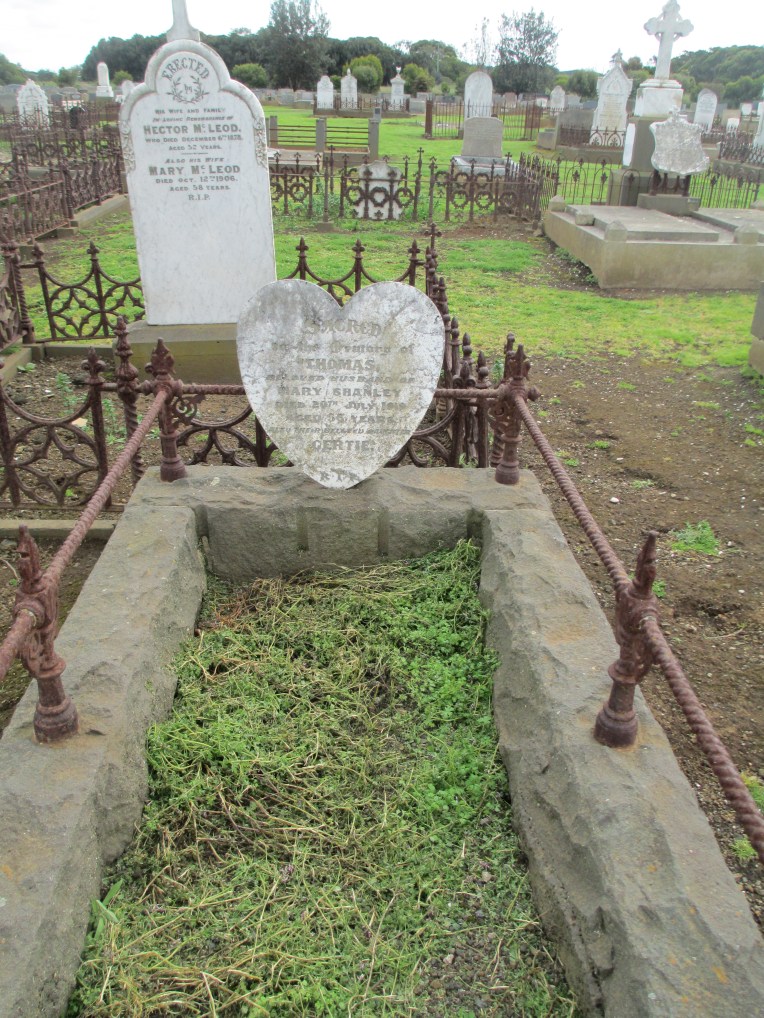
The monuments range from small, such as the heart shaped stone below.

img_9194

To the significantly more dramatic

img_9206img_9201img_9192

img_9195

There are a number of interesting people buried at Tower Hill, but I thought I’d briefly discuss a man whose death was a key part of Australian labour history. William John Mclean was the first person to die for the union movement in Australia. Known as Billy Mclean he was born in 1869 and lived in Koroit, a small town very near Tower Hill. In the late 1800s the nearby town Port Fairy was one of Australia’s most important international ports, though you certainly wouldn’t know it now.

imgp2398

Port Fairy

As an important port much of the wool shorn in areas as far away as southern NSW was taken by the river system and bullock drays to Port Fairy for transportation. Shearers would hitch rides with the bullock drays back in the opposite direction for the shearing season. Billy Mclean was one such shearer. The shearers often endured awful conditions and pretty terrible pay at the same time as being forced to pay exorbitant prices for food from stores that were owned by the stations. As such there were a number of shearer strikes. On the 26th of August 1894 in NSW the paddle steamer Rodney was transporting a non union labor force up the Darling River to work at the near by station of Tolarno. Many of the river captains refused to support the pastoralists by bringing in non union labour to try to break the strikes. Captain Dickson of the Rodney was not one of them. The paddle steamer was set upon by striking shearers and after the non union labour and the crew had been removed from the boat, the shearers doused it in kerosene and burnt to the water line.

The afternoon of the same day, a little further up river, Billy Mclean was one of about fifty shearers who were headed for Grassmere station near Willcannia where it was believed that non union workers from New Zealand had been brought in. Mclean was one of the first to enter the shearing shed and he was shot in the lung, one of his mates Jack Murphy was also shot. Neither died on the scene and they were arrested by the police on the way back to the strike camp. There is definite argument that the shooting was retaliation for the burning of the Rodney earlier that morning.

Mclean was tried and convicted of unlawful assembly, sentenced to 3 years hard labour and sent to Goulburn gaol. In the cold of the prison and never having recovered from his injury Mclean developed tuberculosis of the lung and was sent home to his mother to die, so it couldn’t be said he died in gaol. He died in 1896. He was 26. The man who shot him was never tried and was given a medal by the pastoralists association.

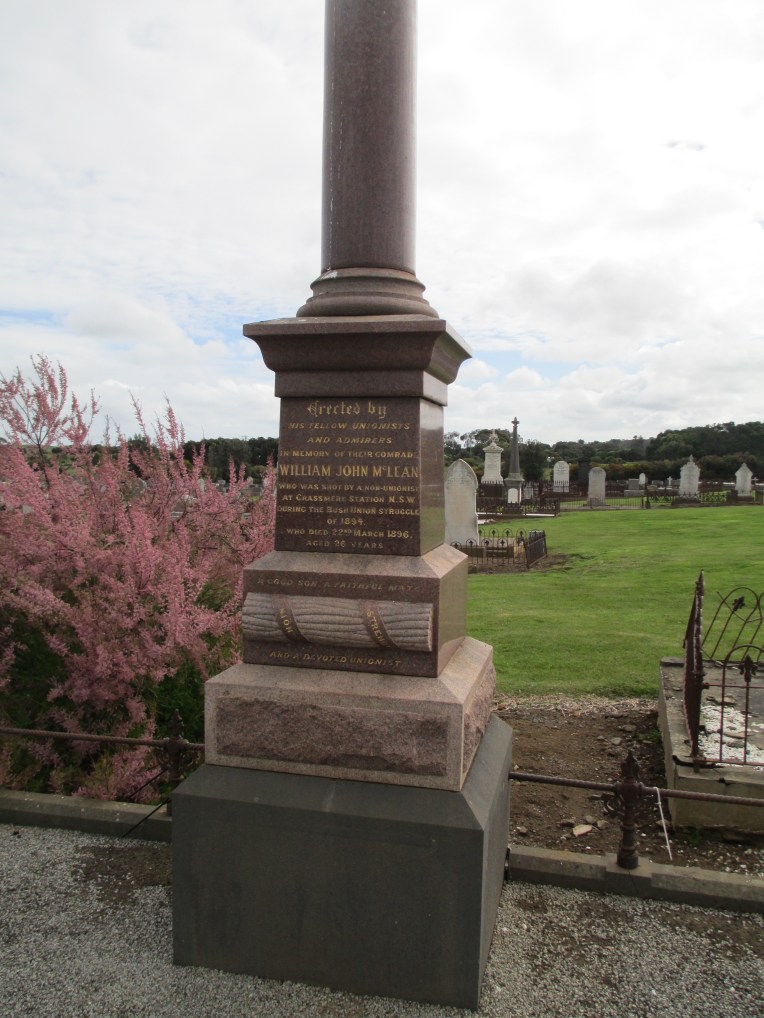
The other shearers rallied round Mclean’s mother and raised 90 pounds for the erection of the monument over his grave. It still stands in Tower Hill Cemetery today and is 14 feet high. You can see it in the photos below.

img_9211

img_9210The epitaph reads

ERECTED BY

HIS FELLOW UNIONISTS

AND ADMIRERS

IN MEMORY OF THEIR COMRADE,

WILLIAM JOHN McLEAN WHO WAS SHOT BY A NON-UNIONIST

AT GRASSMERE STATION, N.S.W.,

DURING THE STRUGGLE OF 1894,

AND WHO DIED 22nd MARCH, 1896,

AGED 26 YEARS,

A GOOD SON, A FAITHFUL MATE, AND A DEVOTED UNIONIST, UNION IS STRENGTH.

Donald MacDonald, the general secretary of the AWU wrote to Henry Lawson asking him to compose the epitaph. It is not known if Lawson did or not.

For more information on Mclean and the shearers’ strikes see…

http://ro.uow.edu.au/cgi/viewcontent.cgi?article=1007&context=unity

Billy Mclean is only one of a number of fascinating people buried at Tower Hill Cemetery. Alongside the outstanding individual monuments Tower Hill Cemetery also houses several groups of matching monuments such as those that you can see below. img_9220

As with many cemeteries of this era, there is a distressingly large number of young deaths and whole families. You see the same surnames repeated over and over, showing the long term connection to the area.

img_9213

My next post will be on the nearby Port Fairy Cemetery.

References

Billy Mclean: http://ro.uow.edu.au/cgi/viewcontent.cgi?article=1007&context=unity

Tower Hill: Victoria’s heritage. http://parkweb.vic.gov.au/__data/assets/pdf_file/0007/315547/Heritage-story-Tower-Hill-Reserve-history-and-heritage.pdf

Books:

Tower Hill: What happened at Tower Hill? Fisheries and Wildlife Dept 1960.

Tower Hill by M.C Downes.

Both books can be found at the Prahran Mechanics’ Institute Victorian History Library.

The photos are all mine.

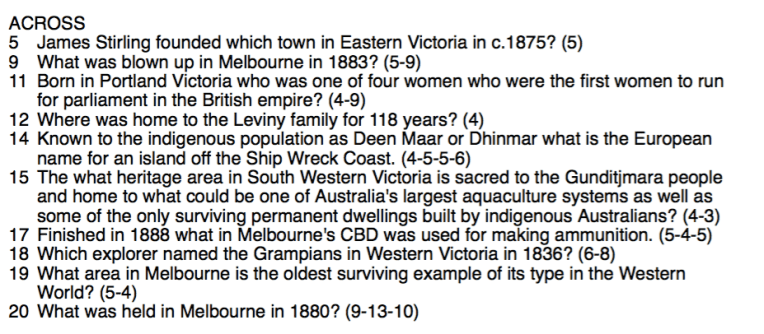
Victorian History Crossword

NB: If it looks like you’ve seen this crossword before, you have. I put it up yesterday but there was a technical error so I had to take it down. There should be no problems with this version. The questions and answers are all the same as yesterday’s, the lay out is just a little different.

Have a shot, see how you go.  Click this link for a printable version of the crossword grid. Crossword Puzzle

Crossword Puzzle Maker_ Final Puzzle

Screen Shot 2016-08-23 at 6.50.45 PMScreen Shot 2016-08-23 at 6.50.52 PMScreen Shot 2016-08-23 at 6.51.10 PM

Cemeteries: St Kilda Cemetery

IMG_8952

This is the second in my series of posts about cemeteries. The first was about Melbourne General Cemetery and can be found here. This time I’ll be discussing St Kilda Cemetery. St Kilda is a suburb in southern Melbourne and its cemetery is an an excellent example of Melbourne’s inner suburban cemeteries.

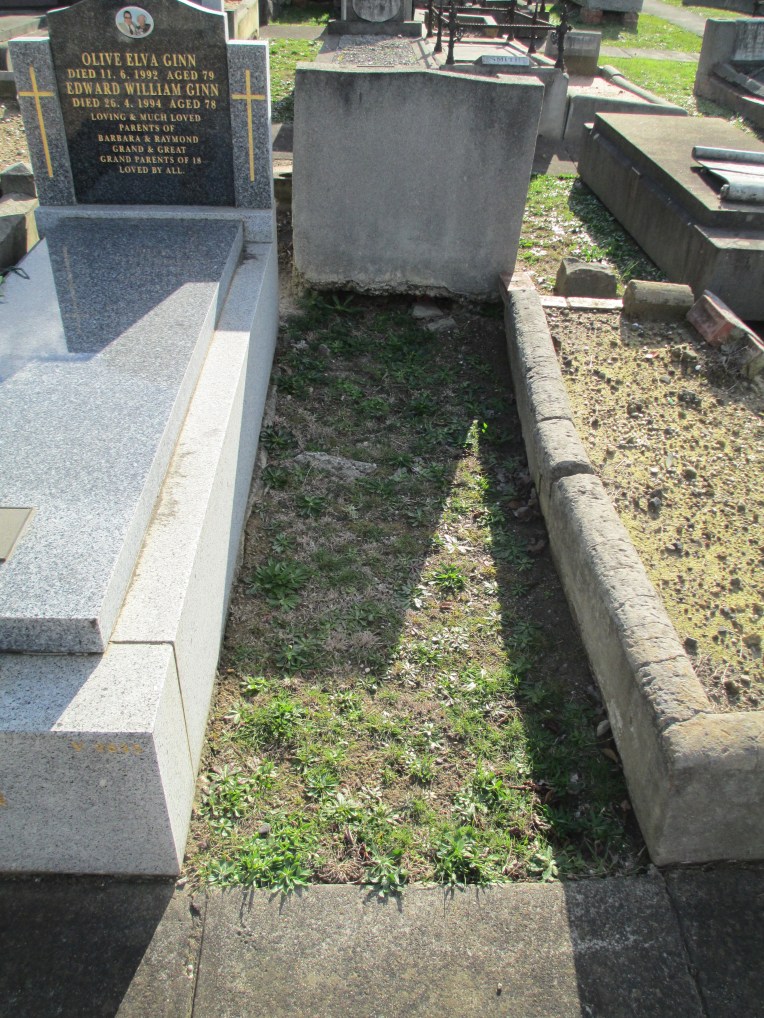
I’ve always found cemeteries interesting as a lens through which to view a city, or a town, and I’ve always found the history they so neatly incapsulate fascinating. St Kilda has a personal connection for me as well because there is a plot there in which several of my ancestors are buried. One of them, Robert Henry Woodward, was originally buried in Melbourne General Cemetery. The family believes, however, that he was moved to St Kilda to be with his wife Letitia at a later date. His grave at Melbourne General Cemetery is certainly unmarked.

IMG_8963IMG_8969

The Woodward Graves.

IMG_8955

Robert Henry Woodward and Letitia Woodward

IMG_9755The site of Robert Henry Woodward’s original grave at Melbourne General Cemetery
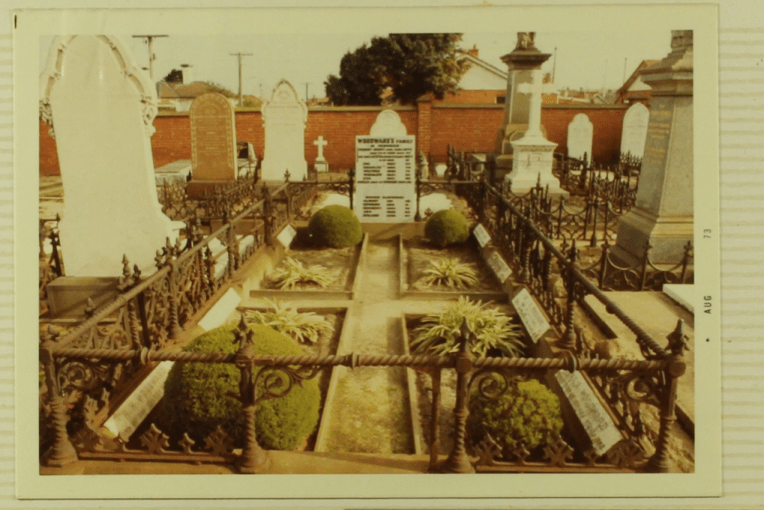
Screen Shot 2016-07-12 at 7.25.39 PM

What the Woodward grave looked like in the 1970s. My extended family and I are in the process of restoring it somewhat.

Robert Henry was one of my first ancestors to come to Australia in the 1850s, and Letitia was born here in 1824 when her father was stationed in Sydney. So I was interested to see where they were buried.

The cemetery itself also has a fascinating history. It was first laid out in 1851 by an assistant of Robert Hoddle, best known for laying out the grid of Melbourne’s CBD. It opened in 1855 and the brick wall enclosing it was added in c. 1883.

IMG_9012

The walls of the Cemetery

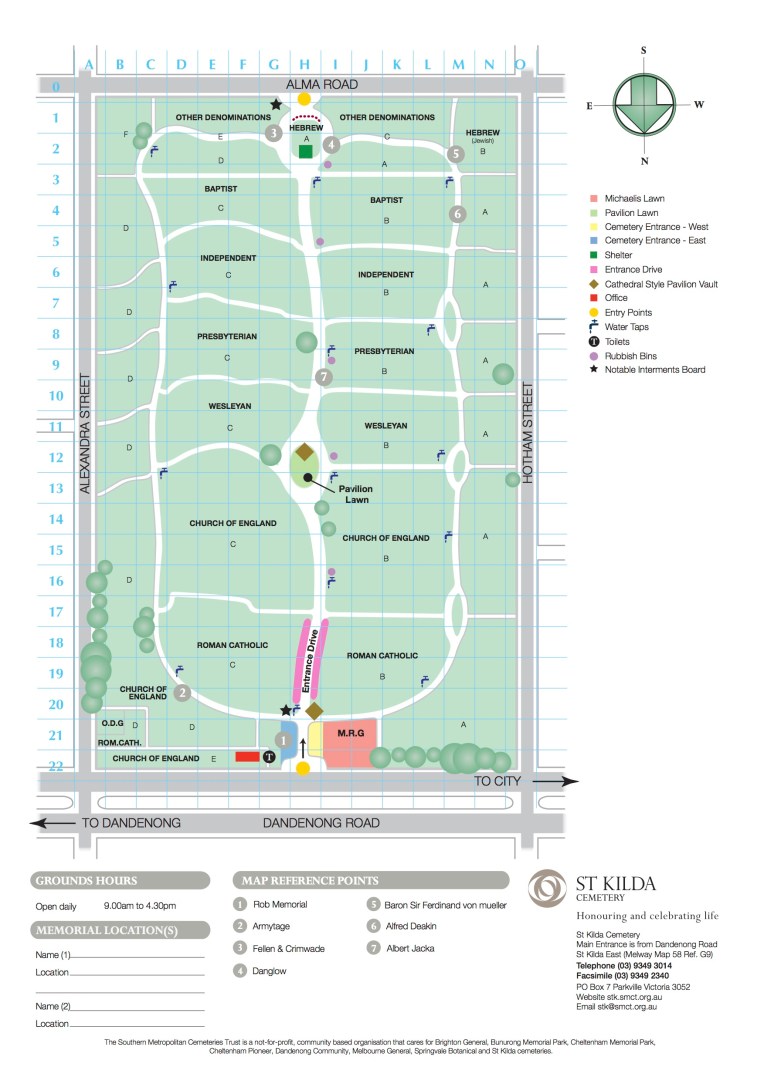
The cemetery covers 18 acres and contains approximately 53 000 burials. St Kilda has been a desirable place to live for over a hundred years and as urban sprawl in Melbourne has increased there have been several attempts to have the cemetery closed. Fortunately none have been successful. The cemetery is laid out in religious denominations as can be seen in the map below.

St Kilda Map-V3_DPMG - FINAL

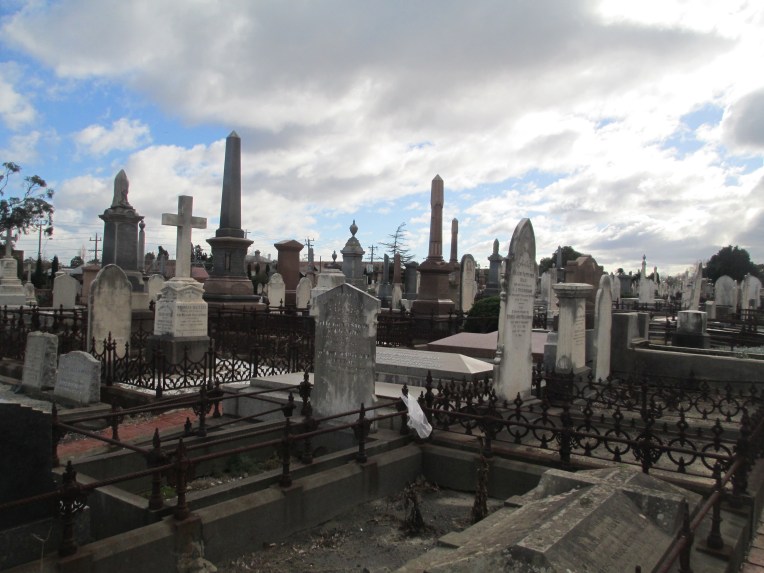
Although in comparison to  Melbourne General Cemetery St Kilda is quite small, it is still large for a suburban cemetery. It certainly feels vast when you step inside, as you can see from the photos below.

IMG_8995IMG_8981

IMG_8948

St Kilda also houses many beautiful funerary monuments. A number of which can be seen below.

IMG_9007

Urns

IMG_8980

IMG_8943

Religious Figures

IMG_8976

Angels

IMG_8946IMG_8950

Crosses

IMG_8945

Scrolls

IMG_9001

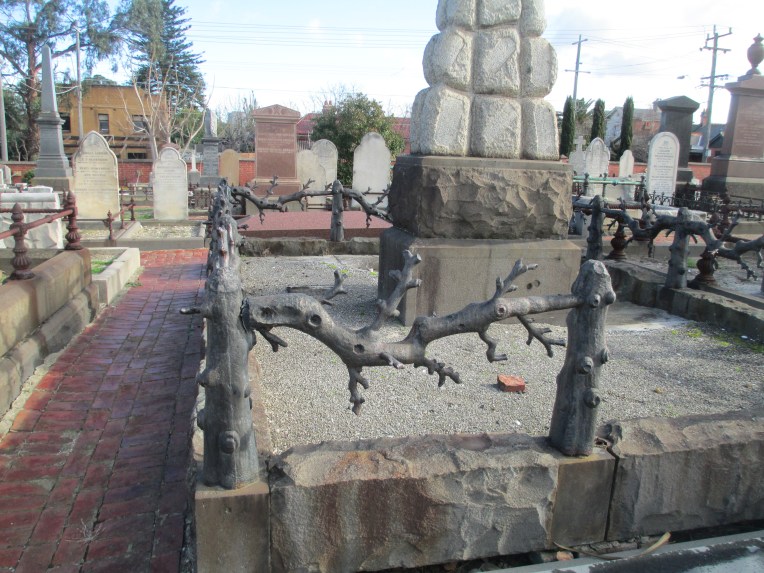
Ornate fences.

There are also memorials to a number of well known people in St Kilda Cemetery.

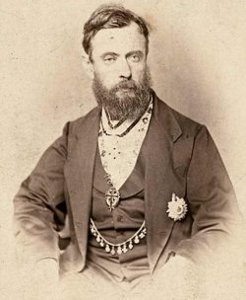
I don’t feel it is necessary to go into the history of each of them, but I would like to discuss one in particular. Ferdinand Von Mueller, best known in Melbourne as the Director of the Royal Melbourne Botanic Gardens from 1857-1873.

A050353_246x550

Von Mueller

http://adb.anu.edu.au/biography/mueller-sir-ferdinand-jakob-heinrich-von-4266

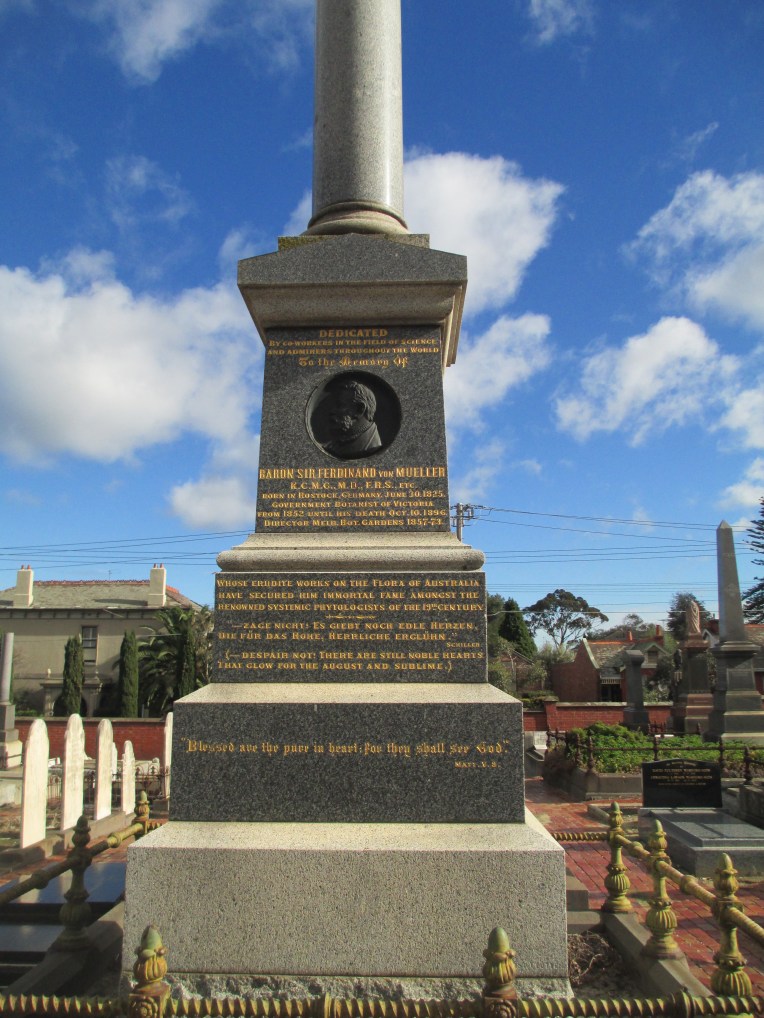
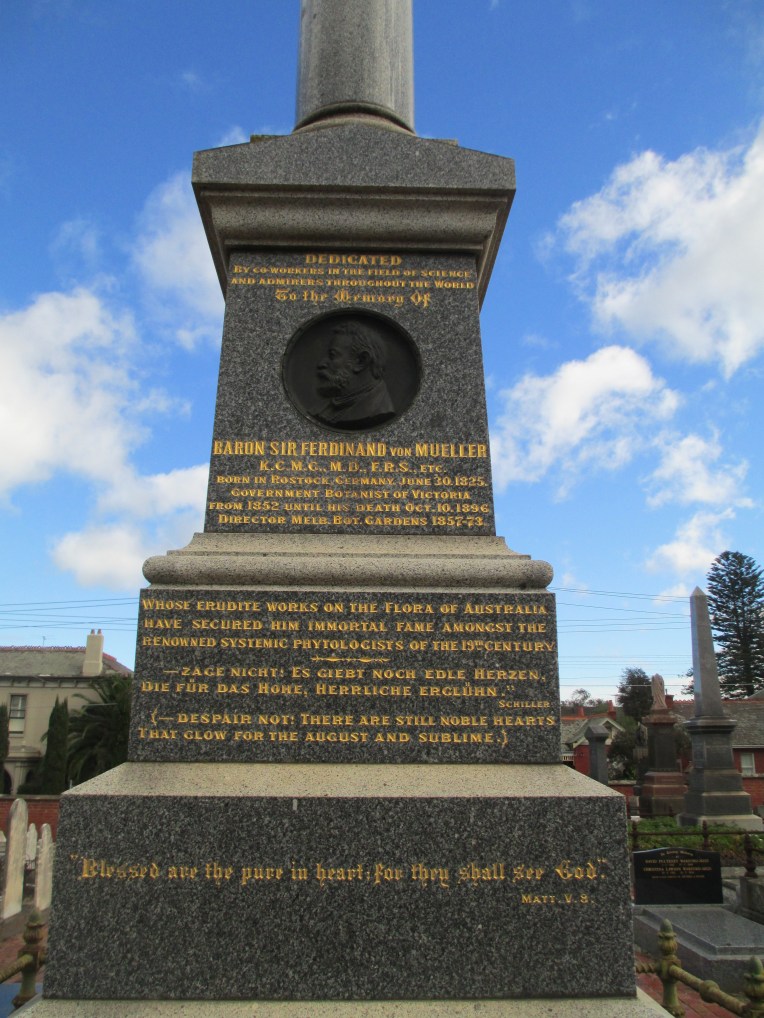
His memorial can be seen below.

IMG_8996IMG_8997IMG_8998IMG_8999

Von Mueller was born in 1825 in Rostock in Mecklenburg-Schwerin in what is now Germany. He trained as a pharmacist, but specialised in botany as part of his degree. He came to Australia in 1847 with his two remaining sisters, seeking a warmer climate for his sister’s health. He began his time in Australia in Adelaide, where he investigated the local flora as well as working as a pharmacist. He came to Melbourne in 1852 when Governor Latrobe appointed him Government Botanist. In Melbourne Von Mueller began collecting specimens of the local indigenous flora. He was instrumental in cataloguing Victorian and in fact Australian flora, adding new genera and greatly expanding exisiting knowledge. He travelled a great deal within Australia and was at the heart of bringing together isolated information from disparate sources on indigenous flora.

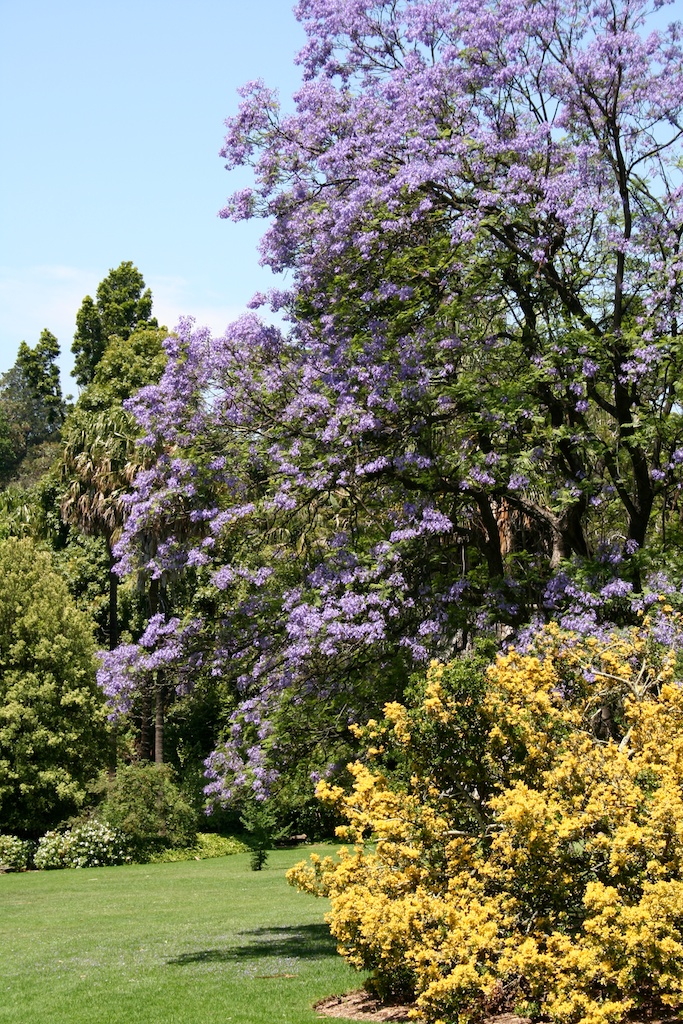
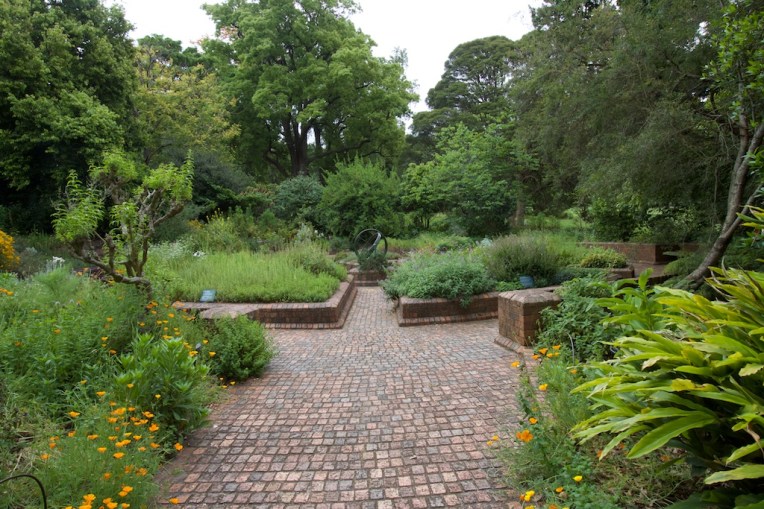
When he was appointed director of the Melbourne Botanic Gardens in 1857 he immediately arranged to have the herbarium built, added his own extensive collection of specimens and began collecting seeds and plants from all over Australia as well as internationally. In the herbarium he built what is now one of Australia’s most important dried plant, algae and fungi collections. Under his stewardship the gardens began to build towards the magnificence which you see today. They can be seen in the photos below.

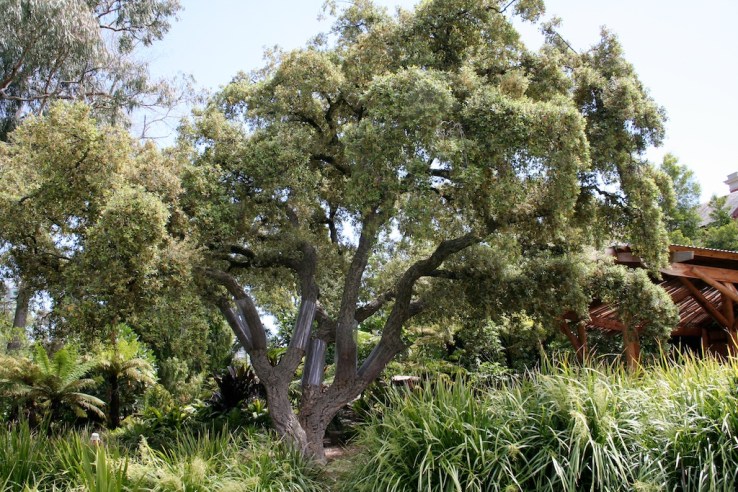
Botanic Gardens Melbourne
Native mexico

Cork oak, Quercus suber

Botanic Gardens Melbourne

Part of the Children's Garden next to

Children’s garden Melbourne Botanic Gardens

Herb Garden, Botanic Gardens MelbourneHerb Garden Melbourne Botanic Gardens.

Along with the Melbourne Botanic Gardens Von Mueller played a role in the establishment of some of Victoria’s numerous rural botanic gardens. For example when the gardens in Hamilton were established in 1870 Von Mueller supplied 450 shrubs and trees, providing the start of planting for the garden. The tree below is possibly one of the ones he sent.

Corsican pine Botanic Gardens Hamilton

Von Mueller was also one of the first to recognise the importance of the native forests of Victoria and campaigned against indiscriminate clearing. Sadly there began to be complaints about Von Mueller’s management of the gardens in around 1868. There seemed to be the feeling that he was focusing too much on the plants and not enough on the beautification of the gardens. Complaints were along the lines of “‘no foundations exist … neither are statues erected … works of art we can call forth at pleasure, while time lost in forming the plantations cannot be regained”[1] He stoutly defended what he saw as the object of a botanic garden, saying in an 1871 lecture

“that from the early transcendental days of Greece up to the most recent decennia all institutions designated as botanic gardens were mainly or exclusively devoted to the rearing of such plants as were adopted for medicine, for alimentary or industrial purposes; and it would be little short of relapsing into barbarism, were we to alienate any such institutions of ours entirely from their legitimate purpose.”

He continued

“The objects of a botanic garden must necessarily be multifarious, nor need they be, in all instances, precisely the same; they may be essentially modified by particular circumstances and local requirements, yet, in all cases, the objects must be mainly scientific and predominently instructive. As an universal rule, it is primarily the aim of such an institution to bring together with its available means the greatest possible number of select plants from all the different parts of the globe; and this is done to utilise them for easy public inspection, to arrange them in their impressive living forms, for systematic, geographic, medical, technical or economic information, and to render them extensively accessible for original observations and careful records. By these means, not only the knowledge of plants in all its branches is to be advanced through local independent researches, conducted in a real spirit of science, but also phytologic instruction is to be diffused to the widest extent; while simultaneously, by the introduction of novel utilitarian species, local industries are to be extended, or new resources to be originated; and, further, it is an aim to excite thereby a due interest in the general study and ample utilisation of any living forms of vegetation, or of important substances derived there from. All other objects are secondary, or the institution ceases to be a real garden of science.”[2]

Unfortunately he was not successful in his arguments as he was replaced as director in 1873. He remained Government Botanist, but he was so upset by his dismissal from the gardens that it is said that he never set foot in them again. Von Mueller was a dedicated worker, writing over 3000 letters a year, publishing over 800 papers as well as a number of books. By the time he died in 1896 he was largely responsible for the international recognition that was given to Australian scientific endeavour. His work was also of the quality and magnitude that much of it has still not been superseded. He is to me one of the most fascinating people with a memorial in St Kilda cemetery.

St Kilda Cemetery as a repository of history has many more stories to tell apart from Von Mueller’s and the Friends of St Kilda Cemetery do run regular tours. Information can be found here.

St Kilda, like other cemeteries, is a fantastic place not just for its own history but also for the survival of the stories of the people who are buried there. It also creates an area of community space in a tightly urban precinct. It is well worth a visit if you are ever in the area. Cemeteries, like St Kilda, are a vital part of the community.

The photos are all mine apart from the photo of Von Mueller from the Dictionary of Biography and the Botanic Gardens and Hamilton Gardens pictures which were kindly provided by garden writer and photographer Penny Woodward.

For more information on St Kilda Cemetery see:

http://stk.smct.org.au/our-history/

For more on Von Mueller see:

http://adb.anu.edu.au/biography/mueller-sir-ferdinand-jakob-heinrich-von-4266

https://www.rbg.vic.gov.au/about-us/our-story

For the entirety of his speech in 1871 in defence of Botanic Gardens see

http://nzetc.victoria.ac.nz/tm/scholarly/tei-Stout33-t4-body-d9.html


[1] http://adb.anu.edu.au/biography/mueller-sir-ferdinand-jakob-heinrich-von-4266

[2] http://nzetc.victoria.ac.nz/tm/scholarly/tei-Stout33-t4-body-d9.html

Easy to Evil Australian History Quiz.

This is how the quiz works.

There are twelve questions.

There are three sections: easy, hard, evil.

There are four questions in each section.

You get the question then a photo and the the answer is below the photo.

Keep track of how you do because there is a scoring system at the end.

Enjoy 🙂

EASY

  1. What is the name of the market in Melbourne which is built on a graveyard on the corner of Victoria and Elizabeth street?IMG_1142

Answer: Queen Victoria Market. You get the point if you said Queen Vic, Vic or Victoria Market. For more information on the graveyard click here


2.  What is the southern most point of mainland Australia which is named after Thomas who was a friend of Matthew Flinders?

IMGP0304.JPGAnswer: Wilson’s Promontory


3. When was Federation in Australia?

PA0013 Answer: 1901 . The picture is Tom Robert’s painting of the opening of Australia’s first parliament in May 1901. For more information click here


4. What year was the Eureaka Stockade

eureka-flag_conserved

Answer: 1854. The photo is of the flag of the Southern Cross.


HARD

5. Where did Australia’s parliament sit from 1901-1927?

IMG_0654

Answer: Parliament House Melbourne. For more information on the fascinating building click here.


6. Where was the first shot fired by the British Empire in World War One ?

pn cheviot 1

Answer: Point Nepean in Victoria. For more information click here


7. What island did Captain James Cook name after he ‘discovered’ it on June 7th 1770?

IMGP3548.JPGAnswer: Magnetic Island.


8. What is the name of the beach Harold Holt drowned at and what year did he drown?

PN cheviot 2Answer: Cheviot Beach 1967. For more information click here.


EVIL

9. What is the name of the boat that sank off the shipwreck coast in Victoria on the 1st of June 1878?

loch ard sunshneAnswer: The Loch Ard. The photo is of Loch Ard Gorge. For more information click here.


10.  What is the name of the man who named the Grampian Mountains in Western Victoria and mapped much of the district?

IMG_7551Answer: Major Thomas Mitchell. For more information click here. 


11. What is the name of the small Victorian town named after the man who was Governor of Victoria from 1926-1931?

IMGP2217.JPGAnswer: Somers. The photo is of Somers’ beach.


12. What is the name of the first lighthouse to be erected in South Australia?

IMGP2093.JPG

Answer: Cape Willoughby Light House.


THE END

So that’s it. How did you do?

1-4: Well you’ve got some basics down pat. Good start.

5-8: Impressive. You know you stuff.

9-12: Incredible effort. You may know more than is sensible:)

12: If you got them all… Sure you didn’t write the quiz?


Hope you enjoyed it.


The photos are all mine apart from the Tom Roberts painting which can be found at http://www.aph.gov.au/Visit_Parliament/Parliament_House_Art_Collection/Tom_Roberts_Big_Picture and the Eureka Flag which can be found at http://www.artgalleryofballarat.com.au/exhibitions-and-events/collection/australian-collection/the-flag-of-the-southern-cross-(eureka-flag).aspx