Medieval Quote Advent Calendar 6th of December

A description of Abbot Samson of Bury St Edmunds

“ABBOT SAMSON was below the average height, almost bald; his face was neither round nor oblong ; his nose was prominent and his lips thick; his eyes were clear and his glance penetrating; his hearing was excellent; his eyebrows arched, and frequently shaved; and a little cold soon made him hoarse. On the day of his election he was forty­ seven, and had been a monk for seventeen years. In his ruddy beard there were a few grey hairs, and still fewer in his black and curling hair. But in the course of the first fourteen years after his election all his hair became white as snow.

He was an exceedingly temperate man ; he possessed great energy and a strong constitution, and was fond both of riding and walking, until old age prevailed upon him and moderated his ardour in these respects. When he heard the news of the capture of the cross and the fall of Jerusalem, he began to wear under garments made of horse hair, and a horse­ hair shirt, and gave up the use of flesh and meat. None the less, he willed that flesh should be placed before him as he sat at table, that the alms might be increased. He ate sweet milk, honey, and similar sweet things, far more readily than any other food.

He hated liars, drunkards, and talkative persons; for virtue ever loves itself and spurns that which is contrary to it. He blamed those who grumbled about their meat and drink, and especially monks who so grumbled, and personally kept to the same manners which he had observed when he was a cloistered monk. Moreover, he had this virtue in himself that he never desired to change the dish which was placed before him. When I was a novice, I wished to prove whether this was really true, and as I happened to serve in the refectory, I thought to place before him food which would have offended any other man, in a very dirty and broken dish. But when he saw this, he was as it were blind to it. Then, as there was some delay, I repented of what I had done, and straightway seized the dish, changed the food and dish for better, and carried it to him. He, however, was angry at the change, and disturbed.

He was an eloquent man, speaking both French and Latin, but rather careful of the good sense of that which he had to say than of the style of his words. He could read books written in English very well, and was wont to preach to the people in English, but in the dialect of Norfolk where he was born and bred. It was for this reason that he ordered a pulpit to be placed in the church, for the sake of those who heard him and for purposes of ornament.”


From the Chronicle of the Abbey of St Edmund’s http://www.fordham.edu/halsall/basis/jocelin.asp
Medieval Quotes Advent Calendar 5th of December

Death of the outlaw Eustache the Monk at the Battle of Sandwich in 1217. A battle in which the “enemy” for Eustache was the English forces who were fighting to the rid the country of the forces of Prince Louis of France. It’s much more complicated than that, but that is an outline. The English forces were led by William Marshal

“The enemy set out in small boats and attacked the ships [of Eustache’s fleet] with longbows and crossbows. The Monk’s men guarded themselves against everything thrown at them in the chase by firing missiles and shooting arrows. They killed many Englishmen and defended themselves nobly. Eustache himself toppled many of them with the oar he wielded, breaking arms and smashing heads with every swing. This one he killed, another one he threw overboard. This one he knocked down, another one he trampled underfoot, and a third one had his windpipe crushed. But Eustache was assailed from all directions with no let up. Battle axes struck his ship on all sides. On the first wave the defenders were able to ward off the attack, preventing the enemy from coming on board. Then the English started hurling pots of finely ground lime, smashing them to pieces on the ship railings, with the result that great clouds of dust covered the decks. That was what caused the most damage, against which Eustache’s men could not defend themselves. To their misfortune the wind was against them, causing even further torment, for their eyes became filled with ash. In the confusion the English leaped in to Eustache’s ship and mistreated his men badly, taking all the nobles prisoner. As for Eustache the Monk, he was slain, his head cut off. With that the battle was over.

Epilogue

No man who spends his days doing evil can live a long life.


From Thomas E. Kelly  editor and translator Eustache the Monk. In A Book of Medieval outlaws edited by Thomas H. Ohlgren. ISBN9780750924931

Advent Calendar of Medieval Quotes 4th of December

A description from Roger of Hoveden of the demise of The White Ship in 1120.

“To his son and all his retinue he [Henry I] had given a ship, a better one than which there did not seem to be in all the fleet, but as the event proved, there was not one more unfortunate ; for while his father preceded him, the son followed somewhat more tardily, but with a still more unhappy result. For the ship, when not far from land, while in full sail, was driven upon the rocks which are called Chaterase, and being wrecked, the king’s son, with all who were with him, perished on the sixth day before the calends of December, being the fifth day of the week, at nightfall, near Barbeflet. In the morning, the king’s treasures which were on board the ship, were found on the sands, but none of the bodies of those lost.There perished with the king’s son, his illegitimate brother, earl Eichard, together with the king’s daughter, the wife of Rotrou ; Richard, earl of Chester, with his wife, the king’s niece, and sister of earl Tedbald, the king’s nephew. There also perished Othoel, the governor of the king’s son, Geoffrey Riddell, Robert Maldint, William Bigot, and many other men of rank ; also several noble women with no small number of the king’s children ; besides one hundred and forty soldiers, with fifty sailors and three pilots. A certain butcher was the only person who made his escape, by clinging to a plank of the wrecked vessel. The king having had a fair voyage, on reaching England, thought that his son had entered some other port ; but on the third day he was afflicted with the sad tidings of his death, and at first, from the suddenness of the calamity, fainted away, as though a person of weak mind; but afterwards,concealing his grief, in contempt of fortune he resumed his kingly spirits. For this son being the only one left him by lawful wedlock, he had named him heir to the kingdom in succession to himself.”

From: The Annals of Roger of Hoveden Volume I pgs 213-214

https://archive.org/details/annalsofrogerde01hove


Advent Calendar of Medieval Quotes 3rd of December

3rd of December

From Roger of Wendover. A description of happenings immediately after the death of Henry II.

I would like to point out that I am not including these quotes as examples of definitive facts. All medieval chroniclers need to be taken with a large grain of salt.

“He died on the octaves of the apostles St. Peter and St. Paul, after a reign of thirty-four years,seven months,and five days. On the morrow,as they were carrying him to be buried, arrayed in his royal robes, his crown, gloves, shoes, ring, sceptre, and sword, he lay with his face uncovered; and when Richard, hearing the news of his death, came to meet the convoy, blood flowed from the nostrils of the deceased, as if he was indignant at the presence of one who was believed to have caused his death.”

From Roger of Wendover Flowers of History Volume II. Pg 76

https://ia800503.us.archive.org/35/items/rogerofwendovers02roge/rogerofwendovers02roge_bw.pdf


Advent Calendar of Medieval Quotes

The basic premise of this particular project is a medieval quote a day for the 24 days leading up to christmas. A medieval quote advent calendar. I’m not going to be providing background to the quotes. These will just be snippets of medieval works. Hope you enjoy

I am a day late on this post so two quotes will go up today.


1st of December

From Gerald of Wales a description of the land around St David’s

“St David’s is in a remote corner of the country, looking out towards the Irish Sea. The soil is rocky and barren. It has no woods, no rivers and no pasture lands. It is exposed to winds and extremely inclement weather. It lies between two hostile peoples who are constantly fighting over it, the Flemmings and the Welsh. However, these saintly men deliberately chose to establish the arch-bishopric there, for they wanted to live as far removed as possible from worldly upsets, preferring an eremitical existence to a pastoral one, so that they might enjoy a spiritual life which no one could take away from the.”

The Journey Through Wales and The Description of Wales. pg 161. ISBN: 9780140443394

2nd of December

From History of William Marshal a description of Marshal himself.

“His body was so well fashioned that, even if he had been created by the sculptor’s chisel, his limbs would not have been so handsome. I can tell you this because I saw them and remember them well. At the same time his had fine hands and feet, but all this was as nothing compared to his overall appearance. Anyone who looked upon it would have found it so upright, so well formed, that if his judgement were sound, he would have concluded that nowhere in the whole world was there to be found such a perfect body. His hair was brown, his face swarthy, but his features were so much like those of a true noble that he could have been an Emperor of Rome. Also, he had wide hips and was so handsomely formed as any noble could be; it was a master sculptor who fashioned him.”

History of William Marshal Volume I. pg 39. ISBN: 0905474422


Surprising Horse Troughs

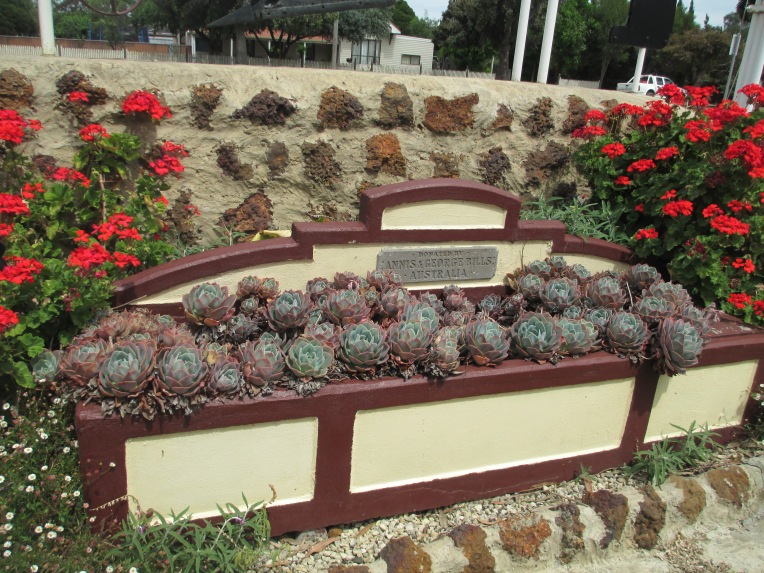
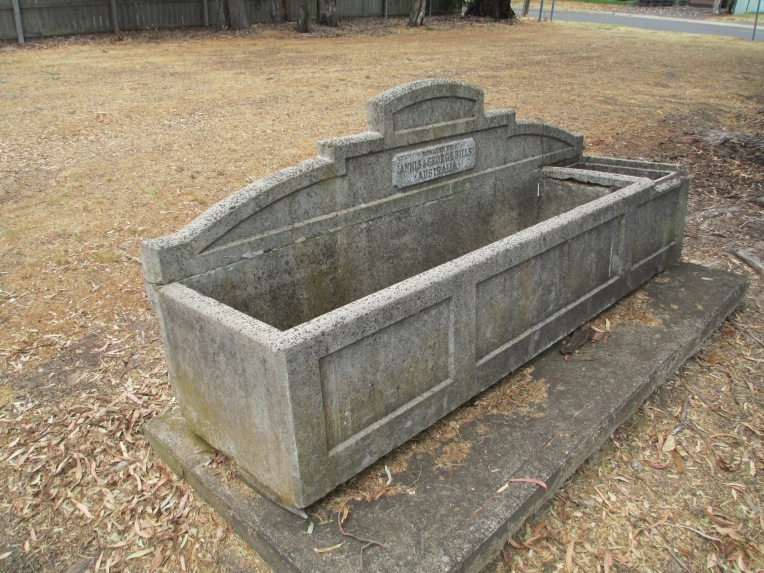
During a recent trip out to Western Victoria in the Wimmera region, to do some unrelated research, I noticed two horse troughs in separate towns that had the same inscription. It read that they had been donated by Annis and George Bills. I was intrigued so I did some research on Trove and I found there is actually a very interesting story behind them.

IMG_7645

Horse trough in Balmoral Victoria

IMG_7807

Horse trough in Edenhope Victoria

These horse troughs are the result of an interesting will and testament and can be found all over Victoria and New South Wales. George Bills made his money out of mattresses, first in making them and then in creating and patenting machinery to weave them. His father, who was a naturalist, came to Australia in the 1800s and, as the Horsham Times described it in 1935, “his heart ached to see the sufferings of dumb animals.” This was a concern that he passed on to his son George who also associated himself with the society for the protection of animals in England, New Zealand and Australia. George’s wife died before him and they had no children so he decided to make provision in his will for the future welfare of animals. The residue of his estate, after several personal bequests, was set aside to provide free memorial horse troughs the length and breadth of the British Empire. Towns applied for them to the trust and many such as Horsham actually have more than one. George died in 1927 and approximately 86 000 pounds was left for the provision of horse troughs. Each was made to the same design and carried the inscription ‘Donated by Annis and George Bills Australia.” By 1937, according the the Adelaide Advertiser, the trust had set up more than 400 horse troughs in Victoria and were expanding to New South Wales.

Sometimes they were for more than horses though and issues could arise, as Dubbo found in 1946. In this particular case dogs and humans were catered for as well as horses. Unfortunately the position of the human’s drinking fountain was problematic. As the Dubbo Liberal and Macquarie Advocate said.

“Unfortunately, lack of foresight was shown in the placing of the adjunct for the public. It is immediately over the small concrete basin for dogs, and at the end of the horse-trough. After drinking, horses have been seen slobbering over the faucet, and dogs licking it.”

The drinking faucet was thankfully moved.

The Dubbo paper also adds the interesting detail that the activities of the trust lapsed during the war period, but began again afterwards, which was when Dubbo applied for its second horse trough with the subsequent problems.

I just think this is a fascinating little piece of history. So far I’ve only found two of the troughs, as I wasn’t really looking for them, but if anyone else happens to see one that has survived in their town I’d love to know. I’d also be fascinated to find out if they are only present in Australia or whether George’s bequest did indeed cover the length and breadth of the British Empire.

The photos are mine.

Information from:

Horsham Times: http://trove.nla.gov.au/ndp/del/article/72616702?searchTerm=annis%20and%20george%20bills&searchLimits=

Dubbo Liberal and Macquarie Advocate:

http://trove.nla.gov.au/ndp/del/article/132963328?searchTerm=annis%20and%20george%20bills&searchLimits=

The Adelaide Advertiser: http://trove.nla.gov.au/ndp/del/article/74356258?searchTerm=annis%20and%20george%20bills&searchLimits=


An update.

After a little more investigation I have found this wonderful blog that has lists of the horse troughs. These obviously aren’t as obscure as I thought.

https://billswatertroughs.wordpress.com/